by Denver Frederick | Oct 7, 2026 | Guest Interview
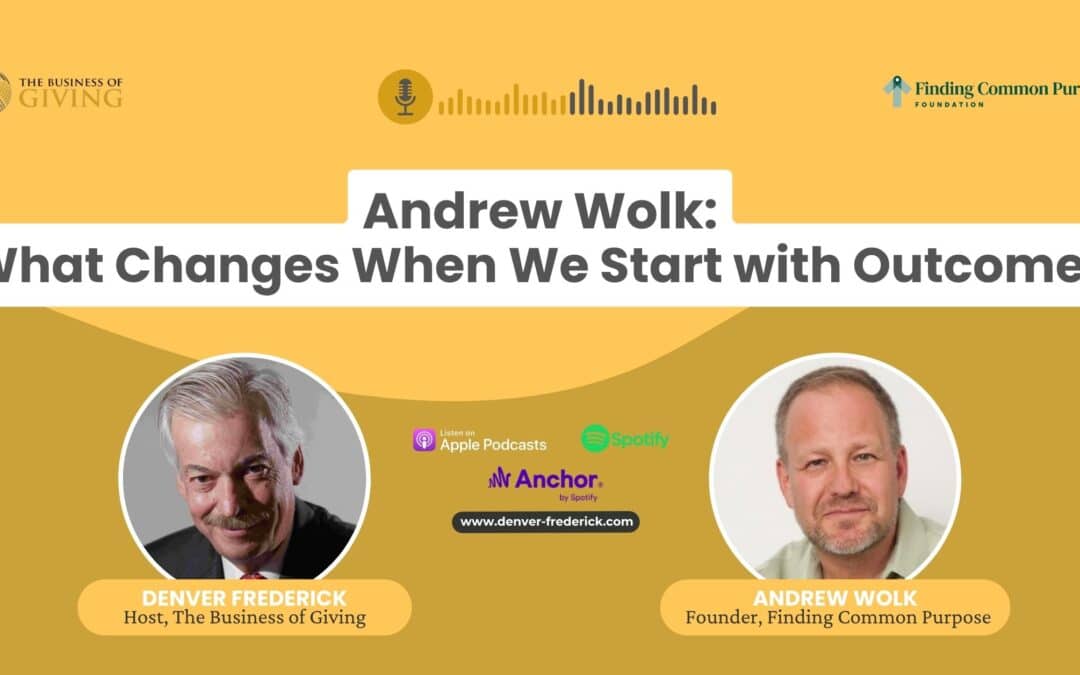
For more than two decades, Andrew Wolk helped social sector organizations build better strategies, measure their work, and strengthen their impact. But one question kept nagging at him: If so many organizations were reporting success, why weren’t more people’s lives getting better?
Across the communities he studied, progress on outcomes like education and housing remained stubbornly slow, and in some places, things were getting worse.
Which led him to ask: What if we’ve been optimizing for the wrong things?
Today, through Finding Common Purpose, Andrew is putting that idea into practice, helping communities focus on what would actually make life better for the people who live and work there.
It’s Andrew Wolk on The Business of Giving.
by Denver Frederick | Oct 5, 2026 | Guest Interview
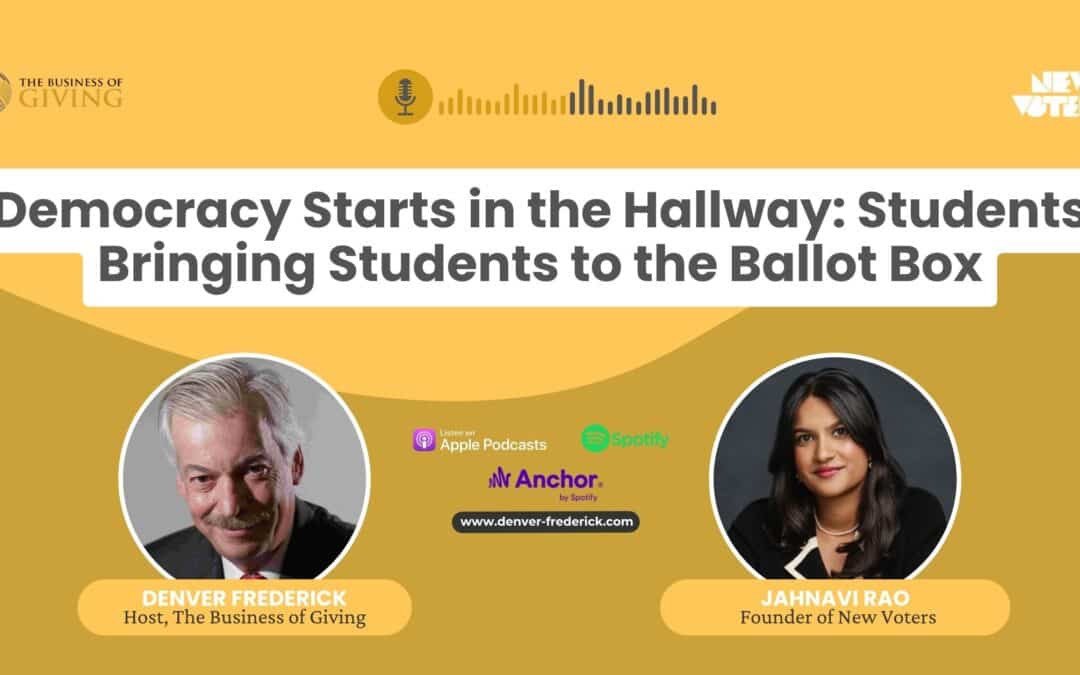
Every year, four million students graduate from high school in this country. Most are old enough to vote, but too few get the encouragement and support to take that first step. My next guest set out to change that by enlisting students to help their classmates register to vote and have a voice in the decisions that shape their future.
Jahnavi Rao founded New Voters while still in high school. It now runs student-led, nonpartisan voter registration drives in 1,300 high schools across 42 states. Here’s the number she built the whole organization around.
We talk about the near-peer organizing playbook that got 85 percent of her own senior class registered to vote in three days, the research network she built to study a question almost nobody studies, and why spending her days with teenagers is what keeps her hopeful about the country.
It’s Jahnavi Rao on The Business of Giving.
by Denver Frederick | Oct 5, 2026 | Guest Interview
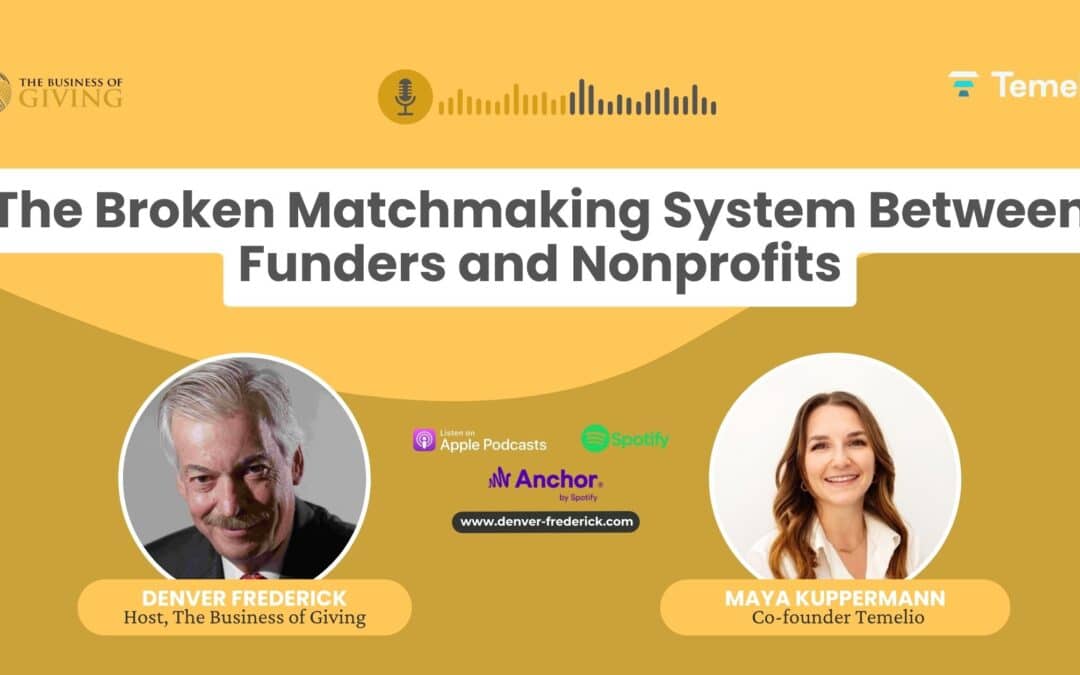
Most tech founders don’t have to convince anyone that software is a good idea. My guest had to build hers for a sector she describes as twenty years behind everyone else. It did not always go smoothly.
Maya Kuppermann co-founded Temelio, the platform that now moves more than a billion dollars a year in grants between foundations and the nonprofits they fund. But in the early days, one of her very first clients had a very different verdict.
That client is still with Temelio today, one of a hundred and fifty. We talk about what it took to get there, why the matchmaking between funders and nonprofits is broken, what a bad grant application actually costs a nonprofit in wasted hours, and the “useless” feature she refuses to take out of her own software.
It’s Maya Kupperman on The Business of Giving
by Denver Frederick | Sep 29, 2026 | Guest Interview
Many companies that survive their first year have something working quietly in the background: an early check from a parent or a well-off friend. My guest today leads an organization for founders who never had that check..
Shawna Young is the CEO of Camelback Ventures, a New Orleans accelerator that puts fifty thousand dollars, and a community, behind early-stage founders whom traditional capital routinely overlooks. A chemist by training and a former science teacher, she thinks hard about who gets seen, who gets funded, and why the gap between the two is so wide.
And sometimes, the best way to understand who gets overlooked is to look at who had the idea first.
It’s Shawna Young, CEO of Camelback Ventures, on The Business of Giving.

by Denver Frederick | Sep 29, 2026 | Guest Interview
Many companies that survive their first year have something working quietly in the background: an early check from a parent or a well-off friend. My guest today leads an organization for founders who never had that check..
Shawna Young is the CEO of Camelback Ventures, a New Orleans accelerator that puts fifty thousand dollars, and a community, behind early-stage founders whom traditional capital routinely overlooks. A chemist by training and a former science teacher, she thinks hard about who gets seen, who gets funded, and why the gap between the two is so wide.
And sometimes, the best way to understand who gets overlooked is to look at who had the idea first.
It’s Shawna Young, CEO of Camelback Ventures, on The Business of Giving.

by Denver Frederick | Sep 21, 2026 | Guest Interview
Many companies that survive their first year have something working quietly in the background: an early check from a parent or a well-off friend. My guest today leads an organization for founders who never had that check..
Shawna Young is the CEO of Camelback Ventures, a New Orleans accelerator that puts fifty thousand dollars, and a community, behind early-stage founders whom traditional capital routinely overlooks. A chemist by training and a former science teacher, she thinks hard about who gets seen, who gets funded, and why the gap between the two is so wide.
And sometimes, the best way to understand who gets overlooked is to look at who had the idea first.
It’s Shawna Young, CEO of Camelback Ventures, on The Business of Giving.
