
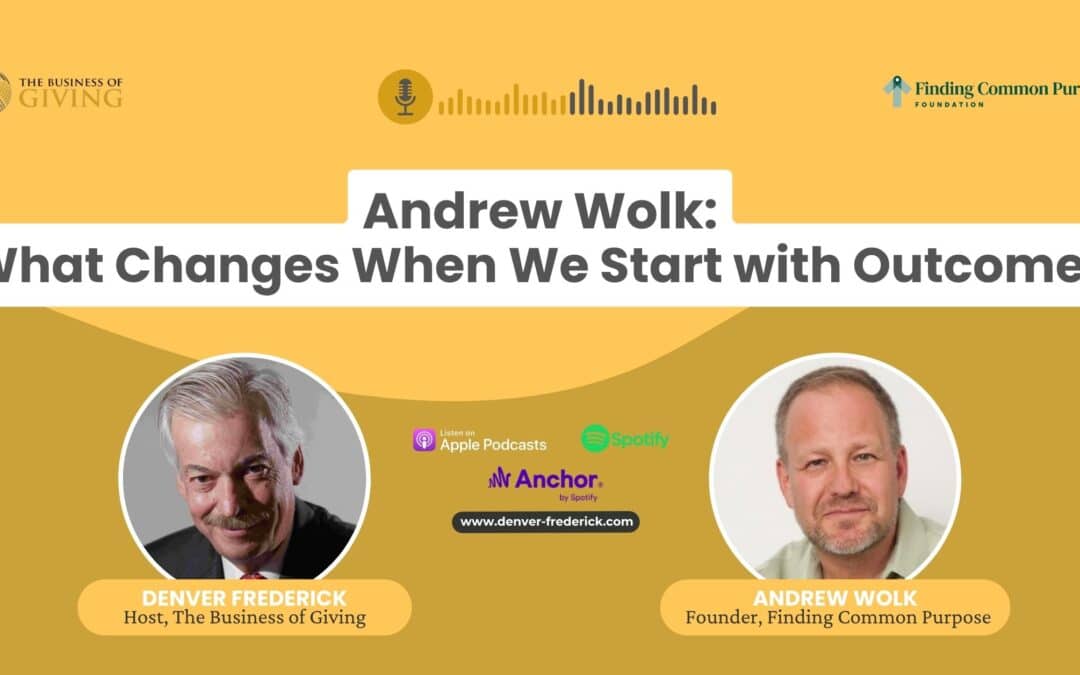
Andrew Wolk Founder, Finding Common Purpose
Denver: Welcome to The Business Giving, Andrew!
Andrew: Well, it’s great to be here, Denver – again.
Denver: Again! Great to have you back.
“Finding Common Purpose is really about building what I’m calling an “Outcomes Movement,” which is to ask all the institutions who are dedicated to improving lives if we can start with outcomes first. And that if we can start with outcomes first, the premise is we’re going to be making decisions much, much differently across the board.”
So, Andrew, tell us about Finding Common Purpose. What is it? And what are you trying to change?
Andrew: Well, Denver, I’ve been in the social sector or the change for over 20 years of my life, moving through business, and social entrepreneurship, and nonprofit consulting, and philanthropy. And I kept coming up with the same question that I was just gnawing at, which was that so much good intention we’ve all had and so many institutions of all types sharing what they described as what they’d done, but it wasn’t necessarily, at least in my mind, translating into tangible improvement in people’s lives across the country. And that became the sort of fundamental question when I left Root Cause, the firm I founded back in 2004.
And so, Finding Common Purpose is really about building what I’m calling an “Outcomes Movement,” which is to ask all the institutions who are dedicated to improving lives if we can start with outcomes first. And that if we can start with outcomes first, the premise is we’re going to be making decisions much, much differently across the board. And so, in a nutshell, we are a grantmaker. So, we are granting into communities to help them practice how to focus on outcomes first itself.
Denver: I just want to have the listeners appreciate what you have done to build this social sector. You may not be happy about that at the moment in some ways, but you are certainly one of the key architects and spent at least 15 years building the strategy, the measurement, the tools, which I think a lot of the sector now takes for granted.
So, Andrew, at what point did you realize that those tools maybe just weren’t optimizing for the right thing, but were optimizing for the wrong thing?
Andrew: That’s a really great question because I do want to be careful here that I am so grateful for both the career I have had and the organizations that I’ve helped throughout that time, and do think that they’ve made a tremendous difference in an individual nonprofit or school district or government.
But I did have a pivotal moment in my life, I will say. And we were very, very fortunate, I don’t remember the year, but we had successfully completed a consulting project with the Soros Foundation to start the campaign for Black Male Achievement. This was prior to the Trayvon Martin killing. And the idea was just to put a laser focus on the Black men and boys and where they stood vis-a-vis other populations in this country. And Root Cause was given the opportunity to then help start this campaign itself. So, we went from a consultant to an operator, which was very exciting for me and where I like where my work has gone now, because I could put a little bit more of a stake in the ground on what would actually happen, as opposed to give them a business plan or something like that.
So, I came up with this idea, given that we had played such a role in the measurement of individual nonprofits, of this idea of a Black Male Achievement Outcomes Dashboard. And I had some members of my team pick a few different outcome measures. And we picked some cities across the country that had large populations of Black men and boys and had them just come back with data for me. And they showed me that in Detroit public schools, that only 4% of third graders were reading at grade level, and that 4% number had actually not changed over a period of time. I don’t recall how long, but a decent amount of time. And I, like you, was like, “Wow!” And as we looked at the data more and more, I kept seeing similar things in different areas like housing, and I then started to ask myself this question around outcomes and how this was possible.
So that was sort of the pivotal turning point for me. It took me a while to be where I am because that was probably a good 10-, 12 years ago. But it was a life-changing moment for me, I will tell you, in the sector to really question what role I wanted to play in the overall ecosystem of change.
Denver: What were some of the questions you asked yourself about our society when you saw that? Was it: We’re trying to do things in isolation in the school and not in the community, the way they live their lives? Or I’m sure a whole bunch of things must have gone through you in terms of trying to absorb that and figure out – Where in the world do I go from here?
Andrew: I did spend a lot of time asking myself those questions. I think there were a few that came to me. One was it was really hard—and it still is by the way—and it may be, in our conversation, for people to distinguish between the word “data” and the word “outcome.” And so, we had been on a crusade, and I think we still are, of: We need more data. We need to use our data better. We need to organize our data better. And I don’t disagree with any of that. But I do distinguish the difference between that and an outcome.
And I’ll give you a very particular example in the third grade. So, I think education in third grade reading is an excellent outcome. I think it’s universally agreed upon, all the way up at the federal level of the government. It gives you evidence of prediction of graduating high school, evidence of getting through college. There are all sorts of things that it does. Yet it lies at 42% across the country, and it has stayed there for at least a decade, if not more. A data point that people might use as an outcome would be absenteeism – so: How often are kids absent in schools? – And not connecting those dots between that data point that might predict that outcome.
And so just trying in any given social issue area for us to think about what the outcome is that we want is in and of itself is a question I was asking of ‘Why was that so difficult?’ I think we’re trying to understand the answer to that question, but I don’t know that I’ve had a great answer for it as well. I think another one is ‘accountability’ for me. And I think what really became clear to me is that it’s not clear anymore who is actually accountable for these outcomes. Because if we knew that, then would the outcomes that I’m talking about and have written about have stayed the same in so many places over such a long period of time? And so, I’m trying to understand where the accountability lies and whether we can create some accountability.
So those are a couple of things that I’ve asked myself and I’m trying to– with Finding Common Purpose– get a better understanding of.
Denver: They are certainly the right questions. And sometimes I think when we look at outcomes, we’d almost be happy if they stayed the same compared to where they’ve been going in certain places where they’re actually backtracking some, which is just incredible.
You use a deliberately strong phrase for the system you helped professionalize, and that’s the Nonprofit Industrial Complex. What does that convey?
Andrew: I think there is a – because of the need – a perpetuation of existence that I critique more because of the overall outcomes we’re getting, but not the reason why it exists. There is such great need. And a nonprofit itself that has such an incredibly challenging job in an under-resourced environment to serve people needs to figure out how to continue to do that.
But I think that we have also created such an incredibly large system that I would include in that, even though I put the word “nonprofit” in front of there, government programs as well and the philanthropic sector; that we’re moving at such a mile a minute. We are using terms like “What are we going to solve? What problem are we going to address?” That it’s been a system that keeps churning and churning and churning without, as I’m saying, looking at whether or not we’re accomplishing the outcomes that we hope that we might. And so, I think that’s probably what I would say.
And I would say also that I don’t know we’re as self-reflective as we could be in where we sit. And my broader analysis, lastly, is whether you’re on the right side or the left side, I think we can fairly agree that the tensions and tribes that have been created is because there is a great number of people that are not satisfied with where specifically working Americans are today, and their ability to afford to choose a career and get ahead. And so, the Nonprofit Industrial Complex is just a part of that, and shouldn’t we be asking those broader questions about where we are contributing or not to this broader sense? It’s almost like we separate politics from our work, but they’re really not separate.
Denver: That is very true, and it’s a good observation. And I sometimes, when I look at these results and these studies, they seem almost a little distant to me. They’re on a graph, they’re on a board, they’re in a report. But then when I go and see real people living their lives, there seems to be cognitive dissonance between: Well, we’re doing this with this over here, but I’m looking at these guys and gals… it’s not going the way they want it to be going.
And I really have always found what you’re doing to kind of close that. This is how people are living their lives, and we want to make that better more than we want to make our graph better.
Andrew: I couldn’t agree with you more. I think the work of trust-based philanthropy is sort of unique. I think the work of understanding what’s happening on the ground is unique because I think this understanding of how the real lived experience is happening across the different social issues. But then where I do want us all to start is with these outcomes.
So, with Finding Common Purpose, I put out this pamphlet on July 4th of this year called “Common Purpose: Building a Movement to Renew the American Promise.” And I try to dissect the tribal nature we’ve gotten ourselves into, the enormous amount of resources we’ve spent, and yet how poor the outcomes are across seven areas: health, savings, wages, childcare, housing, education and mental health. But I think the reality is that they’re not better; they’re worse, or they’re the same depending on geography. And if we were more clear on what they were, I think you would get a greater level of dialogue. And I’m seeing that, for sure.
Denver: Well, one place you may be seeing it, I would imagine, is in Steamboat Springs. Let’s talk about Steamboat Springs, Colorado, and tell us exactly what’s going on there.
Andrew: Well, I feel super fortunate that I can use Steamboat as a petri dish within Finding Common Purpose to test out this outcomes premise. Steamboat’s interesting in that it’s a resort town, but yet it’s facing the same affordability crisis for working Americans that we see across the country. But the uniqueness about their challenges around housing and childcare is that it is resulting in us losing a large amount of our 24- to 44-year- old population, which is sort of the heart blood that really makes this town work, but also that is going to supply our nurses, our teachers, our healthcare workers. And if we can’t have an affordable place for them to work, then we’re going to lose that.
And so, we have selected three outcomes from an Outcomes Movement perspective that really put a stake in the ground. We start with understanding that there has been a huge loss in the 25- to 44-year-old population, and we have an actual baseline of how much we’ve lost. And then in the housing area, over 50% of the population spends more than 50% on rent when the federal guideline is only 30%. So that’s a huge gap.
Denver: That’s insane.
Andrew: And the number is not that much different for how they spend on mortgages.
The child care one is even more insane. The federal guideline is 8%; some people like to say 10%. The vast majority of working parents here spend 24% on child care. So, we’ve set those baselines, and then what we’ve been doing is working from there and developing relationships with city council or city government.
We now have an affordable housing dashboard that’s up. We now have a child care dashboard that lays out all the data for people to look at. And then we’ve been working on the things that we think really can move the dial, which oftentimes, quite frankly, are not programs. They’re going to be much more policy or resource allocation. So, we explored a ballot initiative around child care to see if we could get financing to deal with the issues that could bring the cost down, and now is the right year, but it whet the appetite for the community.
We just successfully worked with the city to have a huge subsidization for people that want to buy homes at prices that are too expensive without a subsidization on their mortgage. And now we’re exploring rent subsidies… have a policy of something like that. And I think what the outcomes focus is doing is it’s focusing on the areas that can move the dial faster in bigger numbers. And so, time will tell. I wish the data would come out faster. But it comes out once a year, and we intend to now put that information out once a year to our community.
And the last thing I’ll say that you might find pretty interesting is we have ambassadors. So, we have over 20 now of the lived experienced people across this community that speak on behalf of Steamboat For All. These are real people that have the stories of their struggles. They’ve either had to move out of town, or they’ve been able to stay in town by working two or three jobs, or the sacrifices they’ve had to make. Or some have benefited from some of the policies that have helped them stay into town. And that’s been a really important part of Steamboat For All’s strategy, as you were saying earlier, Denver, about having people with a lived experience be part of voicing this for people to really understand how this is affecting them.
“A social entrepreneur is identifying a problem and filling a gap most often in a service – a programmatic service. And this is re-engineering that is to start with an outcome and thinking about the system and how the system can get changed with different levers to move that outcome in a pretty sizable way.”
Denver: That’s a really interesting approach, Andrew. And I’m going to ask you to underscore it one more time by telling listeners, how are you approaching this, and how does it differ from the guy who was teaching social entrepreneurship at MIT back in 1999?
Andrew: Boy, what a great question. And that’s why I said I’d love to go back to my original interview. The guy back then was enamored with and still finds it important to see a gap and write a business plan in my class. And what I did at Root Cause, I started two nonprofits: one in small business development, and one in raising resources for small nonprofits. And I think they’re both valuable. But that guy today is much more interested in the systems that are preventing scalable change in the aggregate in large members of our population that I think are holding our country back in general. And so that difference is starting with outcomes.
So, if you start with the outcome, then you can re-engineer what you may be doing in the nonprofit you start or the nonprofit you’re working on, and whether what you’re doing is truly contributing towards changing that outcome, whatever it might be. And that’s really the difference. A social entrepreneur is identifying a problem and filling a gap most often in a service – a programmatic service. And this is re-engineering that is to start with an outcome and thinking about the system and how the system can get changed with different levers to move that outcome in a pretty sizable way.
Denver: I don’t want to gloss over starting with outcomes, but sometimes outcomes are pretty tough to come by. There are different people in a community with different points of view. What lessons would you be able to pass on to someone who maybe wants to start an outcome in their community, but they’re divided in terms of what the priorities are?
Andrew: So, we’ve been trying to be really deliberate in letting communities own that. We are trying to stay focused within seven issue areas. So, as we explore communities that we’ve been granting into and their broad issue areas – wages, savings, housing, childcare, education, health, and mental health – who isn’t working on one of those? But after that, we want a community to come together and with our help – and we have an amazing data scientist we work with – let them figure out what issue area and then what outcome they want to work with.
The only thing that we ask them to do is be realistic about access to public data. Collecting outcome data or any data, on your own, is enormously expensive. And one of the things over the time between leaving Root Cause and doing this work is we have had such a growth and access to public data. So, we do let them explore it within usually a host of choices around “Okay. Well, here’s the outcome data that you could pick from, and go from there.”
So, for example, we’re about to make a grant in Vermont, and housing is what they’re interested in. They’ve landed on housing supply. They truly believe that housing supply is a key outcome to them making sure that there are more and more, in their case, interestingly enough, young people not leaving Vermont and coming into Vermont. And there just isn’t enough of that. So that’s a conclusion they’ve made and they’ve come to on their own. And so, we are definitely not being top down about the outcome itself, but more that they’re willing to pick an outcome is the best way I would say it.
Denver: That says it clearly. You have a phrase that I love, and you test for any program or grant with these three words – “To what end?” I love “To what end?” Tell me about a time when asking that question actually changed what got funded or what got done.
Andrew: That’s a great question, Denver. Unfortunately, you know, for better or for worse, sometimes I do think business is an excellent analogy. And business is simplistic because the use of net income is just so beautifully, easily understood, and also you can get that information so easily and quickly. And so, in my early days of my career, I started what then was called InnerCity Entrepreneurs, and then it was changed to Interise, and it’s now a small business program that is all across the country.
But we were really clear. We would put out a report card of the small business we would use and to what end were things like the number of employees that you added as a critical outcome in some way; how much savings you might have had by going through the program in some way; and if you were successful in a partnership. So, we had a few different outcomes that we were looking for. I never connected the dots, and it’s much more difficult with social issues, there’s no doubt about it. But I do think that that was an early day of my thinking about “To what end?” way back when, but business being much easier to connect the dots in some sort of way.
I think our challenge, as I said earlier, is even if we use a housing outcome like spending no more than 30%, we still don’t have the response time I would like to know that; that’s going to take a huge data infrastructure that’s a little bit down the path. But that’s a story that I hadn’t thought of for a while, and I appreciate the question.
Denver: I was just thinking when you were talking, if I recall correctly, didn’t you run a restaurant delivery business?
Andrew: I did. Yes.
Denver: Any lessons from that?
Andrew: Well, it’s less of a lesson and more where I changed careers. So, it’s funny you bring that up. Way back when, so this is well before Uber Eats or DoorDash, and some of my close friends asked me: Why did I give up on that because they both went public? But this was in the early-to-mid ‘90s in Connecticut.
But what happened to me was that I was growing it across Fairfield County, acquired a couple of services, and I was getting more satisfaction out of the people I was employing than the revenue growth. And I started to help them get mortgages—these were second jobs for them—and I started to realize that I was more interested in my entrepreneurial skill sets getting applied to social issues.
And for the listeners, if they want to go back, the other seminal moment in my life besides that campaign was reading an article by Greg Dees called The Meaning of Social Entrepreneurship, which is really…
Denver: Yes. I remember that.
Andrew: And Greg is no longer with us. He passed away a good 15 years ago. But it really was life- changing for me. Because I do think of myself as a social entrepreneur now, I guess, turned philanthropist who’s consistently looking for the gaps, and now I’m just at this gap of this Outcomes Movement, for how we sort of maybe do more deliberate system change, I guess.
“…I’m trying to steer us in that we are partners in this, that if we agree that we want to move outcomes, let’s explore this together, but the community knows best, and that we just want to be on the journey with you together.”
Denver: Your life is fascinating. Everything before this was other people’s money, but Finding Common Purpose is a large part your money. So, I’d be curious in what changes, if anything, in your decision making when you are both the architect and the funder?
Andrew: Well, I was fortunate enough when I started to better articulate how I might want to realize an Outcomes Movement, which was to go into communities and see if they’re willing to commit to outcomes first and then build off of that, that I also realized that I could become a philanthropist at the same time, which I wasn’t aware of till just a few years ago. And a light bulb really went off with me to put my money where my mouth was. But to be clear that I was interested in building what we’re calling a pooled philanthropic fund or to let others join us, but I didn’t want to ask others to join us without me putting skin in the game. But we try to be really, really careful about this—and my executive director—to only be top down about outcomes first and stop there.
And because of how much foundation money I’ve raised in the past and know the benefits and limitations—and I’ve had amazing foundation partners, and I’ve had other ones where it’s been a little bit challenging—so I’m trying to steer us in that we are partners in this, that if we agree that we want to move outcomes, let’s explore this together, but the community knows best, and that we just want to be on the journey with you together. And our intention is to try to stick with the community as long as we can, as long as we don’t waver from that outcomes-first point of view. And I think we’re trying to be that kind of funder, and we’re learning a lot. There’s no doubt about it.
Denver: I can see even reading your stuff that you are definitely walking alongside these communities and not in front of them. And that’s really the only way to do it for it to sustain and be successful.
Andrew: These communities have the same challenging outcomes in those areas that we have all across the country. And I think what we’re finding, like in Poughkeepsie, New York, is that this outcomes-focus is creating a different dialogue with their superintendent, with their mayor.
So, for example, the superintendent was pointed out, with this outcomes-focus, that a certain amount of money was not being allocated across the board for kids who are going to be out of school, and so reallocated millions of dollars just by generating a different kind of dialogue about where they’re going. And I think we are slowly, in its early days, just seeing a different dialogue happening across the table when everyone is on the same page on the outcome they want to move.
Denver: How have you found these public dashboards to be? Sometimes you know there have been years of inherited failure. And to have these outcomes, public outcomes, you have to have these public dashboards. And I’d just be curious as to what your experience has been with communities in posting those.
Andrew: I think it’s a work in progress but an essential one, but I want to be candid about it. If you go on the Finding Common Purposes website, we produced a report, a brief about dashboards and studied them across the country, and what we found a few years later is they were already gone. And the dashboard is simply a tool for transparency, accountability, dialogue. So, I think we are in the early days of how they get used right now, quite frankly. I think the nature of putting them up just gets us to first base, that we’ve agreed on some things that are important for a community. But unless they are consistently revisited, and I’m talking with the executive director in Steamboat right now about that, they’re not necessarily that effective.
The other thing I would say that we’re really trying to understand, but in the early days… and I think there’s an organization called CPAL out of Dallas… you might have heard of: Child Poverty Action Lab, is the role of media here and how they can play a greater role in paying attention to what’s on the dashboard and stories behind it to make it front and center. Because I think the challenge is: How do you get the outcomes and the data underneath the outcomes front and center on a daily basis? And we’re trying to practice that in a lot of different ways. So, the jury’s still out. I think they’re essential, but they’re not enough, like that can’t be the win.
Denver: But you are testing and testing and testing, and that’s how you’re going to figure out what’s going to work, and it’s going to be different in every community, but there’ll be at least a core.
Andrew: I think that’s right. A fascinating thing Steamboat is trying in a couple of weeks is this art exhibit called Dear Steamboat, which the whole community can come visit. And the primary focus is going to be on those outcomes, but it’s going to be through a storytelling lens of people in the community saying, “Dear Steamboat, here’s what it’s like to live in this community if I’m working here,” and the underlying will be challenged around housing and childcare and in that group from a storytelling perspective. But you will see in different exhibits the data in front of it that comes right from those dashboards.
“…people who work in a community should get to be able to live in that community, in any community.”
Denver: Andrew, does this become a little harder and messier when it’s your own community? And you’re walking up and down the main street.
Andrew: No.
Denver: Okay. Good!
Andrew: No, I feel so strongly that people who work in a community should get to be able to live in that community, in any community. That when I got here and saw that friends of mine were questioning if they could stay here, or friends of theirs had to leave for this reason who were doing the essential jobs and then thinking about “Can a teacher live where they work anywhere in America?” feels to me like a fundamental question we should be asking ourselves. And I fundamentally challenge someone who says that’s just the way it works, that if you can’t afford to live here and you teach and you have to commute 45 minutes in to teach the kids – I don’t agree with that.
So, I’m proud to walk around town. I don’t want anyone to feel like this is…it is not my initiative. It’s the community’s initiative. It’s run by a phenomenal executive director, Laryn Duke, who ran for city council. We have 20 ambassadors. We have so many people now working on this thing. We have a separate advisory board that I’m not even on. So, I’m just one of many trying to really move the dial on those three outcomes I mentioned in Steamboat. Just like we’re granting in other communities where I have no role, and I’m hoping that picking the outcomes we can see whether things are moving or not.
Denver: Finally, Andrew, 10 years from now, because we seem to talk every 10 years, if Finding Common Purpose actually takes hold, and I believe it will, what is the one thing an ordinary working family should experience in daily life that they cannot experience today?
Andrew: I ultimately think the power lies within the community itself, and that a working family is better educated about whether or not the system is working for them in a way that allows them to be thriving, and thriving defined for me is in those areas. And I feel like there are some that they feel that they are getting the support they need. And I don’t want to define that support, because on the right, it might be that there’s a strong community connection of people around them, and government is out of it. The other side might be if their child has a mental health issue that there would be a greater way they could get access to mental health.
But they feel as though– which I don’t feel the majority of Americans feel today– that the system is working for them anymore. And they are much more in tune with the outcomes that matter for them and have a much greater role in what they can do about that. And there’s a really excellent section in the last section of Common Purpose that tries to think about what that looks like, maybe it’s five or 10 years from now, where more and more people are getting actively engaged besides the once-in-a-moment I’m-going-to-go-to-the-voting-booth kind of thing. I think that’s what I would say, and I think that could be with any of the areas themselves.
Denver: That would certainly be an outcome we would all celebrate.
Andrew, if listeners want to learn more about Finding Common Purpose, the work you’re doing to become involved, to contribute, where should they go, and what will they find when they get there?
Andrew: So, I’ll start from macro down. So, I would really encourage people to go to readcommonpurpose.org. And you can either read the pamphlet. It’s short, and it really describes how we got to where we are, and what an Outcomes Movement could do for us. And you can order a copy and we’ll mail it to you, or you can just read it right online.
But then I would encourage you because Finding Common Purpose is really trying to put my words into action… And so go and peruse the website. And if you’re in a community, and you think that you might be doing stuff that we might be interested in, there’s a way to sign up. If you’re a funder, and you want to learn more about how you might want to join our pooled philanthropic fund, there’s a way to sign up there. And that’s at findingcommonpurpose.org.
And then I am actively contributing now on LinkedIn. So, Andrew Wolk. You can search me on LinkedIn and ask to connect with me and enjoy a dialogue, or comment on what I’m doing, or engage in a dialogue with me. And this is early days, but I’m hopeful that this Outcomes Movement might put us on a different trajectory than I think we’ve been on for working Americans.
Denver: Well, early days and exciting days.
Andrew, I want to thank you so much for being with us today and for a wonderful conversation. It was a real pleasure to have you on the show.
Andrew: Yes, thank you so much, Denver. And maybe we’ll book that date for 10 years from now and we’ll solidify my sustainability on the work.
Denver: Okay. There you go. Thanks.
Andrew: Thanks so much. Have a wonderful day.
Every weekday morning at 7:00 a.m. Eastern, I publish a short Leadership Note from the Field. These reflections draw on fifty years in the nonprofit sector and nearly 1,000 conversations with nonprofit leaders.They are designed to help leaders step back from the noise, see the deeper pattern, and lead with greater clarity.A recent note explores a distinction I believe matters enormously right now.In philanthropy, don’t confuse headlines with forces.Headlines dominate the moment. But deeper forces such as the $124 trillion wealth transfer, the rise of women as philanthropic decision makers, and the growth of giving across the Global South will shape the next twenty-five years.You can read the full note, along with a new one posted every weekday morning, on my blog at denver-frederick.com or on LinkedIn.