
A direct cash assistance program used to take months to launch. My guest today turned one on earlier this year in about four hours. The hard part of helping people was never writing the check. It was the system the check had to travel through, a system that for too many people was built to keep them out.
Brittany Christenson is the CEO of AidKit, the infrastructure beneath some of the nation’s most effective aid programs. Here is how she describes the work.
“We don’t make the communities bend around our technology. We bend our technology around the communities that we serve.”
She came to this by an unusual road, from applied math and a ninety acre organic farm to the company that now moves cash to people in moments of crisis. What follows is a conversation about trust, dignity, and why she believes poverty is a problem we already know how to solve.
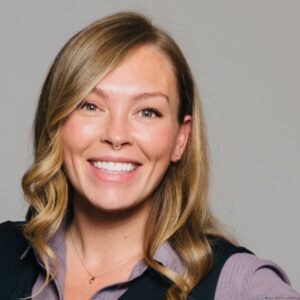
Brittany Christenson, CEO of AidKit
Denver: Welcome to The Business of Giving, Brittany.
Brittany: Thank you so much. It’s great to be here, Denver.
Denver: You studied applied math; you researched epigenetics, then ran a ninety-acre organic vegetable farm. What does someone with that path see in the problem of delivering aid that maybe a career technologist might miss?
Brittany: You’re coming in hot with a great question right up front. I think the biggest thing is really having had the experience to see communities face disruptions and disasters firsthand — having applied for farm assistance from the federal government when we had hurricanes Sandy and Irene up here in northern New York. I’ve had that very close community connection, largely coming through my farming experience as well as my nonprofit leadership experience, that I think makes the work that I do at AidKit much closer to the ground truth of how to serve communities well.
Denver: So you’re not starting with the technology, you’re starting with the person.
Brittany: That’s right. That’s actually one of our mottos at AidKit. We don’t make the communities bend around our technology. We bend our technology around the communities that we serve.
Denver: I like that… During COVID, you helped launch one of the first SNAP online payment pilots. Was there a specific moment where you said the delivery system, not the money, is the actual problem?
Brittany: I was really shocked at how difficult it was to work with the various state and federal partners in order to deliver that SNAP Online program here in rural New York. It was Amazon, Walmart, and the Hub on the Hill — the three vendors that could accept SNAP Online during the pandemic in New York.
We were really proud to be up there with the giants, and our partners at the state and federal offices were fantastic. But they had so much red tape to navigate, and the system really wasn’t set up to make things as streamlined as possible for families and community members. It’s been a real honor to work on that problem over the last seven years.
Denver: Let’s talk about streamlining, because you’ve described AidKit as the infrastructure behind the nation’s most effective aid programs. A program that used to take months to launch, you can sometimes do in a matter of days. How did you make it go so much faster?
Brittany: We’ve got an amazing team at AidKit — about fifty of us — and our implementation team is incredibly motivated, as are our engineers. From day one, we’ve tracked the metric of time from contracting to launch, and we’ve consistently iterated and found little ways to speed that up.
One of the biggest factors is that because we were born out of the pandemic, we’ve been operating in an urgent, emergent environment for our entire existence. We ran a lot of relief programs, and everyone knows — whether you’re doing science in a lab in a petri dish, or building software — that rapid iteration and learning is what helps you get the rough edges off and make things streamlined and fast.
We’ve iterated dozens and dozens of times on high-scrutiny public programs. Each time we learn, we can shave some time off here, create a template, or sign a contract two months earlier so we can figure out the stakeholder management piece and be ready to go when a disaster hits. We actually just launched a program earlier this year in about four hours. Speed is no longer the bottleneck to getting aid out the door.
Denver: What you said about your founding really struck me. Often when an organization is founded and how it comes into being defines the culture from there on out. When you start with that culture of urgency and quick iteration, it doesn’t end when the crisis ends — it just becomes who you are.
Brittany: That’s a hundred percent right. Going back to my farming background, one thing I learned is that the seed matters. You can’t grow broccoli with a cabbage seed. Our origin has absolutely defined who we are and who we’ve grown into.
Denver: You spoke with such pride about your team. What do you think the key is to building a great team like that?
Brittany: The biggest thing is trust. You have to hire people who are an excellent fit — and that doesn’t always mean on paper alone. You have to hire people who have grit, who have passion, who are aligned with your mission, who wake up every day motivated by helping people.
Honestly, I think our mission is our biggest competitive advantage for talent. We’re able to attract folks from places like Google and Meta and pretty incredible engineering organizations, because they want to work on problems that matter, and they want to help people. Mission and trust are the two biggest pillars of our culture. We actually just won an award from Inc. for one of the best workplaces in America.
Denver: You should be proud. Tell us a little about some of your clients, how you work with them, what you do for them, and how you are evolving together.
Brittany: We have the best clients. We get the chance to work with some of the most innovative and unfazed-by-bureaucracy people on the planet. We work with a lot of county governments, state governments, and major nonprofits, including United Ways.
Yes, we have a technology platform, but part of our secret sauce is also professional services. We have expert implementers who have designed and built direct cash assistance programs over and over again, and we can really come in with our partners and advise them on things like targeting.
For example, we work with about seven different areas doing early childhood educator funds. We all know that having a high-quality childcare workforce is critical — it’s what lets all the rest of us working parents actually show up and do our jobs. It’s the cornerstone of the economy, but it’s also a classic example of a broken market. The families that need childcare can’t afford to pay more than they’re already paying, and yet the childcare providers can’t afford to work for any less than they’re making.
There’s a growing trend in early childhood education of providing a wage boost so that childcare providers can make a living wage while families don’t have to struggle more to afford it. In those cases, we sit down with our partners — generally a county office — we share case studies, look at the population in their area, assess which providers exist, how much they’re making, where they’re located, and how many slots are available. Then we design a program together that targets the folks who need support the most, because there’s never enough money for everyone who needs help.
We then configure our technology with the partner’s branding and community voice first, so they have an efficient system for accepting applications, verifying eligibility, and paying providers in a way that works for them — whether they have a bank account or not. A lot of the childcare workforce operates within the informal economy or may not have a bank account. We address those edge cases and make sure the folks who really need the support the most are the ones who get it.
Denver: I was reading about assumptions we make, and one of them was that raising wages causes unemployment — particularly in the food industry. If you go above fifteen dollars, unemployment is going to skyrocket. Guess what? It didn’t skyrocket. We hold onto these things for decades without ever testing them, and then we find out it was okay.
Brittany: That’s really interesting. That’s actually a big part of the work we do as well. We partner with organizations like the Urban Institute and the Inclusive Economies Lab at the University of Chicago, and they run randomized controlled trials on some of the large-scale cash programs we implement together. They’re able to take those rigorous, peer-reviewed findings in front of legislatures and really help inform policy design going forward, so we don’t have to make false assumptions and lose years or decades of progress because we don’t have the right answer.
Denver: Your clients are government agencies, United Ways, other nonprofits — those are the people who pay you. But you’re really focused on the recipient. Do you ever run into friction where you’re trying to maintain the dignity and humane distribution of aid when a client has other concerns around compliance and efficiency? And if so, how do you handle it?
Brittany: From day one, our top value has always been recipients first. We started during the pandemic as a nonprofit project, so we really come from mission-aligned roots. We decided that if that friction arises, the recipient wins.
I also want to say that with modern technology, it’s actually a false dichotomy that you have to choose between what’s best for the recipient and what’s best for the customer. What the customer wants is to not fail an audit and to continue getting funding for their program. We can help them with their compliance concerns and verification needs while delivering that in a way that makes the program really easy to access the program for people who are legitimately eligible. That’s really where the value we bring comes into play.
Denver: The tools built to stop fraud can sometimes build walls that keep out the very people who most need help. You argue that smart technology closes that gap rather than widens it. You know, someone I had on from Simprints in the UK talked about embracing the gray—the difficult space between maximizing access for vulnerable people and preventing fraud. How do you go about embracing the gray?
Brittany: I really like that framing. We have tried hard to dissolve the false trade-off between fraud prevention and accessibility. In the past, a program might require a driver’s license or a home address — sounds straightforward enough. But what if you don’t have an address? What if you lost your driver’s license, or you never had one because you’re an immigrant who arrived legally but has a different ID card?
What we do is work with our partners to educate them on what their community will actually have available to verify identity. We prevent fraud while still collecting documentation — we just broaden the range of acceptable documentation. And we create tools to make reviewing those documents much easier, including detecting whether a document is AI-generated.
On the address piece, we’ve worked on some of the largest programs in the nation’s history serving unhoused individuals. Cash works — it really helps people get off the street and get settled. If you ask someone who is unhoused to fill in their address as a condition of submitting the form, that obviously won’t work. Instead, we have them list the address of a local community-based organization, shelter, or service provider they work with, and show coordinates on a map of where they’re currently living. We can then send a community navigator from a partner organization out in person with an iPad to help them finish their enrollment and bring them a prepaid debit card when it’s time to start receiving benefits. We really think through these edge cases.
Denver: So they can essentially drop a pin — this is where I am. It might be under a bridge, but they can still get help. Let me pick up on what you said about cash. I’ve been in the sector a long time and worked for relief organizations. Supplies can show up — blankets, food, all those things — and they can be incredibly helpful. But I’ve also worked with organizations that call that the second disaster, when everything gets blocked. Talk about why cash is so important and what it can do that traditional boxes of supplies just can’t.
Brittany: Before I started working with AidKit, I ran a nonprofit and used to give out emergency food packages. One of the things we quickly realized was that while people are grateful to receive something, it might not be appropriate for them. Not just that they don’t like the food in the package — they might not have the skills or the tools at home to prepare it. They might be out of propane and can’t cook it anyway, or not even have a chair to sit in to eat. So what can we give people that actually allows them to eat? Money is accepted anywhere, and you can buy whatever you need.
I really think of cash as the lubricant between all the other goods and services we provide. It fills those invisible needs and gaps that prevent people from leveraging resources to help themselves move forward and get out of tough situations. There’s also the intangible element of trust. When you give someone cash, you’re saying: I trust you. I trust you to meet your own needs. I trust you to buy what’s going to help you. I’m not going to tell you what’s best for your family, because you’re the only one who knows that.
Denver: You really empower them. I remember the early studies from GiveDirectly — everybody assumed people would buy alcohol and cigarettes. It turned out nobody bought alcohol, nobody bought cigarettes. They fixed their roof, bought a cow, did things along those lines. Again, it gets us back to the assumption question — we’re so certain and so wrong, time and time again.
Brittany: Exactly right, Denver. We’ve actually had the pleasure of working with GiveDirectly in the US over the last several years. They’ve been an excellent partner and have done a lot of good.
Denver: Brittany, you see this work from a place almost nobody else does — the system the money runs through. From where you sit, what is something the field still says about aid that simply isn’t true anymore, or maybe never was?
Brittany: Two things come to mind. The first is the challenging narrative about who deserves help — that only certain people who are working hard enough, showing up in the right ways, and involved in the right institutions deserve help, and that others do not. I think that’s one of the illnesses of our society — the belief that any group of people gets to decide who deserves aid and support.
The second thing that strikes me is about poverty itself. Poverty is literally defined by how much money you have. The math of how to pull people out of poverty is pretty obvious — it’s a lack of cash. We have enough money in this country to truly eradicate poverty. There’s no doubt about it. It’s a policy choice. The concept that we’re destined to always have some percentage of the population living in poverty and we just have to accept that — I can’t sleep at night believing that, because it’s just not true by the numbers.
Denver: And I also wonder whether the people who believe that really believe it, or whether they prefer it that way — a rationalization wrapped around a design rather than ignorance.
Brittany: Absolutely right. Like it or not, a lot of corporations and individuals benefit from having people in poverty. When someone is poor, you can charge them higher interest rates. When someone is poor, you can charge a lot more for goods and services if you’re their only option. There’s a lot of complexity around the issue of poverty, but we can be doing so much better, and I’m really grateful to be part of the movement that’s trying to help.
Denver: Yeah, yeah, well, you’re in a great spot, and you’re right about entrenched interests. They’re formidable, and they’ve got connections in the right places, and they love the status quo—or maybe even more, the status quo.
And you mentioned before you evolved from a nonprofit, you know, relief effort into this venture-backed public benefit corporation. Brittany, how do you make sure that taking investment to serve low-income people doesn’t, over time, bend the mission toward what’s profitable rather than what’s needed?
Brittany: Since our very beginning, we’ve introduced not just moral and values-based protections but also structural protections at AidKit. We became a public benefit corporation and went through the lengthy process to become a certified B Corp, because we wanted that mission lock — we wanted our board to sign off on the charitable purpose behind everything we do. That structural setup has been really important.
We’ve also maintained founder and CEO control on our board of directors, which means the investor share of ownership is relatively small, and in terms of voting rights, we can protect the mission.
The other thing I’d say is that incentives are a really important structural element of any business. When we decided to take on investment to grow our impact, we made sure to build in values-aligned incentives. Our business model is such that as we help more people, we also grow as a business — allowing us to hire more individuals and continue to grow our impact. There’s a clear incentives alignment in our model, and those are some of the ways we’re making sure we remain incorruptible long term.
Denver: You made it a legal structure so there’s no slippage — you’ve got traps set up all over the place. You hold some sensitive data on some of the most vulnerable people in the country, including immigrant communities, at a moment when that information can be weaponized. How do you think about protecting the people behind these applications?
Brittany: That’s a very important question and one we spend a lot of time on here at AidKit. From the very beginning, we set things up as an end-to-end system. One of the challenges with data privacy is the surface area for breaches and integrations. By being an end-to-end system, it gives us a lot more control — and a lot more responsibility — over the data we hold.
We keep it where we can see it. We’ve invested in a very strong compliance function and have complied with all of the most stringent compliance frameworks for our industry. We also have clauses in our contracts for data deletion and to make sure we’re not in a position where we’d have to expose anyone’s sensitive data to government entities.
We always comply with the law, and there are different funding sources — philanthropic funders can give money to a wider variety of populations than government funders, for instance. We’ve worked to become expert advisors to our clients on how to serve the people they’re trying to serve, with funding sources that allow that to be safe and that really protect the data long term.
Denver: And that’s a consulting aspect of your business you alluded to a few moments ago.
Brittany: Exactly. The professional services we provide are absolutely critical in our line of work. The technology is great, but again — we’re bending around the communities, not the other way around.
Denver: Talk a bit about scenario planning, because it seems like you and your team have spent a lot of time thinking through contingencies at every level. That really seems to be baked into the core of the organization.
Brittany: Absolutely. We do scenario planning on a variety of levels — are you asking at the business model level, or more at the program-by-program implementation level?
Denver: I think it’s really across the board, because it does seem to be a cultural thing. It doesn’t seem like you do it in one area but not another. It seems like you look at every situation, see all the different possibilities from a lot of different angles, and have at least a plan of action for whatever might happen.
Brittany: I think you nailed it. And I think it naturally grows out of our mission alignment. Because we take the work we do so seriously, and because we know there are great rewards and great risks we can create for the communities we serve, we always think through the downsides and protect against them.
That means being really smart with our contracting, being really thoughtful about who we partner with, and having a culture of accountability where our people don’t just come in day after day and do what they’re supposed to do — they come in and critically think about the actions they’re taking and the way they’re interacting with our partners and recipients. That’s absolutely baked into every element.
Denver: It sounds like you’ve got the right balance between optimism and hope, but also a few people around who say “This could go wrong,” so you don’t all walk off the plank together. Finally, Brittany — picture aid delivery a decade from now. If AidKit continues to succeed at everything you’re doing and planning, what does it feel like for the recipient? How will it be different than it is today?
Brittany: Right now, when you apply for aid, it can be very difficult to even find out what’s available and what you might qualify for. When you do find that out, it can be a challenging process with a lot of document uploads, a lot of waiting, and a lot of not knowing your status or whether you’ll be approved. Once you are approved, there are often re-approval processes and red tape that never really ends.
On the administrator side, what’s happening today is that they’re using paper-based forms or lightweight digital applications, but then they have a terrible mess on the back end — documents coming in through email, information gathered on a phone call, other information coming through a chat connected to their backend system. It’s just a mess.
What we really envision is that instead of aid delivery being a scramble where someone sets up a spreadsheet and a Google form after a disaster, agencies and organizations have aid delivery infrastructure already in place that they can turn on when the time comes. They can tap into their database of people they’ve served in the community, easily send them a text message, and let them know what’s available. They can say, “We already have your information on file, and you’re going to qualify for this,” or “We only need one more document to prove it.” And the people receiving help feel held by their community. They feel sought out, they feel supported, and they feel hope. That’s what we’re trying to change. And I don’t think it’ll take ten whole years to get there.
Denver: It doesn’t sound like that would be the exception. When I think about seeking help and I think about when I try to change my phone plan and I think, my god — trying to go from my old provider to a new provider…and then you extrapolate that onto this. This really has got to be something.
For people who want to learn more about AidKit, tell us about your website and how they can get in touch with you.
Brittany: AidKit is all over the internet. You can find us on LinkedIn and at AidKit.com. We’re always happy to chat with folks who want to learn more. You can read case studies and learn about different deployments we’ve had across the US and South America. You can also see more about our functionality on our website. Please do reach out — we’d love to talk to you.
Denver: Thank you so much for being here today, Brittany. It was a great pleasure to have you on the program.
Brittany: Likewise — a real honor. Thank you, Denver.
Every weekday morning at 7:00 a.m. Eastern, I publish a short Leadership Note from the Field. These reflections draw on fifty years in the nonprofit sector and nearly 1,000 conversations with nonprofit leaders.They are designed to help leaders step back from the noise, see the deeper pattern, and lead with greater clarity.A recent note explores a distinction I believe matters enormously right now.In philanthropy, don’t confuse headlines with forces.Headlines dominate the moment. But deeper forces such as the $124 trillion wealth transfer, the rise of women as philanthropic decision makers, and the growth of giving across the Global South will shape the next twenty-five years.You can read the full note, along with a new one posted every weekday morning, on my blog at denver-frederick.com or on LinkedIn.