
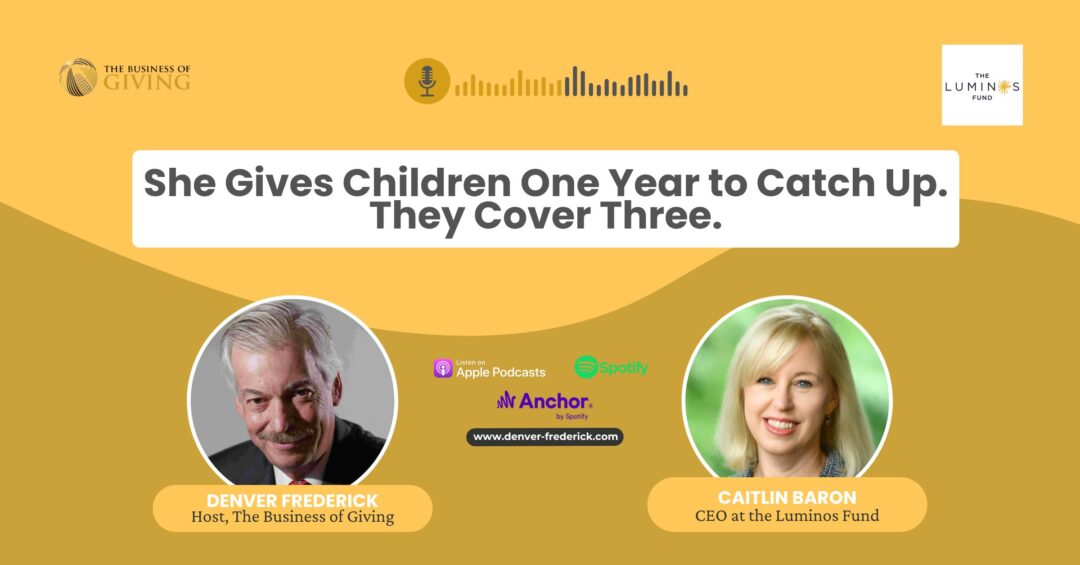
Imagine a child, nine years old, who has never once held a pencil or opened a book. Not because she doesn’t want to learn, but because poverty or conflict or displacement slammed the schoolhouse door before she ever reached it. Across Africa, that is the reality for 80 million children. And once they fall behind, most education systems simply move on without them.
My next guest refused to accept that.
“My real discovery that really led to the impetus to start Luminos was the realization that there’s still far too many children in the world who don’t even get the chance to grab onto that first rung of the educational ladder.”
Caitlin Baron built something most education systems never bothered to create — a way back in. One intensive year in which children cover three years of learning and walk into a classroom with kids their own age. The evidence says it works. A new book, The Luminos Method, lays out exactly how.
It’s Caitlin Baron on The Business of Giving.
Denver: Welcome back to The Business of Giving, Caitlin.
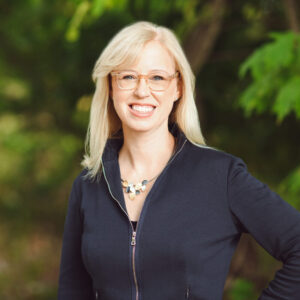
Caitlin Baron is the CEO of the Luminos Fund and editor of The Luminos Method
Caitlin: Thank you so much for having me, Denver. It’s a pleasure to be here.
“…my real discovery that really led to the impetus to start Luminos was the realization that there’s still far too many children in the world who don’t even get the chance to grab onto that first rung of the educational ladder.”
Denver: For listeners new to Luminos, start with the problem. What is the specific crisis in global education for the most marginalized children? And what moment made you believe that you had to build something fundamentally different if we were going to ever solve it?
Caitlin: I can say it’s a great entry point, Denver, and I think for any of us who are adults working in the world, we all know how fundamental our education was to opening the doors of opportunity for each and every one of us.
And my real discovery that really led to the impetus to start Luminos was the realization that there’s still far too many children in the world who don’t even get the chance to grab onto that first rung of the educational ladder.
And so, in the African context where we at Luminos do most of our work, it’s still one in five children who miss out on the chance to go to school. And that can happen for a variety of reasons. Poverty is by far the most common. In the context where we work, even free education can be too expensive when children are needed at home to work on the farm, or to care for siblings.
But sometimes it’s a matter of crisis, climate change, conflict, families being displaced from one region to another. And far too often, in the communities where we work, when children miss out on school, there’s no practical way for them to catch up and continue their studies. They wind up being forever lost to the world of education.
But what we realized at Luminos was that daunting as this challenge is across the African continent, the solutions to this challenge lay there as well. There are a wealth of robust, dedicated, highly capable community-based organizations eager to play a vital role in helping children catch up to grade level and thrive.
And so, what Luminos does is we work in partnership with community-led organizations across the continent, creating rich, high-impact catch-up education learning programs that enable children in just one year to cover three years of learning. And importantly, that means that they can get back to school and get back to school with kids their own age.
Denver: Your book argues that children on the margins can learn more… They can learn faster than we ever thought possible. So, what were people getting wrong about those children, or about the very nature of learning itself?
Caitlin: I think in the context of international education, at the very least, Denver, I think so often, we look at the scale of the problem– 80 million children missing out on the chance to go to school.
And in the face of such vast numbers, I think inevitably, sometimes our imagination narrows about what’s possible. And we revert to counting bums in seats, or putting tablets in front of children as the only viable solution to reach children in those numbers.
And it’s a powerful thing that we’ve realized at Luminos that it has significance for a range of different challenges, not just education, is that first things first… transformative education happens in the context of a relationship. And so, really when you’re unlocking the early mysteries and challenges of learning for a child, that’s a fundamentally human endeavor. And so, there’s no substitute for the human in education.
But secondly, challenging as these circumstances are, as difficult as it is when a child falls behind… and there are no easy catch-up education solutions, so a wealth of young people across the African continent who are eager to play a role in helping children in their communities become successful readers and begin a lifelong journey of learning.
And what they really need are the tools to do that and the support to get there.
“And we found ourselves wanting to share out our experience, wanting to be helpful and supportive, but also just recognizing that no matter how much Luminos grew, we wouldn’t be everywhere overnight. So, the real motivation for the book was: How can we distill the fundamental learnings from this work that we believe are equally relevant to students everywhere in the early years…”
Denver: The Luminos Method: The Secret to Unlocking the Light of Learning in Every Child. Now, you edited and contributed to this book, Caitlin, and you drew on a decade of experience across Africa. What was the hardest thing to translate from lived classroom experience into the written page? And I know how agonizing that can be.
And also, what surprised you about what the process of assembling this book revealed about your own method?
Caitlin: It has been such a pleasure and a privilege to work on assembling this book. And yes, I am the editor, but the authors are my myriad colleagues, who play a critical role in every piece of the work.
We decided to write the book, Denver, essentially because we found as time went on, as then we’d reached 500,000 children, we had a raft of 30 different external evaluations demonstrating our impact; we had more and more inquiries coming to us from ministries of education and individual schools around the world.
And we found ourselves wanting to share out our experience, wanting to be helpful and supportive, but also just recognizing that no matter how much Luminos grew, we wouldn’t be everywhere overnight.
So, the real motivation for the book was: How can we distill the fundamental learnings from this work that we believe are equally relevant to students everywhere in the early years, not just the task of children who need to catch up and thrive?
And how can we distill that down into a book that is grounded in the evidence, grounded in the fact base that we know and understand as a sector, but deeply practical and really brought to life through clear images and graphics and data, and then contextualized and evaluated.
I think perhaps counterintuitively, one of my favorite parts of the book is that we end each chapter by saying, “We love this particular technique and approach. Here’s what some of the limitations might be. Here’s where this might not work.”
And I think putting that note of caution in there was a recognition that teachers everywhere are tasked with such massive instructional challenges. And it’s very easy, I think, to put an educational book out there and be like, “Oh, it’s just easy. We do it exactly like this,” without recognizing in the end, there’s a finite number of hours in the day, there’s a fixed number of children in the classroom.
And I think if you want to be saying something thoughtful in education, you need to be sharing out your experience, but you really need to be breaking down and being realistic about the trade-offs and choices, so that individual teachers can take that material and in very practical terms, actually put it to use in their classrooms.
Denver: Yeah. I thought that part of the book made it so relatable. You’re not a cheerleader here on a soapbox, but essentially: This is a real world. We can’t do everything.
Let’s talk about” joyful classrooms.” That’s a powerful phrase, but operationally, how do you design joy as an instructional strategy?
Caitlin: If you have the chance to visit basically any village in Africa, you’ll see an amazingly joyful pack of children running around, having created improvisational toys and games, using found materials to create balls to play soccer games, playing an imaginary role-playing games, really using small bits and bobs of what they find on hand.
What you see before your eyes is the intrinsic nature of how children everywhere learn through play. But when you step inside the typical African classroom, what you see is very different. You’ll see children sitting silently in rows, actually remarkably obedient compared to American kids, but looking straight ahead, not risking stepping out of line, not wanting to risk making a mistake.
And one of the things that we always say at Luminos is, first things first, children everywhere learn best when they’re happy. And that’s true for my kids in the school they go to, here down the road. And that’s true for children halfway around the world as well.
And equally important is the fact that everyone, not just children, everyone learns by making mistakes and learning from those mistakes and moving forward, and so creating a safe space to try new things. “Come up short and try again” is fundamental to any successful learning journey.
And so, that is really the essence of the philosophy that we bring to bear in The Luminos Method. Yes, there’s a set of teaching techniques, toys, games, how do we use song, dance, play in the classroom, but equally important, there’s a set of underlying philosophical principles about: How do we create a safe space for children to try new things? How do we let children take on leadership roles in the classroom so that they can carry that forward?
And how do we reorient the teacher’s focus from the one or two star pupils, who seem to always get the attention in most classes, to those equally high-potential students but those who may be struggling with one element of the learning agenda? And so, it’s really that balance of both bringing all the song, dance, game activities into the classroom, but equally important, bringing that ethos, that philosophy of what a safe learning journey looks like.
Denver: So interesting. Let’s talk about teachers a little bit, and your teacher model. Recruiting and training community teachers in places with huge teacher shortages can’t be all that easy. So, tell us a little bit about that, and tell us about the support that you give to these new community teachers and what that actually looks like.
Caitlin: Well, I think back when the sustainable development goals were first articulated, back just about 10 years ago, I believe the calculus was there that we would need an additional 80 million certified teachers around the world in order to get education to every child everywhere.
Denver: That’s right. And they didn’t have anything at the end of that chapter either. It just said…
Caitlin: Exactly. No trade-offs there whatsoever. I think at one point in time, someone had done the math and said, for a country like South Sudan: you would need four times the total number of teacher college graduates coming out of the school system to be absorbed into the mainstream school system in order to meet that need.
And so, in the context where we work, there are quite frankly… will never be enough formally qualified teachers. And so, the way we like to think about this is like, yes, qualified teachers are absolutely first prize, but there are other individuals who can play critically important roles in the learning journey at different levels of qualification.
And how we think about that is like how you think about a medical system. A doctor will always be a doctor, but a well-functioning healthcare system has nurses, has physicians’ aides, has orderlies in the hospital, and all of those individuals coming together with different levels of credential and qualification actually create a healthcare pathway.
And an education pathway can very much be the same.
Denver: Yeah.
Caitlin: So, in addition to having those formally qualified teachers, being able to take high-potential young people from a given community, who are deeply motivated, but don’t necessarily have the exact set of skills that they need to be teachers. And being able to right-size education instruction so that in a relatively short period of time, two or three weeks, plus critically important ongoing, week in and week out coaching in the classroom, young people who may not have formal qualifications but do have this kind of training and support can actually achieve remarkable things.
And so, community teachers have been fundamental to our work at Luminos, but we think the broader message from this is that when you let go of a deficit model of focusing on what one doesn’t have: we don’t have a sufficient number of qualified teachers. And what you think instead, what you ask instead is: What do we have? Well, what we do have is a large number of young people on the African continent eager to make a difference in their communities. And think from an asset rather than a deficit standpoint, like all sorts of incredible things are possible.
Denver: Yeah. That’s not what we do a lot in philanthropy. We usually go into communities and find out what’s wrong and say: We’re going to fix it. And I’ve had so many people, when I’ve gone into those communities, say, “Why don’t you take what we’re doing well and double down on that, and that will take care of the problems?” But we tend to just gravitate to: This is broken, and we’ll fix it. And that sometimes isn’t the best answer.
Let’s also talk about assessment. And assessments are usually built around the adult, me, my wife, for our kid, and maybe the bureaucrats, maybe the donors, but you flipped that a little bit on its head. And you have made assessment motivating to the child and immediately useful to some of the teachers that you just talked about. How have you been able to do that?
Caitlin: Denver, I think that is really absolutely spot on, especially in the international development world where we work. There’s a very strong emphasis on external evaluation, so having an independent entity come in at the beginning of your program, at the end of the program, and assess how it worked. And that’s fundamental to our work at Luminos as well.
Actually, in every country program every year, we have an external evaluation. It’s hugely helpful. And from that, we know that children are covering three years of learning in one year, which is amazing. But even at its very best, an external evaluation is only a rear-view mirror. It doesn’t tell you about the children sitting before you today, and it doesn’t give you information in a time frame that you can actually change outcomes for kids.
And so, one of the things we do differently at Luminos is, in addition to that external evaluation, we do a ton of real time, week in, week out, classroom-based observation led by the teacher himself or herself. And the point of that work is never data for data’s sake. It’s always: What is the minimum amount of data that a teacher needs to have in order to see each child as an individual and to meet them where they are?
And quite honestly, children in the Luminos program could never make the rapid progress that they make if they weren’t working through an instruction model that was really carefully calibrated to their learning level.
Denver: Yeah, and you do so much in real time. How do you get so fast?
Caitlin: It’s funny, so our program has always been a one-year program.
Denver: Yep.
Caitlin: If you’d asked me years ago, that’s kind of unusual in our space. Most education work is three or four-year initiatives.
Early on in this journey, I think I would’ve thought maybe we’d move away from one year over time, but genuinely, it’s actually become like a fundamental part of our philosophy because when you have only one year to change the life of a child, every moment in the classroom becomes precious. That child’s time becomes precious.
And the energy and the drive, I think that comes out of the knowledge that we have but a short time to get this right, is actually what drives the making rapid cycle iterations and changes, really focusing on every child in the moment. It makes the moment precious because we know we have no time to waste.
“…a child appropriately supported to learn can actually learn a remarkable amount in a short period of time.”
Denver: That’s been the story of my life too, pretty much, is that when you have deadlines like that… It happened to me a lot when I was working at the Statue of Liberty with July 4th, and we were going to do it then, and I’d worked at a bunch of nonprofits before then.
But because Lady Liberty was going to be unveiled on July 4th, the decisions we made were amazing because we would be sitting at a table and we’d be saying: Look, we have to decide on this today or tomorrow, because if we don’t decide on it today, we will be mathematically eliminated.
And that idea of being mathematically eliminated and making every minute count, really creates a self-propelling energy that just carries through everything.
Caitlin: I think that’s so true. And oftentimes, in many ways with education and as a parent, I think you can say, sometimes it takes 12 years to know if it worked out, right? You know?
Denver: Yeah.
Caitlin: And there’s an element of truth to that for sure, but I think one of the things we’ve found is a real gift at Luminos is turning that on its head and saying yes, but also…
Denver: Oh, yeah.
Caitlin: …a child appropriately supported to learn can actually learn a remarkable amount in a short period of time.
Denver: During that year, is there a truth threshold, a single skill or shift that unlocks a child’s trajectory? You’ve seen enough of them now. Is there that moment where you begin to say, “Wow, we have turned this corner.”?
Caitlin: Our program focuses essentially on grades one, two, and three, but squished into one year. So, obviously, there’s a very strong focus on children learning to read and do basic math. Both of those things are vitally important, but the trick with learning to read is that it is fundamentally the gatekeeping event of the learning journey.
And so, in the African context, nine out of 10 10-year-olds are in schools that have not managed to teach them to read. So, the overwhelming majority of children in the African context are failing to meet what’s thought of as the kind of escape velocity event in education. Like once you learn to read, you can read to learn, but really, nothing else can happen until that literacy chasm is bridged.
And so, I think ultimately, for a one-year program, we’ve seen surprisingly strong long-term impact. So, for example, we had a bunch of evaluators who track graduates of our program for six years after they left. What they found was that graduates of the program not only were succeeding at the point they finished with Luminos, but six years later, they were going on to complete school at twice the rate of the average.
And you ask yourself: How can one year make that much of a difference? And it really comes down to the fact that literacy, learning to read is that gatekeeping event for everything that comes afterwards. So, the return on investment of that one powerful year of learning to read is just far greater than almost any other investment you could make in education.
Denver: That’s for sure. Phenomenal! Caitlin, you pointed out that the challenge for girls doesn’t end at the classroom door. What are some of the hidden barriers, maybe not so hidden barriers, that show up after enrollment that can derail a girl’s progress? And what do you do to try to help fix that?
Caitlin: No, it’s a great question. And there are still a handful of corners of the world where there’s a large number of girls who don’t get the chance to go to school. Good news, in most of the African context, that is no longer the case. So, we really do have girls and boys in school at more or less the same rate. In point of fact; actually sometimes there’s more boys out of school than girls. So, that’s great news.
In the regions where we work, girls are getting to the classroom door. The question is: What is their leadership role within the classroom? How often are girls versus boys answering questions, taking on leadership roles? When a girl makes a mistake, what is the reaction as opposed to a boy making a mistake?
And I think that’s really where the magic of Luminos’ work has come in. Good news. We know girls and boys are showing up in equal numbers. That’s amazing. How can we actually make sure that they’re having equally transformative learning journeys in the classroom?
And so, we do that by a lot of explicit instruction to teachers on: Make sure you alternate the gender of the child you call on when you’re asking and answering questions. Make sure you rotate leadership roles in the classroom.
But equally, actually, we do it through data. So, all of our assessment data is disaggregated by girls versus boys, and that means we can identify if there’s ever a place in the program where we’re seeing differential rates of success for girls or boys. We know exactly where to hone in.
Denver: Fantastic. Tell us a little bit about the philanthropic landscape these days. It’s been pretty rocky terrain, whether it be private funding and certainly government funding. What have you found out there? What are you experiencing? And how are you pivoting to make ends meet and beyond?
Caitlin: So, the kind of work we do at Luminos in broad terms is historically the bread and butter of what USAID or U.S. government foreign assistance funding has supported. And so, Luminos had the gift of a small amount of USAID funding, but for many of our peers in the space, other good organizations doing other good work, USAID would’ve been the central supporter of their work.
So, the changes in government support in 2025 are profound and lasting for the communities that we work in. The challenges of children being out of school are, to some extent, harder than they’ve ever been. That being said, international education in particular is a real… it’s like an unexpected high return investment that I think U.S. philanthropy in particular would be well-served to look at closely.
I think that education is by far the most common destination of domestic philanthropic dollars, right?
Denver: Yeah.
Caitlin: People are most likely to give to their college, their school that they went to, or some education program in their community that’s about opening new doors of opportunity.
But interestingly enough, so often when people look internationally, education tends to fall from the list. And I think, actually, part of the reason we are so excited about the impact of our one-year program at Luminos, is it’s like such a powerful reminder that even a really short-term philanthropic gift can fundamentally change the trajectory of a child’s life.
And so, yes, my invitation to the U.S. philanthropic community is that there’s never been a better time to invest in international education.
Denver: Well stated. What do you think that the U.S. education would benefit from in terms of looking at The Luminos Method, and maybe transporting some of those ideas and concepts back here to challenging children?
And particularly post-COVID, have they adopted… I mean, I know you encourage, but where are we at with it all, and what do you think would be really beneficial to this country in terms of the hard work you’ve done and the learnings that you have achieved?
Caitlin: Yeah. There’s a couple critical things I think to bring to bear. One is, first things first, that idea of who are folks other than the teacher who can be a helpful part of the learning journey?
In the U.S. context post-COVID, we actually saw some really interesting usages of tutoring and individual catch-up education, which I think is very much in that spirit of: How can we think not just about the fact that children are behind, but how can we think about different individuals in the community who can play a part in that learning journey?
But equally important, I think that the frequent assessment data is a key piece of the puzzle for us. And in the U.S. context, it’s pretty common to have high stakes once-a-year assessments, where the teacher really only gets that data the year after children have moved on from her classroom.
And that really is a missed opportunity, I think, to get insight in a time frame where the teacher can actually make a difference with it.
“…ultimately, our goal in putting out The Luminos Method book is really that in the end, Luminos wants to be at the center of a movement that is much bigger than us alone.”
Denver: Yeah. Finally, Caitlin, you’ve built a method with proven impact, but if we look ahead 10 years… which I think you have to do on your 10th anniversary, that’s what people do whether you like it or not… the Luminos Method, let’s say, has truly become a movement even beyond what it is today. What has changed? What are classrooms like? Where are those classrooms? What are ministries doing differently?
And particularly, how has philanthropy shifted to show the world finally the learned lesson from all this?
Caitlin: Yeah. It’s a great question and we’re incredibly proud of how far we’ve come, but we’re even more excited about the road ahead. And as you say, ultimately, our goal in putting out The Luminos Method book is really that in the end, Luminos wants to be at the center of a movement that is much bigger than us alone. So, our work will continue to grow in scale. We’ll continue to reach more children across Africa, but we’re now opening our doors to other organizations to come learn from our model, take seed grant funding back home to replicate and scale it.
And increasingly, spending most of our time working within government school systems so that not only do we have this rich, interactive catch-up education program, we actually have that kind of wonderful, immersive learning experience for children in mainstream school as well.
Denver: A wonderful way to leverage all this work and achievements you have. The book is The Luminos Method: The Secret to Unlocking the Light of Learning in Every Child. It makes a compelling case that the world’s most marginalized children are capable of far more than most education systems assume, and backs it up with decades of evidence.
I hope everyone picks up a copy, and I want to thank you so much for being here, Caitlin. It’s always a joy to have you on the program.
Caitlin: It’s an absolute delight. Thank you so much for inviting me.
Every weekday morning at 7:00 a.m. Eastern, I publish a short Leadership Note from the Field. These reflections draw on fifty years in the nonprofit sector and nearly 1,000 conversations with nonprofit leaders.They are designed to help leaders step back from the noise, see the deeper pattern, and lead with greater clarity.A recent note explores a distinction I believe matters enormously right now.In philanthropy, don’t confuse headlines with forces.Headlines dominate the moment. But deeper forces such as the $124 trillion wealth transfer, the rise of women as philanthropic decision makers, and the growth of giving across the Global South will shape the next twenty-five years.You can read the full note, along with a new one posted every weekday morning, on my blog at denver-frederick.com or on LinkedIn.