
What if the secret to changing the world isn’t buried in your bank account, but hidden in talents you’ve never fully recognized?
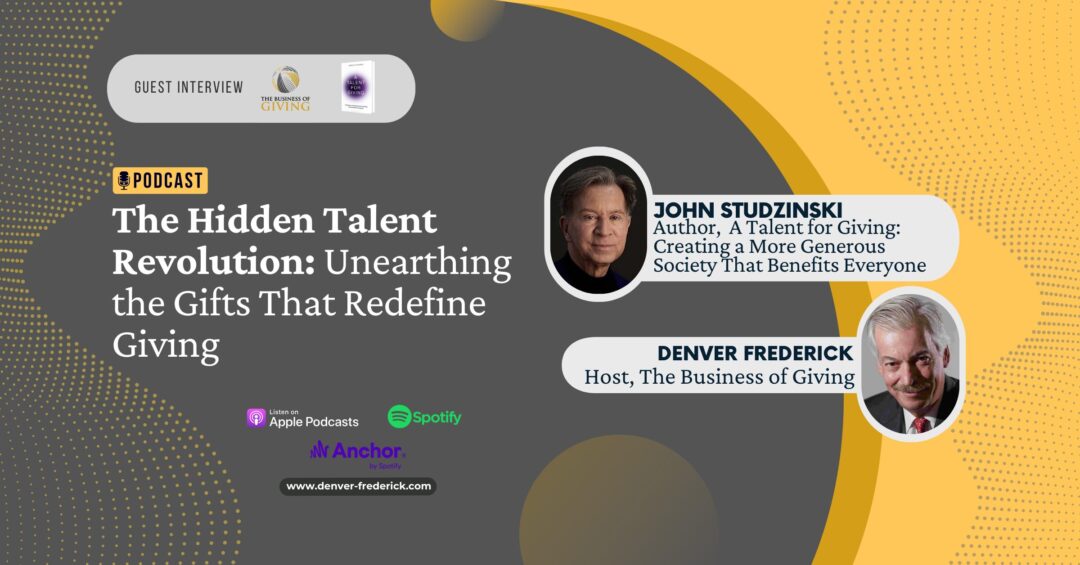
Today we welcome John Studzinski—a financier who survived a near-fatal car crash that killed nine others, a philanthropist who’s discovered over 5,000 emerging artists, and author of the revolutionary new book A Talent for Giving: Creating a More Generous Society That Benefits Everyone.
For six decades, John has shattered philanthropy’s elitist barriers with a radical truth: every person possesses world-changing abilities, regardless of wealth or status. As founder of the Genesis Foundation, he’s built a movement that rejects checkbook philanthropy for something far more powerful—authentic human connection and hidden talent unleashed.
“I think we don’t spend enough time when you’re young, and I wrote this book with a view that maybe adolescents and young adults would read it and think about it. But I think today, more and more, your talent is hidden.”
This conversation will revolutionize how you see giving—and yourself.
It’s John Studzinski on The Business of Giving.
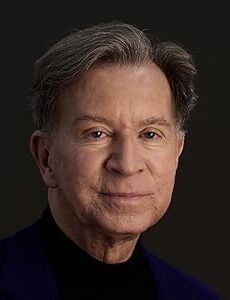
John Studzinski, Author, A Talent for Giving: Creating a More Generous Society That Benefits Everyone
Denver: Welcome to The Business of Giving, John.
John: Greetings, Denver. Thank you for including me in your wonderful program.
Denver: Well, thank you, and thank you for doing this. For listeners new to the term, what is entrepreneurial giving and how does it rethink or challenge traditional philanthropy?
John: Well, I think the term entrepreneur in my mind relates to an individual and how an individual can create something, or co-create something, based on their own situation, their own skillset, and I like to use the word ‘their own talent.’ And some of that talent is obvious, and sometimes that talent has to be unearthed or discovered.
And I feel that today, I don’t see this as a disruptive force, but I think the world today has so many institutions, government, corporations, big foundations that people have felt are responsible for solving problems.
And I think now as entrepreneurs create businesses– and you’ve seen that in Menlo Park and in Boston in the tech space– we have to think about more and more looking at problem solving when we think about ourselves at the individual level. So you and I are both entrepreneurs, whether we realize it or not, and everyone listening to this is probably more of an entrepreneur than they realize.
“…I think we don’t spend enough time when you’re young, and I wrote this book with a view that maybe adolescents and young adults would read it and think about it. But I think today, more and more, your talent is hidden.”
Denver: One of the brilliant insights in the book… which I thought there were very many, you said, “Why is knowing your own strength vital before giving, and how does this guide the responsibilities you take on?” Speak to that a little bit.
John: Well, I think we don’t spend enough time when you’re young, and I wrote this book with a view that maybe adolescents and young adults would read it and think about it. But I think today, more and more, your talent is hidden.
And I’m mindful of the parable of the talents in the Bible of one worker who is given five, and he invests and makes five. One worker’s given three and invests three and makes three. One worker is given one and has no confidence at all, is ambiguous, uncertain, and actually obviously rather paranoid, and buries the talent in the ground and is overtly chastised.
And I think people have to be more open with themselves about what their talents are. Everyone knows they have one or two talents. Some people are conversational; some people are extroverts; some people are introverts. Some people write well; some people speak well.
But actually, everyone listening to your program has to think about: Well, actually I’m good at two or three things. If I wanted to do something today, whether it’s: Do I have convening power? Am I good at technology? Am I good at humor? Am I good at communication? How do I unearth that?
So I do think people have to look at their obvious talents, the ones they’ve been brought up with. Everyone’s family or everyone’s network, everyone’s community identifies their one or two obvious talents. But I would also encourage people to think about less obvious talents.
I started convening groups when I was six and seven years old when we started a soup kitchen. And I only did it because I was brought up in a very hospitable family. And I didn’t realize, if you’re hospitable and you have a gene for hospitality, that may mean you have an ability to convene.
And I sort of converted the hospitality to a convening talent, which I’ve used for the last 60 years of my life.
Denver: Yeah. Yeah. That is really interesting. And we don’t identify those talents early enough in our life.
And I even think about philanthropy and purposeful giving and giving… I just wish it was done at an earlier age and in a much more intentional way, because when I’ve seen it done in certain families that way, it’s a lifelong habit and those people really grow. But essentially, we don’t really think about it until adulthood in too many cases.
John: Denver, one of my great frustrations is, if someone said, How would you change things in the world? I would try to re-inculcate the notion of national service and also teaching volunteerism into schools.
National service, which takes place in countries like Switzerland, Austria, just to name two countries, what that does is that everyone… it’s a unifier in terms of nationalism, loyalty. You learn skills, you create a network, and you also, if you will, develop enough confidence in yourself perhaps to get a job.
So it’s fine if you come from a middle class or upper middle-class family, but if you come from a poor family and you go through national service, it gives you a whole new lease on life. So I actually wish national service was much more broadly embraced in a whole range of countries, particularly in countries like the United States and more broadly across Europe.
Volunteerism, I’ve tried to introduce into schools in the U.S. and in the U.K. and you’re constantly met with: “Well, there’s safeguarding now, and we have to be careful with things that could happen to young people.” But I’ve taken a lot of young people to Lourdes.
And when you teach young people service at the age of 14 or 16, or even a younger age, and you teach them something very simple like serving food in a food bank, you’re amazed because they realize they’re capable of doing something. And you know what? It enhances their self-esteem.
Denver: Yeah.
John: And they actually realize that the human condition is more entertaining than actually sitting on a mobile phone or Instagram or doing some sort of video game. And I’ve watched young people engage, and sometimes I take a lot of people to Lourdes, and I’ve watched young people engage in food banks, they come away thinking they develop relationships, and they also sense this notion of self-esteem.
Denver: Yeah.
John: They themselves feel that they, as human beings, add value. Their own dignity is enhanced. So you try to explain to a child about dignity and self-esteem. When you’re helping a marginalized person, you’re helping them. But actually, you know what? It’s really a transaction. You are getting as much out of it, and I would actually argue you’re getting more out of it, much more out of it personally than you realize.
And I think this is a great challenge for the work you are doing, getting more people. I’m not saying the financial side of philanthropy is not good, although I do call it checkbook philanthropy as I think it’s important that we see that as one leg on a table that has four or five or six legs. And spending time in volunteering, you learn much more about yourself actually than you do almost anything else.
Denver: Yeah, absolutely. And I think we’d address some of the big problems, at least in the United States, we have right now. One is a sense of purpose. And particularly among young men, this does give you that.
And the second thing is, depending on the kind of national service, it keeps you physically fit. It gets you off the couch and interrupts eating Doritos or Tostitos or whatever, and doing something like that which can really help considerably.
John, your faith is a known inspiration. How does it specifically shape your approach to philanthropy, especially in seeing human dignity in every person you aim to help?
John: Well, thank you for asking the question. It’s something I’m… it’s very interesting because it’s something that I’m very engaged with. It’s the center of my life. I have great moments when I’d be sitting at a dinner party in Los Angeles, New York, or London, or Hong Kong and someone very interesting or someone very, maybe even someone very unknown will say to me, “So I understand you believe in God!” And this will come out of nowhere.
And I said, “Yes, I do.” I said, do, and I’ll say, well… and my immediate reaction is they obviously want to put me on the defensive to think that I’m going to talk about God from the standpoint of science. Mm-hmm. And I say, “No, I think we need to think about this in terms of faith.”
But then I say, “Let’s think about your life. Have you ever been in the presence of God?” And then sometimes you unearth a lot of discussions about people’s own spiritual moments where they were close to God but didn’t realize it, or they met somebody who was potentially that wonderful Hebrews 13 angels unaware, where they’ve been in the presence of an angel and were not aware of it.
My faith is something that is; I think there’s an extraordinary amount of wisdom in the scriptures. By the scriptures, of course, in my case it’s the Old Testament or the Hebrew Bible and the New Testament.
Denver: Right.
John: But the scriptures, the Quran has an equally profound amount of insights, and it is about looking at you and our colleagues, and sort of looking at the individual through the face of Christ. And I’ve always felt that if you actually take the scriptures… sometimes it’s word by word, sentence by sentence, there’s a lot of… you can just isolate one sentence or one word, and there’s an extraordinary amount of wisdom.
And I think we often… it gets to something you and I touched on before the beginning of the program, which is the difference between religion, which has 5,000 years of history, versus faith, which is very personal and really characterizes your relationship or my relationship or your audience’s potential relationship with God or the Greater Being.
Denver: Was there ever a point in your life, John, where your faith got a little wobbly?
John: My faith has gotten stronger. I had a near death experience in May of 1987. I was in a multiple car accident on the Autobahn in Germany, and I was the only one who survived. Nine other people in this multiple car accident were killed.
And at that point, I had to think carefully about… I would… that whole experience strengthened my faith because I’ve obviously had the supernatural experience or the adrenaline, a rush, or the spiritual experience of saying: It’s not your time to go. You actually have more to do. And I do believe that, and that I had that whole experience of saying, Okay, your time isn’t up.
Because I did go through the tunnel. I was in intensive care for… I lost a lung. I broke an arm in 62 pieces. And I had to go on a life support system and inflate my remaining lung. And I did it with a lot of focus and prayer. But my faith goes up and down, but it never disappears.
There are days where you do feel in the presence of God, and there are other days where you feel you’ve got to help other people try to engage with the presence of God.
Denver: Let’s turn back to philanthropy, and you’ve indicated that it’s become a little ego-driven. What trends concern you, John, and how can we restore authentic giving?
John: Well, I think I use the term…I’ve worked on so many projects for the last 60 plus years, and there’s always the notion when people get engaged in something, you want to try to understand their motivation, and also how you can partner with them. And I am very sensitive.
And one of the things I’ve done, Denver, in trying to understand how to engage young people in giving, is I’ve convened small focus groups, and I’ve asked them what they’re passionate about. I’ve asked them whether they want to be a philanthropist. I’ve asked them, and their immediate reaction is, “What’s philanthropy?” That’s a 19th century term, or that’s a very wealthy person, or that’s somebody who’s made a lot of money, who now wants to enhance their stature.
And it is to a certain extent, many, many people do see philanthropy as an accessory. They reach a point in their life where they’ve done well, so they want to do good. And I respect that, and there’s nothing wrong with that. What these young people though don’t understand is when I say to them: What are you passionate about?
They’re not passionate about anything in today’s world. If you ask them what they’re angry about, they’re angry about a lot of things. If you ask them what they’re concerned about, they’re concerned about a lot of things. So I think when we… I’m trying to look at giving from the standpoint of encouraging individuals to become generous disruptors.
And I think the word ‘disruptor’ is a good word.
Denver: Yeah.
John: It’s not a bad word. People associate that word with Elon Musk, and he is a great disruptor. One of my great icons and I talk about him in the book, is Benjamin Franklin, who was the great, great disruptor of the Enlightenment–one of the most important people in American history.
I was always mindful of the fact, when I went to see the opening night of Hamilton, and I said to Lin-Manuel Miranda, “Fabulous! Wonderful evening! But where’s Ben Franklin?” And he said, “Ben Franklin is such a big character. He dwarfs Hamilton, Jefferson, and everyone else, so we kept him out.”
So today, I am sensitive to people who are… when you talk about philanthropy, you want someone who really has a grassroots understanding, and there are some extraordinary people. I didn’t talk about any of them in the book, and I’m not going to talk about them because everyone knows who they are.
There are people who have real values about… and when you can identify certain people about what certain great philanthropists stand for– that their giving matches their values– that doesn’t necessarily have to have anything to do with their ego.
“Many people say, ‘I can’t do anything because I don’t have a lot of money.’ I say, ‘Well, wait a minute. The whole purpose of this book is to tell you you’ve got talent, whether that talent relates to technology, to networking, to ties.’ I use Ts a lot as alliteration– to tenacity, temperament, or the power of two, which is my great belief in mentoring. But all of that, I would like to see that every individual will find something that they can actually do.”
Denver: How do you hope your book will inspire these millennials and Gen Zs to help them shape new norms of giving?
John: I would like to be having this conversation with you in 12 to 24 months, and I’d like to have you include maybe a half a dozen people in this conversation who have been inspired to look at their own talent, look from their own seat on the planet, where they can actually do something, whether it’s start a project.
Many people say, “I can’t do anything because I don’t have a lot of money.” I say, “Well, wait a minute. The whole purpose of this book is to tell you you’ve got talent, whether that talent relates to technology, to networking, to ties.” I use Ts a lot as alliteration– to tenacity, temperament, or the power of two, which is my great belief in mentoring. But all of that, I would like to see that every individual will find something that they can actually do.
What’s really powerful is if you go to the Bible, Denver, one of the things Christ is most motivated in the Bible is he notices that the elderly lady who has the smallest amount of money is there contributing the greatest percentage of her income at the temple. And that is a great symbol of the fact that we all can contribute. And some people can do it more disproportionately than others.
And many people say to me, “I’m just starting my career. I don’t have time.” My answer to that is: Allocate an hour a day. Allocate an hour a week. If even young children… parents can overprogram their children’s lives,.. give your child a chance to volunteer to do something an hour a week or two hours a week, and you’d find that it’s the experience of giving, I think, can become a cornerstone in one’s education and one’s orientation. I really do.
Denver: You know, along those lines of giving, I started my career at the United Way back in the 1970s, and I always remember that the biggest givers were the hotel workers of New York City. Now these are chambermaids, you know what I mean? And their per capita was bigger than the banks. It was just amazing in terms of the generosity.
But let’s get a little bit to the how-to, and I know you don’t have a how-to book, but how can listeners build a giving community with peers or family, using time and expertise rather than just money? Any advice on that?
John: Well, first of all, I think we’ve got to take this in steps. And I think there are some people who are natural innovators who will say, Okay, we need… food banks is a good example. So many places in America, so many places in the world, logistics-wise, don’t have food banks. And some people are clever enough to figure out how to solve that very quickly.
But there are other situations where someone may decide, Well, okay. I’m going to volunteer at an organization just to understand how the organization deals with certain types of problems, whether it’s in healthcare, medicine, education. And then from volunteering, I’m going to develop my own set of what I like, what I dislike.
And I think if I would encourage people to volunteer; I would encourage people to commit their time to engage in discussions about what angers them, about what frustrates them. And the ability of communities today, a lot of it is driven by technology, of course, and a lot of it is actually driven by the ability of people.
I think people are more like-minded today than they’ve ever been. And people talk about Gen Z being the snowflake generation. I don’t like that term. I think, well, on one level, snowflakes are beautiful. They have beautiful shapes. They’re architecturally original… each one is original. But the truth is it’s a very hypersensitive generation. It’s seen as a high-maintenance generation.
But I also think it’s a generation that is exceptionally close to humanity. And I think by being close to humanity, they understand the human condition better. If you look at the data, Generation Zed or Z is actually their use of social media is plateauing, and their engagement with faith and the notion of a greater being through prayer and meditation is actually marginally increasing.
Denver: Right.
John: So I think this generation is interested in spending more time with human beings. So to answer your question, I’m talking about people engaging and volunteering with people, doing something with people. I’ve learned so much of my own view of the world by spending time with homeless people, marginalized people.
I’ve done a lot of work with networks of religious sisters relating to modern slavery and human trafficking. And you test yourself, in fact, by pushing yourself out of your comfort zone in terms of your environment too. We all live in very comfortable environments, and I find I’ve taken a lot of young people into places where they weren’t expecting to go, and they come back really inspired.
I’ve been involved for 30 years with a project that originally Prince Charles, when he was Prince of Wales, and now of course he’s King Charles, set up, called Seeing is Believing.
Denver: Yeah.
John: But you have to go into a community and see a problem, and then you have to think about finding a solution to solve a problem. And sometimes it’s obvious, and sometimes it requires a set of ingredients.
And I think one of the things that the young generation is very good at, they’re very good lateral thinkers, and they actually are extremely good at seeing things in many different ways, partly through the use of technology, but partly through their use of community. And I think from that, you might find lots of interesting solutions.
I think if anything, Denver, people have got to stop just assuming that it’s going to be the government, or a corporation, or someone else is going to solve the problem or the issue. You can solve the problem or the issue, or it can certainly start with your ideas and your solution.
Denver: Absolutely. And speaking about spending time with people, you’ve also spent a lot of time with young artists, and the Genesis Foundation, which you founded in 2001, has really been a game changer for them. What’s the story behind it, John, its creation, and how does that fuel the message of A Talent for Giving?
John: Well, again, everyone on this podcast, Denver, you and I can think back at one point in our lives, did somebody give you your first break? Everybody had their first break, and I don’t care who you want to talk to: Everybody had their first break. Taylor Swift had her first break. Everybody. You just don’t arrive on a chariot. You have to start somewhere.
And the Genesis Foundation was really about trying to nurture young artists because I was very worried at the time that people coming from the upper middle class, their parents might know people in the visual arts world, the performing arts world, the movie industry, the writing industry, publications and all that. So it’s easy for them to get experience. It’s easy for them to get a job. It’s easy for them to get an apprenticeship or an internship.
I didn’t want the arts to be dominated by the upper middle class anywhere. I wanted it to be dominated by a cross section of humanity. And from that, I thought we would recruit people who had ideas and give them their first break, whether it was their first opera commission, their first music commission. There are some people like James MacMillan, who I’ve commissioned multiple works for him over the last 30 years.
But these are all people where if you give someone a commission, it does have a domino effect. So it’s all about giving someone their first break. It’s all about believing in somebody. It’s all about helping nurture their self-esteem. And self-esteem, again, we’re living in a society now where self-esteem is incredibly threatened because people look at themselves on social media and compare themselves to everyone else who seems to be happier.
Now I’m hoping that trend is starting to plateau or reverse, but the truth is everyone’s self-esteem deserves to be nurtured. And we did that in the Genesis Foundation, and we’ve now created a network over 25 years of over 5,000 different types of artists doing different types of things, and we continue to support them.
So it really relates to believing in an artist and giving them a break. And from that, they have to do two things, Denver. One, they have to obviously follow through on their talent, but number two, they also are required to mentor someone in a similar position.
“And I think it’s incumbent on all business leaders to remember they’re not just there to perpetuate their own values. And of course, they’re running a business. They have shareholders, they have stakeholders, they have employees, they have communities, but they also are, whether they like it or not, role models for the common good. And that is the most important thing I keep saying to business leaders: You are a role model for the common good, and you have to keep that in mind.”
Denver: Yeah, that’s fabulous. Pay it forward. Yeah, it’s amazing and I’ve seen it probably not as much as you, but when you believe in someone, not only their self-esteem, their self-confidence just goes through the roof. And it’s incredible what you can unlock in an individual because often, they’ve never had a single person in their lives believe in them, and it makes all the difference in the world.
With your finance background, John, how can businesses make giving a true cultural shift, not just PR, to benefit employees and more particularly, to benefit communities?
John: Well, businesses have been preoccupied with this for a long time. And of course, we have the term corporate social responsibility, which has gone through a number of different iterations. I think businesses all have now an inherent responsibility to have a corporate culture.
And I think the most important thing everybody is embraced with, and it’s not just very young people. It goes to millennials as well. People are not interested just in their career path and how much money they’re going to be paid, or who they’re going to be working with. They want to understand culture and values.
So I think it’s a question of creating a business and having a business that has… obviously, we talk about social impact businesses… we talk about corporate culture, we talk about corporate values, we talk about chemistry. And I think businesses have to… and many of them are excellent at that.
It’s that wonderful notion from the Bible: The fish rots from the head.
Denver: Yeah. Right.
John: If the fish is rotting, it starts at the head, but if the leadership is strong and they’re a role model in terms of giving, then that is a reflection down the organization.
And I think it’s incumbent on all business leaders to remember they’re not just there to perpetuate their own values. And of course, they’re running a business. They have shareholders, they have stakeholders, they have employees, they have communities, but they also are, whether they like it or not, role models for the common good.
And that is the most important thing I keep saying to business leaders: You are a role model for the common good, and you have to keep that in mind. You are watched like a hawk in your organization, and people will look to see: What are your values? Are they good values? Are you interested in materialism? Are you vain? Do you have an ego? Are you much more vulnerable?
I use that wonderful expression from Teresa of Avila: The devil enters their soul through their ego. And I often believe that’s true. Is the CEO egocentrical? Or is the CEO really about his stakeholder community… or her stakeholder community? And I think that’s very important.
Denver: Yeah. I mean, if you really know the CEO, you know the company. And if you really know the company, you’re going to know who the CEO is. I mean, they are going to be aligned in every way.
Talk a little bit about your book, A Talent for Giving: Creating a more generous society that benefits everyone. What went into it, and what do you hope it sparks in readers? And what do you hope… what’s your bold vision for a more generous society a decade from now?
John: Well, if I had to, humility is one of my tenets, so I’m cautious about this.
Denver: You’re tongue-tied.
John: Yeah. No, no. I think aspirationally, I would like this book to become a core read for people thinking about how to play a role in a generous society. And by that, I mean, a core read, meaning the book is written as a philosophy book. It’s written in the first person. It’s written from experience. It’s written from an odyssey perspective of things that worked, things that didn’t work.
And it’s written from the standpoint of trying to… with a certain amount of… there’s not whopping amounts of great success here. There’s lots of great case studies of things that work, but there’s also, I think, Denver, the candor that you need to start with your own deck of cards of talent and decide how to play those cards and know how to lay them down, whether you’re playing solitaire or bridge, and go from there.
So I think my aspiration is that this is a core read. It’s not something… actually, I’ve written it as a philosophy book. I’ve written it so that the chapters don’t have to be read in sequence. They can be read out of order. I’ve written it so that it can be used as a reference book to inspire people over time, and not something that is: you read and then you give away, or you forget about.
Denver: Finally, John, if you could issue one call to action to today’s wealth holders or advisors based on your life’s work and based upon this book, what would that one call to action be?
John: I think to approach giving for a more generous society for the common good, to go to something that I learned very categorically from Mother Teresa. You can only change the world one person at a time, so don’t be intimidated by the thought that: I’m not a big-project person; I don’t have a lot of time. Or I don’t have a lot of resources, or I don’t have a lot of network, or I don’t have a lot of money.
Think about the fact that you can change the world for the good by focusing on: Start small, even incrementally, and understand that there is a domino effect towards giving. And as you’ve inspired many people, Denver, one person that you inspire or people listening to this, they inspire… that will inspire other people.
And you’d be surprised of the power of two in terms of mentoring, but you’d also be surprised at how much impact you can have if you just start with the human condition of helping people, one person at a time.
Denver: Great advice. And along the lines of what you were mentioning about corporations, I don’t think people sometimes appreciate the power of contagion. Behavior is contagious. And when you move in a certain way, other people observe, and they behave the same way. And pretty soon you hit a tipping point, and things really begin to change.
The book again is A Talent for Giving: Creating a more generous society that benefits everyone. It’s a vibrant, inspiring guide that empowers everyone to transform lives with their unique talents. Pick it up, and ignite a more generous world.
Thanks so much for being here today, John. We have a date in about 18 months with you and maybe five or six others.
John: Wonderful.
Denver: And it was such a delight to have you on the program.
John: Denver, thank you very much.
To celebrate my 50th year in the nonprofit sector, I’ve put together a gift for you — a practical, field-tested guide to building world-class nonprofit workplace cultures. It’s called Cultivating Nonprofit Excellence, and it’s based on insights from nearly 1,000 interviews and 150 focus groups with nonprofit leaders around the globe. It’s completely free and instantly downloadable at blanchedalmond-mosquito-418475.hostingersite.com