

What started as a solo trek through Nepal’s earthquake-devastated Langtang Valley became a global movement connecting adventure with authentic impact. Today we’re joined by Candice Young, founder of Trek Relief, an organization that transforms travelers into changemakers through community-led projects across the world’s most remote regions.
From installing solar panels in Peru to rebuilding schools in Nepal, Trek Relief has completed 28 trips across multiple countries, creating a unique model where participants don’t just witness need—they actively address it alongside local communities. What makes their approach different? Every project emerges from what communities actually request, not what outsiders assume they need.
“And so then the vision was: I want to make it as easy as possible for others to do what I did, any traveler. If you’re going somewhere, you see something, you know you can do something about it.”
Join us as Candice shares how one moment of witness became a decade of purposeful travel that’s changing lives on both sides of the journey.
Denver: Welcome to The Business of Giving, Candice.
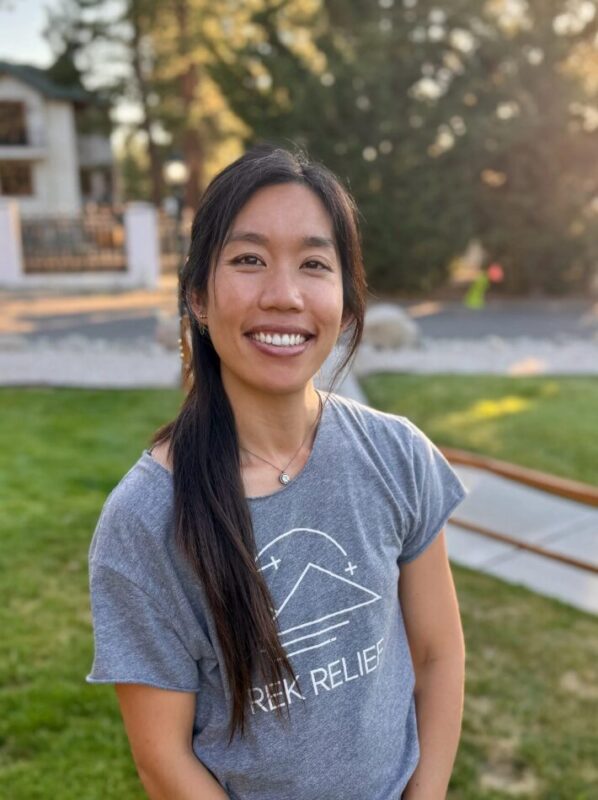
Candice Young, Founder of Trek Relief
Candice: Thank you so much for having me on here, Denver. It’s such a pleasure.
“And so then the vision was: I want to make it as easy as possible for others to do what I did, any traveler. If you’re going somewhere, you see something, you know you can do something about it.”
Denver: One moment in Nepal’s Langtang Valley, I guess it was after the 2015 earthquake, where you turned your fundraising effort into Trek Relief’s global mission, and how did it shape your approach to blending adventure with impact?
Candice: Yeah. Well, just being there the first time, I wasn’t planning on fundraising at all. I was just trying to go somewhere that was close to the earthquake. I’d already spent three months volunteering and working as a project manager of an organization that was rebuilding 50 homes and toilets.
So we had finished a project. I was going on vacation, going trekking and went there, and was just absolutely stunned by what I’d seen. It felt like a nuclear bomb had gone off, and it was one year after the earthquake. And I was surrounded by a bunch of aid workers and construction and all that stuff with the nonprofit, but the thing was that this village that I visited in the Himalayas… they had no roads. I had to walk two days to get there.
Also, it wasn’t as densely populated, so it just wasn’t high enough on the radar for people to prioritize them for getting help. And so when I was walking through there, people who were survivors of the earthquake, they were coming up to me and my friend and saying: Please, stay here the night. Would you like a meal? Please share the business, like make it fair… anything, to just get them back on their feet.
And so I was so moved. We spent 10 days walking through there, just trying to change our itinerary just to help people that we met along the way. And I was so moved by what I saw that by the time I got back to the Internet, I just posted on social media… I was like, “Hey, anyone who wants a vacation, come here. They could really use the help. It’s beautiful. It’s the Himalayas. You won’t regret it.”
And so I had two more months set aside to trek, and the whole time I was checking out different mountains, my mind kept on going back to what I’d seen there and the people that I’d met. And so finally I had this idea: Maybe, you know what? Maybe I can do a fundraiser for them. And so I started to voice that to my trekking partner. Then she was like: Maybe someone in the lodge that we just met could have some ideas.
I mentioned it to him the next morning over breakfast and he was like: You know what? I think that’s a great idea. By the way, I’m a professor and I teach crowdfunding and entrepreneurship, and I have some ideas. Maybe we could figure it out together. So in the one week that we walked in the same direction, he gave me a whole crash course of a semester. We came up with the name Trek Relief together, and he challenged me.
At first, I thought maybe I’d raise like $10,000, which was a huge reach for me. And he’s like, “No, you should go higher.” And I was like, “$50,000?” And he’s like, “Yeah, go for that.” And I was like, “What? That’s a lot. Oh my gosh.” But everything he said made sense. And so by the time we got off the trail, I got back to civilization, started doing everything he told me to a T.
And I set aside a year to reach that. And in the end, I reached it in eight months just by posting, tagging, thanking. This is all just on Facebook at the time… that was 2016. And within eight months, 40 friends and family and friends of friends ended up coming through Langtang Valley, and most of them overreached the goal by 33%.
So they all came in and brought funds. I helped organize volunteer work… I was coordinating with people I’d met in the Valley as well. And so, yeah, we ended up adopting a school and rebuilding it. So that was a really cool experience, and when we reached that goal, I was like: You know what? I could see this is so much work, but at the same time, I felt so fulfilled, so self-actualized.
I felt in my mid-20s, like I finally found something that was very meaningful and purposeful.
Denver: Fantastic.
Candice: I could see this being caught, this model being applied to any cause anywhere. Everyone who’s coming on these trips, like “Candice, this is amazing! Can you take us to Everest? Do this over in Everest?” And all these things. So it started to snowball, just by the feedback and what we were able to accomplish.
And so then the vision was: I want to make it as easy as possible for others to do what I did, any traveler. If you’re going somewhere, you see something, you know you can do something about it. So that’s how we decided to take it into a nonprofit.
And now, almost 10 years later, we have friends that have started this in Patagonia, Mongolia, and Peru as well. So yeah, we just finished, I think, our 28th trip.
Denver: Wow. That’s something.
Candice: … a different country.
Denver: You know, it’s funny, when I always ask people about wanting to learn more about an organization, I always ask them about their founding story. And it’s funny that your founding story was really a word-of-mouth story. And to this day, you’re a word-of-mouth organization. It’s a game of tag. Somebody tells somebody else and 10 years later… That’s exactly who you are.
How does Trek Relief combine these epic adventures with community-led projects? Like installing solar panels in Peru, or rebuilding in Nepal? And how do you distinguish this purpose-driven travel from, let’s say, traditional voluntourism? Or do you distinguish it?
Candice: Hmm. Yeah, I think our unique area here is that it’s almost like a boutique kind of feel. We’re very like: If you come on a trip, you become a candidate to become a trip leader or a program director at some point, or creating a program.
And so we are allowing people who feel very strongly about a cause or a mission, and say, You know what? If you feel strongly about this, we’re here to support you. And so we’re allowing people to create that change and create that choice in how to design those programs.
So it’s not necessarily a top down, like: This is our program, and this is what we’re focusing on. But rather, we would like to curate an opportunity for people to step into leadership by choosing the programs that they are interested in supporting. And then from there, developing out that itinerary that goes around it.
Denver: How do you foster authentic cultural connections for travelers? And do you have a specific practice you use to ensure participants really engage respectfully with local communities?
Candice: Yeah. Yeah. That’s a really important one because sometimes you go to cultures that are so different that you don’t even realize you could be doing something very…
Denver: Well-intentioned.
Candice: Exactly. And so yeah, definitely prepping everyone before they come, having a section in our onboarding emails to kind of talk about these basic things to just watch out for, and just to know before stepping in.
But also, a lot of our programs do involve an element of homestays and staying with families, especially when we’re in a rural part doing volunteer work, we’re placed… There are usually no tourists that go there. And so people take us in, and we really get to stay with homes, and people have just absolutely fallen in love with their family members and stayed in touch.
So it’s something that’s very beautiful to be able to see the exchange, but also not just stay exchanges like, What’s the Wi-Fi password? Or, when’s the next bus? But rather like: Thank you so much for coming here and asking these questions and helping with our medical center, or helping us with our schoolwork for the kids. These kinds of things… it’s a lot more beautiful to be interacting in this way.
Denver: If I was a first-time Trek Relief traveler, Candice, what is one secret tip you would give me that I would thank you forever for?
Candice: Hmm. Well, the thing is, this is something that we do on some of our trips, but we invite people to bring things, like for example, Nepal. So even before your trip, if you want to start doing some service before, and you want to prepare, sometimes we hold book drives even in your local area.
And then we ask for gently used secondhand children’s books that are suitable for English as a second language; then we bring them. We haul them over in our luggages, whatever’s available in our space. And then we bring them up into the mountains, and then we have moments to be able to distribute them within the school or within the families that we’re staying with.
And that’s a way that we can start to spark that practice of what service doesn’t have to be with a group. Service can start with you, right? And so, there’s so many ways that we can be angels in our lives, and that’s just one little way. That’s just a little example that we did.
Denver: What does leading by following look like on a Himalayan trail… or a Peru project? And maybe you can share a moment when deferring to others led to a better outcome.
Candice: Yeah. Yeah. So actually, it’s really beautiful. I have been really enjoying this transition from leadership into followership as other people have started to step into becoming trip leaders and program directors.
And for me, I have been really enjoying this role of stepping back and not being the person that knows everything on this trip, or is not calling the shots, and rather I’m the person that’s more, say, documenting, for example. Or, I enjoy doing photos and videos as my creative outlet.
So that’s one thing that I’ve really enjoyed, and I think that there are people who do things way better than I do, and it’s really such a joy to learn from them. So yeah, I think there’s so much to be said when you give other people those opportunities.
Denver: This has been a 10-year journey. Was there a moment when you doubted Trek Relief’s viability, and what pulled you through that moment? Because I’m sure there’s had to be a time where you said, Hey, are we going to make it? Is this worth it?
Candice: Right. Oh my gosh. I’m sure everyone has.
Denver: Everyone has…
Candice: It doesn’t have to be even a nonprofit. It could be just any kind of entrepreneur. The whole rollercoaster journey, ups and downs. Funding– where’s it going to come from? How’s it going to work? The things that come up that bring down your morale sometimes, they all happen. It’s all part of the journey. I would say during the pandemic was a huge one, right?
Like especially, Trek Relief is about travel and moving to different places, and we had to majorly adjust when that happens. Do we continue? We were just about to have a 21-person school handover ceremony in April, 2020, and then we had to cancel that trip, of course.
And then what? How long are we going to be stalling for? And all those unknowns. But we were able to adjust. In the end, one of our precious teammates, she ended up quarantined down in Patagonia, which is where we had one of our projects.
And so we said, You know what? This seems like this is happening for a while. We’re not traveling, but you’re down there, so might as well make the most of that if you’re willing and going to stay down there. Do you want to continue the project, and we’ll just send you money? So we ended up giving her a grant to continue with the work down there.
We ended up, Nepal had a huge COVID wave coming over from India. They were having funeral pyres just spilling out into the streets. So we ended up doing a major online fundraiser for them. And through that, we ended up developing a new partnership, with a new partner.
So there were actually some really beautiful outcomes that came out of what at first looks like adversity
“So I feel really happy that we are able to sustain our programs through the travelers. So we’re equipping everyone who’s coming on our trips to give them opportunities to fundraise– training, support if they’ve never fundraised before. So we have those systems in place for them to do peer-to-peer fundraising. Also, we encourage people to look into company matching if they want to donate and see if that’s available to them. So basically, our programs are self-sustained by our participants. So that’s really wonderful.”
Denver: We talked about fundraising a couple times. How does a lean nonprofit like you sustain operations? I mean, are there donations or partnerships or fees? How do you go about doing all that to keep the place moving and functioning?
Candice: Yeah. Yeah. That’s a great question. So I feel really happy that we are able to sustain our programs through the travelers. So we’re equipping everyone who’s coming on our trips to give them opportunities to fundraise– training, support if they’ve never fundraised before.
So we have those systems in place for them to do peer-to-peer fundraising. Also, we encourage people to look into company matching if they want to donate and see if that’s available to them. So basically, our programs are self-sustained by our participants. So that’s really wonderful. And any other fundraising that we have beyond that helps us support our organizational expenses.
And so we’ve had some really wonderful supporters over the years and really believed in our mission and supported us through private donations and helping us with their corporate matching as well. So we feel really lucky that way.
And also, Sarah, who was the one down in Patagonia, she won some grants from Patagonia as well, Patagonia, Inc., because her work is incredible, and the vision is that all the things that she did in Patagonia is going to be replicated amongst the schools there. So that’s a really beautiful project that we’re excited about.
And because of becoming a Patagonia grantee, that’s led us to even more resources through the Patagonia network, through coaching, through resources, finding volunteer and capacity, and all that stuff. So yeah, it’s just a crescendoing effect. The more energy put into something, the more you feel back.
Denver: Talk a little bit about that because you’re a bootstrapper. I mean, here you are, you went out, you raised $10,000, which turned out to be $50,000 in eight months, and you keep on doing it.
So you come across as being kind of scrappy, in terms of making things work. What do you have in your mind in terms of a secret to successful fundraising that maybe a lot of traditional nonprofits don’t appreciate as much as they should, and should be doing more of?
Candice: Right, right. I mean, I think that we have been really, really lucky with a supportive network of people who have been down to volunteer their time, their services. They just really believe in the mission of what we’re doing. And so in the beginning, I was just so, so lucky and supported by people who just saw how much work I was putting into it.
And of course, to do what I was doing, I was making a lot of noise on social media too, so that really helped with getting the word out, and people could see what I was up to, and they believed in it. Like I’d meet up with them and say, Hey, you know what? Like I do this. Can I help you with this?
And that really helped set the tone for not having to spend a bunch of money on admin, all the stuff that you don’t really want to be having to raise money for. And so that really helped build our reputation. And even now, we’re trying to be more sustainable…. Make sure that people who are actually really good at what they’re doing are the ones doing the work.
And so trying to, yeah, be really smart about how we’re fundraising. And so the money that we are bringing in through the organizational fundraising is helping pay for them. But yeah, always I wish I could pay more and hire more, but we’re doing our best.
Denver: Yeah. Let’s talk about a couple of your programs. You have the Nepal Climate Resiliency Program. Tell us about that.
Candice: Yeah. So that actually was a project that arose out of the pandemic. So I mentioned, we did a big fundraiser for COVID relief, and then one of the projects and realizations out of that project was like we were helping distribute food… or like providing all those resources for that.
And then one of the things is like, well, and there’s a common theme, because this is one of the projects we have in Patagonia, which is food sovereignty. What if you’re in the mountains and there’s a landslide, and you get cut off from supplies? And out there, they are already growing potatoes, that kind of stuff, but that’s not very nutritious if that’s all you’re eating.
And so the idea was to start helping promote that idea of food sovereignty by distributing greenhouse supplies to every family in the mountains. And so they chose a region. And the whole idea behind this, which was ingenious, was to be able to receive these supplies… then they called it a woman’s group.
And so the whole idea behind this was to also promote woman leadership. And so they said, to receive these materials, then we need to start having a women’s group meeting every once a month. And from this, these repeated trainings and meetings, then you start to receive these supplies. And then these meetings, over time, then natural leaders will start to emerge out of that.
And so then that became this whole thing where not only do the women receive the materials and training to make the best of these supplies… and they’re pretty basic materials… so like basic infrastructure for greenhouses which were effective, but then also they can sell the extra crops that they have. So now, the women have a source of income as well.
Denver: Fantastic.
Candice: And so through that, that was a program that we supported for three years, and we saw a woman actually end up in the district seat, which has never happened before. So that was really cool to see like all these unexpected outcomes that come out of this original intention of just food sovereignty, but so much more can come out of that based on how it was designed. So that was really beautiful to witness.
Denver: Yeah. A nice virtuous circle. No question about it. Talk a little bit about those outcomes. I mean, how do you measure your long-term impact? And I would imagine, a lot of that long-term impact is exactly what you just described, which is almost unexpected.
Candice: Right, right. It’s so interesting because it’s hard to know what to measure when some of these things are unexpected. And so what’s beautiful is that we stay in contact with these communities that we’ve been helping.
Sometimes when I’m scouting for another project, Oh, hey, well, that’s Salyan. We did a project here in 2018. Let’s swing by there and go check on things. And we’re friends with everyone… everybody’s on Facebook over in Nepal, also in other countries as well, like that’s one of the main ways to communicate. So it’s quite easy to reach out and say like, Hey, do you have any photos of what’s going on there? Like, what’s happened lately?
And especially now these days, language is not an issue anymore. We have AI to help us translate what we want to say. So it’s actually really, really cool. In some ways I wish, I was like, Oh, I wish that AI was around when we started all this. I would’ve saved so much time. But yeah, it’s been really great.
Denver: Yeah. Well, I think if you take a look at cell phones, you always think back to: How did we ever get along without cell phones?
Candice: Right?
Denver: And we did. And how did we get along without the Internet? I was talking to somebody the other day, and I said I reached out to them and I said, Back in the day, I’m a bit older here, but to reach out to someone, I had to go to the library. I had to get their address. I had to then get a piece of paper. I had to type something. I had to find an envelope. I had to put a stamp on it.
And then you call up people, and they had no idea where that letter was. So all these things we look back on and say, How did we ever survive? And we’re beginning to feel that way about AI right now, like: Was there a time before AI?
Candice, what’s the most unexpected… and let me call it a gift… that you’ve received from a community you’ve worked with? And how did it change the way you think about giving and receiving in your work?
Candice: Yeah. So there’s so many different projects we’ve done, so it’s kind of hard to choose one of my favorites, but I’ll share the one that comes to mind right now. So one time, this is going off our long-time project and one of our participants said, “Candice, can you do this, but take us to Everest?”
And so I was like, “Okay.” And they were medical professionals, and so they wanted to do something along the lines of medical. So to go and scout that project, I ended up going to the district hospital near Everest. The Everest doesn’t need help, and so I went to the Lower Everest Region where they do need help.
And then I said, “Hey, my name’s Candice. I’m with Trek Relief, and we’d love to support something in the medical world.” And they said, “Oh, perfect. There’s actually a doctor that came here. He just arrived today, and his roof blew off. And all of his whole center is destroyed.”
Denver: Wow.
Candice: So then he’s like, “Oh, well, can I show you the place?” So he took me by jeep five hours from there, and then showed me the roof. And it was a corrugated tin roof, and it was like a primary healthcare center. So it’s like midrange, underneath district hospital, but higher than the health post. And it was completely wrecked, muddy, destroyed; they had instruments and everything, but it was not workable.
So he gave me a list of everything he wished that they had, and nine months later, we came back, fulfilled the list. It was $22,000 worth of medical equipment. We brought 24 people. We brought the first dental chair to the region. They never had a dentist before. Everything from baby doppler, fetal monitor, all these things.
And it was such a unique wish list, and it felt it was such a joy to complete it. And not only complete it, we ended up having so many people sign up for that trip that we were able to outfit three other health posts nearby. And in that way, it’s almost like even though we were given the wish list, it was such a gift to me to be able to fulfill on this and say, You know what? This is all possible!
And when I was there interviewing people, like, Hey, what is it like for you to go to the hospital? We would have to walk two days to get to any medical treatment. And so to see them nine months later and they say, “Oh my gosh, you’re back and you did it.” And it’s like, Yeah, they got the fetal doppler, then you go use it.
Denver: Yeah, there you go.
Candice: So that, it was a gift to me to be able to witness.. You know what? This is all possible; this works. So I think that was a huge, huge milestone achievement for me in that moment.
Denver: Yeah, that is a great story. And sometimes it’s fun to finish a checklist like that, especially when you’re having trouble with certain items, and you get them, and you say, Okay, that’s another one!
Candice: Right. Exactly.
“…scale, but scale in a way that feels good. Not scale just for the sake of scaling, but scaling in a way that feels like organic, sustainable, people are happy, no one’s burnt out. I think that’s the sweet spot that we want to aim for.”
Denver: We talked a little bit about governments. Let’s talk about corporations, who some of your major sponsors are, and what you do to hold them accountable to their commitments.
Hugh: Well, at the moment, we’re calling on many corporations to support the FIFA Global Citizen Education Fund because it’s a very practical way. At a time when the world is so fragmented, we really do believe that education is one of those great uniters, and so we’re calling on so many of our corporate partners to step up and support the FIFA Global Citizen Education Fund. And we have some big announcements that we’re going to make at the festival this year.
We also are working, as I mentioned earlier about the power of public-private partnerships, to encourage a range of energy companies to invest more in renewable energy across the African continent, backed by financing from governments that believe in the power of public-private partnerships.
So we announced a partnership between Global Citizen, the European Commission and the South African government called the Scaling Up Renewable Energy campaign. And we set ourselves this ambitious goal ultimately of trying to leverage over a billion dollars in financing to support renewable energy projects across the continent. But to do that, you need the private sector.
Denver: Yeah.
Hugh: You need companies to ultimately agree to invest, and they will argue, Well, it’s too risky to invest in Africa. They will be like, Well, are we really going to get the return? And this is where you can make the case. And I think institutions like Rockefeller and our friend, Ruchir, and the World Bank have made the case compellingly, and I credit Ajay Banga as well for this, of demonstrating that actually if you provide currency hedging and a degree of first-loss capital, then you can turn what is a risky environment into a highly valuable environment for investment.
And I’ve always believed that job creation is the closest you have to a silver bullet for the eradication of extreme poverty. And really, the only way you create jobs in the long run is through the private sector and backing entrepreneurs. You have to back those riskier projects, or otherwise you’re not going to create jobs and you’re not going to alleviate poverty in the long term.
Denver: And you need those impact-first investors. And there’s probably nobody any better at that than Rockefeller.
Let’s stick with Africa a little bit. Global Citizen is expanding significantly across Africa. What does a distinctly African version of this model look like? And Hugh, how might it reshape the DNA of the movement globally?
Hugh: Well, next year we’re expanding the Move Afrika tour to three countries. And this is the first of its kind large-scale touring circuit across the continent to invest in the local economy and create jobs because we knew that when we looked at how to really make a difference across the continent… I’ve had the good fortune of living on the continent for many years…
I lived in South Africa for two years when I was a kid, in the Valley of a Thousand Hills in KwaZulu-Natal, but I’ve also traveled extensively across the entire continent. And I think the thing that people say across the continent is, again: We want jobs because jobs are key to economic growth. But they also identified that the creative economy is a way to create jobs, and many people weren’t invested in the creative economy.
Like if you consider the fact that when a huge artist, all the biggest artists, when they announced their so-called world tours, most of them skip Africa entirely, or they’ll just do a show in Joburg or Cape Town. Not really across Sub-Saharan Africa at all. And so we said with Move Afrika, we wanted to demonstrate that you could work with 90% local crews, ultimately get to a hundred percent local crews.
And we piloted this with Kendrick Lamar in the first year in Kigali, and then last year with John Legend, also expanding from Kigali, Rwanda to Lagos, Nigeria. Next year we’re going to be taking it to three markets, and then we’re going to expand rapidly after that. But the whole premise is we have to employ locally, train locally, create jobs, and create sustainable jobs, and try to demonstrate that this can be done at scale.
It’s a really tall order, but we believe it can be achieved. And I am proud to see more and more partners investing in quality infrastructure across the continent. There’s a new arena that Live Nation is investing in Lagos, Nigeria, for example, which is a creative hub and is urgently needed. And so it’s great to see more and more people investing in infrastructure that will help the creative economy flourish across the entire continent.
Denver: Absolutely. I’m often asked about the future of philanthropy, and I advise anybody who’s concerned or wants to know about it, to look at Africa and to look at the Global South because all the changes over the next 10 years are going to be coming from there.
How have you cultivated a culture at Global Citizen where starting, iterating and making imperfect progress is embraced as a strength rather than a weakness?
Hugh: It’s interesting, we had a board meeting this past week, and we were talking a lot about our culture at Global Citizen. And I emphasized two points in relation to our culture that I think have to be as true today as they’ve ever been for us. The first point is that we never set out to create an institution. We set out to build a movement and to grow and nourish a movement. So once extreme poverty is ended, Global Citizen should end.
We don’t need to create the jobs of our employees. That’s not why we’re here. We’re not trying to perpetuate an institutional approach. We always have been about movement building. So we don’t want to be the next Save the Children. We don’t want to be the next UNICEF. We’re not trying to be the next institution. We want to be the movement for the eradication of extreme poverty.
That’s the critical point, and that impacts the language you use as an organization, the urgency with which you fight for everything you’re doing. It impacts every aspect of your culture. The second thing I said is that we should embrace that we’re the constant startup, and the reason why I think that’s important is I’ve seen other advocacy organizations die through a failure to innovate.
You can become a very large advocacy organization, but if you don’t innovate, you absolutely will die. I’ve seen it time and time again.
Denver: Yeah.
Hugh: Even throughout the last 10 years, I’ve seen some of the biggest advocacy organizations out there have faded away because they didn’t innovate. And so like I think the AI revolution is a challenge for Global Citizen right now.
I think we have to move fast. I think we have to move with great agility. We have to make mistakes and make them quickly. We have to learn in the same way that we have at other stages in our evolution as an organization. So embracing the ability to move fast, make mistakes, pivot, and keep going is at the heart of our movement.
Denver: How do you continue to move fast? And I only ask that, I mean, it seems like an obvious question, but that seems to be, in my mind, one of the big things that plagues the nonprofit sector and the NGO sector. They just don’t move at the urgency of the problem they’re trying to solve. And I was just wondering how you’ve been able to have your organization, this organization, move with such agility and such speed.
Hugh: Well, I think there’s a couple things. One, we’re lucky in that our leadership team has remained remarkably consistent. So whether it’s Liza, Katie, Blake, Mick, Simon, Caroline, through to all of our department heads, it’s very rare that in an organization our size, the leadership team has worked with each other for like 10 years plus.
So you understand each other’s quirks, each other’s nuances, and you create a shorthand so that you can move fast. So that you don’t have to spend five hours doing trust falls team building, but you can actually spend five hours actually getting the job done.
Denver: Yeah.
Hugh: And I think that’s been a really important part of our culture. And I think the other part of fast moving is realizing that it’s not about the size of your organization per se. We don’t try to hire a ton of staff for the sake of it. There are times when we could have inspired a lot more people, given the scope of what we were working on and how big it was, but we resist the urge to just become a big organization.
And we focus instead on how we can scale up at particular moments, particular times for specific campaigns. So if we need to expand our campaign right now, we will expand working with people who are specialists for that campaign rather than trying to create a huge headcount because I think a huge headcount then increases your burn rate.
Denver: Yeah.
Hugh: It increases the ability of you needing to perpetuate your own existence. That’s not in our culture.
Denver: We touched on intrinsic motivation before. Where does your intrinsic motivation come from that keeps you moving forward day after day?
Hugh: I’d say it comes from three places. One, through my personal faith; I’ve always been a man of faith since I was a kid. Secondly, it comes from when I was 14 years old, I met a kid named Sonny Boy, who was living in a slum built on top of a rubbish dump in the center of Manila. And his story and what he went through changed my life. And I spent a night with him in this slum surrounded by garbage and cockroaches crawling all over us that night.
And I’ve kept in touch with him. We message almost every other day…
Denver: Wow.
Hugh: …to this day. And that’s been… that was many years ago now. And then I think the third motivation for me is the belief that the world can get better if we are willing to embrace the role that we can play to build hope and create opportunity. There’s so much negativity in the world right now.
Denver: Yeah.
Hugh: There’s so much tribalism, so many leaders who are playing to people’s basic fears rather than people playing into people’s sense of what’s possible.
And I’ve always believed in the importance of a social contract. And for many of us, we thought it was a given, this pretty basic principle that we should help our neighbor, or rebuild nations, or lift up those who are less fortunate than ourselves. This isn’t a new idea, this is a long-term social contract.
And I think we, as a society, have to refind and reexpress that social contract because I think there’s so many leaders who are trying to tear at that very basic idea that you should help those less fortunate. Like I think it’s such an important fundamental principle to a healthy functioning society, is that we care for those who are less fortunate because here, by the grace of God, go all of us.
Denver: Yeah.
Hugh: Like we don’t deserve to be born where we’re born. As Warren Buffet rightly called it, and it’s good when it comes from one of the wealthiest men on the planet, he called it “the ovarian lottery,” and I like that because it reminds people who think that their intelligence or their hard work got them to where they are. I think it keeps all of us humble and reminds us that actually none of us truly deserve our lot in life.
And yes, you might have worked hard. I would like to think that I worked damn hard, but that doesn’t mean I deserve it.
Denver: Absolutely. “I earned it” is not an honest statement. And you’re right, the things that we’d always had taken as a given are no longer a given. And they have certainly shaken me, but like you, I think it’s so important to keep your optimism that we will get back there to where we want to go.
The Global Citizen Festival, it’s returning to New York Central Park on September 27. Tell us about who some of the featured artists will be, and tell us a little bit about the impact you’re hoping to have, but fill listeners in as to what they can expect.
Hugh: Well, this year, the lineup is absolutely extraordinary. It’s going to be headlined by The Weeknd, by Shakira…
Denver: Wow.
Hugh: …by Tyla, by Mariah the Scientist, by Ayra Starr. We have an extraordinary lineup, and then all of that is going to be hosted by the one and only, Hugh Jackman. And then we announced this past week that some extraordinary guests like Camilo, Bill Nye, Adam Lambert, Danai Gurira, Liza Koshy are all going to co-host,… Kristen Bell, Tony Goldwyn.
So many extraordinary people are going to be part of it, and so it is going to be an amazing gathering, but the most important thing is the impact that we have. And by the end of the night, I want to see that $30 million raised to provide education for 30,000 kids around the world. I want to see that we’ve made progress in calling on Germany, on France, on Norway to do their part, to protect the Amazon rainforest and protect 30 million hectares.
And I want to see that we have called on those governments that can, to provide incentives for the private sector to invest in renewable energy in Africa, in partnership with the European Commission. And I want to celebrate the fact that we’ve mobilized thousands of New Yorkers to volunteer for the first time. So I think that the focus of this year is super energizing, and I can’t wait to see the impact we can have.
And the good thing about this campaign is that so much of the impact happens as you get closer and closer to the festival. And so I wouldn’t be surprised if we have some big leaders step up in the coming weeks.
“…I’d encourage you to think about the way in which you take action across five dimensions. Think about it in what you learn, say, give, buy, or do. Learn about the issues. Speak about them with your friends and family. Give your time and money. Purchase products that make a difference. And ultimately, learn to become an advocate so you don’t see this as something that is amorphous or abstract, but something that you can weave into your daily lives.”
Denver: Fantastic. Finally, Hugh, for those who can’t attend the festival in person this year, what are the most impactful ways they can still be part of it? I mean, beyond streaming the performances, what steps can they take to make a genuine contribution to the causes that you just mentioned, and others?
Hugh: Well, I mean, it’s important to realize that more than 6 million of our members don’t live in the United States. So they can’t go to this festival, or rather if they are, they’re going to have to fly in. We are a global movement, and in the next 12 months, we’re going to be in five continents. So we have the first ever Global Citizen Festival in Latin America later this year, in Global Citizen Amazonia.
We’re going to be at the G20 meeting in Johannesburg in South Africa. Our Global Citizen Across Europe is expanding rapidly. And we’ve taken Global Citizen NOW just this week to Singapore, so we are all around the world. But the best thing you can do right now is download the Global Citizen app or go to globalcitizenfestival.com and start taking action by earning points.
Because we also have a rewards program in partnership with Live Nation and Ticketmaster, where you can earn the opportunity to see all of your favorite artists around the world. And so no matter where you are, whether you’re right now listening from Dubai, or whether you’re listening from London, you can go see your favorite artist through the Global Citizen app as a reward for the amazing work that you’re taking to support the global movement to eradicate extreme poverty.
And I’d encourage you to think about the way in which you take action across five dimensions. Think about it in what you learn, say, give, buy, or do. Learn about the issues. Speak about them with your friends and family. Give your time and money. Purchase products that make a difference. And ultimately, learn to become an advocate so you don’t see this as something that is amorphous or abstract, but something that you can weave into your daily lives.
And this is the power of the Global Citizen movement. It’s taking that action every single day. You would’ve seen, if you follow Hugh Jackman on Instagram, he posts actions all the time because he wants to illustrate that it’s super easy for citizens, wherever you are in the world, to take action through the Global Citizen app every single month.
Denver: Fantastic. And you know, when people start doing that, it becomes contagious with their friends and their network, and more and more of it happens. It is exponential.
I want to thank you so much for being here today, Hugh, and for inspiring us all. It was a great pleasure to have you on the program.
Hugh: Thank you so much, Denver. It’s a pleasure to speak with you today. Thank you.
To celebrate my 50th year in the nonprofit sector, I’ve put together a gift for you — a practical, field-tested guide to building world-class nonprofit workplace cultures. It’s called Cultivating Nonprofit Excellence, and it’s based on insights from nearly 1,000 interviews and 150 focus groups with nonprofit leaders around the globe. It’s completely free and instantly downloadable at blanchedalmond-mosquito-418475.hostingersite.com