
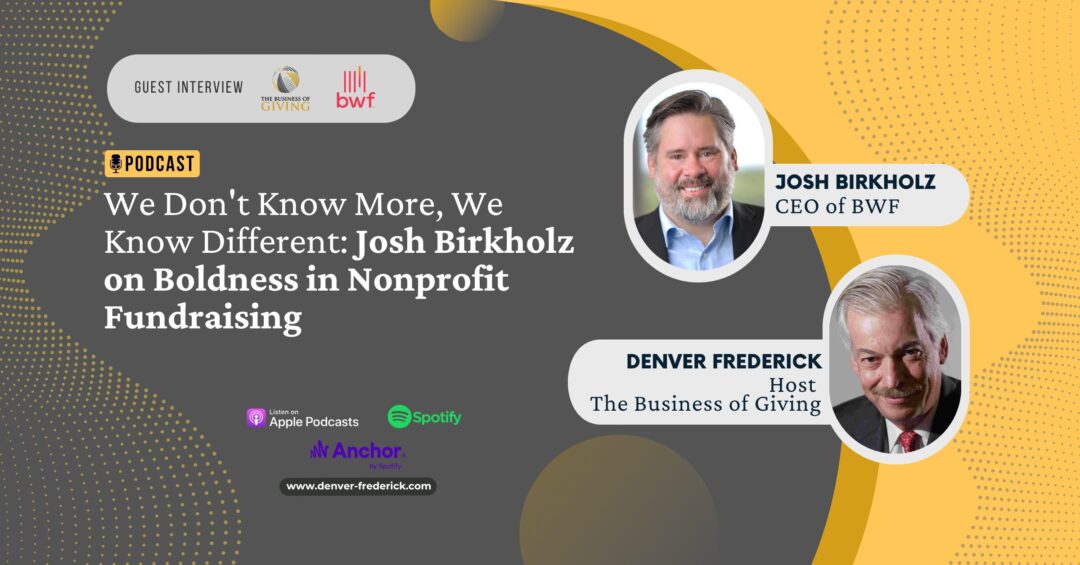
Welcome to The Business of Giving, where we spotlight the people and ideas transforming philanthropy and social impact!
Today, I’m thrilled to introduce Josh Birkholz, CEO of BWF, the powerhouse consultancy that’s been sparking transformative change since its iconic work on the Statue of Liberty restoration. Josh is a pioneer in data-driven fundraising strategy, co-author of BeneFactors, and one of the most influential voices championing bold, mission-first approaches in modern philanthropy.
Here’s his take on building donor trust:
“When things aren’t going well with an organization, actually being vulnerable about it can actually bring you closer to a donor.”
In this episode, you’ll discover how to build momentum in uncertain times, leverage donor data effectively, and lead with courageous clarity—essential insights for navigating 2025’s economic challenges. So Let’s get started.
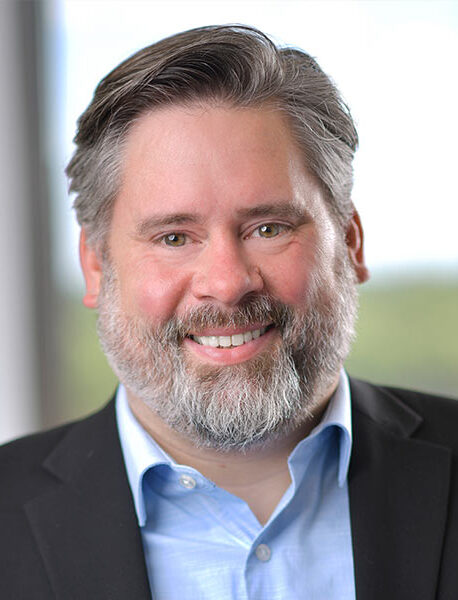
Josh Birkholz, CEO of BWF
Denver: Welcome to The Business of Giving, Josh
Josh: Thank you. It’s good to be here, Denver.
Denver: BWF started with bold campaigns like the restoration of the Statue of Liberty. Josh, how has that innovative spirit carried through to today’s work?
Josh: Yeah, I think it’s really something in the water at BWF, like with the Statue of Liberty, it was a moment of big change. And we’re often a firm that is brought in for big changes, not for status quo, although we’re pretty good at the status quo. But what we get really excited about is: How do we get from point A to point B when point B seems so far off?
I think from our very start, I mean, like you said, the Statue of Liberty and even innovation since then, Bobbie Strand who is here, who developed this whole field of prospect research; Bruce Flessner, who really was a thought leader around new wealth and entrepreneurial wealth, which was really kind of insightful towards where wealth was funding philanthropy in the next several decades, to… We did the first Giving Day with Florida State, the Great Give, a collaboration, which is… it’s hard to not find a Giving Day.
Myself personally, I’m really involved in trying to build data science and analytics in the sector place. And even to this day, we’re trying to look at different ways on building the base of support, following the lead of The Generosity Commission around authentic video and actually seeing growth in the university space where we thought alumni participation was a lost cause. We’re actually turning those numbers around.
And I think part of what drives us to do that is at its core, a service ethos… I’d say an empathy for the sector. It might seem a strange thing to say, but consultants can easily be caught up in being right, being the most knowledgeable, being out there, being the smartest one in the room. And for some reason, well… and perhaps they’re valid reasons. We carry that weight on our shoulders quite frequently. But the reality is we’re in professional services.
If I was in professional football, I should be the best football player in the room. If I’m in professional services, I should be the most service-oriented person in the room. If we talk about means to the ends, being knowledgeable, thoughtful, innovative is just a means at the end. Our goal is really to be the most helpful people in the room, and so I think that’s driven us to specialization. Not just be jack-of-all-trade consultants that come in and talk to leadership, although we were quite good with that.
But let’s invest in the prospect research, in the annual giving or membership programs, into the technology so that we can really look at all of the different angles, the multiple perspectives as we help to work with clients. So I think it’s been in the water for BWF. It’s something we’re terribly proud of, and I don’t see it changing anytime soon.
“I think for us specifically, something I tell all of our new consultants when they start is: We don’t know more, we know different. And what I mean by that specifically is our value is something different we’re bringing to the table, not that we’re more knowledgeable about the things they know.”
Denver: Well, that’s good. You can know a lot about the founding of an organization to understand how it operates today. And I’ve always found BWF to be someone who doesn’t lead a nonprofit, but walks alongside a nonprofit. And I think that kind of part… I mean the partnership, you get this feeling that the firm cares about the success as much, if not more, than the client. It just is there. They’re not a vendor, but they truly are a partner.
Josh: Well, thank you. Thank you. And I think consultants… and there’s so many great consultants in this business, and I have such tremendous respect for all of them. I’m on the board of The Giving Institute, which really focuses on that collaboration between consultants.
But I think you’re absolutely right. I think for us specifically, something I tell all of our new consultants when they start is: We don’t know more, we know different. And what I mean by that specifically is our value is something different we’re bringing to the table, not that we’re more knowledgeable about the things they know. There’s certain things that the client will always know more about– their own political situation, the economics, the nuances within the staff. But we bring outside perspective. We bring basis and other things.
And I think coming in from that perspective, what we’re sort of speaking to, walking alongside, is at its core a power dynamic, is consulting where we come in as the authority to tell you what to do. Or are we someone who’s really a true collaborator to ideate together, to bring new ideas together, just like new art forms? Jazz came together from two different genres coming together, like every new genre and similarly great innovation, from different minds coming together. And that’s not just from the consultants, it’s that pairing of client and consultant.
Denver: Yeah. Yeah. I think the thing about difference sometimes as a consultant, you almost are reluctant to say something because you think everybody knows it already. But then you find out that they don’t know it, and it connects with an existing piece of information they have. And next thing you know, Eureka! You have a brand-new innovation.
Say another word about data science. I was always impressed with BWF, even as far back as the 1980s. It was on the cutting edge of that for its time and that was nearly 40 years ago. Talk a little bit about how that’s evolved, but specifically maybe one breakthrough that’s reshaping how nonprofits connect with donors today.
Josh: Yeah, no, that’s great. I think you’re right. I mean, prospect research at its core was an original form of data science. It was more manual. You’re looking up information, but you’re applying data in such a way to actually free up the fundraiser to do different work. So it’s an information support all the way through a lot of the early screening companies and data companies in the ‘90s.
Where they start to… I mean, it was partly just the conversation. Remember Mark Penn coined the phrase “soccer moms.” We were starting to classify people in the ‘90s by group activity. And some of the early work there was, Alright, these are the types of people we have; they might give this other way.
Then we see in the tech sector, like Amazon started to look at actually: your behaviors predict behaviors. You bought this book; therefore you might like this other book. And so we were… I’d say as long as I’ve been in the business, and those that have been much longer, there’s always been some aspect of a major donor has to have the wealth to give a major gift, and they have to have some likelihood to do that. Usually it’s some affinity, some warmth measure of propensity, and so forth.
And what we started to do is look at what Amazon was doing, and others, like: Here’s people with certain behaviors that are unique to those that give major gifts, and here’s those that don’t have that. So we started to see the early data science. Not too different from Moneyball with baseball, or in really any other sector in retail saying, Alright, what makes these top donors different than the others?
And early on, I think it saw an early adoption by the prospect research community. And it really mirrored. And when I started a data science program at the University of Minnesota and then later at BWF, I actually copied a lot of what was happening in other sectors I looked at. Fair Isaac was one that was really influential. Fair Isaac created perhaps the most influential data score that any of us still… well, regularly acquaint with it, and that’s the credit score.
And the reason for that was an efficiency for their underwriters. If there’s some people that will never get a loan, is there some number that tells us they’re not likely to clear before we give it to underwriting and spend all the staff costs? And we came up with this credit score. Similarly, the early predictive science, predictive models, like who’s likely to give a major gift. And if they’re not, should we spend the resources to pursue them?
So now we’ve seen, as we’ve moved from predictive modeling into AI, there’s been a lot of changes. Certainly within AI, it’s still being applied to the pipeline, kind of, to find perspective donors and to actually change itself and learn from our dataset.
But we’ve also seen quite a bit of change on the generative AI side and how we categorize information, like determining which faculty or physicians or program staff or artists are most affiliated with certain topics that we’re raising money for to align them, to produce content, to actually produce at scale, be able to give us personal relationships with more donors than we have people to do.
Now we’re still kind of in a learning mode. For some it’s exciting, it’s novelty. Oh, I have this AI fundraiser meeting. That’s cool that my college does that and for others, it’s kind of creepy. So we’re still wrestling with it, but it’s similar to… I remember reading an article by David Lamb in the ‘90s. “There’s this new thing called the Internet, and it’ll change how we do prospect research.” It feels like that. Like the internet’s here to stay, AI’s here to stay, and we’ll just kind of see where it goes.
“…when there’s things that aren’t going well, talking to your closest supporters and saying, ‘We have to admit this is a challenge for us’ can actually bring you closer. So I would say: Embrace and lean into that vulnerability sometimes.”
Denver: That’s exactly right. We’ll see where it goes. Let me ask you a question that’s always plagued me a little bit, and that has to do with campaign momentum. So often you start a campaign: you get those gifts coming in, you got an incredible amount of energy and excitement, and then the next thing you know, it flatlines. It is just really quiet.
How do you sustain momentum during a major fundraising campaign? And have you had an example of where you’ve seen that play out?
Josh: Yeah. It’s a good question because a lot of times it relates to the economic conditions. Sometimes it’s just stalling because we’re wearing out, our volunteers have worn out. I know like on practical things, a lot of organizations have gone to rotations of volunteers; rather than committing for a seven or eight-year effort, commit to a couple years, and then we can have some turnover, some fresh thoughts.
I think a lot of the research on the community nature of giving is really important. A lot of major donors will often mention, like when you ask someone what it’s like to be a donor, one of the first responses we hear more often than I expected is: It’s kind of lonely. I feel like it’s me, it’s on my shoulders. Or, I gave, and who do I celebrate with?
And we started to find that once major donors became friends with other major donors, their giving went up, the collective giving went up. So even though it might not sound like fancy data science or AI, but just building friendships among your donors is actually a really solid skillset around campaigns, I think, for maintaining momentum.
Another thing that comes to mind is during the pandemic, we had a lot of pauses. We had a lot of strain momentum. And what we did is we tried to analyze those groups that continued to give and maintain their momentum, and we saw a few things. One of them is: certainly the closest constituents were the ones that stepped up when times were tough, which worked out if you’re going into a quiet phase of a campaign.
Right during the peak disruption, your closest people are the people you’re talking to. Some of those campaigns where they had their quiet phase right before the pandemic, all of their closest people were already in pledges, and it was more of a struggle for them. But what that pointed out is how much of that lift happens from those people that are closest to you.
So when times are tough or when things are stagnating, I’d build community. I’d be purposeful about being very present with the donors. And maybe this is that obvious thing, like you said, sometimes the consultants say the thing that’s obvious, but be there for those donors… talking to them.
The old: You want advice, ask for money; you want money, ask for advice. That probably applies to campaign momentum with those folks. I would also look at different factors of buoyancy. And what I mean by that is during the last times of disruption or when things are strange, who continued to give anyways?
Maybe… evaluate who gave even when times were tough before, not only going back to those people, but what was their profile? Who are people like that? What was the situation? For some it might be just what sector they’re working in; like right now is economic disruption.
Some sectors, some people are still making money. Some in the consumer defensive, people in grocery, health insurance plans, medical, I guess pharmaceuticals, financial conglomerates. There’s people that are making money, so like: Who are your alumni that work at places like that, or corporate supporters or affiliated foundations that are in sectors that are doing well?
The last thing I’ll say is in terms of campaign momentum, is actually embrace the vulnerability. Don’t run away from it. When things aren’t going well with an organization, actually being vulnerable about it can actually bring you closer to a donor. I’ll give you the story that seems not related, but I promise you, it is. In my last book, bene…
Denver: Okay. I’ll hang in there.
Josh: In my last book, BeneFactors, I talked about this moment when my daughters are a little bit grown, but they’re all high school volleyball players, which meant as a high school dad: you had to take a turn as a line judge, where you go in and say, it was inbounds, out of bounds, and so forth.
And it was my turn. I was on the schedule. I had my black pants and my white shirt, which was the dress code for it. I had been wearing a jacket that day. But as I got to the high school, I closed the car door, and it grabbed the back of my pants and tore them right open.
Denver: Oh my goodness.
Josh: Probably one of the most embarrassing moments ever, and I’m like, Oh no, I can’t line judge in this situation.
Now, fortunately, I had a business jacket, so I put that on and it covered up the tear. I’m like, alright, I’m here. I’m still going to go to the game. So I go up there. Sit in the stands. And the person organizing it, she came up to me and said, “Hey Josh, it’s your turn to line judge.” And I’m like, “No, I’m not going to line judge today.”
And she was getting red and mad at me. She’s like, “But you’re up, you promised.” I’m like, “Nope, I’m not going to do it.” And I was feeling guilty. She was so angry with me. It was like there was definitely a wall between us. And after five minutes of guilt, I got up and I walked down to her. I’m like, “I know you’re really mad at me, and you’re right to be mad at me, but let me tell you what just happened in the parking lot.”
“And based on what happened is if I go out on that court and take my jacket off, I promise you no one’s watching this volleyball game.” And she laughed. She said,” I got you.” And actually we became closer friends from that.
Denver: Yeah.
Josh: So what was embarrassing to me, when I embraced that vulnerability, actually brought me closer to her.
Similarly, although the analogy might be a reach, when there’s things that aren’t going well, talking to your closest supporters and saying, “We have to admit this is a challenge for us,” can actually bring you closer. So I would say: Embrace and lean into that vulnerability sometimes.
Denver: Yeah. My refereeing background from my daughter’s basketball, which I learned very quickly, is to be certain of your calls. And when I was a little hesitant about: Did it go out off you or off her? or whatever, I got killed. But when I started blowing the whistle saying, “Out, Josh, other team’s ball” or something with such conviction, everybody went along with it. So that was my refereeing.
Well, let’s talk a little bit about embracing vulnerability, particularly with right now. This is a shaky economy. Nobody knows what’s going to happen next. How can nonprofits keep donors giving and use this vulnerability in a way to try to deepen that relationship?
Josh: Yeah. There’s so much of concern right now and in many ways, this is perhaps the most important time for private support, the essential nature of giving. And it is tough. And I like to remind folks too, with all the things happening, that you are the experts in private support, and lean into the solutions you can offer rather than to be caught up in what the problems are.
Now the problems are real. We’re all there, and I get that. I have the empathy to that, but I think there’s some things that we can do in this area. Like when funding’s at risk, like with some of the federal funding. What are you doing to help with that operating margin, and leading into the core budget, relieving expenses.
Sometimes, they talk about discipline is actually a value in your future self over your current self. Discipline is also required at the organizational level. It’s not the time to give up on what helps your organization be better in the future, like pulling back on base level giving, which might be more expensive, or the mid-level giving, which actually can help fund some of this operating margin in the meantime.
Looking at budget-relieving designations for the high-net-worth donors that are there, I would look at some of the ways that we can fund overhead, but the other aspects that I focus on right now would be some of the sector alignment. I mentioned how some sectors are doing well.
Also within your funding streams, corporate giving often is a leading indicator of disruption so you can kind of tell early on from them, but corporations don’t give just based on the markets. They also give based on earnings. In the Giving USA data, what we’ve seen is their giving has been related as a ratio to their corporate profits. So I’d be paying attention to their earnings as well… who’s doing well.
Individuals, it’s more psychological. We start to see things like pledge hesitancy. I’m willing to give to you, but will I give a five-year pledge when I’m not sure what the economy’s going to be? So embrace that. Say, “Would you be willing to make this year’s portion of that pledge? And then we’ll revisit next year to make the rest of the pledge.”
Or even thinking about conditional arrangements, like your stock market’s down here; when it gets up to here, would you give this gift? And maybe even put it in a non-binding, like “Yes, if when the stock’s here, I’ll give that gift.” I think one of those… I mean these are these moments where, like where I led… Think solution-oriented.
There are definitely ways that we can grow these programs. It’s the reality though… times are going to be tough. I’d be thinking about who could be cross purposed if it gets worse. Like if we’re strained on staff, which of my staff people are… Can I start to cross train them in case they’re going to have to do multiple things… that we’re a little bit more resilient to that?
Remember that the operations shouldn’t be the first thing to go because oftentimes, the operations do stuff so that the higher cost fundraisers can actually bring more money in. So when we peel back on that, you’re repurposing higher dollar towards that same activity of the operation and you’re getting a net loss in fundraising.
So I’d be really thoughtful before I thought, Oh, operations, they’re not bringing in money because that might be one of those discipline you’re serving today at the expense of tomorrow.
Denver: All good advice. I think about 25% of nonprofits actively solicit donor-advised funds. How is BWF helping clients unlock this growing funding source, which three out of four never bothered to take a look at?
Josh: Yeah. Well, I mean, the donor-advised fund is kind of this big conversation, and it’s sort of a cool one though too, because I remember I was meeting with a whole group of planned giving donors or fundraisers and they’re asking: How can we build more life income, gifts, and other things?
And I pointed out to them that planned giving professionals are the smartest people about what’s better for the donor. However, the donor-advised fund, while it is arguably better for the donor… Fidelity and others, even though this thing’s been around for a hundred years, they were like– let’s focus on making it easier for the donor.
So they made it easier for the donor, and suddenly it just kind of took off. And the donor-advised fund does solve some problems in terms of ease of giving, but it also is a hedge against the economy for some of them. People that want to gift their gains and also kind of sell their losses, they can be ready to give even when times are tough.
So there is a smoothing effect that’s there. And so I focus… I mean, donor-advised funds at their core, just like with all giving, even though we’ve seen foundation as the portion of US philanthropy climb considerably over the last 40 years, we don’t think it’s changed the amount of philanthropic decisions that are made by individuals. It’s still 83% to 85% of giving in the United States.
So there’s still an individual making that choice behind it, that payment method. So I would focus it still on that individual, but be mindful that that’s going to influence their timing a little bit. And really on that thought of the hoarding too, I met with this high-net-worth donor who on paper would look like they’re just parking money in their donor-advised fund, and we hear that story quite often.
But I talked with him about it and he’s like, I’m thinking about my third chapter when I sell my company. The thing that gives me joy is giving money to nonprofits. I view my donor-advised fund as my 401(k) for charity. And he’s like, this way every year until I’m done, I get to go and meet with donors. I get to see impact of my gifts.
So for this donor, in his mind, this donor-advised fund was his 401(k) for philanthropy. So on paper, maybe it doesn’t look like a great thing and it tells that story, but the reason I gave that story when I want to talk about how to unlock donor-advised funds is many people are focused on the negative aspect of it– the givings going there instead of here.
What we found in the Giving USA research is that people’s giving preferences before they set up their donor-advised fund mirror their giving preferences after they set up their donor-advised fund. So if 50% of their giving was in higher education before they set one up, it’ll continue to be 50% but through their donor-advised fund.
We saw a little bit difference in the religion sector. Only people are less likely to give their religious giving through their donor-advised fund, although that’s starting to change. So I would avoid the negative. I would just think of it like a payment method and be excited about it, but focus just like you always would about bringing that donor into your mission and being part of you.
I think that’s what’s really key, even with the donor-advised funds. Don’t be hung up by the vehicle; focus on that person.
Denver: Absolutely. And he just wants something to do after he sells his company. I mean, now he…
Josh: That’s right.
Denver: I’ll have time. I won’t go crazy.
Analytical and forward thinking, Josh. So let me ask you about the $84 trillion wealth transfer to millennials, which is underway. What are you advising your clients about that?
Josh: Yeah. Well, the thing I’m advising them is there’s a… it’s a hundred percent there. But where I’m focused a little bit more is this next five years, there’s the retirement. There’s probably the peak retirements this next five years. More people are retiring than ever before, which means they’re shifting to giving out of an asset basis.
There’s going to be company conversion. The majority, based on research I saw from Philanthropy Solutions and from the Federal Reserve, is the majority of dollars that are given to charity are from business interests. So this changeover of business ownership is the immediate thing we’re going to see in the next five years.
And then we’ve got that wealth, it’s probably a little further out where that starts to transition towards the millennials. So I’m focused on business transition first, getting these high-net-worth people on boards, getting them involved as they’re retiring.
Now the second thing is when we look at the wealth transfer, a lot of the statistics out there cover the whole generation. The reality is it’s still that top 1% or top 2% that are going to be charitable. So try to weed through that to find what are the wealthy people doing in terms of their wealth transfer, I think is sort of a key thing to it.
I mean, we’re starting to see a little bit of resurgence in life income. Annuities have been up the last couple years, the rates. Even with economic uncertainty, it does suggest annuities are still in a good spot. We’ll see some other areas where we, I think, planned giving is going to be peak. So I would be talking about donors right now.
I mean, they’ll probably change their will again, but I would think, first of all, private company transition, second having that bequest.
Denver: Josh, some nonprofits hesitate to take risks in tough times, and goodness knows, we’re in a tough time right now. How do you encourage them to make bold fundraising moves? Not reckless, but bold. And is there an example where you’ve seen a bold strategy that really paid off?
Josh: Yeah. Well, when it comes to boldness, I think of it at the granular fundraiser level first. Now for them, boldness flows out of what I’ve usually found to be organizational esteem and personalizing the mission. Meaning if I’m a major gift officer and I work at the local, let’s say, community college, I’m going to have a certain level of boldness with my donors.
If suddenly my next job is, I don’t know, Harvard, Yale, or Stanford, some prestigious institution, I’m more comfortable making a really large ask because I’ve got the esteem of the organization behind me. So I’ve adopted some organizational steam.
The second is we did a study on fundraisers, kind of top-down, top producers in the United States down to lower. And we’re trying to figure out why are they raising so much more money because the top 20% raised about 80% of the dollars of this study population. And what we found is their ask levels were at or above capacity, where the average is 40%.
But more insightful to that is we had them rank what they love most about their jobs. And these top performers said, the mission I’m raising money for on this scale of one to 10 was the top thing, where that was about a six for everybody else. So we followed that by a study of donors and we asked: Think about that fundraiser that calls on you.
And we asked them: Do you think that fundraiser would give you the same gift or would give the same gift they asked you to give if they had your resources? Kind of a yes or no. And we found the top performers were those that the donors thought: Oh, they would give the exact same gift.
The reason I start there is: believe in the mission, the essential nature of the mission, why that’s exciting, why that’s critical in the world, is first of all the key to boldness. And that esteem can grow. You can build that esteem. Remember, it’s not you and your boldness. Is this mission worthy of the boldness?
I would start there, first of all, because… so then getting towards when we’re having these bold ideas, I loved the Hope Challenge up at Hope College. I thought that was a brilliant idea. It’s something different. Let’s disrupt. I think that’s really cool. I think that we see again and again the big gifts go to big research, to big ideas.
Part of that is a lot of the high net worth are looking for, as Seth Godin said, they’re looking for significance. They’re looking for meaning. A wealthy person can buy a yacht; they could buy whatever they want, but can they buy that I mattered? And when we let them solve a big problem, they find that they mattered.
So I’d say a lot of these big, mega gifts that we’re seeing, I think it’s related to the boldness first of all, that we’re willing to share the boldness. We ourselves are bought into the mission and we’re bringing that donor into the mission. That’s where that culture change of boldness becomes.
But yeah, the whole moonshot concept, and I think that’s what’s key, because in a tough environment, it seems like everyone’s in a campaign. And by informal surveys, just about everyone is in campaign. It’s probably peak for a number of campaigns at this moment in time.
Denver: Yeah.
Josh: So think about unique fundraising proposition, like you had a unique selling proposition. Why now? What is the thing that is key? I remember talking with… I think I was talking with a president at a university in California, I’ll just say that, who was really gifted. They had a great program around cross-cultural education, with Spanish speaking, with Mexico specifically, in terms of their proximity.
And they were looking for ideas on: How do we get big gifts around that? And I said, Well, for your work, that’ll bring some good gifts. But if you establish how you are changing the paradigm for all other universities to do cross-cultural education, suddenly that’s a bold thing. That’s not you just funding your program, you’re changing the whole landscape.
We’ve seen that in St. Jude with cancer research. We train all the other children’s hospitals how to do this and so forth. The boldness also is in that ripple effect and the legs that are beyond that. So maybe those are a few ideas.
Denver: Oh, good ideas. Yeah, I always call that movement generosity. We’re not just out for ourselves, we’re out for…
Josh: Oh, love that.
Denver: …everybody in that. And it really is. And when you see people who have that about the issue, and they want to open their doors up and share it with everybody because they want it to be solved, it changes the way you think about that organization, that person, and about that issue.
We’ve talked about a couple disruptions that are coming along, not beliefs of the transfer of wealth, et cetera. Are there any disruptions that you see in this space over the course of the next five years that maybe not so many people are talking about right now?
Josh: Yeah, it’s a tricky question. I think everyone’s really focused on the economic disruption right now. And it reminds me a little bit how everyone was very concerned about due diligence, which was warranted in ’18 and ’19, and all of a sudden, they just dropped it all together when the pandemic happened because they had a bigger problem than: Should we take the gifts from Epstein or Sackler?
Now certainly since then, we’ve built up due diligence in a lot of places and saw an organizational risk there. There’s still a risk from due diligence, but similarly going into our current potential economic uncertainty, kind of wherever this shakes out, going into it, we’ve been dealing with a donor problem.
The number of donors have been declining in the United States, not per capita… the total number of donors is fewer year after year. And I feel because of that, we’ve shifted so many programs towards the high net worth, which makes sense to make the numbers hit. But as we start to lose that long history of the loyal donors, we’re completely dependent on the entrepreneurial donor that’s passionate about the thing.
So the boldness is key to survival at this moment right now, but are we going to lose that loyalty donor? I’m afraid that we’re hitting that within the next five years or so, where there’s going to be fewer and fewer of these high-net-worth donors or people that were our friends for 30 years. It’s those that came out of nowhere, which is fine.
It’s trickier to fundraise from, and still many university campaigns, 90% of the dollars in their campaign were from people that started in the annual fund. As the annual funds have declined, is that still going to be the case? So I think it’s really critical. I mentioned it earlier, to invest in that base of support, even if the returns aren’t there right now, to build that community.
So to me, I think that’s the risk that maybe we’re losing. Now to the credit of I think Giving USA and The Giving Institute, which put out The Generosity Commission, which was funded by many organizations, a wonderful report, it’s free to read, generositycommission.org, really gives some ideas on how we can really build the everyday donor back up in America.
And I think that’s worth the read for anybody. Even if you’re dealing with disruption and operations and ROI, still read about the future.
Denver: Yeah, no, we’re losing the middle class of donors.
Josh: Yeah. Totally.
Denver: And when you get reliant on a few big donors and they should disappear, you’re in big trouble.
Josh: You’re in big trouble.
“But I think the key to most of these behavioral and performance issues are actually reclaiming: Why are we here to begin with? Why are nonprofits essential? Why is fundraising essential? And why is this such an amazing place that we get to live in to help people do the best thing they ever did… to fund things that really matter and to see that with courtside seats?”
Denver: So it really camouflaged how precarious the situation is because of some of these mega gifts.
Finally, Josh, you talk to an awful lot of people. What is the question that you encounter most frequently? And what is that piece of advice you would give the person you talk to most frequently among your clients?
Josh: Yeah. So I’m a fundraising consultant, right? So people often will come to us when things aren’t going well. Sometimes when things are going well, I love those, those are great, but we want to do something, something better. And usually it’s a performance-related thing. I mean, the reality is these are still human beings that we’re trying to get out fundraising.
And so the questions… probably not the most exciting thing to hear, but: How do we get people to go make cold calls for the first time? is still the most common issue, discovery or qualification work. And closely related to that is talent, our talent pool, which has been an underfunded place.
So how do we have great talent that can make cold calls, especially being frustrated by some of these autonomous AI fundraisers who are putting up better metrics than our people. This is really scary for us right now. And so where I focus on them is similar to where the donors, I think great fundraising organizations bring the donors into the mission.
They’re not seeking people to give to us so that we can do great things. The donors are part of doing the great things. I try to coach clients in helping their fundraisers reclaim the mission of the organization, remember why they’re there. Maybe it’s cliched, maybe it’s a Simon Sinek’s: Start with Why or whatnot.
But I think the key to most of these behavioral and performance issues are actually reclaiming: Why are we here to begin with? Why are nonprofits essential? Why is fundraising essential? And why is this such an amazing place that we get to live in to help people do the best thing they ever did… to fund things that really matter, and to see that with courtside seats?
Denver: Yeah. I have an organization I work with that we just worked with them on creating a purpose gallery for the organization, and they put it right behind the reception area. And it is why, the reason we’re here, with all kinds of creative artifacts and songs and things of that nature.
And people stop in there because even as a fundraiser, every once in a while, you hit that wall and say, I could use a shot of adrenaline here. And they go in there and they say, Yeah, that’s why we’re doing this, that’s why I’m here. And they walk out of there with a bounce in their step.
Josh: I absolutely love that. I mean, so many people, they hear mission, vision, values. That’s the time to glaze over. But like in a for-profit, it’s about shareholder value. For nonprofits, it is about mission, vision, and values. That is our shareholder value. And what are we doing to advance that? I love that. I hope everyone can have a purpose room.
Denver: Yeah. Josh, if listeners should want to learn more about BWF, what you do, et cetera, tell us about your website and the information they can find on it.
Josh: Absolutely. Yeah, bwf.com. BWF, historically it was Bentz, Whaley, Flessner. We just go by the three initials now, B-W-F dot com, and we have services around fundraising and campaigns, helping a program really go through big change or to be equipped with that technology and operations. Like do we have the technology, the CRM support, even the data science, the AI work, as well as what we call our EDX division, which is engagement and donor experience.
We’re a consulting firm, a company. Most importantly, we’re side by side caring about your mission, and we really do. We’re a truly mission-driven for-profit and it gives us tremendous joy to work with organizations like you as you’re charting these uncharted waters.
Denver: I can certainly attest to that. And I want to thank you, Josh, so much for being here today and for a lively conversation. It was a real pleasure to have you on the show.
Josh: Thank you, Denver. Pleasure was all mine.
To celebrate my 50th year in the nonprofit sector, I’ve put together a gift for you — a practical, field-tested guide to building world-class nonprofit workplace cultures. It’s called Cultivating Nonprofit Excellence, and it’s based on insights from nearly 1,000 interviews and 150 focus groups with nonprofit leaders around the globe. It’s completely free and instantly downloadable at blanchedalmond-mosquito-418475.hostingersite.com