
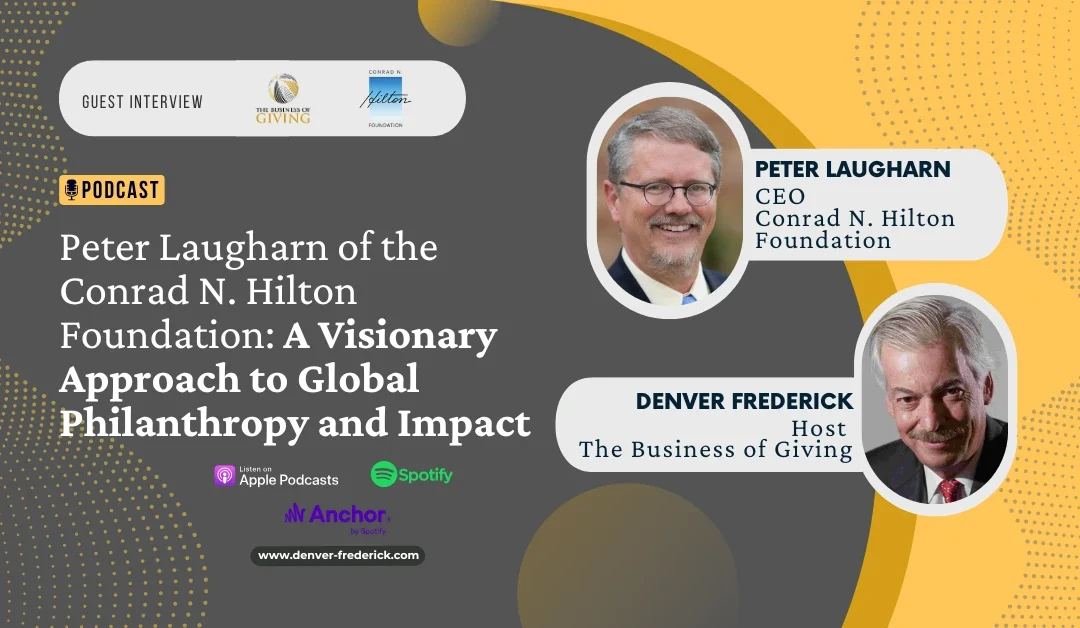
I’m Denver Frederick, the host of The Business of Giving. My guest today is Peter Laugharn, CEO of the Conrad N. Hilton Foundation, one of the largest family foundations in the United States.
Under Peter’s leadership, the Foundation has doubled its grantmaking capacity and expanded its focus across seven core initiatives, tackling issues from homelessness and foster youth in the U.S. to safe drinking water and refugee support globally. He brings a refreshing perspective on progress in philanthropy, saying:
“We never completely fail, and we never completely succeed. We take it apart, rework it, and keep going.”
With this mindset, Peter is guiding the Hilton Foundation to build sustainable and systemic impact by partnering with communities and empowering local leaders. Join me now as we explore his mission-driven approach and the transformative work of the Conrad N. Hilton Foundation.
Denver: Peter Laugharn, welcome to The Business of Giving.
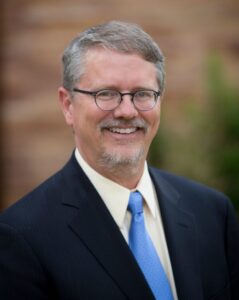
Peter Laugharn, CEO of the Conrad N. Hilton Foundation
Peter: It’s great to be here. Thanks, Denver.
Denver: You know, share with listeners the history of the Conrad N. Hilton Foundation and how it has evolved over the years to address new global challenges.
Peter: Great. Well, we were founded by the man who founded the Hilton Hotels chain. The foundation was founded 80 years ago in 1944, but we’ve just gone through an adolescent growth spurt when Conrad Hilton’s son, Barron, bequeathed his fortune to the foundation as well in 2019, doubling our size to become one of the largest foundations in the US.
According to Conrad Hilton’s will, the funds that the foundation grants were earned all over the world, so they should be spent all over the world. And we’ve interpreted that to mean about half in the US and half globally. Global half is about 80% in Africa and 20% in Latin America.
Mission of the foundation is the alleviation of human suffering, which is a big, broad category, but that’s led us to working on homelessness in the United States as well as youth employment, early childhood and foster youth, to working internationally on refugees, safe drinking water, early childhood.
And then a particular love of Conrad Hilton’s Catholic Sisters, we’re the largest funder of Catholic Sisters worldwide. And typically, that’s about health, education, and protection.
Denver: Well, you have seven core initiatives that you just ran down and that was great. So, let’s talk about a couple of those if we can, starting with homelessness.
Peter: That’s right.
Denver: Now, LA is described as being at an inflection point in addressing homelessness. From your perspective, Peter, as a leader of the largest philanthropy supporting homelessness in LA in this space, what fundamental shifts do you see happening that make this moment perhaps different?
Peter: That’s right. Well, first, let me set up what’s difficult and then what’s getting better. You know, Los Angeles is unfortunately the lead in the United States on homelessness. About a quarter of the unsheltered population live in LA County.
It’s a big place, 10 million people, but we have 75,000 people who are homeless. And it’s becoming part of the city brand, along with good weather, beaches, the entertainment industry, and homelessness.
Denver: Yeah.
Peter: So, it is the number one issue on people’s minds politically, morally, and I think the leaders of our city and county are charged to solve it. And we felt at the Hilton Foundation.. we’ve worked on homelessness for about 20 years and have seen a lot of good work done… but we do feel that this is a particular moment right now where our elected leaders have stepped up.
Mayor Bass was elected two years ago and made clear this is priority one, two, and three of her administration. And the city and the county both made emergency declarations right after she assumed office. So, we think there’s a moment to mobilize not just the government, but the entire population of Los Angeles to work on this. Nobody should be leaning against the wall saying, “I wonder how this might turn out.”
Denver: Yeah.
Peter: In addition to being a funder of innovative approaches, we’ve also tried to help organize civic leaders. I’m the co-chair of what’s known as the Leadership Table on the regional homelessness alignment; that brings together the private sector, labor, the faith community, philanthropy, people with lived experience, all to see what their constituencies can do to help solve this issue.
And we had good news in May, the point-in-time count that measures homelessness, it was the first time in six years that homelessness had not gone up. And in fact, unsheltered homelessness had gone down in both the city and the county, by notable amounts. So, we feel that the tide is turning, but this is a real moment to put our shoulders to it.
Denver: Yeah. You have a true collaborative…working people talk about it, but it sounds like you really have all the integration happening among different peoples and different sectors.
The Hilton Foundation Homeless Initiative has a focus on people-first solutions. I mean, we have a general idea what that means, but tell us exactly what it means and the impact that that has had.
Peter: Well, you know, I think we try to do two things in all our grants or all of our initiatives. One is to offer real-time solutions for real people. And that is people in whose eyes you can look.
So, to know that, for example, new entrants to homelessness have gone down, to know that people are getting services more reliably, and if you as a homeless person show up at one door, you get all the services that you need; you don’t have to knock on 40.
And that all of the solutions we are advocating for are about people in whose eyes you can look, and people with actual names and not just a string of zeros at the end of a number. And I think that’s been very important to us. That’s why we fund street outreach. We fund encampment resolution of a humane variety and methodical.
And we are more and more getting into, I think, a very promising field, which is the prevention of homelessness. LA County houses more people than any other county in the country. We house about 25,000, 28,000 people a year. Now, if you do the math, if we had no people coming into homelessness, we would solve this problem in three or four years.
But the problem is that there are a lot of households that are housing insecure, that are one paycheck away from losing their shelter. And the more we can do to make people not fall into homelessness to begin with, the better. And I think this is a very good area for philanthropy to invest in because we can experiment. We can pilot.
We can try out new things that government is not going to want to invest in until they know that they work. So, that’s one of the things we’re working very closely with the city and the county on now: What do we think the promising efforts are and how could we make them investible by the city and the county?
Denver: Yeah. I love what you said too about not dealing with homelessness as a demographic…
Peter: That’s right.
Denver: …but really as individuals. Sort of the way the doctor would treat a patient, as opposed to just a universe of people… and that really makes a big difference. So, is philanthropy evolving along these lines into systems change more than it had been, or would you have a different read on that?
Peter: Well, you know, I think when we’re doing our best work, we are doing, you know… look an individual in the eye type of grant-making, where we know precisely the group that is benefiting from it. And we’re looking at systems as well.
You know, in the money on the table for homelessness, philanthropy is 2% the amount of money that’s available in Los Angeles. And government is almost all of the remaining 98%. So, if we are not concerned about how the system works, we will only be able to solve a small part of that.
Denver: Yeah.
Peter: And it’s gotten us into a higher-level governance than we ever expected to be. We’re regularly in meetings with the board of supervisors and the mayor’s office and say, “You know, how can you all coordinate when one of you passes, the other needs to catch? How can we bring the 300 foundations in Southern California into the game?”
“And he instructed us that Sisters should always be our largest program…and because he believed that sisters would go places no one else wanted to go; they’d work with people no one else wanted to work with, and they would stretch a dollar in ways that isn’t often seen.”
Denver: Yeah. You know, another area mentioned is supporting Catholic Sisters… goes way back. And they certainly are on the front lines of change in often very challenging circumstances. Tell us a little bit about their work and the unique influence that they bring.
Peter: Yeah. I mean, Conrad Hilton was educated by Sisters in the New Mexico territory before it was a state, late 1800s, early 1900s. And he instructed us that Sisters should always be our largest program… and because he believed that sisters would go places no one else wanted to go; they’d work with people no one else wanted to work with, and they would stretch a dollar in ways that isn’t often seen.
Denver: Yeah.
Peter: And in our experience, those are all still true. They’re true not only in the states, but they’re also true in the global south. And since the Sisters’ demographic has become older in the United States, a lot of our program has migrated into Africa, into India, and into Latin America.
But the sense of it is still the same– that you have people who are willing to take on great challenges, who are very trusted, and who are able to really pull off things that you wouldn’t expect and that you don’t see from larger, more bureaucratic groups.
“…we found that a lot of the things that parents need for their children to flourish in young age, the preschool age, actually has to do with household wellbeing. You know, it’s not that parents for the most part don’t know how to parent, but it’s often that they don’t have the resources that are necessary; or that working means they can’t look after their kids.”
Denver: Yeah. They’re an incredible cohort. Another, one of your core initiatives you talked about at the outset were refugee families. Now, there are about 120 million displaced people in the world, maybe 45 million of those would be classified as refugees. How do you support them? And I know you do it through a two-generation approach. Flesh that out a little bit for us.
Peter: Sure. This is our newest program. We started it in 2021 with our new strategy. We had always had a concern for people affected by disasters and by migration, but it had been mostly responsive funding when some geographical area flared up, and we decided we’d like to be working in this more systematically. And, again, you know, both at the level of people, but also at the level of systems.
So, we looked around the world and said, “What are the countries that are doing things that we think other countries should adopt, and how can we learn about that, support and encourage it, and bring it to others?” And, we looked at countries in Africa and Latin America. And let me talk about both Colombia and Uganda.
These are countries that have percentages of migrants that are quite high, Colombia, primarily from Venezuela, but in the 3 million, 4 million people for a country of 50 million, and Uganda from South Sudan, from Congo, historically, from almost every country that borders Uganda. And they’ve both been historically very hospitable.
In Colombia, Venezuelan migrants have been given every right except the right to vote. So, they can work, they can own land, they are not treated as a class apart, and they are physically integrated into the country. And likewise in Uganda, refugees can own land, they can own businesses. And these were practices that we thought were exemplary.
Denver: Yeah.
Peter: We wanted to learn how they worked and how we could help them work better. So, the two-gen approach is really looking at livelihoods for parents, particularly young parents who have the hardest time making a livelihood, and young children. So, early childhood and young parents.
And, you know, we found that a lot of the things that parents need for their children to flourish in young age, the preschool age, actually has to do with household wellbeing. You know, it’s not that parents for the most part don’t know how to parent, but it’s often that they don’t have the resources that are necessary; or that working means they can’t look after their kids.
So, it’s really finding solutions that work for both the parents and the kids. For example, childcare is a win-win-win situation. It’s good for child development. It helps women get employment and in itself can be an enterprise. So, we’re funding things like that.
Denver: Yeah. Yeah. It’s interesting now. You think back… what you said about homelessness too, and the way you’re looking at this situation in terms of supporting refugee families, and it seems, Peter, your approach is actually trying to deal with the way people actually live their lives, as opposed to a particular problem.
It’s like, you know, this is the way they live. They need these things in order to be able to function. And when you un-silo things like that, I guess, you just see outsized results.
Peter: That’s right. And parents don’t look at their children as just a client of education or someone who goes to a clinic. They look at their children holistically, and we have to look at them through the same eyes even if, from time to time, your main push is on education or on health.
Denver: Right. Got you. Let me ask you about one more, and that’s going to be safe water access, particularly in remote areas– critical but also challenging. What are some of the big obstacles you run into, Peter, and how are you partnering with communities to overcome them?
Peter: Sure. And let me make a pitch to your listeners.
Denver: Okay.
Peter: I think this is a tremendous area to begin funding in and, you know: Come on in, the water’s warm, if you like. I think it should be the second most popular global funding priority after public health. When you look at it, everybody needs water. We die without it.
People are willing to pay for water, so you can do program-related investments as well as grants. It doesn’t require a lot of new technology to solve the problem. And yet, 600 million people do not have access to safe and affordable drinking water.
Denver: Incredible.
Peter: So, this is an area where I think there ought to be a lot more investment, and there would be a lot of return for people who got into it. Historically, what we have done here: we started out 30 years ago in Ghana, basically drilling wells, which was very satisfying. You can count them, and you know that they bring immediate benefit.
But it was a little bit of Johnny Appleseed. You’d go into a village, drill a well, and then move on. And we found, over time, that a lot of those wells broke down– or lost boreholes–and they didn’t bring ongoing value.
So, we switched our emphasis to continuing to provide the infrastructure such as the wells and boreholes, but to make sure that communities and districts were organized well enough that they could maintain their water systems. And, over time, we’ve actually gotten into market-based approaches to water supply.
And, I think this is really the way to go when you’re thinking about those 600 million people. Some of that will be addressed charitably. But for the bulk of those people to have their issues addressed sustainably, it has to be market-based.
And so, we’re working in Ghana, in Uganda, in Ethiopia with district government, regional government, national government to see that there are systems that are sustainable and that the regulation of market-based approaches actually permits them to work, even to the level of you have some people who can pay and some people who don’t. Who can– those who pay– subsidize those who can’t pay so that everybody can get their needs met.
It’s wonky work, but I think it has real potential and, again, I would invite others into it. We’d be happy to help you get in.
Denver: Yeah. Well, you did a pretty good selling job there, Peter, I got to tell you, you know what I mean? And you can’t even calculate the amount of hours that women and girls get back…
Peter: Absolutely.
Denver: …by not having to walk miles and miles and miles every single day to get clean water.
Peter: Absolutely right. I remember the day that the Minister of Water in Ghana said to me: The idea of a girl walking with a bucket on her head is medieval. People make it into romantic art, but it should not be part of our perception. And she got us all thinking about: Well, how far are we from piped water on premises all over Africa?… Which when I lived in West Africa in the nineties, was just not part of our thinking, except in the capital city? So, the progress is being made.
Denver: Well, you have set me up perfectly for the next topic I want to talk about, and that is you being a strong advocate for locally-led development, and you have dramatically increased your international funding to locally-led organizations. Tell us about that shift, maybe some of the challenges you had, you know, internally in particular, and making it and the impact that it’s had thus far.
Peter: Sure, sure. You know, as I said at the beginning, we’ve always funded globally as well as within the US. That’s part of our DNA, part of the donor intent. But for a couple of decades, the main channel for us to fund in other countries was through US and non-profits working internationally… and fine organizations.
I’m an alum of Save the Children, CARE, Catholic Relief, World Vision… have all been partners that have accomplished great things through our funding. But we knew that, at the same time, there was growing talent in all these countries who would be able to do things themselves.
And, my previous job before Hilton was at an organization called the Firelight Foundation, where every organization we funded was an African organization. So, I knew that this was feasible from a grant-making perspective. When I came to Hilton, I saw that we were funding 80, 85, 90% of our global funding through US-based organizations.
It’s like, “You know, I think we have some play here. I think we could open up a local part to that portfolio.” In 2016, the World Humanitarian Summit set the world a goal that 25% of humanitarian dollars should go to local organizations. So, we said, “Hmm, this is interesting.”
And then, in 2020, after the murder of George Floyd, we were saying, “Well, what does equity mean to us as a global grant-maker?” And we decided that really it did mean getting a substantial part of our funding closer to people who are experiencing problems indirectly.
Then, in 2021, USAID Administrator Samantha Power made a commitment to get 25% of their funding to local organizations. We said, “Hey, this is time. Let’s really retool. Let’s set ourselves a goal, and let’s up our game.”
So, we spent about a year and a half thinking, “What do we need to do in a whole of organizational shift to be able to do more local funding? How can we source local organizations that might not have been visible to us before? How can we make our due diligence appropriate to local organizations as well as highly developed US ones? How do we talk about our risk appetite and whether or not, and in what ways, this is a risky move? How do we ensure our compliance with US tax law, which basically requires us to certify that the local non-profits we grant to are the equivalent of US 501(c)(3)s?”
And we went through all of those things with the support of our board, came out the other end saying we’re ready to roll. And we went through about 15%, say, local organizations in the teens, to 25% in 2022, 40% in 2023, and now I think we’ve settled around 30%.
You know, there have been some things that we’ve needed to contend with: often the local grants are smaller, so it makes a larger portfolio for a program team. And sometimes there are capacity building needs that, of course, you wouldn’t run into in a 70-year-old organization.
But there are real benefits on the other side there. These are known, trusted organizations that don’t pull up stakes and move to another country. They, again, stretch dollars, and they can do community organizing much better than an offshore organization with local offices.
Denver: Yeah.
Peter: So, you know, we still look at our portfolio as diversified. We’ll always be funding international organizations as well, but we are proud of the way this makes funding available to local organizations.
I would say as well, we have tried to bring other foundations into this and try to work with other bilaterals, notably USAID, but the whole of the OECD. And, we were instrumental in helping 27 other foundations sign a donor statement about locally-led development.
And we’ve been working very closely with USAID, which is about a hundred times bigger than us, but has some of those same issues about due diligence, about sourcing, about procurement and compliance. And often, a smaller organization that has solved one of those can give some advice to a larger organization… so we’re trying to do that.
Denver: Yeah. Yeah, that’s great. Sounds like there’s a lot of pieces that need to be put in place, but really the key piece is having the CEO and the board just deciding to do it. And then once you do, yeah, it helps. It’s just “Do it.”
So, well, let’s talk a little bit about those other organizations because you’ve been very successful in leveraging your funding to attract additional financing from other organizations. Tell us how you go about that, some of the strategies you’ve utilized.
Peter: Yeah, well, you know, I typically say to my colleagues, they’re tired of hearing this, “A dollar granted that only gets a dollar of value is woefully underspent. It’s suboptimized. Our funding… since the problems we take on are big,– you heard we’re 2% of the homelessness funding… if our dollars are only used retail for their face value, we’re not doing our job.
Denver: You’re a rounding error. Yeah.
Peter: That’s right. So, whenever we go into a situation, we learn who are the other larger sources of funding. How are they doing, and how can we help them do their work better?
The county of Los Angeles and USAID– same-size budget, about $40 billion each, and same issues with internal bureaucracy, accountability to voters, et cetera. But issues will not get solved without them doing their work well. So, I think we’ve always looked at ourselves as a colleague, an advisor, a problem solver alongside these larger actors.
And, you know, I frequently say to the heads of these agencies, “Hilton doesn’t need his name on a building somewhere. We’ve got that all over the world. We are a funder of the wiring and the plumbing. So, tell us what needs to work better in your system for people to get the benefits that they should be getting, and we’ll help you figure that out.”
We’ve done that a lot in the homelessness system in Los Angeles, and more and more looking at that in terms of international development funding.
Denver: Yeah, that’s invaluable. Everybody wants to cut a ribbon, and nobody wants to take care of the plumbing. That’s why our subways in New York are falling apart. You know what I mean?
Peter: Yeah. But the moment your plumbing stops working, it becomes a crisis.
“We never completely fail, and we never completely succeed. We take it apart, rework it, and keep going.”
Denver: No kidding. Peter, how do you use data analytics and predictive modeling and other forms of technology to measure the impact that you’re having?
Peter: You know, I think in the first instance, we will use, for example, predictive analytics to think about where resources need to go and where are some of these phenomena we’re trying to work on. For example, homelessness prevention. A lot of that is going to be on the basis of predictive analytics.
You know, it’s not necessarily obvious why this rent-burden household becomes homeless and this one does not. So, we look very closely at what are the factors that tip individuals and households into homelessness.
And similarly, with both disasters and migration, what are the patterns? if X happens, what’s likely to happen? And, as you said in the intro, we’ve now got 120 million, 130 million people who are displaced. When I started this job nine years ago, it was 70 million.
Denver: Wow.
Peter: So, that’s not going in the right direction.
Denver: Not at all.
Peter: And the 21st century is going to be difficult, particularly with the climate-based migration. So, having an idea where that might head, I think, is really important to us. And then, of course, it helps us… those analytics help us make hypotheses about what we think is going to work.
And, at the other end, that allows us to really say, “Okay, where were we right? Let’s do more of that. Where were we wrong?” Or maybe the phenomenon was right, but our approach was not effective, let’s figure out how to do that better. We never completely fail, and we never completely succeed. We take it apart, rework it, and keep going.”
Denver: That’s right. I always say, “Embrace the gray” because pretty much that’s what everything is. You know what I mean?
Peter: That’s right. There’s a lot. Yeah.
Denver: There’s an awful lot of it. Peter, how have your past experiences at Save the Children and the two previous foundations– and even through COVID– helped shape the way you lead?
Peter: You know, the time at Save the Children, eight years in West Africa, I learned a lot about what communities can do and how they are often a forgotten asset. And I’ve seen that through the grant-making we’ve done ever since. Rather than looking at people as just victims, think about them as actors, and think about how they can help problems be solved.
At Firelight, I certainly learned that you can do a lot of local grant-making, and in fact, it’s less risky. Less money evaporates than through the very established organizations, which have many levels and entirely, legitimately, will pare down funding until it gets to the community level.
At COVID, I think we learned that some things we never dreamed would work actually do. We were able to house a lot of people during COVID. When it started, we thought, “Oh my God, this is going to be awful.” You’ve got people in a pandemic out on the streets.
And yet we found that we were able to start programs that used unused motel rooms, that made a lot of space available in ways that we hadn’t dreamed would be effective. And I think it stretched us.
Likewise, I think with all the upheaval in 2020, we rethought some things that we had become complacent about and renewed our commitment to having a society that’s both more equitable and less divided at the same time. So, we’re still working on that, too.
Denver: Yeah, yeah. But it sounds like you became more innovative because you had to.
Peter: Indeed. It was a step-up moment. And I think in a lot of ways, we did.
Denver: Finally, Peter, in addition to locally-led funding of organizations, what trends in philanthropy do you believe are the most significant at this moment, and how are they influencing the foundation’s approach to making a meaningful difference?
Peter: You know, I think philanthropy… taking a look at the entire world and what its role within that… is important. We used to do just a “Here’s a project we could fund; here’s another one that’s nice” and continue to have a portfolio. But it doesn’t make much change beyond the particular projects you have. I think we should not think that way.
And I think there are lots of ways that foundations can get involved in bigger movements and serve as both the actor that has the longest perspective, that has, in some ways, the most flexible funding and the freest judgment. But that is a smaller player than government or even than the accumulation of households.
So, you think about: How can our work help their work work? And that’s true in the sustainable development goals; that’s true in climate funding; that’s true in the metro work we do in LA, like homelessness. So, I think looking for bigger efforts where you can be a catalytic player, and figuring out how to do that, is vastly important for philanthropy.
Denver: Yeah, think bigger, think bolder, and know the role that you can play.
Peter: Indeed.
Denver: And that sense of self-awareness goes a long way.
Peter: Absolutely.
Denver: For those who want to learn more about the Conrad N. Hilton Foundation, tell us about your website and the kind of information they’ll find there.
Peter: Sure, you can go to www.hiltonfoundation.org, just refresh the website, and you’ll have lots to do there. You can see our seven initiatives and the thinking behind them, the goals– both system and individual that we’re working on there– and how you can inform yourself more on what both an individual or an organization can do. We are always interested in partnerships with other foundations and indeed other actors. So, Come on in, the water’s warm.
Denver: Yeah, it really is. I enjoyed it. It’s very clean, it’s very clear, and it’s one of the better websites that I’ve seen. I want to thank you, Peter, so much for being here today. It was really a delight to have you on the program.
Peter: Thanks, Denver. Look forward to doing it again.
Denver Frederick, Host of The Business of Giving serves as a Trusted Advisor and Executive Coach to Nonprofit Leaders. His Book, The Business of Giving: New Best Practices for Nonprofit and Philanthropic Leaders in an Uncertain World, is available now on Amazon and Barnes & Noble.