
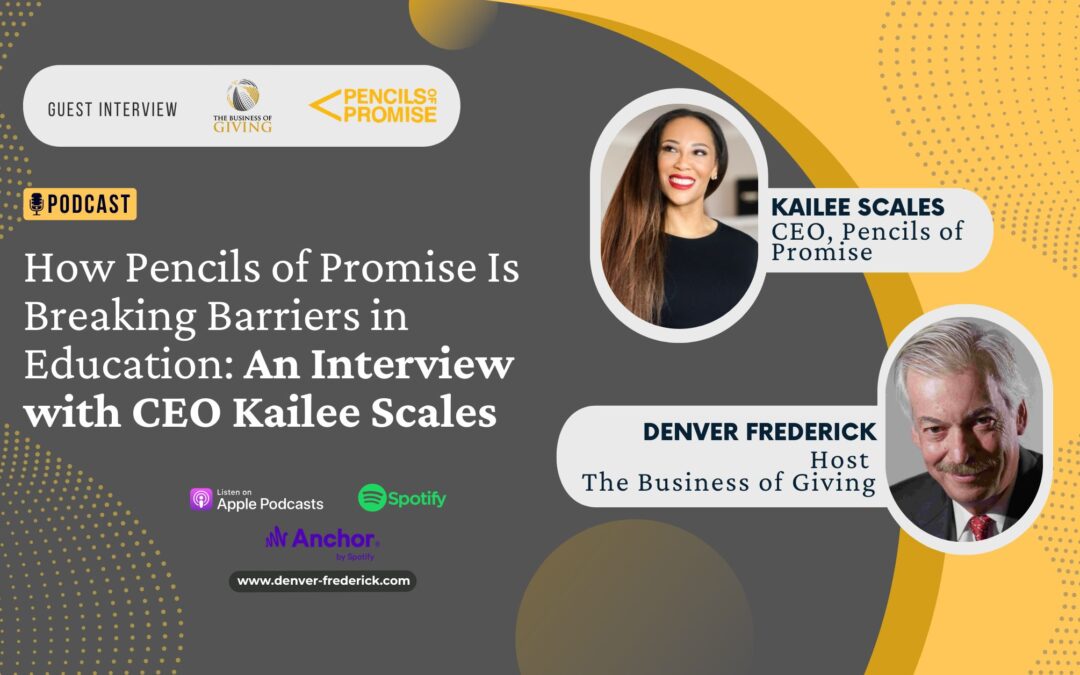
Education is one of the most powerful tools for creating equity and opportunity, but for millions of children worldwide, access to quality education remains a challenge. One organization is working tirelessly to change that. Joining us today is Kailee Scales, CEO of Pencils of Promise, a global nonprofit dedicated to breaking down the barriers to education in rural communities across Ghana, Guatemala, and Laos.
As Kailee passionately shares, “And when the child asked for a pencil, he just was very interested in why, and the child explained that it was because when he saw other children going to school, he knew that they were doing something very important and very special. And he wanted to be like those children. And it really spiraled into this idea that all children deserve access to education; all children deserve to be able to unlock the deepest corners of their minds and to optimize their potential. And so, that became Pencils of Promise, an organization where we remove the barriers to education for all children”

CEO, Pencils of Promise
Denver: Kailee Scales, welcome to The Business of Giving.
Kailee: Thank you so much for having me. It is an honor and a pleasure.
“And when the child asked for a pencil, he just was very interested in why, and the child explained that it was because when he saw other children going to school, he knew that they were doing something very important and very special. And he wanted to be like those children.”
Denver: Kailee, Pencils of Promise started with a powerful moment–a young boy in India asking for a pencil. How did that one encounter grow into a global movement, and how does that experience continue to shape your mission and your values today?
Kailee: You’re referring to our founder’s story, Adam Braun, our founder, when he did much travel throughout the world as a young man, trying to really understand the way the world worked and other people who resided within it. And he did come across a young boy.
He had the habit of asking children, whenever he met them, what they wanted, and he expected a child-like something that he was used to, some type of dream of a toy or a food.
Denver: Sure.
Kailee: And when the child asked for a pencil, he just was very interested in why, and the child explained that it was because when he saw other children going to school, he knew that they were doing something very important and very special. And he wanted to be like those children.
And it really spiraled into this idea that all children deserve access to education; all children deserve to be able to unlock the deepest corners of their minds and to optimize their potential. And so, that became Pencils of Promise, an organization where we remove the barriers to education for all children.
Denver: That’s fantastic. I love simple stories like that and the trajectory and how it just changes so many people’s lives. Where do you operate? What countries are you in?
Kailee: We are in Ghana, Guatemala, and Laos.
Denver: And you focus just not on building schools but you’re really into delivering quality education. What are some of the most significant outcomes and improvements you’ve seen, Kailee, in the communities that PoP serves.
Kailee: Well, first of all, it’s important to note that we work in the most rural communities, so equity is the underscore of all the activities in which we embark upon. And children in rural communities all over the world are often overlooked.
And so, because talent is equally distributed, but opportunity is not, we want to make sure that all children have the opportunity to explore their talents. So, where we are in rural communities, there are lots of barriers to education for children, including infrastructure.
So, you mentioned building schools. Infrastructure is a barrier. Infrastructure is challenging for children in rural areas because many of those infrastructures are old, they are overcrowded, they’re dilapidated. At times they could be dangerous because of the way that they are structured.
And they may be just falling apart, just not a place for children to learn. There are places where children are in multi-grade learning in alleys or all in one classroom. Sometimes boys and girls of different grades attend school on alternate days, things like that.
Denver: Yeah.
Kailee: So, infrastructure is certainly a barrier. But as you state, it is not the only barrier to education. The teachers in rural areas don’t necessarily have the same training that teachers do in other parts of their countries or other places in the world, so teachers may be behind in the lessons and in the skills that they need in order to ensure that children can matriculate on a par with their peers.
Things like hygiene and clean water are barriers to children. So, in the areas where we are, children often don’t have access to clean water, even in their home environment. And they drink water from the river or from a general place where everything happens– washing, cleaning dishes, cleaning bodies.
And so, if they drink that water, they will get sick, and that will prevent them from going to school. There, we have other hygienic issues that children don’t know,–just educating them about hygiene, brushing teeth, and things like that that can make children sick.
Our girls, we want to make sure that girls attend school and girls have barriers as well, particularly in your rural environments. When girls have the onset of their periods, many times in their communities, they’re encouraged to stay home.
Denver: Yeah.
Kailee: Even in the school setting, they don’t have the access to the things that they need, like private bathrooms and, again, water in order to ensure that they can attend school on their period.
So, PoP’s holistic approach is to address all of that because we want to make sure that we’re not building schools that remain empty because students don’t have all of the other things that they need and to ensure that they have good days, good years, and a matriculation in school. So, we want to address all of those barriers.
Denver: That’s a great rundown. You know, we think about education, but education is actually the last link of the chain.
Kailee: Right.
“So, we do empower teachers to understand how to engage children properly in the classroom. We teach them things like how to ask children their names and how to encourage them, as opposed to frighten them at times, because we want to ensure that both teachers and students have a good experience in the classroom.”
Denver: There are so many other things that need to be in place for that to occur. You know, you talked about teacher training, and one of the things that you do that is truly distinctive is: you are into a socio-emotional training as well. So, talk a little bit about that, what you do for your teachers.
Kailee: Yeah. So, in many of the areas where we work, socio-emotional learning helps both teachers and students, so it helps teachers understand how to relate to students in the classroom. So, in some of the areas where we work, there’s an issue of corporal punishment in the classroom.
And this can go from: this can be intense, this could be emotional, this could be physical, because these are things that are passed down for generations in rural areas where they don’t know, they haven’t heard yet. If we remember, many, many years ago, even in Western countries, teachers were able to smack a child’s hand or do things that we would never do today.
Denver: Oh, I was smacked a few times.
Kailee: You know.
Denver: And I had it coming.
Kailee: But I’ll say, it doesn’t necessarily engage a child in learning and doesn’t necessarily allow for the freedoms that you need to explore and express yourself and ask questions. So, these are things that we’ve learned since those times that are not conducive to the best practices of learning in the classroom.
But in rural areas, they may not have gotten that message yet. There may not have been anyone to tell them, “Listen, there’s a better way.” So, we want to make sure, because part of our goals and our theory of action is to ensure that we increase attendance in schools, that children want to go, and that teachers want to see proper outcomes for their students.
So, we do empower teachers to understand how to engage children properly in the classroom. We teach them things like how to ask children their names and how to encourage them, as opposed to frighten them at times, because we want to ensure that both teachers and students have a good experience in the classroom.
Denver: You know, being in rural communities, one of the things that I think about is technology and being able to get it to those areas. Talk a little bit about that and, Kailee, how you see AI transforming education.
Kailee: Yeah. So, you know, I’ve traveled all around the world in my day. And, in rural communities, it can often feel like time stands still, right?
Denver: Yeah.
Kailee: You know, I was so surprised to see when I would travel all throughout the world that there are places that transportation was horse and buggy. The houses were made from the earth… and I mean from the mud, and there was no electricity, things like that.
And so, obviously, when we think about technology and how quickly it advances and how quickly it allows for other people to advance their learning, their decision-making, their convenience. And then you think about people in other parts of the world who don’t have those conveniences, you think about how the disparity between us grows wider and wider.
So, we believe it is very important to provide technology, and access and the technological equity to students, because, again, it is the throughway of equity in human rights and allowing for all of us to have what we need.
So, at PoP, we do a few things. Number one, resources can be challenging, like having enough books, having a variety of books. Having a variety of books in the cultural context can be difficult.
So, by providing the e-readers, something that we know, something that by providing e-readers to children, we’re able to download a plethora of books and titles and languages, so that children can access hundreds of books just in the palm of their hands.
And, I mean, you know, I have a child, and the technology and the swiping is just amazing, like they come out of the book. And so, being able to see the joy of learning… when a child is able to access an e-reader and swipe and read and enjoy all different types of books just right there at their fingertips is incredible.
And so, e-readers are something that we provide to our students. You also asked about AI and this technology that allows for speed really, when you think about it, allows us the ease of doing the things that may take us a longer time more quickly.
And our teachers and our team members, so our team members, we train teachers, as I said earlier; we make sure that teachers, and these are full lessons, they take multiple years. So, we have to devise and develop curriculum to teach those teachers. Teachers themselves then have to create lesson plans to teach their students, and it’s a lot.
And so, AI can certainly help and has helped, and we’ve piloted an AI program to help both our team members to devise and conceive a curriculum to train our teachers very specifically, and for our teachers to be able to create lesson programs.
So, our AI technology intervention will include uploading all of our lesson plans because everything that we do is in tandem with the country governments and the ministers of education.
So, we work with local governments and the ministers of education to ensure that the curriculums that we are devising and all of the teacher’s plans and our staff plans ensure better outcomes for our students.
Denver: Fantastic. Let me pick up on that, in terms of working with local governments, I believe that all of your country directors are local as well. Talk about the importance of that and how PoP goes about engaging the community.
Kailee: Well, I would say, yes, our country directors are all local, but so are all of our teams.
Denver: Yeah.
Kailee: So, our entire teams in Ghana, Guatemala, and Laos are nationals. We believe that that is very important to be able to devise our strategies around country context that ensures sustainability of our programming because it is directly reflective of the needs of our communities. And so, that is incredibly important to us.
So our country directors were the initiators of their program in-country and built the team and built the relationships and built the partnerships from the ground up.
So, we’re very, very proud of that as well as, as I said, our teams who are able to speak the language, understand the community members, some of whom are from said communities and really understand, firsthand, the experience of students.
So, we’re able to ensure that, again, our programming is directly reflective of the needs of our communities, and we are not discouraged, or we’re not confused by other needs and other people who have their own ideas. And, that trickles down into the entire way that we devise our programming and that we undertake our interventions.
So, our communities, as you said, are very, very, very involved. We don’t just show up, right? We don’t just show up in a place and say, “We’re here, we’re building. You’re welcome.” That is not the way.
Denver: Yeah.
Kailee: That’s not the way the world works. It can be, but that’s not the way we impart our impact, because that’s not sustainable. What if the community is like, “No thanks.” It’s happened. A community’s like, “You know what, that’s great. Appreciate you, but we prefer to keep things the way they are.” Fine. We are here to promote equity and freedom.
And so, when we enter a community or when we do our initial needs assessment, we meet with stakeholders within the community. So, we will meet with leadership, whether it be formal leadership as it relates to government or as it relates to community leadership, so elders. We meet with decision makers, both formal and informal. We meet with parents.
And so, we have a deep conversation with people about what we can help do, their specific barriers that they’re facing, and we see if we’re fit. And if we are a fit, we are very clear in our timeline and our process, but we want to ensure that the communities are active participants. Because, again, if not for that, what’s the purpose?
And so, we devise… some of our countries called it the Community of Promise. So, we deliberately put together a committee of people that represent all of those different stakeholder groups, and we bring them together, and we plan together, and then we work together.
So, when it comes to the builds, for example, our communities contribute 20% of those builds, and they can’t do it financially, but they can do it in labor or in food or in water. And sometimes, that’s difficult for communities to be able to spare those things, so we don’t burden them.
But the approach is in an aim to, again, build as a community and the sense of connection to the work, the sense of ownership, because it is theirs.
Denver: Yeah. They own the program.
Kailee: It is their students, it is their children. And so, to be a part of this collaboration, we are very collaborative in our efforts, and it is the way that we are able to sustain. So, every single school that PoP has built since the beginning is fully operational, because it is a joint community collaborative effort.
Denver: How fantastic. You co-create, but they’re driving the car, and that’s better.
Kailee: Of course.
Denver: Absolutely. You know, one of the biggest challenges we have in the nonprofit sector is measuring impact. How does PoP assess success, both in terms of short-term educational outcomes and long-term societal change that you’re aiming for?
Kailee: Yes. So, we want to ensure that our students are attending school. We want to measure the school attendance. We want to measure their satisfaction in the classroom. And we also want to measure their educational gains. So, we want to make sure that children are showing gains in their reading and literacy.
It’s important to us because that is our theory of change. That is the purpose. So, we have a full learning and evaluation team. We measure ourselves against ourselves. We want to make sure that the trainings that we are conducting are landing in the classroom, that teachers are imparting those trainings properly, and that they can ask questions or change, or we can change as it relates to what the outcomes are.
We also utilize agro scoring to ensure that we understand the children, the student gains in PoP schools and outside of PoP schools, so we can make sure that the interventions are helpful and that students are doing better in the classroom.
We also measure attendance to ensure that students are in school so that, again, we know that we are addressing the right thing, the right barriers that are preventing students from going to school and matriculating. And that is really the baseline of our learning and evaluation.
“They wanted to feel connected to other human beings. They wanted to feel that those human beings were helped, were better because of their contribution, and that is a baseline that we cannot forget in this space…”
Denver: Pencils of Promise relies on partnerships with donors and organizations. As a matter of fact, I know you’re much admired in the sector for being really gifted and skilled at that. How do you build long-term partnerships, Kailee, and what advice would you give to other nonprofit leaders looking for sustainable funding?
Kailee: I love this question. I love this question because I think I just want to speak to my fellow people in the field that there are challenging times out there.
Denver: Oh, yeah.
Kailee: I will say, the field has changed. There are many think pieces and books written on the subject. I would say that what is truly missing from our world and as it relates to philanthropy, is a deep connection between people truly, but certainly between the way that an organization may engage with their donors.
It has become very transactional. It has become very superficial because people don’t often have the time or the patience, and they’re really distracted by something else that’s happening in the world because things are constantly happening in the world.
And I think that what’s very important for PoP, and one of the things that PoP did was ensure that we have a radical connection to those who support us. And we want to make sure that those who support us feel what they intended to feel when they decided one day that they wanted to contribute to children that they’ve never met and never seen in places in other parts of the world.
What did they want to feel? They wanted to feel connected to other human beings. They wanted to feel that those human beings were helped, were better because of their contribution, and that is a baseline that we cannot forget in this space, that all people, whether it be a corporation, a corporate funder, whether it be an institutional funder, whether it be an individual funder, there are people behind these decisions that want to feel something in a world that doesn’t always offer us things to feel that are good, and that make us feel connected to each other.
So, we must truly provide that radical connection. We must be able to share the impact of what goes on in places that you don’t necessarily go. And so, that is what my team and I consistently work on, and we share messages from students. We share art from students.
And this doesn’t mean that other people own things or have rights to know things about other people. But it does mean that we can feel connected as humanity because that is what philanthropy is. It is the service to humanity. So, I believe truly in that connectivity and ensuring that people who support our work, all work, truly feel the impact of their contributions.
Denver: Yeah, that’s very well-stated. I think we spend too much time in the sector writing case statements and appealing to their brain. And that only gets you so far, and it’s not very far. So, if you don’t appeal to the body so they feel something inside of them, it just is never going to realize the potential that you can from funding.
You know, another thing that you do is you have the hundred percent model for online donations. That’s quite unique. Tell me about it.
Kailee: Again, this is about radical connection and making people feel like what they are doing is really serving what they intend to serve. And, of course, there’s always need to ensure that the wheels are turning and the lights are on, of course.
But for us, we have a very small team in the US, purposefully so. We have lean teams. We have a training of the trainer model, so it allows us to have lean teams in our communities. So, we provide a lot of what people contribute to us directly to our children.
And so, through our online donations, we’re able to really ensure that that is reserved to draw that distinct connection because people want to feel like if I’m going to go online and spend a lot of time entering my credit card number or donating monthly, I want to know that what I’m doing matters.
And it’s another way also because a lot of online donations are smaller, and donors who contribute in smaller numbers, they feel kind of like lost in the mix. They’re like, “Well, nobody notices me. What’s my little $25 doing? What’s my $50 doing?” Well, I can tell you it does a lot!
Denver: Yeah.
Kailee: And it’s important that people who contribute $25 feel the same way as people who contribute $50,000, because that could be a sacrificial gift for you. And the feeling is the same.
I’ve woken up this morning and I want to help somebody that I’ve never met, and that $25 is important. So, we want those people to know, really know that those contributions matter and they go to actual people, and they change children’s lives daily and then forever.
Denver: Yeah. And, just on another side of that, sometimes those $25 donors become $10,000 donors. You know what I mean? Because they just felt that connection, and it grows from there.
Kailee, with the benefit of hindsight, what were some of the things that you did during COVID-19 because you had to do them? There was no other way to go about it, but lo and behold, they’ve stuck. They’ve lasted and they’ve improved the way the operation functions. Anything come to mind?
Kailee: Yeah. Well, I’ll tell you a couple things. First, I did begin my tenure at Pencils of Promise during the pandemic, and I’ll say to my brethren, my brothers and sisters in the nonprofit world, not the greatest.
Denver: Baptism of fire, as they say.
Kailee: Right. A couple challenges, but I will say, hopefully, never have to do that again, but I will say that PoP in particular truly adapted during that time because we all remember… it wasn’t very long ago… the impact that COVID had on education. We know that students were out of school.
We were all talking about it. We were all talking about how negatively this would impact students, both emotionally and academically. And we were all very concerned, right? And so, imagine that in areas where schools, where education we’re already trying to build, we’re already trying to connect dots.
So, the interruption could have been catastrophic, and there were lots of conversations around ensuring that children who we were already trying to bring to the forefront in education and give them additional tools didn’t fall further behind. And so, we had to adapt.
What does that mean? How do we do that when people are, you know, separated literally? And so, we did a few things. So, in Ghana, we used the radio to provide radio lessons. When we stay connected to our teachers, we often utilize SMS texts to stay connected, just when sometimes our team is far away and we want to make sure that we’re in connection always.
And so, we utilize a lot of SMS texts. We were able, in small, concentrated areas and regions to do small visits, masked visits between teachers and students to ensure that learning was still going on. It was challenging for us because, you know, we talked about in all parts of the world how challenging it was for parents to now have to support their children as they were learning at home.
And in the areas where we work, parents are often illiterates because what we are doing is breaking the cycle of lack of education and poverty. So, that was a challenge, right? Like if students are at home and they’re trying to keep up and their parents aren’t able to support them, it was challenging.
So, that’s when we had, oftentimes, when it was okay, when it was deemed safer, when masks were available, that teachers would come together with communities in small groups to be able to engage students in that way. So, you know, we kept it going during the pandemic.
And we realized after, as we were coming out of the pandemic, that we were doing anecdotal conversations with other schools that may not have been in the PoP network, and we realized that teachers were apprehensive about going back into the classroom. But we realized that our teachers were very upbeat and excited to reenter the classroom because we remained connected to them throughout the time.
And so, again, this is one of the things– we bring radical connection, not just to our donors, but within our community. That’s what we learned. We learned that our teachers want to be close to us as a team. We learned that teachers want to be close to their students.
We learned that communities want to learn and remain closer. So, we ramped up a lot of our workshopping with our community members. So, many, many lessons that we brought from that wild and horrific time period into our daily activities.
Denver: Well, radical connection radiates through everything that you do. From your work with Black Lives Matter to PoP, Kailee, what key leadership lessons have shaped your approach to leading PoP today?
Kailee: Yeah, I would say that it’s very important to me to understand my role as a leader. It is very important to me. And so, I believe that my role as a leader is to empower others, to certainly set the goalpost, right?
So, the north star– What is the north star? And vision that world. So, I’m a visionary and I’m an implementer, I’m all the things, you know, we got to be sometimes.
Denver: You’re a CEO, it’s a bundle.
Kailee: It’s a lot of stuff.
Denver: Yeah.
Kailee: But being able to really clearly define a vision of the world the way it should be is very important to me as a leader. I have a long history of doing this work. I have a long history of understanding the problems in the world, and I have a clear vision of what I believe the world can be. Will I be here to see it? I don’t know. Will I be here to help it along the way? Absolutely, yes.
Denver: That’s right.
Kailee: And so, by carving out that vision and sharing that vision and rallying my team, gathering the buy-in towards that vision, understanding from them how to shape that vision, and then leading us towards that, and being that rock for them, like making sure that we will navigate challenges because I’ve seen many.
We will navigate successes because I’ve also seen many, but we will not lose sight of the goal. We will not lose sight of the north star because we deserve it. The world deserves it. We individually deserve it.
So, as a leader, I want to make sure that my team feels joy within that vision and can navigate all of the challenges along the way but never lose sight of what we all deserve.
“It has brought me this feeling of love that can never be replicated, and it is something that I encourage people to feel because we’re not alone, we’re together. We’re together in our joy, in our confusion, in our sadness, in all of it. And so, if we remain connected to each other in spirits, in thought, in wishes, in action, and we have choices every day where we can make these things true or not true, then we build the world the way we want to see it. I believe we can harm or we can help, and we have choices, as I said, all day long that give us the opportunity to choose. And if we choose wisely, we get to carve the pathway for the experience that we want to have and the experience that others have. And it has been the greatest understanding of my life.”
Denver: And as part of that vision, if I am correct, you believe in collectivism and that we are all responsible to one another. Talk a little bit about that and how do you think we can encourage more people to adopt that mindset?
Kailee: I try to encourage more people.
Denver: I just try.
Kailee: The water’s good over here, folks. So, I think, my ideas of collectivism began very early in my life. As you mentioned earlier, I am from Queens, and my parents, really, I don’t know why, but for whatever reason, they thought it was very important for me to understand the way the world worked and to contribute to the world.
And so, at a very early age, I was volunteering. I was doing things in my community, and that was good and bad. I gained the joy of supporting others and being connected to others, but I also saw the problems of the world at a very early age and recognized that the world was just not fair.
At times where others might have been protected, I was not. I knew the world was not fair. So, I felt a deep responsibility. That’s one of my core values. I felt a deep responsibility because there was no reason, I learned very early and that has since been validated, that there was no difference between me and many of the people that I was fortunate to help or support or engage with.
No difference. It was random. I didn’t deserve what I had. I was born into my circumstances. And equally so, others are born into their circumstances. And I realized that if that’s true, and I’ve been all over this world with the richest and in the most overlooked places, and I realized if that were true, if that is true, then I have a responsibility to others to show my gratitude for what I was given.
I also am connected to every person that lives on this planet because we all have this randomness that gave us our circumstances. So, as a result of that, it’s really shaped the way I see the world and the way I live my life and the way I engage with other people.
And that connectivity has brought me to places and put me in environments with people that are the most moving, most compelling, most enriching, moments of my life. It has brought me this feeling of love that can never be replicated, and it is something that I encourage people to feel because we’re not alone, we’re together.
We’re together in our joy, in our confusion, in our sadness, in all of it. And so, if we remain connected to each other in spirits, in thought, in wishes, in action, and we have choices every day where we can make these things true or not true, then we build the world the way we want to see it.
I believe we can harm or we can help, and we have choices, as I said, all day long that give us the opportunity to choose. And if we choose wisely, we get to carve the pathway for the experience that we want to have and the experience that others have. And it has been the greatest understanding of my life.
Denver: Yeah. Yeah. That’s a great understanding. And I think just a simple understanding that you wish more philanthropists would have. We don’t get as much as the people that we serve, we actually get a lot more. And, we just don’t appreciate that, but that is exactly what’s happened, and that’s just the way you stated it.
Well, let’s stick with this idea and let me close with this, Kailee. Since becoming CEO, how has your vision for Pencils of Promise evolved, and what new initiatives are you the most excited about at the moment?
Kailee: I love that question, once again. Two things. Well, first of all, I think that, elevating my experiences of my team members in country to leadership roles at the organization has been very, very important to me from the start of my tenure, making sure that it’s not lip service, that our people who are directly connected to the beneficiaries have a seat at the table and help with decision making.
So, that is certainly one of the changes that I implemented very, very early on, elevating the leadership of those who are directly connected with our beneficiaries. The other thing is really a focus on the people that we serve, a different focus, a shift in focus, a more nuanced focus. So, we focus on primary school students, that is K through sixth grade, boys and girls, in all those classrooms.
But, for us in the future, we want to have an even finer focus on girls, so ensuring that girls have more of what they need– more safety in schools as it relates to having dignity and pride around when their periods happen and more tools that they need; building their future power, so ensuring that we set up micro enterprises for our girls around menstruation and menstrual health for themselves and for their community.
And also working with students who have disabilities, both mental and physical disabilities, and ensuring that our trainings are refined and our activities and our resources are refined to work directly with those students because, again, it is an evolution of equity, and no child should be in a position where they are not able to optimize their potential.
So, we want to make sure that we are looking at all children and elevating and empowering all children. So, that is the evolution of PoP… looking deeper into equity in education.
Denver: That’s great. And it’s a great focus and I forget what the old line is, it’s about : when you help a boy, you help a person. And when you help a girl, you help a community.
Kailee: That’s right.
Denver: And it’s really so true. Kailee, for those who want to learn more about Pencils of Promise or financially support this great work, tell us about your website and what visitors will find there.
Kailee: Yes. Please visit us on pencilsofpromise.org. You’ll find a lot of our numbers, so you’ll be able to see all the things that we’ve been able to accomplish. You’ll read all of our stories, you’ll see all of our lovely faces from all around the world, and their roles. You’ll get updates on different activities that we’re doing.
Please sign up and subscribe, and you’ll get to hear all about our school inaugurations and our groundbreakings and stories from our teachers, art from our students. It’s amazing. Also, please follow us on our social channels at Pencils of Promise, and you’ll see much of the same thing.
We have artwork Wednesdays on our Instagram where you’ll see beautiful pictures that our students create just for you. So, I encourage everyone to follow us on those places.
Denver: And we’ll all get to feel, if we do.
Kailee: You’ll feel like I feel, which is incredible.
Denver: Thanks, Kailee, for being here today. It was such a pleasure to have you on the show.
Kailee: Thank you so much for having me. It was wonderful. You’re great. Thank you so much.
Denver Frederick, Host of The Business of Giving serves as a Trusted Advisor and Executive Coach to Nonprofit Leaders. His Book, The Business of Giving: New Best Practices for Nonprofit and Philanthropic Leaders in an Uncertain World, is available now on Amazon and Barnes & Noble.