
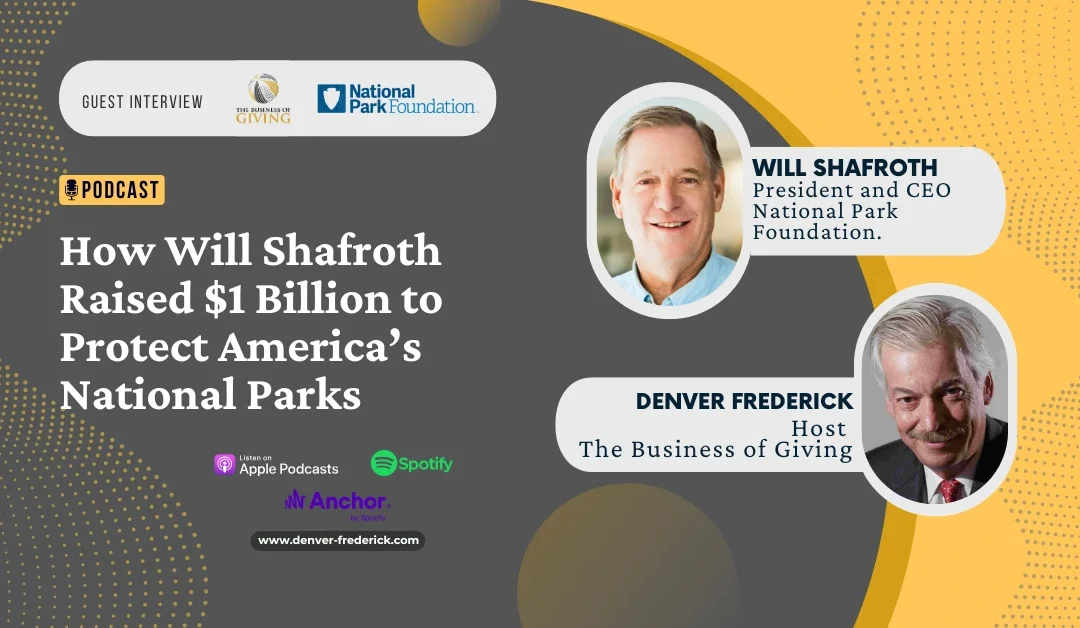
Welcome to The Business of Giving. I’m your host, Denver Frederick.
America’s National Parks are some of the most iconic and cherished landscapes in the world, and their preservation requires constant care and innovative thinking. My guest today is someone who has played a pivotal role in protecting these treasures. Joining me is Will Shafroth, President and CEO of the National Park Foundation.
As Will passionately shares, “We help the Park Service do things more creatively or innovatively, which as a nonprofit we’re better able to do sometimes than a government agency.”
In this episode, we’ll explore how Will has transformed the Foundation’s approach to fundraising, fostered partnerships that enhance the visitor experience, and worked to make National Parks more inclusive for all Americans. Stay tuned for an insightful conversation about the future of these incredible spaces.

Will Shafroth, President and CEO of the National Park Foundation
Denver: Will Shafroth, Welcome to The Business of Giving.
Will: Thank you, Denver. Nice to be here.
Denver: You know, the National Park Foundation has a unique role as the official nonprofit partner of the National Park Service. Share with listeners the mission and history of the foundation.
Will: First of all, thanks for having me on, Denver. The National Park Foundation was established through an act of Congress back in 1967, a partnership with Stewart Udall, the then Secretary of the Interior; Lady Bird Johnson, First Lady of the country; and Laurance Rockefeller, who had led a presidential commission initiated by President Eisenhower and finally adopted under President Kennedy that looked at a whole range of issues affecting our public lands. One of the conclusions was: we needed a nonprofit partner to give citizens of this country an ability to give back to these places that they loved, and we’ve all experienced that love that you have when you go to many of these national parks.
And so the foundation was started back in 1967. We are the official philanthropic partner or official charity of the National Parks. People have an ability to give to us to support different programs and projects that make the parks better. And today, I think we describe our missions somewhat more sophisticatedly, if you will. One is that we help to accelerate the work that might otherwise happen on the Park Service on their own. We help broaden the scope of that work to help them think about accomplishing more broadly. And also, we help the Park Service do things more creatively or innovatively, which as a nonprofit we’re better able to do sometimes than a government agency.
We do all that work in close partnership and alignment with the National Park Service. They’re the official partner. They’re the ones on the ground, 20,000 employees strong, doing great work on behalf of all of us, but we get to plus up that work and make it even better.
Denver: Well, Americans have certainly given back, and under your leadership, you have raised well over a billion dollars, $184 million last year alone. Will, what were some of the most effective strategies you implemented to achieve this really unprecedented success in fundraising?
Will: Couple of things. I mean, I just mentioned it in my introduction, Denver, which was, the foundation really became aligned with the Park Service.
Now, that seems like an obvious thing. Well, why didn’t you do that before? Well, we just hadn’t. And so, we really figured out what were the things the Park Service really needed us to do, but also that we were going to be good at raising money for.
We’re not going to be good at raising money for park salaries or repairing roads or water systems or doing things like that, but we’re actually really good at conservation of natural resources, helping them to buy land, or to protect wildlife, doing scientific studies.
We’re good at helping them tell America’s story in a broader way, so that the whole story of our country comes out.
We’re good at engaging young people and citizens, in general, and in learning about the parks and coming to the parks, and even working in the parks.
And finally, we’re good at helping to improve the visitor experience, building new visitor centers, expanding trail systems, and even helping with the Park Service around housing, to do that.
So, having defined those priorities, we now have license to go out and raise money from a whole range of people.
So, the other part of the secret sauce is that we’ve just gotten better at everything we do. We now have a very robust foundation program. This year, we’ll raise $25 million from corporations, plus another at least $25 million in in-kind revenue we get from companies like Subaru and Nature Valley doing TV commercials on our behalf and really broadly improving our brand ID.
We have a broad range of direct mail, digital fundraising, planned giving, major gifts, principal gifts– that we’re more sophisticated about how we get that work done, and it’s resulted in substantially more dollars raised… and then those dollars being delivered into the parks, creating impact on citizen resources.
Denver: Nothing like multiple streams of revenue. One of those recent gifts was a $100-million grant from Lilly Endowment. What a huge boost to the foundation that must have been. Tell us about that gift, Will, and how it’s going to be directed.
Will: Yeah, that was a big game changer for us, Denver, that we never had a grant that size in the history of the National Parks, and the fact that Lilly Endowment gave us so much flexibility about how to spend that.
Really, it was towards the four purposes of our campaign, and so we really have the discretion to figure out what are the most impactful ways that we can spend those dollars.
And so, initially, we’re definitely going to do some investment in the park partner community. I acknowledged that earlier, that we work with the Park Service, but also a group of 450 local organizations that wake up every day to think about: How can we help this park? –Yosemite, Yellowstone, Acadia, Everglades, whatever it is, and so making investments in that community of organizations will help them be better, to raise more money, to create more impact on the parks… and so it’s a really good investment.
We’re also going to be focused on helping the Park Service to think about the future a little bit more, thinking about issues like housing, digital technology, transportation, even the workforce. What kind of innovative solutions can we help them develop and help prepare for the future?
Congress doesn’t provide long-term funding; they fund on an annual basis, often through a continuing resolution that isn’t approved till March. So, for the Park Service, they’re not in a position to make longer term planning decisions in many instances. So, the Lilly Endowment funding will definitely be used for some of that.
And finally, we want to help with some work that’s happening in Indiana Dunes, the only National Park site in Indiana close to home for the Lilly Endowment. We know we’re going to make some investments there. We’re still working with the locals on that, but those are just some initial investments. But in the long term, Denver, big picture thinking about: How do we be most effective in developing innovative solutions for our National Parks?
Denver: Well, a hundred million dollars has a nice ring to it, and it’s even nicer when you say “unrestricted” right after it. That is for sure.
You know, let’s talk a little bit about those partnerships because I don’t think that people recognize the role that the National Park Service, and in turn, the National Park Foundation, has played in the modern day public-private partnership. We just don’t think of the Park Service in that innovative way, but we should, because if you take a look around today, they’re ubiquitous, but they really all began with the National Parks, correct?
Will: They did, yeah, and every park has got a partner that meets the needs of that park. Friends of Acadia, it does an incredible amount of work on behalf of that park to provide employee housing, to work with L.L.Bean on creating an innovative bus transportation system, to provide educational internships for scientists that work at the Schoodic Institute. It’s an incredible diversity, but it really is leaning into what the park needs and what the park offers, and those 450 organizations are collectively raising about $500-million-a-year for parks all over the country, and that gap is something that wouldn’t otherwise benefit either the resources of the park or the visitors that experience those places.
Denver: What do you find to be the key elements of a good, healthy, robust, and long-lasting partnership?
Will: Well, one that is grounded in common purpose, number one. And you see that, you can tell when the superintendent and the local friends group leadership is… they’re on the same page about things; then magic can happen.
Secondly, you’ve got people who are willing to go out and work hard to both raise money, steward those donors, and ensure that the impact is happening in the park. There’s integrity in the delivery system, in other words.
And then finally, people are committed to the mission. That seems like an obvious one, but it’s different than like creating widgets in a factory, right? Like this is the National Parks, I mean, this is about our heart as much as our mind, and if your heart isn’t connected into it, then you’re not going to bring your best stuff. And so those are the things, I would say.
Denver: Will, you’ve also built bipartisan support for major legislation like the Great American Outdoors Act. What strategies have been most effective in fostering this cross-party collaboration, especially today in this polarized climate we have in our politics?
Will: I can’t honestly take a lot of credit for that, Denver. I would say that the good thing is that everybody loves the parks. They’re like, you know, the Democrats or Republicans or Independents or Libertarians… who likes them more? Like everybody has the common human experience in the park.
I guess describing it is more about our heart than our head, and it is just true when you go there, you all feel the same emotional sensation when you see Old Faithful erupt or when you experience a bison or a grizzly bear on your path. Or just look out on the ocean in Acadia National Park and Point Reyes National Seashore, it’s just something that’s a human experience.
And so, fortunately, it is one of those places that when members of Congress take their seats, and whether you’re in the House or the Senate… or Republican or Democrat, you find common cause because these are places that are a physical manifestation of our democracy.
And so, all that being said, there was still a lot of hard work to get to the bill. The Great American Outdoors Act, which gave $6.5 billion to support the Park Services deferred maintenance backlog budget needs, had 27 members of the Republican Party in the Senate to vote on a permanent funding measure to support land conservation and deferred maintenance. Now, that doesn’t happen, and there was a lot of work and a lot of commitment on a lot of people to make that happen.
But the great thing we talked about earlier is that these local organizations are in every state, they’re in every congressional district, they’re in every Senate… you know, every senator cares about these things, and so they have constituents who can also talk to them. So, whether or not your appeal is the greater good for the nation or your own backyard, you have somebody knocking on the door to remind you of that.
“And so, we created some programs, one of them called ParkVentures, which is an attempt to engage communities of color and other forms of diversity, LGBTQ+ community, et cetera, in creating affinity groups that will allow them to experience the parks with people from their own community and creating organizations that are going to perpetuate that.”
Denver: Yeah, and I think a great point you just made there a moment ago was when it comes to common purpose, so often, it’s at the emotional level, it’s not at the rational level. And as you say, when you walk into the park, your head’s not thinking; your heart’s the one doing all the thinking, and that is where you get that common purpose.
You know, one of your foci has been making the national parks more inclusive and welcoming to all Americans. Tell us about some of the progress the foundation has made in that area and what else needs to be done.
Will: Well, this started back more than 10 years ago, Denver, the Park Service and the foundation worked on a survey of the different populations in this country– age, ethnicity, et cetera, and we found that the multicultural millennials were really not really interested in or engaged in the National Parks in a dramatic way. Meaningful numbers were down.
And so, we created something called Find Your Park back in 2013, 2014 to really be an effort to engage multicultural millennials through use of influencers and media and interesting events, things like that, and it really began to help move that needle.
One of the jokes of the superintendent of Yellowstone at the time was, “Find your park, just find somebody else’s park because my park’s too crowded.” We may have had a little bit too much success in our efforts at that point, but since then, we’ve really gotten more practical in recognizing that people may not have had a history of going to the parks.
There were a lot of practices that affected our society, more racially discriminatory practices, that were manifested in National Parks also for many years, and so people didn’t necessarily, from a lot of communities, feel they were welcome in the parks, and so we’ve had to try to focus specifically on how do we do that.
And, so we created some programs, one of them called ParkVentures, which is an attempt to engage communities of color and other forms of diversity, LGBTQ+ community, et cetera, in creating affinity groups that will allow them to experience the parks with people from their own community and creating organizations that are going to perpetuate that.
Outdoor Afro is a great example, an organization started by a woman named Rue Mapp out in California to look at how to engage the African American community in activities and parks– recreational, historical, and cultural, et cetera, and creating a long-term pipeline of people who care about these places, who want to go there, who are going to bring their friends there, and to make sure that everybody feels welcome and that they belong in these places.
Denver: Youth, you mentioned that a few moments ago… engaging the next generation in national parks. That’s been a priority during your tenure. Tell us what’s been going on there.
Will: Well, we know that like scientifically, the social scientifically, they’ve demonstrated that 4th graders are the most influential age group in a family through the decision making process about what they do.
Denver: That’s fascinating.
Will: Fifth graders are pretty influential, but 4th graders, like if you had to pick one grade, that would be it.
And so, the Park Service and the Congress, with Congress’s approval and with our private dollars, we’ve leaned into this notion of: Let’s look at finding ways… and it connects to the previous conversation we had about engaging everybody in the parks… is look at Title I 4th graders. These are the kids that are otherwise the least likely to get into a National Park experience on their own.
So, create field trip experiences for these young people through Title I schools, working with teachers and administrators. We provide the bus transportation; we ensure that, in some cases, the kids have a meal because some of the Title I kids, they receive free and reduced lunches. And we make sure that they have a great experience when they get there, either with the friends group or the Park Service themselves to introduce these young people to these places. And it could be the Statue of Liberty, it could be Santa Monica Mountains, it could be Fort McHenry in Baltimore, any number of places to show these young people something different that’s out of their neighborhood, out of the ordinary, and it awakens their level of curiosity and awe and wonder.
That is a wonderful thing, and we don’t have a lot of longitudinal information saying that experience for that one kid in Santa Monica made the difference, but we know it’s healthy and good for them, and that’s one thing we’ve been doing. We’ve been increasing our investments, Denver, in engaging 16- to 25-year-olds in Youth Corps– these are the modern manifestation of the Civilian Conservation Corps from the ‘30s, but it’s getting young people real jobs in parks to build trails, to plant trees, to restore buildings, whatever it might be. They’re learning job skills, they’re learning leadership skills, they’re connecting to these places in the outdoors and creating a lifelong affinity for them. And they become stewards and leaders in the future who bring those values forward. So, those are some very important ways that we’re doing that.
And finally, we do actually something called a Junior Ranger Angler Program, teaching young kids how to fish… and not just the act of fishing and baiting a hook and reeling them in, but water quality and species preservation. And we broadened the frame of the work that we’re doing to help them learn about a whole diversity of things and not just the fish, but catching the fish. Being there with their family or classmates is a great way… pun intended… to hook them on conservation.
“We need to get better at marketing these other amazing experiences. There’s 431 National Park sites. I can tell you that even people like me who’ve been at this for a long time, Denver, I’ve only been to maybe 150, and I have a lot on my bucket list. So, you’ve got to have people to think outside the box a little bit and go to some of the other places.”
Denver: And actually, this will be a habit they’ll have for their entire lifetime.
Let’s go back to go find a park other than “my park,” and I mean that in the sense of overcrowding. I mean, when you hear about overcrowding and visitation and the rest of it, how are you trying to get your arms around that? What are some of the long-term solutions to it?
Will: Well, the Park Service handles a lot of that work, Denver. We’re not so much in the business of telling the Park Service how to manage the parks, but they’ve gone to some pretty innovative things.
So, for instance, Rocky Mountain National Park has a timed entry program whereby you have to sign up. A substantial portion of basically the slots that are allowed into the park are done through reservation now. So if you got a 10 o’clock reservation, you show up at 10 o’clock, you’re going to get in. If you don’t have a reservation, you may have to wait in line for an hour, and so there’s that.
Zion has over the years just recently gone to electric bus system, and so most of the people go into Zion; they park their car and they get on a bus, and the bus drops them at any number of places to go on hikes, go to a visitor center, visit some natural landmark, whatever it might be. And that’s a way of managing the crowding and the impact that mostly automobiles will have on a park’s air quality, on the congestion and the overall visitor experience.
And so, those are some of the things. We’ve also been helping the park over the years to better disperse visitation across the system. And, I don’t know what the exact number is, but it’s about 40 of the National Parks have 50% of the visitation. So, 325 million people visited the parks in 2023; half of those went to 40 parks. Therefore, those 40 parks have got a lot of people. And so, how do we not tell people: Don’t go to Yellowstone?… Now, we don’t want to do that, but maybe: Go to Yellowstone for three or four days instead of seven. And go visit Little Bighorn or Devils Tower or Badlands or Theodore Roosevelt National Park within a half a day’s drive of Yellowstone.
So, there’s ways of doing that. We need to get better at marketing these other amazing experiences. There’s 431 National Park sites. I can tell you that even people like me who’ve been at this for a long time, Denver, I’ve only been to maybe 150, and I have a lot on my bucket list. So, you have people to think outside the box a little bit and go to some of the other places.
Denver: Do you have one or two hidden gems you could tell us about that are not frequented that often, but people, if they knew about them, they’d have the time of their life?
Will: Yeah and I’ll give you a couple of those. I go to Voyageurs National Park up in northern Minnesota, which is not very well known. It is one of the 63 National Parks, out of the 431 National Park sites, so it’s a special place, and it’s a four-and a-half-hour drive from the Twin Cities, but I got to tell you that when you get there, you know you’re in a wild place. And you don’t have to be a canoeist or a kayaker… you even got a motorized boat, and go camping on these special sites on a houseboat or whatever you want to do, but being out there and hearing the sound of a loon and seeing the beavers working in these lakes and hearing wolves and coyotes howl at night, that’s kind of an incredible thing.
I also love some of the southern civil rights sites. Little Rock Central High School is one of my favorite places in Little Rock, Arkansas where the Little Rock Nine were the first young black kids to integrate that school system as required by Brown v. Board of Education. And we’ve talked about the power of nature and the effect it has on you. There’s also a similar human experience I have had and others have had it. When you go to a place like that, and you realize the bravery of these young 10th graders, who were escorted by the National Guard… and to walk on the very same sidewalk that they walked on and see the very same school auditorium they were in, there’s something about that. I can feel it right now as I talk about it, and to go to a place like that is quite powerful.
So, there’s another 20 or so in the South that you could go to, but it’s a part of our history that unless you go there, you’re not as familiar with.
Denver: Yeah, yeah. Well, these will go down as my tips of the week, and I know what you mean. The first time I ever went to Ellis Island and walked up those steps before we had done the restoration. Just powerful when you think of what happened here, and you’re walking on that same soil. It moves you, in a little different way than the park in Minnesota, but really just as dramatically.
Will: Exactly.
“Channel Islands does a program where they’re able to have a live feed from a scuba diver in the kelp bed off Santa Cruz Island into these classrooms in Santa Barbara, Ventura, Carpinteria, et cetera, that brings those kids in and they can talk to the scuba diver and ask him. Again, how many people are actually going to go scuba diving in their life? Not that many. But to do that, it might open up a level of curiosity in oceanography and marine conservation for these kids that they’d want to be a part of that. And so, technology can do that. We have a long way to go, and we’re trying to do what we can to accelerate that for the parks.”
Denver: Talk about emerging technologies. What’s the Park Foundation doing in that regard as it relates to AI and virtual reality and things of that nature to enhance conservation… and also perhaps a visitor’s experience?
Will: Yeah, it’s a great question, Denver, and one again that’s in the category of things that the Park Service is interested in doing… it doesn’t necessarily have the budgetary resources or maybe even the expertise on staff to work on and to advance… so we have been raising private money, working with Boston Consulting Group and others to help think about: what would a single app that would direct a sort of an end-to-end visitor experience be to support the parks, whether you’re planning… whether when you’re in the park, and understanding where the crowding is happening and not happening, or in your post-park experience to donate, or to volunteer, or to share about your experience.
That’s the kind of thing that we think could be quite powerful in terms… and frankly convenient that you have a single place to go. Right now, if you go to try to do a complicated trip in the parks out west, you probably have to go to 15 or 20 different websites, and you’ve got to somehow have a spreadsheet and do all that.
We want to simplify it. We all have these things. Whether or not we’re going to a park to have more of an analog experience, we are tethered to our digital devices, and so we may as well do that.
The other thing is that we think it’s important to support the Park Service in having WiFi connectivity around the visitor centers or maybe in the campgrounds, but not something that’s going to be in the background so people are on their cellphones three miles back on the trail. And so, there’s a balance there that we’re trying to work with the Park Service to figure out.
And then also, we think that bringing parks to the people is another really important thing. You know, less than 1% of our population will ever go to Alaska and visit those amazing places up there. And I just spent a week in Alaska this summer, and I can tell you that it is like a whole other level of wildness that exists up there. And as much as you might want people to go up there, very few people are going to ever get up there.
So, let’s use technology to at least give people an opportunity to experience these things digitally. Like, just on their phones or on their computers, but also bring them into schools. And so, one of the things I love about what the Park Service does is that they have an ability to create feeds.
I’m a graduate of University of California in Santa Barbara, and the Channel Islands National Park is right off the shore there. Channel Islands does a program where they’re able to have a live feed from a scuba diver in the kelp bed off Santa Cruz Island into these classrooms in Santa Barbara, Ventura, Carpinteria, et cetera, that brings those kids in and they can talk to the scuba diver and ask him.
Denver: Wow.
Will: Again, how many people are actually going to go scuba diving in their life? Not that many. But to do that, it might open up a level of curiosity in oceanography and marine conservation for these kids that they’d want to be a part of that. And so, technology can do that. We have a long way to go, and we’re trying to do what we can to accelerate that for the parks.
Denver: That is so cool. I mean, well, I’ve got to get part of that 1% club going to Alaska. I’m not there yet, but that’s on the list. Probably a better chance of that than scuba diving when it comes to me.
You know, when I think of a living lab, when it comes down to climate change, I’ve always looked at the National Parks. It’s just that you have a chance to observe things over years in sort of, if you can say, a controlled environment in some ways. Tell us a little bit about what your thinking is on that, and I know you’re going to be really focused on this in your next assignment. But what do you hope to do and the impact you hope to have in terms of addressing that issue?
Will: Denver, you’re spot on. Parks are really the most protected places we have in this country, and while we’ve talked, more than half of them have to do with history and culture, the ones that are protecting geology, ecosystems, rivers, mountain ranges, et cetera, they are places that can be laboratories because they haven’t really changed for a long time. So, as the climate is changing, we can really use parks as living laboratories and understanding: How do we need to modify our management practices to adapt to the future change in temperatures and increase aridity–less moisture or more moisture– depending upon where you are, and so that we can use the parks as a guidepost, not just for the park lands, but other public lands and other ecosystems around our country and around the world.
And so, I think that is a critical piece, but also putting in place ways… pilot projects, and incubate new ideas for becoming more resilient. We’re doing a great project on Cape Cod National Seashore right now. We’re restoring a historic salt marsh that had been diked a hundred years ago, and that is going to make the Cape Cod and the dunes system more resilient to rising sea level.
And so, there are things that we can do at a practical level also that will not only benefit the parks, but benefit the whole country and the whole world.
Denver: Wow. That’s something. Well, with your family’s deep conservation legacy, which I think also includes your great-grandfather’s role in creating the Rocky Mountain National Park, how did that history shape your work at the National Park Foundation, and what lessons did you bring to your leadership?
Will: It’s interesting. I appreciate you raising John Shafroth and his role in both establishment of Rocky Mountain National Park, but also he was a co-author of the Antiquities Act, which ultimately gave presidents the authority through executive order to set aside lands for public purposes. I didn’t fully appreciate that till kind of later in my life, honestly. I was too busy.
Denver: None of us does, for those things.
Will: I would say that my older sister, Sydney Macy, who went to work for The Nature Conservancy right out of college, helped show me the way also about a career in land conservation, which is really how I got going.
So, there’s a lot there, and I think there was just a strong push towards public service in my family. My uncle was a mayor, Denver, and so, I saw it around me a lot growing up, and I think it wasn’t necessarily pushed on us, but it was around for some of us to lean into.
Yeah, it’s an important part of our society, and I’ve been really grateful to have been able to be engaged in this important work in the nonprofit level and local state and federal government level, and to be able to give back to something as a part of our country’s legacy and realizing, yeah, we’ve accomplished a lot as an organization, but we have a lot more to do.
Denver: Yep. Finally, Will, as you prepare to step down as the President and CEO of the National Park Foundation and shift to this new role focused on future challenges, what is your bold vision of how National Parks should evolve over the next 20 or 30 years to stay relevant and to stay resilient?
Will: Well, that’s a big question, Denver. Thank you for asking.
Denver: I always save the big question for the end.
Will: That’s okay.
Well, I think that as great as these parks are, the challenges that they face, both in terms of declining funding and deteriorating infrastructure, big challenges like climate change that are going to fundamentally change how the Park Service has to think about its business, they’ve historically been like: “Let’s preserve them as they were” before, you know, Europeans settled the land. That’s no longer really a thing.
So, there’s lots of these rivers that are hitting a confluence and making the mass of challenges that we’re facing even bigger, and how they work, conspire with each other, make it even more difficult.
And so, I think that we need to kinda rethink in some ways how we’re going to have visitors experience these places, and we need to be really leaning into technology as a way to manifest the ability for people to connect to these amazing places because not everyone is going to get there. And they’re going to be crowded sometimes, and so we have to use technology to our advantage to improve the visitor experience while people are there, but also bring parks to the people. That’s number one.
I think that we need to expand and accelerate the work that I just described around addressing climate change. These places can teach us a lot. Let’s take advantage of that, and let’s use the parks as great models of how to go forward across our country and across the world and in dealing with sea level rise, dealing with more arid climates, higher temperatures. So, those are the things that are coming, and parks can help us as a community, as a society, be better prepared to do that.
And then finally, I think there’s the human element that we often forget about, Denver, and that is these amazing Park Service employees. Most of the people in your listenership, I’m sure, have been to a national park. They’ve experienced a ranger talk; they’ve had a conversation with somebody who has absolutely enriched their experience and probably enriched their lives through those conversations, and we need to take care of these people.
Right now, the situation for where most of these people live is not suitable for the quality of the work they do, the importance of the work they do. So, we have to be cognizant of giving the workforce of the National Park Service good living conditions, good employment conditions so they continue to serve us and make the visitor experience, the management of the cultural, natural resources, as good as it can be.
Denver: That’s a great note to end on. They are some of the most remarkable and dedicated people I’ve ever had the pleasure of encountering.
For those who want to learn more about the National Park Foundation or financially support this work, Will, tell us about your website and what visitors are going to find on it.
Will: www.nationalparks.org is our website and, yeah, lots of opportunities to learn more about what’s going on in the parks. You know, we rely on the contributions of more than half a million people a year to do the work we do. And there’s always some fun things that you’ll get invited to do as well If you’re a member of the National Park Foundation. And I encourage you to reach out, learn more about us, tell your friends about us, and together, we can do great things.
Denver: Fantastic. Best wishes on your next venture, and I want to thank you so much for being here today. It was a real pleasure to have you on the show, Will.
Will: Thank you, Denver. Appreciate being here.
Denver Frederick, Host of The Business of Giving serves as a Trusted Advisor and Executive Coach to Nonprofit Leaders. His Book, The Business of Giving: New Best Practices for Nonprofit and Philanthropic Leaders in an Uncertain World, is available now on Amazon and Barnes & Noble.