
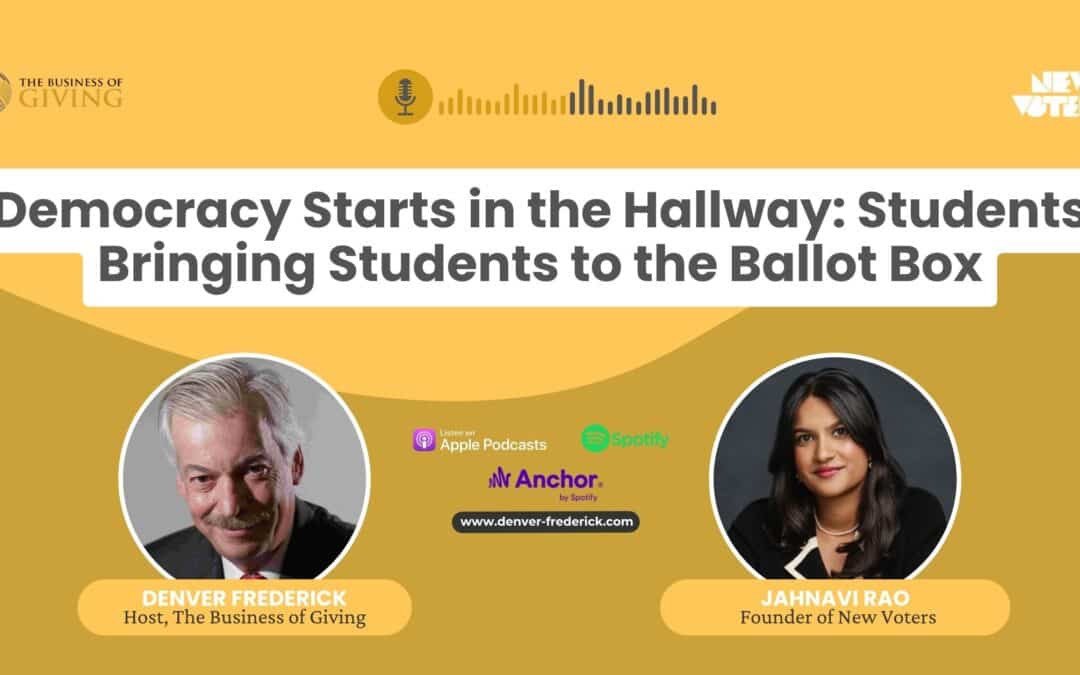
Every year, four million students graduate from high school in this country. Most are old enough to vote, but too few get the encouragement and support to take that first step. My next guest set out to change that by enlisting students to help their classmates register to vote and have a voice in the decisions that shape their future.
Jahnavi Rao founded New Voters while still in high school. It now runs student-led, nonpartisan voter registration drives in 1,300 high schools across 42 states. Here’s the number she built the whole organization around.
“…statistically, over 75% of baby boomers voted in 2024. Only 41% of 18- and 19-year-olds voted in 2024. And so, it’s nearly double. And if 18-year-olds alone voted at the same rate as baby boomers, as I mentioned before, they would be the deciding voice in almost every contested election in the country.”
We talk about the near-peer organizing playbook that got 85 percent of her own senior class registered to vote in three days, the research network she built to study a question almost nobody studies, and why spending her days with teenagers is what keeps her hopeful about the country.
It’s Jahnavi Rao on The Business of Giving.
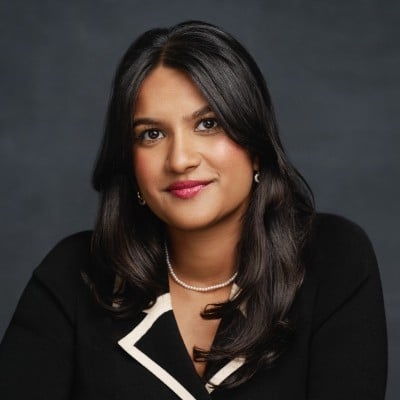
Jahnavi Rao founder New Voters
Denver: Welcome to The Business of Giving, Jahnavi!
Jahnavi: Hello, Denver! It’s so nice to be here.
Denver: So, tell us: What is New Voters, and what are you trying to do differently?
Jahnavi: So New Voters is a nonprofit dedicated to helping high school students find and deliver on their political power or potential political power. What makes this unique is that we specifically help high school students run nonpartisan voter registration drives in their schools. So, the sense is four million students graduate from high school every single year, and almost every single one of them are eligible to register and vote by the time they graduate. However, traditional institutions are not focusing or delivering on civic engagement for high school students, whether that be campaigns or various nonprofits, schools themselves, for the best of intentions.
And if 18-year-olds alone voted at the same rate as baby boomers, they would be the deciding voice in almost every single contested election in the country. So unique in both who are audiences and then unique in that I, at 26, am not going into a high school. I’m too old in some ways. The high school students themselves are by far the most effective messengers at getting their peers to do anything, let alone registering to vote.
“It was October 2017, and I don’t know if you know, but there were not any particularly consequential elections happening in October 2017 in Pennsylvania. But there was this feeling, this sentiment of the decisions being made today impact us and our generation more than anybody else, and we deserve to have a say in what’s going on.”
Denver: Well, your first voter drive, I think you registered something like 85% of your senior class in three days. Now, what did you discover in those three days that adults have been trying to discover their entire lives and have failed to do so?
Jahnavi: I did not consider myself a political person at all before I ran our registration drive. I was a music kid. I was planning to go to a conservatory. I was 16 when the 2016 election happened, and I remember feeling helpless. I was too young to vote. I remember sitting on my couch and watching the results, and seeing numbers and colors and knowing that I wasn’t part of them, and going into school the next day and seeing my friends on both sides of the aisle walking around in a daze.
I remember talking to people who I thought would be happy with the results of the election and asking them, “What’s going on?” And the resounding opinion was that, “This was the most talked-about event of our entire lives, and it felt like we had absolutely no say.” And that understanding of my school and my peers is what enabled us to have such a successful registration drive when we did it. Because it was October 2017, and I don’t know if you know, but there were not any particularly consequential elections happening in October 2017 in Pennsylvania. But there was this feeling, this sentiment of the decisions being made today impact us and our generation more than anybody else, and we deserve to have a say in what’s going on.
So, I had never done anything like organizing or mobilization. The most I’d gotten was friends to show up to my performances. But there is an inherent knowledge that every person has, an ability that every person has, and that is to get the people in their sphere of influence to mobilize. For my mom, it’s the Greater Philadelphia area and Karnataka/Kanadukathan, which is my state in India that my family’s from. For my dad, it is people who he plays bridge with. And for me in high school, it was my class, my grade in high school, who I’d been going to the same school district with since I was in preschool. I knew I could get all of the music kids to register to vote. I could get everyone in the marching band, everyone in the choir and the theater department, but I certainly couldn’t get anybody on the football team or anybody in the Science Olympiad team.
So, our team started with around 20 people, and it was people I knew, like the president of our student council, the captain of the football team, the head of the high school Democrats, and the head of the high school Republicans. And we, as students, were able to mobilize our own friends and our own communities to register to vote. Our first event was we went into every single homeroom with a senior, and we made a presentation about why it was important to register to vote, but the fact that that presentation was delivered by somebody who you’ve known since probably preschool makes that message so much more effective. However, after that first in-person presentation form collection, we only had 40% of registrations.
So, what we did was with that team—it expanded from 20 to 50 because people who had been in our presentations came up to me and were like, “I would love to get involved. That was so inspiring.” So now we have 50 people on our team. We have two days until the voter registration deadline. So, we have a spreadsheet of every person in our grade, and everyone puts their name next to a person. And there were a few people that nobody knew, and then we found them on Instagram and if we had mutuals with them. And I remember my friend Danny, she went into her field hockey locker room with a clipboard and was like, “Hey, teammate. I know you’re not registered, and you’re not registered.” At homecoming, we’re grabbing people as they were going in. I cold- called people’s parents from the phone book. And I was like, “Hey, did you know your son isn’t registered to vote?” And they’d be like, “Jack, come register to vote. So, how’d you get my number?” It was back then when people weren’t getting as many random calls.
And I didn’t know it at the time that it was a near-peer organizing campaign. It was leveraging the resources that we had, which were our relationships with each other. And that’s how we were able to do it, and that’s very much how New Voters is based still. Our high school students run their own campaigns in their schools based on their own knowledge of their school, and it remains the most successful way to do this.
“I think that the magic of the interactions between a teen registering another teen is that they know each other, and I think that that’s the same magic that happens anywhere.”
Denver: That is organizing 101, a nice rundown. Is there anything that happens special between two teenagers that changes the likelihood that someone actually will act?
Jahnavi: I wouldn’t say it’s actually very different than what happens between anybody that gets them likely to act. It’s: Do you believe that you have the ability to make a difference? Like the term political efficacy, which you may know, but it’s: Does the world happen to you, or do you happen to the world? And Americans as a whole, but teens especially, have a very low sense of political efficacy, a very low sense of agency. And in that conversation between two teens, in that conversation between two anybody trying to get anyone to do anything, can you instill in them: you have power, you have the ability to make a difference?
Because yes, you can do some sort of short stop and be like, “It’s so quick. Just register to vote right now. It’ll be done in two seconds.” Or you can have a real conversation about “Hey, did you know that our city controller is elected? And did you know that they decide what fields are publicly accessible and maintained for you to do soccer practice on? And I know you’re a soccer player. And did you know what the margin was in the last city controller election? And did you know that it’s happening?” I think that the magic of the interactions between a teen registering another teen is that they know each other, and I think that that’s the same magic that happens anywhere.
Denver: And I think you even alluded to before, the peer connection is stronger at that age than at any other age probably because you’re just so influenced by your peers. And you get to be 35 or 40, you’re not as influenced by your peers, but it is a particular moment where you definitely are.
Jahnavi: Definitely. I don’t know for sure when the influence goes away. Obviously, peer pressure is very effective on young people. But it’s also like we have a huge lack of third spaces and a huge lack of social connection and capital as we get older. Where else do you go eight hours a day to the same place with somebody, and you’re sitting with them, and the purpose is to socialize at some of those times? In the workspace, it’s getting increasingly more digital. You are taking calls online and hopping off immediately when the call ends. In school, you’re walking to classes together. You’re waiting for the bell to ring. You’re doing discussions during class. You have lunch. There’s so much more of an opportunity for young people to create meaningful relationships with each other, given the in-person nature of school.
Denver: As you began to gain momentum and became more and more successful, did you ever find that there was a moment that despite these strong results, you weren’t taken seriously just because of your youth?
Jahnavi: I will be so honest. I’m a pretty harsh critic of myself. So, when things don’t go well, I find that I tend to think about where I could have been better. I’ve been very, very lucky that the collaborators that I’ve had and the institutions we’ve worked with have been very excited to promote and amplify a young person. But given that you’re asking this question right now, honestly thinking back, nothing was ever explicitly said to me.
But in the last few months, versus when I was 22, we have so many more opportunities for major partnerships and governmental partnerships, and so on and so forth… that we didn’t have when I was younger. And I wonder if part of that was a concern around my age. That being said, when I was a full-time student and I was leading New Voters full time, I couldn’t put the same amount of time into it as I do now. I think that the most obvious place to me where I was discounted through my age was when I first wanted to do New Voters, actually.
Denver: Tell us about that.
Jahnavi: My school’s awesome, my high school, and incredibly supportive. New Voters is running its ninth year of registration drives—
Denver: Congratulations.
Jahnavi: –at my high school. It’s crazy. But I remember talking to adults in the school system and in our local politics, and just over and over again getting “Politicians don’t listen to young people,” “Young people don’t vote,” and kind of like pat-pat, “This is a really hard problem.” And—
Denver: But I love that you’re doing it. It’s so wonderful, you know.
Jahnavi: Yes. The energy is so amazing. And then we turn around, and we run a better registration drive than candidly I’d seen happen anywhere at that point. I’m sure that there have been instances where I’ve been discriminated against because of my age. I find that I have been very, very fortunate that a billion and one people have taken a chance on me, and that’s why we’re here.
Denver: I always wonder sometimes, too, that you’ve built this substantial reach with remarkably limited resources when you first started out, needless to say. And I’ve talked to other organizations who say sometimes being extraordinarily resourceful stops being a virtue and starts concealing the fact that your good work is being underfunded. Was that ever the case?
Jahnavi: I think young people are incredibly capable of creating and building consequential institutions, but oftentimes they’re asked to do that through passion alone. I think our ‘bootstrappiness,’ et cetera, is 100% a virtue of New Voters. We were able to bring a hundred kids to DC this summer for a four-day summit on remarkably little resources, and it was safe and exciting, and we were told it was the best experience that some of these students have had.
That being said, once you do it once, people keep expecting you to do it the same way again. And well, actually there’s very real burnout that happens with the staff. My director of programs ships all of the items for our boxes to her apartment, keeps them there, and then puts the boxes together, packs the boxes individually herself and sends them to every single drive leader. This is not a sustainable way to go about this.
Denver: No.
Jahnavi: And I think I struggle a little bit because it’s catch-22, right? Do you demonstrate your ability to do something and then receive resources for it? Or do you have a great idea, receive resources, and then do it? And I think the way that the startup world works, it’s very much you have an idea, you get money, and then you maybe deliver. In my world, I led New Voters with zero dollars for six years before I got any money. We had like money for our drives, but before I started paying myself or any of our students who do anything, and it wasn’t until I graduated.
I think that there are things that can serve as proxies for funding, like responsibility, serious mentorship opportunities. We have pro bono legal counsel that I got when I won a pitch competition in college and then our incredible lawyers were like, “We’d love to stay and help you pro bono.” And they’re still doing it now, six years later.
Philanthropy is such an odd…you know better than me, but it’s—
Denver: I would concur.
Jahnavi: It’s such a weird place because no one would ever argue that six years is the amount of time you need to spend on something before you get funding. But I think most people would probably say: Do something first, and with my high school students, they want to start nonprofits. As someone who has been a part of the high school student nonprofit industrial complex, I do not encourage our high school students to create nonprofits. I’m like, “Join something that already exists.”
Denver: Exactly.
Jahnavi: But for our high school students who want to do things, I do tell them like, “Hey, it would make sense to do stuff first, engage in service, identify a need, and then fundraise for it rather than the other way around.”
But there is something about if you have a really great solution and you’re young, I do think it is way harder to get funding for it because, at least in the nonprofit space, I think in the startup world it’s very different, but in the nonprofit space, so much emphasis is placed on your network and connections, and also your age and your years of experience in a way that I don’t think it is in the VC startup world.
Denver: I think you’re right. There’s money to be made in the VC startup world. There isn’t quite the same formula here. But when I look at your experience, you worked year after year after year, and you gained traction and you gained momentum. But what was it that actually caused the right people to notice you? What do you think that was?
Jahnavi: I think 99% that I had amazing mentors and adults who supported me. One of my biggest mentors is named Sam Novey. I met him my freshman year of college. He helped start a lot of the organizations in the college voting space. I met him my freshman year. I had already started New Voters at that point, and he was so encouraging. During COVID, we called every week, and it was just like a regular check-in. He connected me with so many people.
But my freshman year, he was like, “Come to DC, I’ll set up meetings for you with people.” He met me and my dad at the station. And then he was like, “We’re going to go here, we’re going to go here.” And then when I was graduating from college, I was seriously considering a different job offer I’d gotten. And I was telling him about it, and he was like, “What did you like about that opportunity that you’re not getting at New Voters?” And I said, “Well, I loved that it was in person. I love that I had a boss. I love that someone told me I did a good job.” And he was like, “Okay, what if I get you an in-person space, and I talk to you every week, and we set checkpoints, and you have to tell me whether you got them or not?” Nothing expected in return.
And we did that for six months. I was a senior fellow at the University of Maryland. He created this position for me. I have an office. I still have it now. We talked once a week, every week for six months. and at that point I was like: I don’t need this anymore. And there are so many people like that that I met when I was very young who were just so unbelievably generous with their time and advice and introductions.
We are…It’ll be out by the time this podcast comes out, but tomorrow, September 17th, Constitution Day, our official partner with the Maryland State Board of Elections is launching, where we are doing all of their high school voting work, and that’s an introduction that Sam made for me six years after he first met me and was still invested in me. Him and another mentor of mine, [Allen Casey,] nominate me every time. I just received the Obama US Leaders Fellowship and ‘30 under 30’ and L’Oréal, and these are all things that Sam and Allen and other mentors of mine have like nominated me for. So, it’s 99% the older people, mentors in my life, and then 1% luck, the grace of God, whatever you want to call it.
“Unless we have a strong teacher or administration relationship, we re-recruit hundreds of schools every year. The reason that we do this though is because the drives are more successful if the student runs them and has ownership, but the relationship is stronger if it is through the teacher and the admin.”
Denver: Well, you had to deliver along the way. That’s how it all works as well. You know, I sometimes stop and think about how your leaders continually age out of high school. It’s one of the occupational realities of the job. What have you learned about transferring judgment, culture, trust when the people carrying the work are just constantly changing?
Jahnavi: So, certainly, the most impactful thing we can do is have that student stay for longer. That’s probably priority No. 1.
Denver: Beyond high school, you mean?
Jahnavi: Mm-hmm. Sydney is the co-founder of the New Voters Research Network with me and has been with New Voters now for six years. She is entering her senior year of college, and she joined us when she was in high school. And so, priority No. 1 is: How can we have people stay and retain their institutional knowledge? And I feel very grateful to know that New Voters is somewhere that people want to stay, through a combination of the uniqueness of the org. and their opportunity to make change, their ability to build skills, their ability to have real responsibility, and the recognition.
But with regards to the turnover that does happen, I would say it’s like very much still learning, still figuring this out. I won’t lie and say that we do basically have to reinvent the wheel for the schools that we’re in every year. Unless we have a strong teacher or administration relationship, we re-recruit hundreds of schools every year. The reason that we do this though is because the drives are more successful if the student runs them and has ownership, but the relationship is stronger if it is through the teacher and the admin.
“Young people are amazing and so smart and can do anything, and they’re also very young. There are very real drawbacks that come with working with high school students, and there are also very real advantages that come with working with high school students.”
Denver: That makes sense.
Jahnavi: So, there’s a constant trade-off. And I have thoughts and ideas and things we’ve tested over the last nine years that work and don’t. But I would be lying if I said we’d figured it out because it is super transient, and it is really hard. Young people are amazing and so smart and can do anything, and they’re also very young. There are very real drawbacks that come with working with high school students, and there are also very real advantages that come with working with high school students.
Denver: You mentioned a moment ago that you did start a research arm. Tell us a little bit about that and what it does and how it’s changed the dynamic of the work that you do.
Jahnavi: So, I’ll say that the conception of the New Voters Research Network was moderately selfish. I really like to research. I was seriously considering pursuing a PhD, and I was talking to some of my professors who were all big supporters of New Voters when I was graduating from college, and I was like, “Do I pursue research?” And they were like, “You know what? Honestly, you can do a lot of research through New Voters and the data that you have access to at New Voters.”
And that was like a light bulb in my head. I was like, “Oh my gosh. Yes!” We have so many students and those students can access so many students. I just was starting to do a deep dive into what literature exists in the youth civic engagement space, and there is a huge gap in the literature when it comes to youth civic engagement. But even more when you disaggregate high school from the broader youth population. There’s basically no research on high school political behavior.
So, I was like, okay, step (a) – How do we address this gap in research and in research on high school political behavior?” Objective (b) – how do we make sure that New Voters’ programs are evaluated? Because I was really shocked, quite honestly–in college, my research focus was behavioral economics, but a big part of that is program and policy evaluation –to learn that most policies are never evaluated when they go into law, either before or after, for efficacy. And most organizations and nonprofits aren’t evaluated for whether their programs work at all.
And as someone who considered myself a researcher and very motivated by data – my dad is a Bayesian statistician – I was very concerned by that. And I was like, “Well, I won’t be leading a nonprofit that doesn’t have rigorous data evaluation. Not me. Someone else, but not me.” And then objective (3) was in my research, I had learned that the best research is always conducted by people who are in the community that the research is about. So, you have this threefold problem of a lack of research on the topic, a lack of evaluation of programs like ours… not that there exists many, and a lack of research that’s conducted by young people. So, the New Voters Research Network aims to address all three.
Working backwards, we run a yearly summer program called New Researchers, where we train around 100 high school students for free to conduct research for impact every summer. So, we just wrapped up our fourth year of the program. It’s an eight-week free program for high school students, and we have dozens of incredible academics and researchers who come in to guest lecture, and our team of TAs who are college-aged students and former new researchers, participants who are teaching the classes. The high school students learn the basics; they learn how to present an article, like a difficult political science article. They have to conduct a case study of their own high school civic offerings. And finally, they have to pitch an original research project in civic engagement. We do a competition. So that’s definitely our biggest thing, is: How are we making sure students are ready to help conduct research?
And then on the other two, we conduct evaluation of New Voters’ programs, we do interviews with our students. We just wrapped up interviews of 50 of our alums to create a research study on what careers they consider and go into after participating in New Voters. We have designed RCTs, randomized control trials, to see whether programs work. And then on the biggest level, we work with think tanks and other researchers to conduct research on high school political behavior. Most recently, a piece came out with Public Agenda, which is a think tank about listening to young men, where our research assistants who were participants and new researchers and then became research assistants when they were in high school, conducted focus groups with young men and basically reported on what’s actually happening with young men.
Denver: What is happening with young men?
Jahnavi: Well, I’ll definitely direct you to the research article–
Denver: There you go.
Jahnavi: –to learn more about that. I definitely don’t want to misrepresent it.
Denver: I know. You can’t open it up because there’s just so much.
Jahnavi: It’s a whole another podcast.
“…statistically, over 75% of baby boomers voted in 2024. Only 41% of 18- and 19-year-olds voted in 2024. And so, it’s nearly double. And if 18-year-olds alone voted at the same rate as baby boomers, as I mentioned before, they would be the deciding voice in almost every contested election in the country.”
Denver: It’s a whole another one. I remember how shocked I was when I first heard how few government programs were ever evaluated. And it is minuscule. It’s like 50%? No; 30%? No. It’s like two percent. It is some incredible number when you think of the tax dollars that no one is ever even evaluating these things. Why don’t you give listeners a snapshot of what’s happening in the civic space among young people in terms of voter registration, how active they are. But let’s look at that 18-year-old in terms of people who just don’t really have any idea as to how active young people are in civics.
Jahnavi: Absolutely. Well, (a) there is a common narrative that young people don’t care and that young people are apathetic. I do think in recent years it’s been up-ended, but to say it again, young people are the opposite of apathetic. Young people care so much about everything. I’ve never met a young person who… it might not manifest in politics, but they care so deeply about their sports teams, about their community, about their, you know, artists.
Denver: They’re passionate.
Jahnavi: Exactly. And it can be very easily.. and it very often is… directed towards politics and current events. I think people see the lack of engagement of young people in politics through voting and attribute it to a lack of care, and that’s certainly not the case. However, there is a low turnout.
So, 4 million students graduate from high school every year, and around 90% graduating seniors are eligible to register to vote by the time they graduate. However, 18- and 19-year-olds are the lowest voter turnout of any age in the country, which is really remarkable when you think about it, because people get their driver’s license when they turn 16. People are excited… they get their first drink when they’re 21. They buy the lottery ticket.
That’s not the case with voting. Voting is something that very much happens when you’re older. And statistically, over 75% of baby boomers voted in 2024. Only 41% of 18- and 19-year-olds voted in 2024. And so, it’s nearly double. And if 18-year-olds alone voted at the same rate as baby boomers, as I mentioned before, they would be the deciding voice in almost every contested election in the country. And there’s the CIRCLE, which is a research institution out of Tufts, that does a lot of really fantastic research on this, but there’s something called the Youth Electoral Significance Index or the YESI Index, and that ranks states– Senate and House and Governor races– by how consequential youth impact is on those elections. So, a very interesting resource for people to check out, and it’s calculated by a combination of how slim margins are and how many young people are in the state.
We can talk about why the baby boomers register and vote at such higher rates than younger people, but the reason that young people are struggling is something around like one in five young people who didn’t register to vote didn’t because they had difficulty registering. And there’s a huge information gap, and schools’ civic education is in the dirt.
Denver: It’s in the dumpster.
Jahnavi: It is in the dumpster, truly. The disparity between how much funding is given to STEM education, which is very important, and to civics education is astounding. It’s something like five cents to $50. Don’t quote me on that.
Denver: But I get the point. Yeah.
Jahnavi: But that being said, young people are probably among the highest in terms of service. They are incredibly high in terms of activism. They’re incredibly high in terms of knowledge on current events as compared to previous generations. And in fact, a study in 2024 said that current generation, like Gen Z, at 18- 19, vote at higher rates than past generations did when they were 18 and 19. So there is still a massive opportunity for growth, but it’s certainly not attributable to a lack of care from young people.
Denver: I always wonder what the partisan environment we’re in, how that impacts people. Because I try to think back when I was young, and that would turn me off, I think. There’s just something that you find so distasteful about it on each side that it’s really disenchanting.
Jahnavi: It is really nasty. I think that the partisan environment is really tough, but I think even more than the partisan environment, it’s the young people’s lives have been characterized by governmental failure. Current 18-year-olds went to elementary school during COVID. And they have been growing up doing school shooting drills and were born after An Inconvenient Truth and with the knowledge that we’re rapidly approaching the point of no return is constantly in their news. Their schooling is completely, upended by AI. The job market they’re entering and they know they’re going to enter is unstable. They don’t know if they’re going to have social security.
The partisanship is very real, and it’s very nasty. And it’s something that the polarization and the discussion around politics is not a positive one. I don’t think that people’s impression of politicians is particularly positive. But I think even more damning than that is that the young people, and I think to an accurate level, don’t trust the government to deliver for them. But it’s a self-fulfilling prophecy, right? You don’t trust and then you don’t vote, and then it gets worse.
Denver: I think that a lot of us are just not trusting the government on anything, on whatever they say. And I’ve always been pretty much that way since the ‘70s, but it does seem to be a bit more. I always figure the first thing I hear is not necessarily going to be it.
Your larger ambition is to make civic participation something young people actually practice rather than merely study. If that were to become normal in American high schools, what do you think would be different 20 years from now?
Jahnavi: My goal with New Voters is that young people participate and create a representative government for young people. My broader ambition is that the government as a whole is representative of everybody who lives in this country. So, with the piece of young people participating at the same level as baby boomers or having full access and a responsive government, I think it would look like before a politician starts on the campaign trail or creates their team: They have to consider the youth of America, and they have to think about: What are young people’s aims and ambitions and goals, and what are the longer time consequences of the actions that we are taking?
There’ll be a significant change as to the policy and specifically time-scale priorities of people in government. I also think that it would result in more young people running for office, and not only a more representative electorate, but a more representative government that is just as diverse in age and race and gender as the country is.
Finally, I do think that a more representative government will result in a more democratic government, will result in common sense democratic reforms that the people of America want to have happen. Gerrymandering sounds like a niche word, but you’d be hard-pressed to find a young person who doesn’t know what it is.
So, the political leanings of young people are not as clear as they used to be. Younger Gen Z is much more Republican, older Gen Z is much more Democrat. But both of those parties don’t look like what young people want them to look.
Denver: I got it. That makes all the sense in the world.
Now, if people listening want to learn more about New Voters and they want to get involved, maybe give you a few bucks and financially support this work, and maybe something that’s coming up that they should know about because you got a full calendar, tell us where it is and where they need to go to find out about it.
Jahnavi: Well, you can check out New Voters at www.new-voters.org. We are rapidly growing. We are in around 1,300 high schools across 42 states. We register on average around 25 students per registration drive, but some drives register over 550 kids to vote. And we are currently… In 2025, we had 400 students involved in our programs total. Now, we have 400 students signing up with us a month. As we’re approaching the 2026 election, that number is only growing, and it’s only going to increase as we, head into the 2027 and 2028 election cycles.
So, we are looking at election registration deadlines coming up in October across the country, every single House of Representatives seat being up for re-election in 2026. We are looking at 8 million people, new voters, being eligible to vote by the time the 2028 election happens. We need to be able to support every single one of these students who are coming to us. And that’s where we’re focused on, is both: How do we make sure we’re supporting every one of the students who want to work with us? And how are we increasing the number of students registered per school? How are we going from 25 to 50?
Sophia in El Paso, Texas, registered 540 kids to vote at her high school. Shaun in the Bay and SF registered over 530 kids to vote at his high school. How do we replicate, learn from, and amplify those kinds of stories? So, the need is urgent. New Voters is rapidly growing and our capacity has not. But as I said, we are bootstrappy, we’re figuring it out, and the more that we can do, the more representative our government will be.
It’s an honor to be a place where young people want to be, and they are truly the most incredible. It’s impossible to not feel hopeful about the world every day when I work with high school students. My friends are in a constant state of existential dread. And I’m not going to lie and say that I’m not, but they’re like, “How do you work in this space? How do you do it every day?” I was like: The level of belief in the future of this country that I have because of the students that we work with is unfathomable.
Denver: Yes, off the charts.
Jahnavi: Off the charts. With the election around the corner and with everything happening in the world, in Nepal, and so on and so forth, it feels very paralyzing. And the thing that I always remember is we, as a nation, and humans as a whole have had so many…we’ve had inflection points, terrible inflection points in the past. And every single time we’ve gotten out of them, it’s because people cared enough to do something about it. And I’m surrounded by young people who care, and they are doing something about it. So, it’s impossible to not be hopeful.
Denver: Well, you have built something extraordinarily special here. Do you ever find you’re becoming more and more the oldest person in the room, though?
Jahnavi: I am the oldest person. In all of the spaces I go outside of New Voters, I am the youngest person in the room. But the students in New Voters, they call me a millennial as an insult.
Denver: There you go. I remember Bill Clinton said that because he became the governor of Arkansas at such a young age. He said, “Every meeting I went to I was the youngest person in the room, and now I’m the oldest person in the room.” And he said, “It just seemed like it happened overnight.”
Well, I want to thank you so much for being here today. It was a real pleasure to have you on the show. Thanks.
Jahnavi: Thank you so much for having me.
Every weekday morning at 7:00 a.m. Eastern, I publish a short Leadership Note from the Field. These reflections draw on fifty years in the nonprofit sector and nearly 1,000 conversations with nonprofit leaders.They are designed to help leaders step back from the noise, see the deeper pattern, and lead with greater clarity.A recent note explores a distinction I believe matters enormously right now.In philanthropy, don’t confuse headlines with forces.Headlines dominate the moment. But deeper forces such as the $124 trillion wealth transfer, the rise of women as philanthropic decision makers, and the growth of giving across the Global South will shape the next twenty-five years.You can read the full note, along with a new one posted every weekday morning, on my blog at denver-frederick.com or on LinkedIn.