
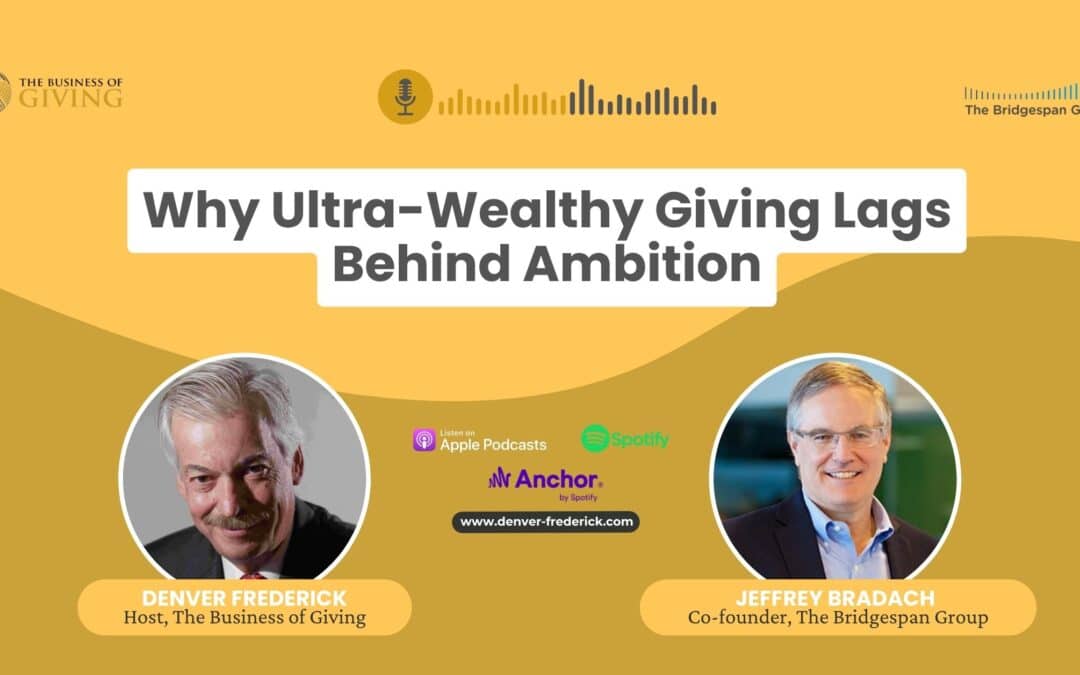
Most philanthropists want to do more good, faster, than they actually do. My next guest has spent twenty-five years inside that gap, watching enormous wealth sit still even as donors say they want it moving.
Jeffrey Bradach co-founded The Bridgespan Group and recently wrote an essay called Slow Philanthropy, Why giving by the ultra-wealthy often lags behind their ambitions—and what could help move money faster.
What he found were small frictions, quiet allergies to failure and waste, and a strange kind of self-deception running through the whole system.
Here is how he puts it: “I always go back to a phrase that Jed Emerson coined 20 years ago or 25 years ago, where he described the donor-nonprofit relationship as a dance of deception, where each side is presenting themselves in a way that they both know isn’t really true.”
We talk about what a dollar sitting in a bank account actually costs the world, why the ten-year mark brings a reckoning for so many donors, and what MacKenzie Scott understands that almost no one else does.
It’s Jeff Bradach of the Bridgespan Group on The Business of Giving.
Jeffrey Bradach, Co-founder, The Bridgespan Group
Denver: Welcome back to The Business of Giving, Jeff!
Jeff: It’s great to be here. I look forward to the conversation.
Denver: Likewise. You know, in your essay “Slow Philanthropy,” you explore why giving by the ultra-wealthy so often lags behind their ambitions. Now, you’ve spent a good 25 years watching capital move and not move forward on social problems. After writing this essay, Jeff, what do you now see more clearly than you did five years ago?
Jeff: I think among the things are that surprisingly little friction can stymie giving for the ultra-wealthy. And not just the ultra-wealthy. I focused on that group because there was data. Bridgespan has had the privilege to work with a variety of people. The Giving Pledge has lifted them up.
But I think one of the things that really stood out was the small frictions that get in the way and the ease of delay, the fact that the counterfactual when a donor is looking at a philanthropic opportunity to put money in a nonprofit, it’s not as though they’ve committed to give X amount of money and now they’re just going to find one, and no matter what, the money’s going.
In fact, the counterfactual is: “I’m going to consider this nonprofit. But, if it’s not meeting what I think is necessary for the kind of impact I want, I’ll wait. I’ll keep the money in my bank account and see it accumulate, giving me more opportunity to have impact later.” So, this kind of nuance between small frictions and delay… I didn’t fully appreciate until digging into this more.
Denver: It seems to be greater there than it is in making an investment decision, making a purchasing decision. There’s something about philanthropy that—I don’t know—just gets us a little crazy in terms of I-really-want-to-get-this-right.
Jeff: So, to be clear, I don’t ever describe philanthropists as behaving crazy or being crazy.
Denver: And that was me. That’s me.
Jeff: Exactly. But I would say that the mystery of these self-imposed constraints that philanthropists put on themselves and the lens through which they think about their philanthropy is really a puzzle. I describe it in the article. It’s a set of internal barriers to giving, things like the fear of failure, which to your point about this comparison to the for-profit sector, no investor would think anything of the fact that I have a portfolio of 10 investments: five didn’t work, three were pretty good, and then two were home runs. You hear that all the time. That’s the way you think about it.
In philanthropy, you hear, “I don’t know, this might not work. Show me some more data. I’m not convinced,” on every single deal. The notion that you have a portfolio, some work and some don’t, is much rarer. And so, this puzzle of “Well, why is there this allergy to the possibility it might not work?” Similarly, this allergy to waste to such an extreme that you cap overhead rates in ways that you know are detrimental to the performance of the organization, but your concern with waste, your desire to hold people accountable overwhelms, in some sense, your knowledge of what it takes to build a vibrant organization that can deliver results. And some of these are puzzles that I explore in the essay, but I would just say, they still remain puzzles. It’s not obvious why you would engage in what seems like self-defeating behavior.
And I talk a little bit about identity. People, often these philanthropists have been—almost by definition, they’ve been enormously successful in one arena. Now, they hop into this other arena where they’re beginners, but that feeling of discomfort that comes with being a beginner may actually lead them to hold tight in ways that get in the way of doing what they’re intending to do with their work.
The second thing is that sometimes I wonder if, in many ways, the expression of who you are as a person is more manifest in your philanthropy than it is in your business life. So that suddenly… like it’s counterintuitive because, well, you already have a billion dollars. There’s not a risk that you’re literally on the precipice of danger… deprivation. But the risk to your identity of: “If I make a mistake in this where I get to choose anything I want and I do this,” that may feel heavier in some ways than the business risk. So, a lot’s going on in there, and this essay starts to dig into some of those dynamics, but it remains a mystery.
Denver: No doubt about it. It kind of harkens a little bit of these prediction markets, where you like to win the money, but more than that, you want to be right. You know what I mean? And you want to tell the boys that you were right. Because it’s who I am. This isn’t a game; this is who I am.
The other thing that you bring up there, too, and I think a lot of it starts at the very beginning, is that I’ve been in philanthropy for over 50 years, I don’t remember anybody ever talking to me about risk. It’s a word that we don’t use. I’ve made presentations my whole life… I never say to a prospective donor, “I will admit it, hey, this may not work.” It just isn’t there. And that kind of just carries forward that everything is going to be fine.
Jeff: Well, I think, and again, this is just one of the peculiar parts of philanthropy. And it’s not unlike when an entrepreneur goes to a venture capital firm. She or he says, “I think we’ve got the most important product in the history of the world, and you should put in $10 million to help me get there.” So, you have that, but you’re operating in an ecosystem where, in some sense, failure is not only recognized but often celebrated, celebrated in a sense that this was a great idea but the market shifted. Whatever it is, there’s a narrative around it.
In philanthropy, I always go back to a phrase that Jed Emerson coined 20 years ago or 25 years ago, where he described the donor-nonprofit relationship as a dance of deception, where each side is presenting themselves in a way that they both know isn’t really true. Like the donor knows your mission may be “I’m going to end homelessness.” You’re probably by yourself not going to end homelessness. You think you’ve got to say that because you think that’s what’s going to unlock it. And I kind of want to hear it because that is what excites me.
But it puts you in this crazy relationship that as I talk a little bit about in the article, there’s a dynamic of disillusionment that is often created by that, where eventually the chickens come home to roost, and you’re like, “There’s still homelessness. There’s still hunger.” And you can make a dent in it, you can make a difference, you can collaborate with people to do even bigger things, but it’s just hard. These are hard problems and hard things to do. So, I think that that dynamic is part of what’s at work here, too.
“I think that part of writing a piece like this is trying to cast light on some things that we all know, but that they lurk beneath the surface and they really get in the way.”
Denver: I think that’s spot on. I see it a lot in overhead. I can count my overhead any way I want to count my overhead. I can have it 30% and I can have it 11%. But I’m going in with 11%, okay? And the donor knows there’s no way I’ve done this for 11%. So that dance of deception, as you and Jed so well put it, continues on.
Jeff: It definitely does. And I think that part of writing a piece like this is trying to cast light on some things that we all know, but that they lurk beneath the surface and they really get in the way. They just get in the way of money moving, a more candid conversation about what it really takes, what are real realistic time frames.
I used to joke at Bridgespan that part of our work could be described as ‘dream killing’. Like somebody comes in and goes, “I’m going to solve this!” And we’re like, “Awesome mission statement, but let’s now drop down to: What are you going to do to hold yourself accountable? What are you biting off of this big problem?” And I think you have the same thing on the philanthropy side. Philanthropists want to make a big difference in the world, and their expectations sometimes have to be leavened with, “Whoa, this is going to take years to do this.”
Now, again, there’s other kinds of philanthropy, direct service and so forth, that have a different feedback loop and different kinds of outcomes. But I think that this balancing act of expectation, commitments, and reality often get out of whack and gum up the whole process.
Denver: Absolutely. And I think the service that you performed is articulating a lot of this stuff, which everybody knows. But you know what? It doesn’t count if you know it and don’t say it. Sometimes, eventually, somebody’s got to say it. And if they didn’t know it, it was back there. You know what I mean? So, you hit him in the back of the head and they came out and said, “Yes, this is a little bit of the game we played.”
Another phenomenon is that 10-year reckoning, where right around the 10-year mark, very often a funder or donor may say, “Have I really had any impact?” And then they scale back. Tell us a little bit, Jeff, of what’s actually going on in that moment.
Jeff: I think as I’ve reflected on the various conversations over the years I and my colleagues have had with people, part of it is a simple recognition that it is a deep learning journey when somebody jumps from their business career into philanthropy. And often they’ve done what often is described as checkbook philanthropy. They’ve been giving some, but now, they’re really biting off a bigger problem. They’re thinking more deeply, committing more resources, and it takes multiple years to often figure out: What do you really want to invest your time and money in? It’s not as though everybody comes fully emerged as “I’m going to be the education philanthropist of the universe.” That itself is often a discovery process.
Then you get into a zone where you’re interested in outcomes. And then you start asking yourself, “Well, what’s the best way to get that outcome? Should I work with the government? Should I fund startups?” All of these questions. And so, there’s a lot of fits and starts, particularly at the beginning of the journey, as people are learning. And I think that the sobering question of: “What have I accomplished?” is somewhat, as I said, the chickens coming home to roost to go like, “Okay, now we’ve got to be realistic about what’s here.”
Now, sometimes it leads to a pullback. Often it leads to just a pause and then a reset of “Okay. Now, I’m clearer on what I want to accomplish.” You see it in everything from the Gates Foundation going from libraries to global work. You see it from Pierre Omidyar evolving from what started as a foundation became the Omidyar Network, became a decentralized Omidyar Network. To me, these are not like, “You should have figured that out at the beginning.” It is the evolution of the issues they’re working on, what they’re learning, what they find works for them in their philanthropy as it unfolds over time. And the 10-year mark is not: I don’t want to make it like a prediction.
Denver: Right. I only used that as an example
Jeff: But it is a pattern that is strangely robust. And it is just natural, like, “Okay, I’ve put in $100 million. I’ve invested a billion dollars. What do I have to show for it?” And again, if you’ve entered it by saying “I’m going to end hunger,” “I’m going to cure this disease,” ten years is actually pretty short for some of those wild, ambitious goals. And so, it is a recalibration of what you can expect and how you can contribute to it.
Denver: And it’s healthy. The only time we really ever learn is pausing. You’re never going to learn how to ski going down the hill. You might learn a little bit going up in the ski lift and reflecting on what you just did and do you want to do again. But you need that moment of pause, and that’s when you can really, as you say, reboot and go… more times than not in a much, much better direction.
Jeff: Yes, and I think that is the pattern that we’re observing.
“…the most obvious and important one is simply that a dollar kept in your pocket or kept in your private wealth management account and not in the world in some way pursuing impact.”
Denver: So in Slow Philanthropy, you call delay a feature and not a bug. Is there any version of that delay that is actually expensive in ways that donors do not yet price?
Jeff: Well, I think the most obvious and important one is simply that a dollar kept in your pocket or kept in your private wealth management account and not in the world in some way pursuing impact. And let’s keep it super simple – giving scholarships to a thousand kids that now can go to college and graduate from college, like make it that stark. That’s a big opportunity cost. That delay this year is affecting a thousand kids.
Now, you can then lift that up to “Well, we could do systems change.” Then you could start to speculate about the opportunity cost. But I think the most important one is again this mixed-up counterfactual that on the money side of the equation, you’ve got the money in your pocket, no money out in the world, but you have zero impact with the money in your pocket and potential impact with money out in the world. And I think just from the first principle of “Is that what you intend?” And is your search for the optimum perfect investment leading you to forego impact for how long? What is the cost of that?” And I’ll just be very literal about the cost: There are people who could be eating who won’t be eating.
And it’s not to make it your problem. But on the other hand, if you’re saying, “I want to give my money away, I want to make a difference in the world, but I can’t quite find the perfect thing,” as though there is a perfect thing, is I think illusory and greatly underestimates the cost to the world of what you’ve stated as your own goal.
So, part of the frame of the essay isn’t to try to say there’s some people out in the world now saying, “I don’t like philanthropy. I just think it’s better to be in a company.” I’m kind of like, “I’m not arguing with those people. Maybe another day I’ll write something about that.” The more interesting puzzle to me right now is the people who say they want to do it—and I deeply believe they mean it– it’s not a PR stunt—and then get stuck and get trapped in this delay cycle. And part of it is maybe holding the mirror up to what the actual choices are, and as you said, the costs of delay are may help unpack that and get people moving.
“…if only there were shovel-ready bets that philanthropists could just find, the money would flow like a river.”
Denver: That’s right. You can’t figure it out just theorizing at a kitchen table. You have to go out there, you got to make a couple of mistakes, you got to learn, and you got to start. It’s sort of like collecting Social Security at 80, you know? You maximized it. Get going!
Well, Jeff, is a slow problem actually an identification problem? Would capital move if it could more reliably see the highest potential work for an individual?
Jeff: Sometimes. And I’ll give you just a brief arc of Bridgespan’s work on this topic, which 15 years ago some colleagues wrote a whole body of work, and we’ve done a tremendous amount of work, on big bets in philanthropy. And the animating driver of that work was a hypothesis that if only there were shovel-ready bets that philanthropists could just find, the money would flow like a river. And I guess what our conclusion is: it flows like a small stream, maybe. It’s not a river, which isn’t to minimize that, because as I said, I think every dollar that’s withheld and not going into the sector, there’s a real cost to.
So, whether it’s collaborative platforms, all of these different infrastructure pieces that have helped try to lift up, if you will, big bets, shovel-ready bets…that was this first piece. First, it was just the big bets themselves, and then we said, “Well, maybe these collaborative platforms, which in some sense feature the big bets but bring peers together, you get to leverage all the expertise of others and so forth, maybe that helps.” And again, I would say that’s another tributary into the river.
But I guess the motivation for the Slow Philanthropy article is that none of these are cracking the code. And I want to be careful because I don’t think it’s a search. This isn’t then the next search for the singular thing that is going to solve it. I don’t think this is that kind of problem that’s going to have a singular thing.
Denver: Not singular. There’s never a singular answer.
Jeff: Yes. And so, it’s going to be multiple things, and all these things that have been building up. Big bet, shovel-ready big bets, collaborative platforms. If you look at Give Well, things that are kind of rating nonprofits. All of those are moving some money for some people. But I think net, net, net, it’s still a very small percentage of money that’s moving. And so, we’re still on the quest for helping figure out: What will it take?
Denver: And it’s a never-ending quest, but you will get closer and closer, that’s for sure.
Let me move to the other side of the table if I can. When Bridgespan looks at organizations who are doing some really strong work, but still struggle to attract the capital their opportunity seems to warrant,.. What are the most common places where that value is getting lost today?
Jeff: You mean in terms of where the gap is biggest between opportunity…
Denver: Yes. Between a non-profit organization doing great work, and they’re just not attracting the capital.
Jeff: Again, there’s tactics of sorts that I think are important, like: Do you have a compelling argument for how you’re going to use the money? Some colleagues wrote an article called “Becoming Big Bettable” several years ago. And it kind of highlights that you do have to have a robust plan. There aren’t that many people who will write a very big check to you absent a compelling plan.
I’d quickly say though that if you look at where the big bets go, which is higher ed and cultural institutions, how clear is their specific plan for impact when you give $250 million to Harvard or Stanford? That’s not to say they’re not compelling gifts, but it’s a very long time frame in terms of building scholarship and so forth. So tactical things make a difference in terms of the structuring of the opportunity, the discipline of the plan, feedback loops, and an evaluation plan and so forth.
I think second is there’s a relationship piece with the donor that is connected to that, but is also separate from that. It is: Do they come to trust you? If the trust is deep, frankly, the plan could be, can be thinner. People willing to take a risk on you, willing to make a jump on that. And then a third bucket is actually the donors themselves. Some of the stuff in the Slow Philanthropy essay about helping them see what the barriers are or what are pathways that may be more hospitable to big gifts than others.
So, for example, one of the observations that was kind of a surprise was just this digging deeper into bequests, and the fact that how people think about giving right now and the whole calculus they put into that is different than how they think about bequest. And so, are there opportunities to engage people differently on that? And again, none of these are easy, but again going back to there’s not a silver bullet. What of these different pieces might help unlock greater gifts for nonprofits that really are worthy? One of the beliefs I talked about in the essay is the kind philanthropists have about the absence of absorptive capacity on the part of nonprofits, I think is —I don’t want to say ridiculous, but in many cases it doesn’t make sense. It’s just not accurate.
Denver: No, that’s a great rationalization for them. But they’re not going to give you growth capital or anything like that. They’re just going to rationalize.
Jeff: If I go back 25 years ago, one of the very first organizations we worked with was at the time called Edna McConnell Clark, which later became Blue Meridian. And I can remember getting the email from them after a board meeting where they were making the first three of their big grants to nonprofits. And it was, I think, $4.5 million to the Harlem Children’s Zone. It was like $3 million to Nurse-Family Partnership and $2 million to Citizen Schools. And I was like—
Denver: I’ve heard of donors from back then.
Jeff: Yes, when we got the email, we were like, “This is incredible!” Who could ever imagine?
Denver: Correct.
Jeff: And now, Audacious had ten participants in its latest round, and the total giving was at $1 billion. So, the ceiling is rising in terms of what big is, or Mackenzie Scott’s gifts of, on average reports from the Center for Effective Philanthropy, a year of operating costs. So, the ceiling is rising, but I think we’re nowhere near some limit of what nonprofits can absorb.
Denver: Absolutely. Let’s pick up again on bequests, but then also go to DAFS and the founders pledge, and I guess what those things do is they lower the barrier to commitment. But when the deferred allocation decision finally arrives, Jeff, does it face the same familiarity and recognition friction? Or does the passage of time, I don’t know, change things or change which organizations get chosen?
Jeff: It’s a great question. And I wish I had a beautiful, succinct answer that the data says X. I think it’s unfolding as we speak. So, on the one hand, the passage of time may help you settle in your own mind the line between “This money is not mine now. It actually is someday going to reach the world.” And one would think over time, as that is internalized more and more, the ease with which you could let go of it would increase.
But I just don’t know because the same frictions I talked about in the essay are still there, like the temptation for delay. And so maybe the hurdle rate, if you will, for giving lower some, because you’re a little bit calmer, and we see that in some donors.
There’s a whole movement called the “enough movement,” and there’s the Enough Project where people make the point that once you’re clear about what you need—and again, when we’re talking about ultra-wealthy people, I’m not talking about poverty, vows of poverty. I’m talking about, “Okay. I need X number of these houses, I need a plane, whatever.” But even after you’ve defined that, there’s still this excess wealth, and do people think differently about how they give the excess away than the former? Maybe.
I’m inclined on the DAFs, for example, to say they ought to have some kind of payout requirement, either annually or maybe most comfortably, within 10 years, within 15 years, some outer limit. And the notion that that is going to stymie giving to DAFs – one, I’m not at all convinced that’s true. And if it is, I’m not sure I’m that worried about it because otherwise the money’s not going into the world anyway.
Denver: It’s not a loss.
Jeff: It’s a zeroing on the impact scale. So, that I think are some of the kinds of things that might help. If you knew you had that horizon, that probably would change your calculus along the way because you know you’re giving it away one way or another in the next 10 years, so you would do it.
Similar to the 5% in a foundation, that’s a given. Now, it’s unfortunately become a ceiling rather than a floor. It’s kind of like for most foundations has become like, “That’s how much we give” versus “No, the law simply says that’s the minimum you have to give.” So, you need to try to avoid getting into that dynamic, but I think that may unlock more on the actual allocation and getting the money out the door side.
Denver: And I think in a strange way, Jeff, I think it would be a real blessing to the DAF holder. I loved my entire life to have decisions forced upon me… you know what I mean?… that I’ve actually had to make a decision. Because it relieves something, it gets me focused, which I can never get focused on, and I don’t think that they would consider it a hardship. I think they would consider “You realize how much you’re helping me to make this decision, which I would just never figure out on my own, and therefore I can put more to it.” So, I think it’s a big mountain out of a molehill of people complaining about it. It is a blessing, an absolute blessing.
Jeff: I think it is. It reminds me of Ulysses and the Sirens. Save me from myself because I may drift and delay. But I’d add that the only players in the game aren’t just the nonprofits and the donor. The DAF industry, the financial services industry is also an actor in this, in the sense that their incentives are not strongly to get money out the door. And again, this isn’t meant to be some like they’re evil people hoarding money. That’s not it at all. And DAFs are flowing a tremendous amount of money into the world. But it’s just like a common-sense reality that if the incentive structures are all centered on assets under management, and there is no forcing function on the back end, all things being equal, these institutions over time will focus more on getting money in than getting money out.
And it’s not a nefarious plot. It’s just like—I don’t know, I used to be an organizational behavior professor. I think it’s a fair prediction that that is how these organizations will behave. And so, we just need to figure out how to help move that money more.
Denver: That’s right.
Jeff, evidence concludes that external evidence really does not move donor behavior. So, if better information about strong organizations doesn’t shift where capital goes, what in the world does?
Jeff: One, I think it’s a little strong to say definitively, it doesn’t shift. I think it doesn’t have the same force that it does in the for-profit sector, like in terms of data that suggests this company is going to skyrocket and then money floods in, or this company has a track record of XYZ and money floods in. So, for sure the incentives are thinner. But again, I look at Blue Meridian, Co-impact, Audacious. All of these are built on Coefficient Giving. They’re all built on the kind of evidence, if you will, of organizational performance, outcomes, with varying degrees of certainty of the outcomes, but those have been ascendant… ascendant, instant kind of forms in the field.
Again, they still are tiny against the amount of wealth that’s out there, but I just don’t want to minimize that like data still does matter. But I think these, as the article talks about, these personal factors, these peer dynamics, a whole set of other factors influence flows of money as well…the charismatic leader. And again, there are similarities in the for-profit sector. Like where a super compelling pitch person, people say, “Did anybody look at the numbers on WeWorks before billions and billions of dollars flowed in?”
So, I want to be careful that it’s not like it’s all perfectly aligned economic rationality over here, but for sure, I think the question of relationships, the question of your personal interest and commitment to an issue. Like you can look at it most visibly in health care. If you have suffered some health scare your family has, that is often a trigger motivator to then do philanthropy in that issue. And you now have said, “I really care about cardiac care because I just had a cardiac event.” You didn’t actually analyze the hospital’s suite of offerings and pick cardiac care as the most important thing that would give you the highest ROI on your money. You said, “I care about this, and I want to do that.” So that alchemy of people involved and people giving accompanies the data in it.
The final thing would be personal experience. There was a discussion in Brazil about the Slow Philanthropy article online that was interesting to watch because one of their inferences was that in America, more money flows if you’re very distant from the ground, because DAFs… founder money… and I would say it only halfway flows. It’s not actually flowing to the ground.
Several people made the observation that actually, if you do field visits, if you take philanthropists out into the field and they experience something, that triggers. And I would say that is true. Like I’ve often seen that, that where people will go to Rwanda. Paul Farmer said, “By far, the most powerful fundraising thing was to get people to come and see the work. And then they would come home.” And that’s not disconnected from the data because the work was compelling because of it, but it wasn’t “I looked at a spreadsheet and the ROI was as high as it was.” It was this alchemy of personal interest and data.
Denver: And it’s a different combination for everybody. It’s never never the same.
Let me ask you a little bit about Mackenzie Scott, because she’s been able to move large, unrestricted sums to organizations, let’s say outside the usual durable institutions. And I think we’ve all been inspired by that. What allows her to see and act differently than just about anybody else?
Jeff: And again, my data will be just from her letters that she’s quite transparent on. And I think one, there’s a personal set of beliefs about change in the world, and who she trusts to produce change in the world, which is people close to problems. And so that belief then informs how she does the work.
If you even take something like paying the grant up front, it doesn’t say you have three years or five years or one year. It’s like you know best how to use these resources to achieve the outcome that you’re achieving. So, I think one, there’s a personal dimension that philanthropists differ on, and for whatever alchemy of reasons, the barriers I describe in the article about – worried about waste, and controlling, and not delegating, and fearing failure – she apparently doesn’t have from her letters. There’s the personal part.
I guess the second part would be just that it’s not a rocket science innovation in giving. In a sense, this is just now my observation. So some people are like, “How in the world does this happen?” It’s like, “Well, you find strong organizations with good leadership, and you give them a significant gift and trust they’ll use it well.” That’s the alchemy. It’s not like they turned over some rocks that nobody had ever seen these organizations before. That’s not what’s happening. And so, there is this interesting set, just a different mindset, as again, as reflected in her letters, that I think suggests how you think about philanthropy, how you think about your role in philanthropy just profoundly affects what you do and the speed with which it moves.
Now, she may be a little unusual because she’s a writer, and she can actually share in this really interestingly transparent way how she thinks about it in this collection of essays. But maybe the lesson from it is this examination of underlying assumptions that all philanthropy would benefit from. You say you trust the people you’re funding, so why do you have them issue… sending you reports every six months that frankly you don’t read because you’d have to have a gigantic staff, an even bigger staff to do that. So, what is that? Why is that? Or why do you prescribe that it’s one year, three years, five years? Why? Why aren’t you asking them what structure of funding? So it’s almost like starting with a set of core assumptions about how I want to do my work, and then just trying to align it in some meaningful way to it.
Denver: That’s so well said. But I wonder whether these core assumptions have been handed to us. I wonder if philanthropy as an industry has created too steep a slope and we feel that we’re not worthy of it yet, and we have to learn more, and we’re not doing it right. And we have this imagination that there are other people out there doing it so much better. So, I think I’m going to learn a little bit more, wait a little bit longer, because I got the money, but I’m really not very much of a philanthropist.
Jeff: I think it’s a really good point. I tell a story in the essay about Bridgespan. I would say at the beginning of Bridgespan 25 years ago, we used to say to philanthropists, “This is really hard. You need to take this so seriously. Don’t be a dilettante. Bill Gates left Microsoft and said philanthropy is even harder than running a Microsoft.” We had a whole rhetorical thing to try to get people focused and take it seriously.
Now, I would say we’ve seen that that can be a really debilitating bundle of friction for people. And now we’re like, “Get started. Get started anywhere. Pick something. Don’t worry. Learn by doing.” That whole dynamic. And it’s not either-or, of course, but I do think we got into a “This is hard, and you’ve got to be careful and you could waste your money, you could, et cetera, et cetera.” And again, it’s not that all of those are wrong, but it really is an impediment. And frankly, it is often wrong. The illusion that you are going to, with more hiring of Bridgespan or Coefficient Giving or Arabella, you’re going to figure out the right answer that’s going to change it. You’re going to get a higher odd… There’s a period of data analysis that gets you to higher odds, you’re going to make a difference. But you’ve got to jump in at some point and start doing.
Denver: Great point. And I think what we do is we smother our instincts. We have better instincts than we know. This came home for me when I was much younger. I played a round of golf and I shot 83. And the next day I played a round of speed golf… I did it in one hour and 11 minutes, all eighteen holes. And I shot an 83. And I said, “I’m never lining up a putt again.”
So sometimes I think we take our natural tendencies, and we let books and experts blunt them. And you need those, don’t get me wrong. But you know what? You also get a little bit of diversity when everybody has their own little drummer going that sometimes takes us out of the straight and narrow into different things.
Jeff: And particularly in a context where the temptation, where folks have been highly successful in one arena, going back to that thought, and now are entering this new arena, If you fan the flames of “You better be good at this, you better be…” you’re just inviting a very long on-ramp.
And if you look at the baby boom, like a very long on-ramp of people that are maybe 70 who actually want to do this part-time. They didn’t retire from work to then take on another job. One of the questions at Bridgespan we now always ask at the beginning of a relationship with a philanthropist is: How much time are you going to spend on this? It’s a really… seems boring, prosaic “What’s that got to do with anything?” But if you are entering with “I want to be in control and hands-on, I don’t want to waste anything, I want to make all the decisions, and I want to do it one day a month,” things are not going to move anything other than slowly. They’re just going to move slow. And so sometimes holding the mirror up of “That’s great, but if every decision flows through you, you’re not going to be able to do that much.” Just the scale of it, unless you make very big bets.
But almost by definition, you’re going to be fearful of very big bets because you’ve not been in the game long enough. So, some of these are just these blocks that are inherent to like a set of assumptions you bring to it. And whether you’re bringing them from philanthropy as it exists today and you’ve internalized it, or whether for some other reason it’s there, it really does slow it down.
Denver: That’s why I like to talk to you about this so much, because you don’t talk about philanthropy as much as you talk about the human condition and how it intersects with philanthropy, because that is really just the way we are. We second guess, we do things, we just slow things down for no appreciative gain. So, if somebody were to grab you on the street right now and say, “Jeff, what are the three things that you would recommend, that you strongly advise, that would accelerate philanthropy in our society today?” What would those three things be?
Jeff: A couple of things. They’re at different levels.
So, one would be to kind of welcome back the direct giving of charity, charitable giving, kind of what’s been demonized as: that’s not strategic. I would say that, and I think we’re already seeing this. I think Michael Dell’s gift on the Trump bonds, notwithstanding, people can debate about the politics and all of that. But a $6 billion gift for kids, with money flowing to kids, I think is a meaningful gift, or the Balmer’s $2 billion to child care slots in Washington State. So, one would be resuscitating like rather than delay, while you’re thinking, do direct work. Like there are scholarships, all of that.
Second is less specific to the donors, but more to the field and the industry is figuring out how you connect bequests to a broader range of issues than just higher education, cultural institutions, and healthcare. They have figured out how you work with donors to get embedded in their wills, embedded in their plans.
And I think it’s tricky because very few nonprofits are of a scale and frankly are appropriate. A lot of nonprofits aren’t appropriate for an enduring gift that might come anytime in the next 20 years. If you think of it that way, you’re like, “So who would you bet on?” Harvard seems sturdier than a certain nonprofit. But there are nonprofits… and you see it with the Nature Conservancy. You see it with the Harlem Children’s Zone. You see places that have built endowments that are thinking about planned giving. I think we need a different infrastructure to support bequest giving to these kinds of causes. And I think it’s an act of invention. So we need some social entrepreneurs to figure that out.
And then I think probably the other two, one would be the payout norms or payout rules on DAFs, again, a structural thing, which I just don’t think would affect the inflows that much. And I do think would be a PR win for them, and I don’t think the cost would be that high. And again, you’d have to do all the modeling, but I don’t think we know. Every time we change the tax code, there are unanticipated and unintended consequences, positive and negative that we don’t know.
And then the final whole realm that doesn’t have a specific intervention, but is this first principle holding the mirror up to philanthropists. And again, I’m cautious because philanthropy is personal. You get to do what you want. You don’t have to do it at all. So it’s not a finger-wagging exercise and a lot of people have tried this, have tried to do things on this front.
When we started Bridgespan I remember meeting in San Francisco with a guy named Claude Rosenberg who I think had a group called like New Tithing or something, and it was like: If you’re over this amount of money, you should be giving away X! Fast forward, now we have the Enough Project. It’s a version and for some people it might trigger a very specific shift, but I think a discussion and an ongoing conversation about like, “Wait a minute, what is this philanthropy for? What can it be in service of? What can it accomplish? How much do you need?” I think is something that chips away for some people.
There’s a bunch of like the Philanthropy Workshop, which is a group of early-stage philanthropists that come together. The announcement last week, or this week even, or last week, by Coefficient Giving about the launch pad funds, which is like: pick a fund, pick a topic, get money moving. I just am encouraged by the innovation of ideas that help people break open their thinking of “Oh, I don’t have to build my own foundation. There’s this thing right over here that I could actually contribute to.” So, holding the mirror up and helping people examine their own assumptions about their philanthropy would be it also.
“I think I kind of discovered just how different the calculus on the donor side is of giving while living, versus bequests…It’s a different part of the brain. It locks into something different, and they inform each other. But I think we’ve underappreciated that very concrete act of leaving a bequest and putting something in your will.”
Denver: I’ve had a lot of people over the years, because I’ve been doing this a lot of years, and I taught a course on how to start a nonprofit. And people would always come up to me and ask me, and I gave them all the same answer: “Don’t.” You know? Just don’t. Because there are so many great organizations out there that you can serve better by doing something with one of them instead of setting up your own organization.
I love…, and touching on bequests, when I was actively fundraising, I always would have the entire development staff sit down with the bequest guy or gal because they understood a part of the brain that not one of those other fundraisers understood. They’re all transactional. They’re all looking for the gift. And he or she just understood it in a way, and it just elevated their performance so much because they got out of that rut in terms of trying to get the gift and really who you are, what matters to you, and everything along those lines.
Jeff: I think it’s a lot like you already knew this. I think I kind of discovered just how different the calculus on the donor side is of giving while living, versus bequests. I love how you said it. It’s a different part of the brain. It locks into something different, and they inform each other. But I think we’ve underappreciated that very concrete act of leaving a bequest and putting something in your will.
Denver: This was a great article and I’m going to urge everybody to read it. And I asked you at the very start, after writing this essay, what did you know that you didn’t know five years ago? So, I’m going to close it, Jeff, by asking what still puzzles you most about why capital moves so slowly?
Jeff: A lot. I named some of the puzzles, but I think this puzzle about the self-imposed, the internal dynamics that create the frictions in philanthropy, that still puzzles me about one, “Why?” And then two, “How do you break through it?”
So this allergy to failure, this allergy to waste, this unwillingness to delegate and feel like you need to control in ways that you would never do in the rest of your life in terms of delegation. This assumption that these nonprofits can’t absorb it. Yet you watch year after year, like “Actually, they can absorb it.”
Who could have, would have thought that what McKenzie Scott has done would have been metabolized by these organizations? And again, we can have abstract conversations like, “There’s even a higher or better use that could have been done.” Well, then do it. But in the meantime… so that mystery of: How do you unlock that and how do you break that frame?… I think is a puzzle.
And then I guess the second… there’s so many, like, so I’m just picking two, but this question of—and you kind of set it the norms and expectations, not just about the technical part of philanthropy, like overhead rates and that—but, “How do you think about philanthropy as a part of your life in terms of when you think enough is enough?”
These are very big cosmic questions, but I think that this giant spike in wealth that we’re living through as well as the baby…but we kind of have two giant wealth events happening simultaneously. We have the baby boomers aging with these tens of trillions of dollars of wealth. And now we have this AI spike that’s we’re kind of maybe, “Who knows where these IPOs will go?”
But we’re on the precipice of this other big wave: How do they think about what they leave behind, what the purpose of their wealth is? Is it their wealth?” If you go back to Carnegie and you go back to some of those people, how they thought about the wealth, and how they thought about the role of community and the role of the whole in their giving really animated what they did. So how do we think about… again I’m not trying to impose a different way of thinking although I want to impose the breadth of possibilities of how you think about the impact you can have on the world, on people so they see they’re not too narrow in what they think can be done with their wealth.
Denver: It sounds to me all you’re really asking them to do is to pause, ask themselves the question, put no pressure on themselves to come up with an answer, just stick with the question for a while and keep on asking it. And guess what? Something will appear. And then you can take it from there.
Jeff: And at the same time, keep giving.
Denver: And keep giving. Absolutely. That’s right. You can ask yourself a question and still walk and chew gum and write a check, whatever it may be.
Well, the title of the article is “Slow Philanthropy: Why Giving by the Ultra Wealthy Often Lags Behind Their Ambitions and What Could Help Move Money Faster.” Now, Jeff, for listeners interested in reading it in its entirety, where can they go find it?
Jeff: They can find it on bridgespan.org. And I’ll have to confess there is an abridged version that is excellent, but definitely not as good as the 52-page version. But you can find the abridged version at Stanford Social Innovation Review, also called Slow Philanthropy.
Denver: Well, I would encourage you to read the short one first, but definitely read the long one. You’d be cheating yourself otherwise. I want to thank you so much for being here today, Jeff. This is one of the most talked about articles that I’ve come across in quite some time, and I really appreciate your sharing it with us.
Jeff: Thank you. Thank you very much for having me. I’ve really enjoyed the conversation.
Denver: Likewise.
Every weekday morning at 7:00 a.m. Eastern, I publish a short Leadership Note from the Field. These reflections draw on fifty years in the nonprofit sector and nearly 1,000 conversations with nonprofit leaders.They are designed to help leaders step back from the noise, see the deeper pattern, and lead with greater clarity.A recent note explores a distinction I believe matters enormously right now.In philanthropy, don’t confuse headlines with forces.Headlines dominate the moment. But deeper forces such as the $124 trillion wealth transfer, the rise of women as philanthropic decision makers, and the growth of giving across the Global South will shape the next twenty-five years.You can read the full note, along with a new one posted every weekday morning, on my blog at denver-frederick.com or on LinkedIn.