
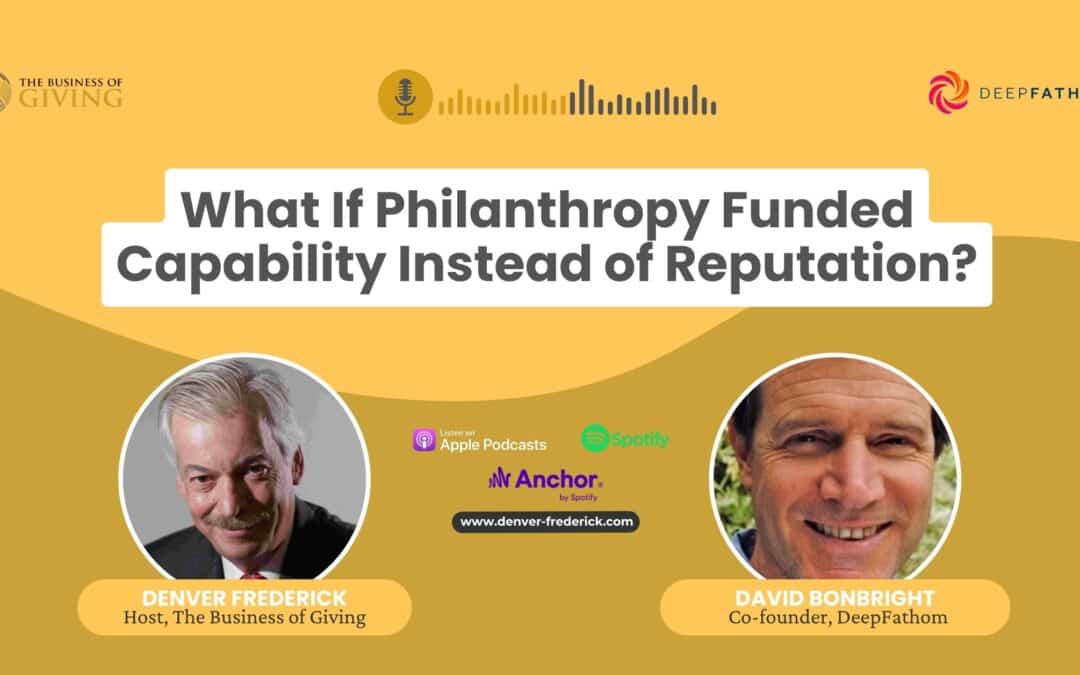
For decades, philanthropy has chased the illusion of certainty, funding polished proposals while starving the quiet, trusted organizations actually doing the work on the ground. My next guest has spent a career trying to rewrite those rules.
David Bonbright pioneered Constituent Voice—putting the people closest to a problem directly into the decisions of how to solve it. Now, through Keystone Accountability and DeepFathom, he is proposing something even more radical: shifting the social sector away from claimed outcomes and towards demonstrated capabilities. He even imagines a fictional city called “Humanville,” where famous legacy institutions get passed over, and the small, hyper-trusted local groups finally get funded.
Here is how he frames the hidden assumption at the heart of traditional grantmaking: “No grant maker would ever say, ‘I gave a grant to somebody who didn’t have the capacity to implement it.’ So that at some level, they think they’ve seen it, they just haven’t pushed it hard enough.”
We talk about the empirical mirror that changes behavior the moment people see their own data, why every honest measure eventually gets gamed, and a hard lesson David learned when he was declared persona non grata by the apartheid government in South Africa decades ago.
It’s David Bonbright on The Business of Giving
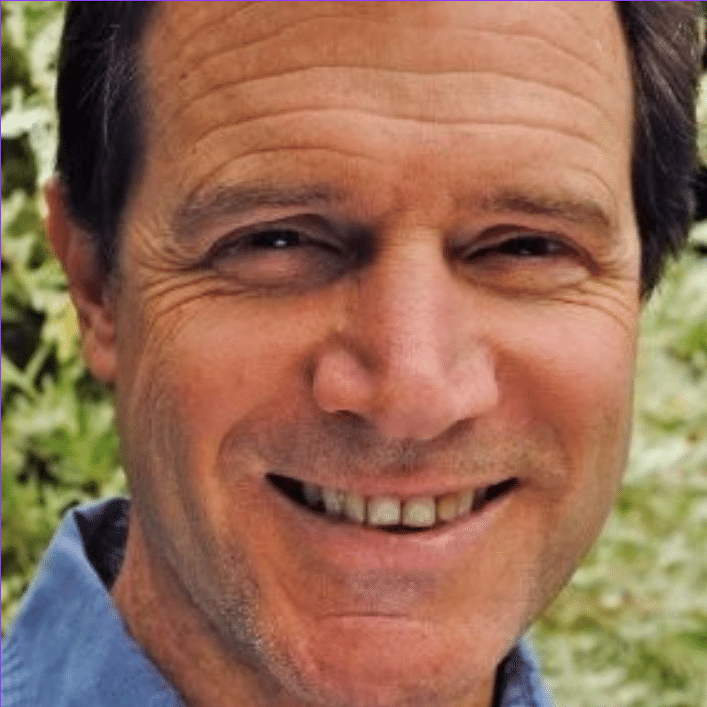
David Bonbright co-founder of DeepFathom
Denver: Welcome back to The Business of Giving, David!
David: Thank you. Wonderful to be with you, Denver.
Denver: You were a young grant maker when the apartheid government declared you ‘persona non grata’. What did that teach you, David, about who gets to decide whose cause is legitimate?
David: Well, I like your twist on that question. At the time, people would say to me, “Oh, what a badge of honor! The apartheid government has said you’re a bad guy, and you must be doing something right.” And yes, but what I mostly felt was, “Oh no! I can’t do my job anymore.”
Denver: A very practical guy.
David: And so, that was part of my answer to your question. I think my big takeaway from that is that there are things out there that are bigger than you that are setting the terms of the chessboard; pay attention to those and keep trying to be able to shape some of those things. And honestly, 40 years later or 35 years later, maybe we could have done more work to have relationships with the people in that government, where they wouldn’t have pulled my visa but said, “Okay. These guys are pushing for things we don’t like, but it’s better to be in this… we’re getting things from this and we’re learning with them.”
That was 1987. It was just two years later they started releasing people from Robben Island, and three years later they released Mandela and began the process. So, we were already at the beginning of the end, we just didn’t know it. And so, I think maybe the big lesson was to try to really build relationships at a deeper place than the immediate conflict that’s happening because there’s a longer story going on and a deeper story.
Denver: That’s an excellent insight.
You have spent years trying to get philanthropy to take “Constituent Voice” seriously, and you’ve moved the needle, but maybe not as far as you had hoped to do so. Looking back, David, what did you underestimate about why a good idea fails to change a system?
David: I think I didn’t appreciate how long it would take. So, we started the work in 2003, 2004, and 20 years later, we were really just starting to see more of a real uptake in practice. And if you’d asked me “Would it take 20 years to get to where we got to?” I’m sure I wouldn’t have started the journey.
“Constituent Voice is the notion that whatever problem you’re trying to solve, for whomever you’re trying to solve it, you will be most effective if the people that are living the problem and influencing the conditions of the problem are actively participating in giving voice to the solution.”
David: Constituent Voice is the notion that whatever problem you’re trying to solve, for whomever you’re trying to solve it, you will be most effective if the people that are living the problem and influencing the conditions of the problem are actively participating in giving voice to the solution… which means many different things– including in the narrow sense of our tools that we built– getting regular feedback from people about how the work was going and where they would like to see it go, and making sure that that gets embedded in the decision making, in the operations, and the interventions.
Denver: So, what do you think the resistance was to it? Do you think it was an inability to get people to change their behavior because they resisted it? Or inertia – that they just had so many other things on their mind that it just never rose to the level of: I’m-going-to-pay-attention-to-this-and-focus-on-it?
David: With something complicated like this that involves a real deep change in practice, and decision making, and accountability, and structure, which is what it boils down to, it’s always all of the above. And so, it’s about working through all those different dimensions.
I think the most uncomfortable one—and it’s frequently now spoken, but I’m not sure it’s as appreciated as it is spoken—is the mindset one: of ‘we know better’. It sits very deep in people who are well-educated, have resources, sit in structures, have put in a huge amount of time and effort to get to where they are, and by gosh, they should then be able to do their thing and not be told what to do.
I can’t tell you how many times people said to me, “Well, what do you mean by this feedback? Are you expecting people to then tell us what to do?” And I’m saying, “No, that’s not what you’re doing when you survey people and take the data or enter into a conversation. It’s not about that. It’s about being in a relationship where you’re genuinely co-collaborating around the way forward and engaging each other’s contribution, not just your idea.” And I just think people really struggle from a deep place in getting over themselves about that and moving into a more—my favorite word—”mutualistic” kind of relationship.
Denver: I would agree with that. I think that’s exactly what’s happening. I also think that they like things more set. They like certainty in their mind. And anytime you introduce some uncertainty or some fluidity, I think it throws people.
Well, you have now moved towards something you call Collaborative Systems Impact. What is it, and what does it do?
David: Well, thanks for teeing that one up. It’s my current passion. The arc of my work has really shown me again a resistance point that we sit, and we live, and we work in our organizations. And the default to be within the organization—and I’m going to use a term around—that the organization is a ‘silo’ within a system, is very powerful. And yet we all know that no single organization, and certainly no single intervention, is ever going to make the real progress on these problems. And that the challenge then, therefore, is to step out of our organizations and operate from the system around the problems that we’re trying to solve, which inevitably means working with others. And we all talk about that and we give lip service to it, but we don’t yet have the measures, certainly, but also practical tools and operating systems that counter our default to operate within organizations and to push us to really collaborate.
And so, the idea of Collaborative Systems Impact at one level is just a mental construct to say, “Guys, since we know that all effective social change is going to come from collaboration, let’s develop the modalities, the tools, the measures, and the practices and behaviors that will incentivize and drive collaboration, enable us to collaborate more effectively.” So that’s the essence of the idea – that we start with a new mental construct.
I always like to go back to the whole idea of social entrepreneurship, which was a mental construct that was introduced into the social change space in 1980. And until that day, nobody ever talked about social entrepreneurship, but the mental construct of having an entrepreneurial approach towards social change that was analogous to a business entrepreneur shifted everything. And now, we’ve got a huge global movement around that and supporting it, and everyone appreciates the power of social entrepreneurship as one way to do change. I think similarly, we need a similar kind of construct around this moment, this collaboration moment.
Denver: Have you found that there are certain people who are more inclined to embrace this collaborative moment, whether it be based on gender, or age, or population, or anything? Because it would seem to me that you’re going to have maybe some who are a little bit more disposed and others who, you know, ‘not in their lifetime’.
David: Yes. So, it’s a great question, and I’ve got a two-part answer. The first part is for me, this grows out of my formative experience in the South African liberation struggle, where the experience of pushing against dictatorial governments, the apartheid governments and the oppressive government, brought people together. And so, they did collaborate, and they did organize, and a lot of it was clandestine because it had to be. But it became a kind of virtue, this clandestine organization, and it had an attractiveness even because it was a secret. But it was the pressure that created the collaboration. And so, I saw that from the early days that it’s easier to organize ‘against’ than ‘for’, to put it that way.
Denver: Yes.
David: But then the other case that you see it—and for the last few years, I’ve been looking around the world for examples of living collaborative systems interventions that are trying to do collaborative system impact, and where you tend to find them is where there has been crisis, often natural crises.
So, one of the projects that I’m working with that is really beautiful is in Melbourne, Australia, called Regen Melbourne, and it’s a citywide initiative to reinvent the city of Melbourne around the principles of regeneration. And it was kicked off by the so-called ‘Black Summer’ when the fires happened, and people were responding to the massive fires and understanding for the first time the deep, deep, inevitable consequences of climate change on their world, and that they had to organize differently.
So, I would say, when you have something hard that you’re pushing on, that forces collaboration, and then the other is these crises. And there’s a whole genre of crisis response in civil society work over the years. Hurricanes, earthquakes, tidal waves – they all produced this fluorescence of social collaboration. And so, in a way, it’s like: How do we get the moral equivalent of that at this moment? Or maybe the world’s moving in such a way that we don’t have a moral equivalent… we have a factual equivalent.
Denver: We have a factual, that’s right.
Yes, you wish you could manufacture it. I could put this on a very, very small scale, but a while back I was stuck on a subway car, and we lost all power, we lost all lights. That’s not that big a deal in the scheme of things compared to some of the other things, but it was a microcosm of how people who were not looking at each other all joined together, all banded together, all started talking together, and you see that unity maybe when you have a common enemy here in the dark, or whatever it may be. And you just say, “Well, why can’t we cook that up? Why do we have to have those real circumstances in order to be able to produce it?” And then, of course, when it is produced among the population, how do you keep it? Can you keep it?
David: Exactly. Certainly, I don’t have the notion that we can artificially produce it, but I think what we can do is provide some principles and then practical tools that help people take the next step on something they already realize. And I feel like there’s a maturation in the field. There is a demand in practitioners, whether it’s in the funding world or the operational world of implementation and deploying projects, certainly in government, that there is a need to collaborate better. I think you’d find very few people that won’t say yes to that.
Denver: You won’t find anybody who’ll say it, but you’ll not find that many people who are willing to do it. It’s, unfortunately, more of a lip service thing. And even when I’ve been a part of collaboratives, people really have collaborated well, but when they go back to that silo you described a moment ago— that’s why sometimes you need a backbone organization or someone to keep people honest because we just retreat to our corners and go back to what our previous behavior was.
David: Fair point. And I think that’s right. And so, that brings me to the kind of jujitsu move that I want to make here, which is to hold up a mirror. So, when people are giving the lip service, you can show them, “Okay, here’s the extent to which you’re walking the talk,” and you make that hard to ignore. And that’s one of my big lessons from the Constituent Feedback and Constituent Voice work, was that once people had that data, they couldn’t unsee it. When they found that 60% of the groups that they were serving felt that they were not reliable, they had to go back into their corners and say, “Well, wait a minute. What’s going on here?” And so, how do we create an empirical forcing mechanism?
And I think that the second thing about this moment that’s really exciting is that when I started to do the Constituent Voice work 25 years ago, doing surveys was a much more expensive and complicated proposition, and analyzing the data was a very expensive proposition; a lot of time went into that. And now, the ease with which you can get feedback from people and the ease with which you can do the analysis using latest generations technology brings the cost down to a fraction of what it was 25 years ago. So very inexpensively, we can show people the behaviors in the system, and then they can hold themselves to account then for living up to what they’re professing they want to do.
Denver: And I think another piece of that, and I’d like to get your feeling on it is we are too polite in this sector. And that’s what happens when the mirror comes up. We just have people look at it and hopefully, they’ll see what we see, and they’ll take it from there.
And I think one of the biggest things that’s held back the sector is we’re polite. We’re a nice sector. We’re doing good work. And we’re going to have to stop being less polite and be more forthright, and let people know when they haven’t hit the mark that they haven’t hit the mark, and then take it from there.
David: I think that’s a fair point. I would rephrase it like this – that there’s been a hard-nosed element to the sector always but it’s been kind of somewhat masked, and that is the obsessive focus on the impact or the outcome results. And so, I want to do X in order to Y, and Y is what matters. But because of the inevitable time lag between what I do today and the outcome I’m trying to make in the world, whether it’s maternal health or livelihoods or incomes or whatever it is, that lag means that I’m never accountable in real time for how I’m doing.
And so, the very complexity in what we’re trying to tackle has kept us from facing up to what I think are the real-time things that we can see, that if we were held to account for, we would really accelerate toward those outcomes. And that’s some reckoning moment that hasn’t happened yet because we’ve never been able to agree on what that is that we should be focusing on today.
Denver: I absolutely see that. Let’s touch base with the status quo for a moment for people who are maybe listening. What information, David, does our current system systematically prefer, and what kind of organization has become invisible as a result?
David: That’s a really great, great question. That’s a core point for me. That’s a core organizing question to my work because every accountability model, which is in a sense what you’ve described to put a label over it, picks and chooses what evidence it chooses to be important. And out of that, it then ends up just doing what it does.
And so, the evidence that we are really focusing on now, it’s more the bureaucratic and technical information. These are all things that are important. They need to be done. So, everything I’m going to say now—I’m not saying we shouldn’t be collecting this evidence and using it. I’m just saying that it’s the evidence that we have and we’ve been relying on, and it’s not producing the results that they want. So, what we’re spending, what we’re doing, the actions, the immediate outcomes.
We trained 1,000 kids on this vocational skill, and six months later, 400 of them were in jobs. That’s a direct outcome that you can measure within six months of an intervention, and that’s all important. And then over the last 20 years, we’ve added the piece that I’ve really been beating the drum around, which is feedback from the people that are inside the problem. So, we’ve got these four data sets. But what we haven’t been able to see is how these things connect up to move the needle on the big problem we’re trying to solve because of this time lag thing and other reasons, and the complexity that’s inherent. So, that’s what we’re getting.
And what’s missing—to go to the harder part of your question—is the deep, relational social capital piece that sits underneath those things that is the real magic about whether or not this intervention is sustained. And this is often the work of more informal organizations, organizations that are closer to community, that are fully aligned with their local communities, where local leaders are standing up and are respected and yet the funding doesn’t get to them. It’s always the intermediaries that are coming in from the outside. And so, that’s absolutely essential.
And by the way, the intermediary organizations, the ones that are getting the money, they’re the ones that are leveraging that stuff that sits in communities. And so, they are able to tap it and use it, but the local organization isn’t getting built from the bottom up because the intermediary has kind of gotten in the way. Didn’t mean to, but that’s how the system works. So that’s the status quo as I see it.
Denver: That’s a good analysis.
You have said we face a gap we cannot spend our way across. So, if more money alone is not enough, what’s going to have to change in how money already in the system gets used?
David: And that’s the right way to put it, by the way, because when I’m saying there’s not enough money to solve these problems, I’m basically saying the money that we’re spending is going to the wrong things. We need to shift the system with the money that we have in order to get different outcomes.
And I think that the key thing that we’re missing that could—at least it’s my hypothesis—shift everything, is if we could get people to see and agree about the capabilities that we need in the system to solve the problem. For example, collaboration, which is my lead question, but the ability to orchestrate and coordinate multiple actors in a system around a problem in a coherent way over a sustained period of time: that is not something that we currently have good data about or that we measure or that we treasure. But if we did conceivably, we could then accelerate toward the outcomes.
So, this is my capabilities flag that I’m waving. And I’m saying there’s a lot of theoretical, interesting work that’s behind this as well, whether it’s at the individual level, the work on human capabilities of Nussbaum or Amartya Sen, or if you look at how theory and practice around management quality and management system quality works, it all goes to these capabilities.
And so, it’s something that we do, by the way, in the world of philanthropy and social change. We do it and we call it due diligence, and we do it at the beginning of a relationship. And we basically do a quick tick, tick, tick; they’ve got these things. But we do it at a very low level. It’s like they’ve got enough. And what we should be doing is at a very high level. We should be saying: “How do we move from a 40 on a scale of 0-100, which is the 40 that I need to make the grant, up to a 90 so that we really are there?” And I think that’s my suggestion about the thing we could be focusing on now to get the kind of evidence that we could then manage to, in order to accelerate to progress, to outcomes.
“I think it’s been because we’ve obsessed about impact measures or outcome measures, and not really looked at what’s closer to it… which is current behaviors in the system. Because current behaviors, including your own behavior, is sometimes uncomfortable to look at, whereas that impact score down there is somebody else’s problem.”
Denver: So, you want to move funding away from persuasive proposals and claimed outcomes towards these demonstrated capabilities. What becomes visible under that system that conventional philanthropy is particularly bad at seeing?
David: It’s not that traditional philanthropy is particularly bad at seeing it. It’s just that it hasn’t taken it seriously. No grant maker would ever say, “I gave a grant to somebody who didn’t have the capacity to implement it.” So that at some level, they think they’ve seen it; they just haven’t pushed it hard enough.
And I think the interesting question behind your question—it’s kind of what you’re really asking—is “Why is that?” And honestly, I think it’s been because we’ve obsessed about impact measures or outcome measures, and not really looked at what’s closer to it… which is current behaviors in the system. Because current behaviors, including your own behavior, is sometimes uncomfortable to look at, whereas that impact score down there is somebody else’s problem. It’s like the CEO who can implement like crazy but knows they’re going to be gone by the time the chickens come home to roost from what they’ve been doing. And so, we’ve got that incumbency issue that’s in the system.
“Social capital really matters, and the organizations that have it are often not the ones that are visible to philanthropy, but they are to the community.”
Denver: In your fictional city, the small unknown organizations qualify for funding while some large famous ones do not qualify for funding. Tell us about Humanville.
David: So, I told this story because I wanted people to see that—this point that we were talking about earlier—that social capital really matters, and the organizations that have it are often not the ones that are visible to philanthropy, but they are to the community.
And so, if you have an accurate tool that’s telling you about the important capabilities – and some of those capabilities are things like being trusted by the community, and having people in the community actually step up and do what they’re being asked to do or being invited to do – then the organizations that really have that capability become visible, and then you can then give funding to them if that’s the allocation rule. So, that’s the essence of this idea, and that’s what happens in my fictional story.
And by the way, that’s what happens if you’re a program officer at a foundation and you don’t do the usual thing, which is sit in the city, but you get off your rear end and you go out and you spend time in the villages, and you hang out long enough to find out who’s really trusted and who’s really doing it. But people are often in these roles where they don’t have the time to be able to do that. They’re not given the space to do that. What I’m arguing for is not something that a program officer couldn’t do. It’s just that they don’t structure their lives to be able to get out that far.
And I had this incredible privilege in my first job at the Ford Foundation in the 1980s to have that time. And by the time I was declared persona non grata, I really knew what was going on. I knew who was sleeping with whom, and what cars people drove, and where people were going out to have a beer. But the Ford was unusual in the extent to which it empowered its program officers to be in that, immersed in the reality of the place.
Denver: It’s great to get that insight that early in your career because it stays with you for the rest of your career to a certain degree, because you’ve known the importance of it and the value of it.
If you’re terribly successful over the next 10 years, and capability begins to determine funding more and more, do you get concerned that organizations will perform to capability, that they will simply create a new class of organizations that become exceptionally good at looking capable?
David: I think there’s always a gaming problem. I remember when I was doing the Constituent Voice work, I interviewed Rob Markey, who was one of the founders of Net Promoter Score in the customer satisfaction world, which became a huge successful tool that’s globally scaled. And I asked him about the gaming problem on customer satisfaction. And I always liked his answer, which was “Actually, we knew that we were starting to succeed when that started to happen because it was worth gaming for it.” And so, I’m putting that question into a good problem to have, and we’ll figure it out when we get to it. But let’s get to it.
Denver: Let’s get to it. I can remember a story you told me when we last got together about dog food. How do I remember a story like that 10 years later? It was about who would buy the higher-priced dog food? You said there was one tell, the thing that determined whether you’re a customer for it.
David: So, Purina wanted to know who their customer was for a higher-priced dog food. And none of the things people were coming up with would work. They asked people, “Would you pay more? Do you love your dog enough?” And so on and so on. The question that it turned out to be was, “Where does your dog sleep?”
Denver: What a great question.
David: It’s such a great question. Absolutely.
Denver: It tells you people’s opinions mean nothing, and their behavior means everything. Because we all say things, but you don’t lie about that. They either sleep there or not. And that’s why I think polls do so badly, because people either are yanking the chain of the guy, or they don’t know, or they don’t want to—but it’s behavior. It’s where you spend your time. That’s what you really like to do.
David: And by the way, that’s when you get into the mechanics of the tool that we’ve been building to measure capabilities, that’s what we look at. We look at behaviors, and then we map them to capabilities.
“…At the heart of it is we’ve moved from a kind of a performative “Fund-me-I’m-the-best” to a genuinely collaborative conversation about what’s working and what’s not. And how do we learn together and iterate together to solve the problem?”
Denver: I love your system. It’s ambitious, don’t get me wrong, but I find it intoxicating.
So, if we sit down 10 years from now and this work has fared even better than you expected, what’s actually going to be different about who holds power and how we decide what counts as progress?
David: Gosh. Now, I can do the kind of utopian description. I think it’s all different. People from different roles – implementers, funders, community leaders, professionals – that are contributing to the problem are all sitting together around the problem, continually reflecting on what they’re learning, and what they’re seeing, and where the tough problems are, and how they need to adjust to solve it. The organizations that are delivering, that have capabilities that are important, will be adequately funded in a very different way.
But basically, the principle will be as long as you can demonstrate you have the capabilities and do what you say you’re going to do, you’ll get the funding. It’s not up to the whims of the individual funder, and that means—going back to your what’s different—that most of the funding will be pooled funding around the problem, so you’ll make sure that you’ve got the pool full enough so that everyone in it can benefit. The government’s going to be leveraging private money. Private money’s going to be leveraging government money in the way that we always talk about happening in philanthropy, but rarely does. It’s really going to be there in that pooled bit.
So, those are the kinds of things. I could go on and on to describe it, but I think at the heart of it is we’ve moved from a kind of a performative “Fund-me-I’m-the-best” to a genuinely collaborative conversation about what’s working and what’s not. And how do we learn together and iterate together to solve the problem?
Denver: Finally, David, tell listeners where you’re at in this journey… and I know you’re in the early innings… and where they can go if they want to go deeper on Collaborative Systems Impact… where would be the best place for them to start?
David: Sure. Well, I’ve just launched a Substack on that, which maybe we can share later in the notes from this. The Substack’s called “The Missing Measure” appropriately enough, given this conversation. So that’s one place where this journey is going to be chronicled. I’m working with a small UK tech startup called DeepFathom, which has the tools, so that’s at deepfathom.co.uk, which is another place where we’ll be chronicling this and talking about the work. So, those would be the two reference points I think I’d point people to.
Denver: Sounds good.
Well, David, I want to thank you so much for being here today. It’s been a real pleasure to have you on the show. It was thoughtful; it was honest and genuinely useful, and I am so grateful you took the time to be with us.
David: Thank you. It’s always a treat to watch The Business of Giving unfold with you. Thank you, Denver.
David is chronicling his work on Collaborative Systems Impact in his new Substack, The Missing Measure. You can subscribe at davidbonbright.substack.com.
Every weekday morning at 7:00 a.m. Eastern, I publish a short Leadership Note from the Field. These reflections draw on fifty years in the nonprofit sector and nearly 1,000 conversations with nonprofit leaders.They are designed to help leaders step back from the noise, see the deeper pattern, and lead with greater clarity.A recent note explores a distinction I believe matters enormously right now.In philanthropy, don’t confuse headlines with forces.Headlines dominate the moment. But deeper forces such as the $124 trillion wealth transfer, the rise of women as philanthropic decision makers, and the growth of giving across the Global South will shape the next twenty-five years.You can read the full note, along with a new one posted every weekday morning, on my blog at denver-frederick.com or on LinkedIn.