

Most mentoring programs ask for a year, maybe two, and rely on volunteers who come and go. My next guest built something almost radical by comparison: a paid, professional mentor for every child, for at least twelve years, no matter what.
Terri Sorensen leads Friends of the Children, which selects some of the most vulnerable four- to six-year-olds in the country—kids facing foster care, homelessness, and deep poverty—and pairs each one with a mentor who stays for their entire childhood, tested now by a twenty-year randomized controlled trial. But ask her what actually makes it work, and she doesn’t lead with the data.
“I had a researcher once say, ‘I’ve studied all the data and the program, and I think the secret sauce is love.’ And to have a researcher say that, I’ll never forget it.”
We talk about keeping that promise for over a decade, scaling from one city to nearly fifty, and the young man who just graduated law school with his Friend still by his side.
It’s Terri Sorensen, CEO of Friends of the Children, on the Business of Giving.
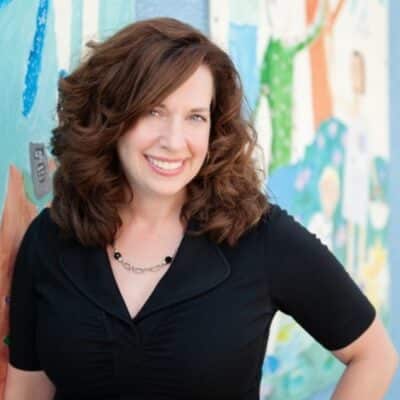
Terri Sorensen, CEO of Friends of the Children
Denver: Welcome to the Business of Giving, Terri!
Terri: Thank you. I’m excited to be here today.
“Friends of the Children – we select children aged four to six who face the most challenges, things like foster care, homelessness, low education rates in the family, and living in poverty. And we select them to have a paid professional mentor for their whole childhood, so 12+ years, no matter what.”
Denver: You know, for those hearing about your work for the first time, what is Friends of the Children, and who are the young people you partner with from the very, very start?
Terri: Friends of the Children – we select children aged four to six who face the most challenges, things like foster care, homelessness, low education rates in the family, and living in poverty. And we select them to have a paid professional mentor for their whole childhood, so 12+ years, no matter what.
Denver: Well, 12+ years is something. How did that idea ever arise? We know that all mentoring is voluntary, and we all know it’s for a duration of a year. You just mentioned you have paid mentors and you also do this for 12.5 years. Those ideas – where do they come from?
Terri: Yes. Well, about 35 years ago, our founder, who if this program had existed when he was a child… he would have been in it – parents in and out of jail, living paycheck to paycheck, often being left alone. And when he actually had resources for the first time, he hired a researcher to help with what would break the cycle and really have long-lasting impact for children who grew up like him. And that man’s name is Duncan Campbell, our founder.
It took two years to allow a researcher to really travel across the country and determine what programs were out there. And while he didn’t find the program that already existed to have this long-term impact, he knew the key elements, and that’s what formed Friends of the Children: selecting amazing individuals who often have similar backgrounds to our children, paying them as a full-time job to do this work. So, each of our Friends works with eight children and families as their full-time job. They’re paid a salary plus benefits, 401k—it’s really a living wage, and then staying for the long term… so starting early, aged four to six, and staying all the way through graduation of high school.
Denver: That is truly beautiful. And Terri, you see so few programs that align the vehicle with the promise. We want everything instantaneously. We think it’s going to be magic. It makes no sense. We all know it makes no sense, and we continue. And to see one who has actually looked at it through thoughtful eyes in terms of: If you want this outcome, it ain’t going to be the summer program. It’s going to take a little bit more than that.
When you’re recruiting someone for this core job who has, among the responsibilities, got to show up for over a decade. What qualities are you looking for when you screen those people which may not show up on the resume?
Terri: Our hiring process is very intentional for Friends. There’s a series of four to five interviews, and part of that is a test of the duration, and that those folks who already have a degree or equivalent experience working with vulnerable children and families are going to show up again and again and be with them for the long haul. We tell people when they’re going through this process, “If you can’t commit for at least three years, please don’t take this job because the children and families we’re working with have people letting them down all the time. They’re going through lots of transitions, and they really need someone who’s going to be there.”
And that actually has people opt out, which we appreciate upfront. And by asking for three years, the average “Friend,” which is what we call our paid professional mentors, stays five to six years. And so, we make a promise that your child will be in the program 12+ years; you will likely have two to three paid professional mentors or Friends. Sometimes it is the same person the entire 12.5 years. I’m happy to say we have many Friends who’ve been there 20-plus years. They’ve seen many kids graduate. But we ask for the three, and as a result, get five to six years from our amazing Friends.
Denver: That is amazing. Let’s stick with the Friends for a minute. How do you operationally support and retain people through what can be an intense developmental period of time with family issues and things of that nature?
Terri: When a person is first hired… a Friend is first hired at Friends of the Children, they go through our national training on the model, and that’s a week-long intensive training. And then thereafter, there is training every single month on activities related to a Friend, on the cultural aspects of the children they’re serving, of how to navigate various systems that our children are involved in.
Each Friend is on a team. And that team of six to eight Friends, they really work together on: What have you tried? What’s working for you? What might work for me? And that’s a key part of it, too. They’re very supportive. They report to a supervisor that they can go to for assistance and help. And data tracking is very intensive. We’re all about the progress of the child, and to do that, we needed solid data that shows that we’re really having an impact, both in the short term, medium term, and in the long term.
Denver: So, you’ve really built an internal support architecture, which sounds like exactly what this program needs.
Let me ask about the children. Do the children stay? Sometimes we forget about them. We think about “Will the Friend stay?” But do the children make it through the 12.5 years, or how does that unfold?
Terri: So, we have a 97% retention rate—
Denver: Oh, wow!
Terri: –year after year, which is pretty incredible. Typically, the only way a child leaves our program is if they move outside of a 30-mile radius. So, we are not place-based even though we have a place. As long as youths and their families stay within 30 miles, they stay in our program, and we continue to serve them as they change schools, homes, go into foster care, out of foster care. And I think that is one of the key things that leads to our long-term retention of children and families.
“By doing it in three-year increments, we found as long as we could continue to engage the funder or investor, show them the progress, they were more likely to renew when it was a three-year commitment versus a five-year or a 12-year.”
Denver: In looking over your materials, Terri, one of the things that stood out to me was how you must have exceptional balance sheet discipline because nonprofit leaders constantly wrestle with matching long-term missions to short-term money. So how do you financially architect a 12.5-year guarantee to a child when the vast majority of grant making arrives in those 12-month timeframes?
Terri: Well, I consider myself a recovered CPA. So, my background – I have an accounting degree, I became a CPA, I worked for Ernst & Young and in the corporate world – and it helps me every day in running a national nonprofit. I always know where we stand financially and know what needs to happen.
Early on, there was a question of: Do you get the funders to commit for 12 years? And again, much like I was talking about with the Friends where we asked for a three-year commitment, that’s what we asked for for funders. We’re a long-term program of 12+ years. Will you commit for three years in a multi-year grant? Whether that’s an individual, a corporation, government funding, et cetera. That’s what we really strive for. And by doing it in three-year increments, we found as long as we could continue to engage the funder or investor, show them the progress, they were more likely to renew when it was a three-year commitment versus a five-year or a 12-year.
Denver: You test things, you see how long you can stretch it out, and you say “That’s the number.” So, that’s how it goes.
Terri: Absolutely. Yes.
Denver: That’s how we roll.
Having watched these relationships unfold for more than two decades, what transformations only become visible in the out years – years eight, nine, and 10 – that a short-term evaluation would probably completely miss?
Terri: It takes quite a long time often to build trust with our children and families. So, I’ve had Friends tell me, “Gosh, I was showing up week after week for two or three years before finally, this child opened up to me and really told me what was going on and what he or she was feeling,” and that’s kind of a breakthrough moment. Sometimes you can see the impact even in a month.
I still remember a grandmother who was the foster parent for her grandchild. And after one month with their Friend, she said, “You know what? I see that my parenting hasn’t been as effective as it could be. And I’m seeing the Friend role model: believing in my grandson, showing up for him consistently, being his advocate, talking about all his strengths instead of all his outbursts or negative aspects.” And she said, “It has already made a tremendous difference.” And this was one month in, but more often than not, it can take a few years to really build that trust.
And then by the time it’s middle or high school, you really see a youth hitting their stride. They’ve been exposed to opportunities they wouldn’t have otherwise had. We work on finding their spark, which is their special skill or talent. And you really see that shine, and they can build on that in their next steps and their plan for the future.
“…out of that program data came our current long-term outcome results, which 90% of our youth graduate from high school or get their GED when most are the first in their families to do so. 96% avoid the justice system, and 95% avoid teen parenting. Those three outcomes were pivotal to showing that it breaks the cycle of poverty.”
Denver: That’s great. Well, I think the impact in human development sometimes compounds like interest. And it takes a while and you don’t see it, but it grows and it grows. And probably the other side of that, too, is that I think about all the things that didn’t happen in that child’s life, which are hard to measure because it’s measuring a negative in that sense that it never occurred, but that makes a big difference.
Well, what you have done is you subjected, I think, a deeply tender relational model to randomized control trials of all things and Harvard SROI studies. What made you willing to put something so human through that kind of hard-nosed verification? And what did the evidence finally prove, and what did it mean for the well-being and future growth of the organization?
Terri: Yes. Well, as I mentioned, we were founded based on research and two years of research. And so that has always been core to our model. I had a researcher once say, “I’ve studied all the data and the program, and I think the secret sauce is love.” And to have a researcher say that – I’ll never forget it. It was amazing. But I think knowing early on that we wanted the gold standard of research to prove that this model worked, so we have a randomized control trial that has gone on for 20 years.
Denver: That’s incredible.
Terri: It is incredible. And I’ve been there the entire time, which has been really interesting. I wasn’t sure I’d see the end of it. We’re going to have results coming out later this year so I can’t share publications and all, but I will just say: Out of that program data came our current long-term outcome results, which 90% of our youth graduate from high school or get their GED when most are the first in their families to do so. 96% avoid the justice system, and 95% avoid teen parenting. Those three outcomes were pivotal to showing that it breaks the cycle of poverty.
The studies have also shown some things we didn’t expect. We’re seeing that those youth who did enter foster care were in fewer homes and had shorter lengths of stay; substance abuse was avoided by being in the program, and better mental health outcomes. So, all of that is very encouraging, and there will be some formal academic journals publishing about this study sometime in the next 12 months.
Denver: Well, I’ll check them out. I’m very curious.
Terri: Thank you.
“…the secret sauce is love. I think love is pretty hard to measure, but I see it every day in our youth and the Friends and the strong relationships they’ve built… that’s the part that I think I’ve seen just stay for a long, long time, far beyond when Friends have maybe moved on to other jobs, and youth now have their own children and families. There’s still a bond and there’s still interaction just because of that relationship that started many, many years ago.”
Denver: Let me ask you another part of that. What essential dimension of a Friend’s impact remains entirely invisible to these studies?
Terri: Interesting. I’ll go back to the secret sauce is love. I think love is pretty hard to measure, but I see it every day in our youth and the Friends and the strong relationships they’ve built. It’s pretty hard to measure the strength of relationships. I think researchers do their best to come up with those factors, but that’s the part that I think I’ve seen just stay for a long, long time, far beyond when Friends have maybe moved on to other jobs, and youth now have their own children and families. There’s still a bond and there’s still interaction just because of that relationship that started many, many years ago.
Denver: So, there’s a real sense of genuine belonging, which is with the Friend, but also probably with their ecosystem and where they belong.
Terri: Absolutely.
Denver: You’ve grown this organization like crazy. I think you were at five locations, then 48. You’ve quadrupled and gone beyond that. Tell us a little bit about scaling. I know you wrote an article on SSIR. I actually read it when it came, back in 2019. Talk a little bit about scaling without dilution and some of the tips because we have a lot of organizations out there probably thinking “I’d like to scale, and this woman certainly knows how to do it.” What do you have to say about it?
Terri: When I took the national role, because I ran our founding chapter in Portland for 12 years and then took the national role, so I really knew what it took to run a chapter. And I would just go to folks like Bridgespan and board members and others, and people would tell me, “This model is so intensive, so long term, so expensive… it can’t be scaled.” And enough people told me that, I was determined to do it.
Denver: Well, absolutely. You needed a little motivation, they gave it to you.
Terri: Yes. So, we set about, and our vision was that every child who needs a Friend would have one. And that remains our vision today. It’s a tough vision to achieve, but that’s really what we set out to do.
And I was really fortunate to have a board member who was a venture capitalist. And he said, “You know what? Let’s launch a $25-million campaign to grow this program and scale it.” And I really thought he was kind of nuts because at the time, our national budget—and each chapter is a separate entity, so just our national budget was like $1.8 million. And I’m thinking, “Launch a $25-million campaign?” But we did. And I just said, “I’m going to trust this board member. ” The board all approved it, and “Let’s go for it.”
So, one of the first pivotal moments was we had an investor who’d been giving about $100,000 a year. And I asked for $5 million to create an endowment to ensure there would always be a national to scale and provide the training and be the hub. And to my surprise, he wired the money. So that showed he believed in our business plan to scale this model, so then I felt more confident.
We went for a social innovation fund grant in 2014. Those were public-private philanthropy fueled by government dollars, and we didn’t get it the first time. But again, pleasant persistence. We went back the second year, and we got a $4 million social innovation fund grant to scale our program. That had to be matched with another $9 million of private philanthropy that we had to raise. So, we did that in less than a year. And so, we were off and running towards that $25-million campaign.
And so, we added seven sites through that social innovation fund growth, and then two of those sites were Charlotte and Chicago. And I had just an inquiry to our info@friendsofthechildren email that said, “Hey, I have a donor who might be interested. Can you talk?” And this was from Rockefeller Philanthropy. So, I did the call, and nothing was shared about the donor, but I told him all about our business plan, our expansion plans. Three months later, I found out that Rockefeller was vetting us for Michael Jordan, the basketball legend, and he donated the proceeds from “The Last Dance,” a multi-million-dollar, multi-year commitment that allowed us to expand further.
And we closed out that $25-million campaign and then launched a $50-million campaign… back to our vision about every child who needs a Friend would have one. And fortunately, Mackenzie Scott closed out that $50 million. So, we’ve had some luck as well as just being pleasantly persistent, and our growth has fueled more growth and more investment.
Denver: Well, if there’s a lesson to be learned from that is that every good nonprofit has to have at least one crazy board member. You got to have one. And sometimes we don’t take ourselves as being as important as we should, and we just don’t, but when you did it, that guy or gal who gave you $100,000 said, “Oh, they’re finally thinking about this at the right scale. This is a league I operate in. Here’s $5 million.” That’s amazing.
Terri: Yes.
Denver: So when you enter a community, what have you learned that you can just simply copy and paste, maybe from the founding site in Portland? And what must be rebuilt locally from the ground up?
Terri: Well, first, we only go into communities that have invited us in. And I think that’s very important. And we found through trial and error we couldn’t just say, “Hey, I want to go to Atlanta,” and then start to meet with people and go. It really is communities who express interest in us, and then there’s some criteria around that.
We were getting calls every week about folks wanting our models, so we would go back and say, “Hey, in addition to a champion like yourself, we need at least $250,000 committed before national will get involved and do a little bit of feasibility on whether your community can support the Friends of the Children model.” So that’s a little bit about how we go into a community.
But then we know what is tried and true to the model and has to be true everywhere, but then there’s a lot that can be localized. Different chapters depend on different funding. For instance, LA is very heavily county-funded, which is unusual for us, but it’s really worked there and has been amazing. LA will be our largest chapter by the end of this year. Whereas in a place like Austin, Texas, there were young tech executives, 50 of them, who made up the $1.5 million we needed to launch a chapter in Austin, and that remains really strong through diversified individuals who really cared and wanted to make a difference in their community.
So, there are adaptations, less on the program side and more on the funding side. However, I will say in the last five years, we’ve really made great progress in indigenous chapters in Indian country. And that was at a request of some of the lowest outcomes occur with children who don’t have a lot of hope and are maybe living on a reservation. And we have adapted the model in some ways to be more culturally appropriate for different communities as well, like in the case of indigenous youth and families.
Denver: Let me ask you, maybe this hearkens back to your CPA background, but I’d be curious as to how the organization readied itself for these kinds of infusions of cash. Most organizations that I know who are at $1.8 million, if somebody came with five million or an SIF fund at four million or $44 million or whatever it may be, they wouldn’t know what to do. But clearly you had certain things in place, and they were in place in such a way that these funders were able to recognize and identify that this is an organization that can absorb this money because they know what they’re going to do with it. Tell us a little bit about that process.
Terri: It’s a great question because I tell all of our local executive directors, “Every one of you should have an answer when an investor asks you: ‘What would you do if I gave you $10 million?’”
Denver: If you don’t have an answer, you’re never going to get it.
Terri: That’s right. So, I’m a big believer in business plans. In fact, we were less than $1.8 million when I first started at national. And we wrote a business plan on how we would scale, and we entered it in a competition in New York City. And we placed in the top three in the first year. So again, pleasant persistence. We went back the second year with some more pro bono advice, pitched it, and we won.
I’m a believer that business plans, you don’t create them and they sit on a shelf. You’re constantly asking yourself: Does this investment fit in with the business plan? And if it doesn’t, you shouldn’t take the money. But if it does, it allows you to really have your hopes and your dreams and your scale outlined, and what it’s going to take to get there.
And so, we really thought through all of that with the business plan, so we were ready for some big investment. And we didn’t shy away from it. I think you also have to be fearless.
Denver: And these funders recognized it. So you must have been out there, or when they approached you, you had all the answers.
You know, Terri, you’re doing this for more than 20 years and proving what multi-generational change actually requires: What is the single most uncomfortable truth traditional funders still refuse to hear about their own grant-making habits?
Terri: Well, I have to say, investors like Mackenzie Scott, who trust the leaders of nonprofits to do what they know needs to be done is some of the most– it’s just such a gratifying investment to know that funders don’t really have the scaling experience, most of them, of having run their own nonprofit and scaled it, and therefore, I think some of the priorities don’t necessarily align with the general operating funds you need, or the freedom you need to do what you need to do to make it a success. And I just think too many funders still box nonprofits in with “I gave you the money for this, and this is what you need to do.”
Now, there are some great ones out there. I’ll use Margaret A. Cargill Philanthropies as an example where they ask, “What are you learning? And what hasn’t gone well?” And we have such a trusting relationship that I can share that, and they’re willing to pivot with us. And I wish all funders would do that.
Denver: There’s an incredible dance going on that is really counterproductive because we go in there, too often… nonprofits say, “Our overhead is 9%,” and the funder knows you’re lying, and you know you’re lying, but everybody’s trying to get renewed for the next grant. And it’s just like a circus. It’s a charade, as opposed to having a real honest conversation. And I just wonder why we never talk about risk in this sector. If I went to my financial advisor and they gave me some options, I’d ask them or they’d tell me what the risk was. But we act as if every proposal we make to a funder, “100%, this is going to work.” You know what I mean? And never talk about it. And it’s just all that’s left unsaid that really prevents these honest conversations.
Terri: Yes, for sure.
Denver: Finally, Terri, when you step away from, I don’t know, about a $100 million budget getting close in your 50 chapters, and in the national data–just picture for a moment as I know you do—one child walking across a graduation stage with their Friend beside them 12 years later. What is a generational story that has actually been rewritten?
Terri: Well, I’d actually like to share a real-life story of one of our youths who walked across the law school graduation stage this May, a young man named Enrique, first in his family to graduate high school, then college, and now law school. And his Friend, even though his Friend has not worked for the organization for the last 10 years, was there to celebrate his law school graduation. This young man graduated from Gonzaga Law School and has a job clerking for the Supreme Court Justice of the Washington State Supreme Court that he starts this fall. And who could have imagined? Certainly, he could have not, we couldn’t even. We are just hoping folks break the cycle of poverty, and have a living wage job to support their family and their life going forward, and really haven’t broken that cycle. But to see someone like Enrique graduate from law school and what that means for his family, both his parents, his siblings, but the generations to come… it’s monumental.
Denver: Yes, and to our communities. What a great note to end on. For listeners who would like to learn more about Friends of the Children or financially support the organization, tell us about your website and the kind of information they’ll find there.
Terri: Please come to friendsofthechildren.org. There’s information on our model, on all our locations across the country, and the impact that we’re having, and lots of stories, too. It’s great reading, and please come check us out.
Denver: Well, you are having significant impact, that’s for sure. And I want to thank you so much for being here today, Terri. It was a real pleasure to have you on the program.
Terri: So nice to meet you, Denver. Thank you for having me.
Every weekday morning at 7:00 a.m. Eastern, I publish a short Leadership Note from the Field. These reflections draw on fifty years in the nonprofit sector and nearly 1,000 conversations with nonprofit leaders.They are designed to help leaders step back from the noise, see the deeper pattern, and lead with greater clarity.A recent note explores a distinction I believe matters enormously right now.In philanthropy, don’t confuse headlines with forces.Headlines dominate the moment. But deeper forces such as the $124 trillion wealth transfer, the rise of women as philanthropic decision makers, and the growth of giving across the Global South will shape the next twenty-five years.You can read the full note, along with a new one posted every weekday morning, on my blog at denver-frederick.com or on LinkedIn.