
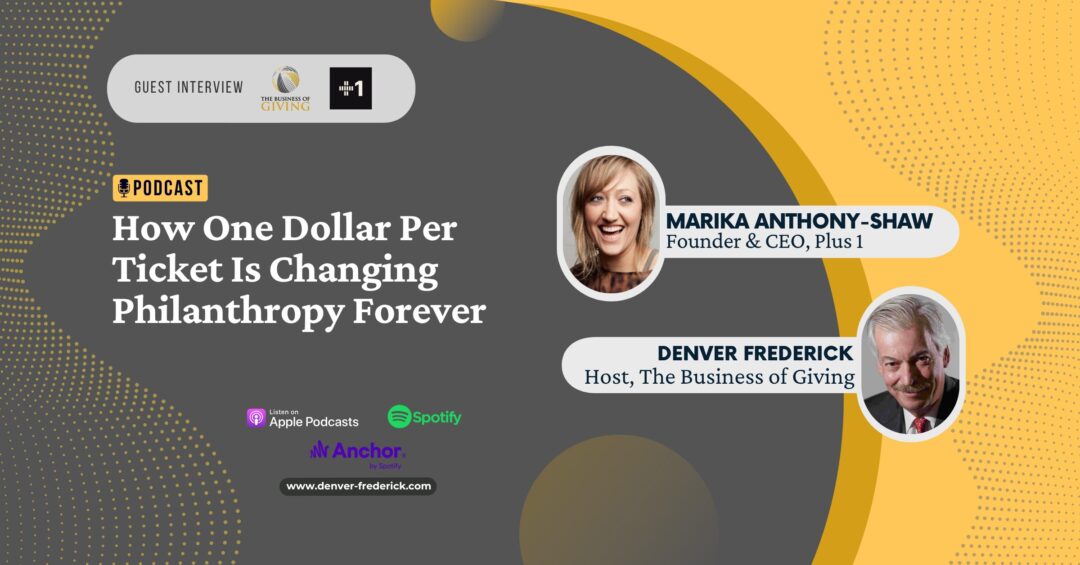
When Marika Anthony-Shaw was touring with Arcade Fire, the band started adding a single dollar to every concert ticket—sending the proceeds to Partners in Health’s work in Haiti. Night after night, that simple gesture grew from $3,000 to $10,000 per show. Over nine years, they contributed more than $2.5 million without asking anyone for money. The question became: Why isn’t everybody doing this?
That question launched PLUS1, an organization that’s now embedded philanthropy into the architecture of live events. Today, Marika leads a movement that has raised over $32 million for more than a thousand nonprofits—not by disrupting the concert experience, but by making generosity a seamless part of it. As she puts it:
“That simple $1 had real impact. It was funding trainings for community health workers in the middle of Haiti. It was going towards building the largest teaching hospital in the Caribbean.”
Join us as Marika shares how PLUS1 is changing the way an entire industry thinks about giving—and how every dollar invested in their model unlocks $21 in grants to communities that need it most.
It’s Marika Anthony-Shaw on The Business of Giving.

Marika Anthony-Shaw, Founder & CEO, Plus 1
Denver: Welcome to The Business of Giving, Marika.
Marika: Thanks so much for having me.
“And so what we were really good at was convening people every night. And so we decided to add this dollar to our tickets. It’s what we knew how to do best. It allowed for a simple infrastructure for us…And that simple $1 had real impact.”
Denver: PLUS1 began with a simple but powerful idea: One buck from every concert ticket could change lives. Can you take us back to how that idea got started?
Marika: It got started many years ago. I was playing on stages as a musician in the band, Arcade Fire, and our lead singer was from Haiti. And we had this great intention as our audiences grew, and as our shows grew, and as the band’s popularity grew: How can we do what we do best to help communities that we really care about?
And so what we were really good at was convening people every night. And so we decided to add this dollar to our tickets. It’s what we knew how to do best. It allowed for a simple infrastructure for us. We partnered with the organization Partners in Health in Haiti, and night after night, this simple $1 grew.
And it was from $3,000 a night, to $5,000 a night, to $10,000 a night. And soon enough, we were selling out Madison Square Garden. And that simple $1 had real impact. It was funding trainings for community health workers in the middle of Haiti. It was going towards building the largest teaching hospital in the Caribbean.
And over the course of those nine years that I was playing in that band, we were able to contribute over $2 & ½ million dollars to Partners in Health without asking anybody for money.
Denver: Fantastic. So you’re piloting an idea without even realizing at the time you’re piloting an idea.
Marika: That’s exactly right. It was this kind of moment, and so of course the question was: Why isn’t everybody doing this?
Denver: Of course. It’s so natural.
Marika: Right?
Denver: I mean, why didn’t anybody think of this?
Marika: And the real insight wasn’t actually the dollar, but the real insight was the missing infrastructure around that: the compliance, the education, vetting, operations to kind of make it all happen. There were these barriers.
And so we had friends and other bands say, “Hey, Marika, can you help me do this too? Can you help me do this too?” And so what we would call planting seeds ended up being really natural.
But really, PLUS1 came out of those conversations of… first of all: Why isn’t everybody doing this, and what are those infrastructure needs to ensure that artists can feel safe, can feel accompanied, can also continue to do what artists do best and convene people; knowing their philanthropic passions, that they can act with confidence, and that the communities that they want to serve can really see measurable results.
Denver: Yeah. I’ve never found those infrastructure ideas in and of themselves to be that daunting. But the idea of them, if you’ve never done it, is enough to say, no, I can’t do that. But once you get into it, I mean, it’s not easy, but once you get the system down, and you realize that: This is a roadmap here… I can get this done, it is amazing.
Well, you talk about changing the architecture of live events, not just adding a buck on top. How do you make that shift from charity add-on to really built-in infrastructure?
Marika: I think before PLUS1, artists who wanted to give back, they faced these barriers that I was just talking about– compliance complexity, a lack of vetting, no infrastructure for ongoing relationships with nonprofits, understanding what impact did they have.
Is the effort that I put in worthwhile? Is it serving the communities that I want to serve? How do I help communicate that with my audiences? What do my audiences care about? So I think PLUS1 really sits in that gap. We connect in the word “architecture”, but we really make it seamless for artists to act on these values. But we ensure that these funds flow to vetted nonprofits.
We work across the business practice, so between live shows, between brand partnerships with digital opportunities, with fan engagement opportunities. So we really integrate across the career or the architecture, as you say, of an artist, to make sure that that word “seamless” or “simple” can be acted upon, but also trusted and really effective, both from the artist side as well as the nonprofit sector.
Denver: Yeah, friction is the worst word in the language. Every time I run into something, even sometimes filling out forms, you go until you finally hit a roadblock and you say, “Oh, I’ll come back to it later.” And three weeks go by before… but if you could remove that friction, many things can happen.
Let’s talk about your audiences. You said you don’t have to be a billionaire to be a philanthropist. Have you seen fans begin to see themselves as givers because of this model?
Marika: I think fans begin to see themselves in these moments. I think it’s really important that we see artists that are, you know, here we are at PLUS1. We have partnered with 400 artists across the industry, thousands and thousands of shows. We’ve granted $32 million. Those numbers can seem really big, but what they really are is these individual moments collectively.
And so I think when fans start to see themselves as dollars, it’s that the actions that we take to be together in community are meaningful. And they’re meaningful for that moment and those 90 minutes that we share air together and sing together, and spend moments and live events together and really have that human connection. And it lives on outside of that room as well, into the communities that are getting meals, having safe haven, feeling supported beyond that.
So I wouldn’t say it’s a Big P philanthropy, but I do think that as artists start to engage with PLUS1, they are philanthropists, but they’re also living by example, and they’re bringing in their communities so that we can all say to each other and to ourselves: These dollars, these simple actions, these simple moments actually do turn into something bigger than the sum of their parts.
Denver: Yeah. I asked that question in some ways because I headed up the fundraising campaign to restore the Statue of Liberty and Ellis Island. And at the end of it, I don’t think I ran into a single person in America who I asked, “Did you support the campaign, the Liberty Centennial?” And every single one of them said Yes, because there was probably some way they felt they’d made a difference.
Maybe they flew on American Airlines who was a sponsor, or whatever it is. And I think that is so important, particularly at a time when less and less people are giving. If you feel like you’re giving and you’re doing something… which you are, you’re inclined to do more and more of it. And it sounds like you have a model that does some of that.
Marika: And when it feels good… I was at a show the other night in New York City, at Radio City, and when the artist chose to say something from stage for her audience, she said, “Just by coming tonight, you’ve made an extraordinary difference for people that need it.” And she announced this. And she’s an incredible artist with a devoted fan base, and it might have been the loudest cheer of the night.
Denver: Yeah.
Marika: Because people are implicated in something that’s bigger than themselves, and we need those moments of hope and togetherness. And it was really powerful.
Denver: Yeah. Yeah. They feel like they’re part of a community too.
Marika: Absolutely.
Denver: So much of giving can be isolation. You’re isolated. I never thought that text giving would take off because you do something on your phone and nobody knows you’ve done it, and nobody sees it or whatever. And often when you can do it in a forum with a lot of other people, that sense of community, particularly for younger generations, I think is more important than ever.
Marika: Yeah. What we’ve built is interesting too because there’s not a single community or corner of North America that one of our artists doesn’t touch. And so it’s hundreds of cultural influencers, but their audiences are everywhere, right? So they are in New York City and they are in L.A., but they go so far beyond that because of the hearts and minds that musicians… that place that musicians hold in our lives too.
So that sense of community that you bring up really is much broader than just one audience for one night.
Denver: Absolutely. $1 per ticket model, unbelievable. But you also support nonprofits in other ways. What else do you do to strengthen these organizations beyond sending them a check?
Marika: I think there’s a couple different ways. As we talked about, we’re really changing how an entire industry thinks about giving. So yes, from the artist’s perspective, we’re making it normal. We’re making it expected even that tourism and cultural moments include a philanthropic component.
But at the same time, nonprofits are gaining access and opportunities to connect with massive and engaged audiences… maybe many nonprofits who don’t have this incredible visibility or marketing infrastructure that would rarely get an opportunity to connect to an audience like this.
So at a baseline, nonprofits are getting access to new communities, and so are funders. There’s a catalytic kind of philanthropic investment that happens with PLUS1 as well… and we could maybe talk about that… but getting access to these communities far beyond what you could normally get access to is a huge part of what we do.
We’re able to, I think, Diplo’s a really wonderful example. We have so many examples that I’ve just tried to think of one, but…
Denver: You’ve got 400. I don’t know how you pick one out, I know.
Marika: But we have Diplo, and Diplo has this incredible program called Diplo’s Run Club and connected to a nonprofit called Good Sports that provides afterschool sporting opportunity for kids that don’t have those opportunities across the country.
And you have this extraordinary organization that is creating infrastructure for sport for kids every day. And then you have this artist who has a very different audience than that normally, but unlocking this visibility, this support. The other day we were watching… Family Feud came on, and he mentioned Good Sport on Family Feud.
And so you have these very disparate kinds of moments come together that have been incredibly, you know… We just hear from nonprofits all day, every day that they couldn’t get access to a ripple effect. Often, they have new funders that they wouldn’t have before. They have new monthly donors that they wouldn’t have before.
They’re buoyed by, Wow, there’s all these people that we’d never met before that support us in this hard work that we do every day. And so there’s a number of levels too that these nonprofits, I think, are just getting that connection through artists, through cultural infrastructure, and through important financial means.
Denver: Yeah. That is wonderful. There’s always a phrase used in the nonprofit community that you have to be “findable and fundable.” And I think when you speak to a lot of nonprofit organizations, and particularly those that are doing some wonderful work, they are so eminently fundable, but they’re not findable.
There’s 2 million of them… a million and a half, and if you can break them out of that silo that they’re in with the same kind of funders into a different arena, that is priceless. It really is. And to make them findable is just fantastic.
Marika: Thank you. It’s a really important part of what we do is make sure that those are the nonprofits that are visible to the audience. PLUS1, us ourselves, we almost try to sometimes stay in the background so we can really highlight and spotlight these nonprofits on the ground that we’re partnered with.
Denver: Let’s talk about the artists a little bit. What happens if they, let’s say, come to you with a cause that they care deeply about? How do you know it’s truly a good fit and maybe not just something that looks good for them?
Marika: So I think a tremendous part of our work is working with artists and being able to unlock with them what matters to them in this moment. And another huge stream of our work is staying up to date, like you said, with what’s out there, what might be more visible organizations or less visible organizations, but really doing that important work on the ground with the communities.
So for us, it’s really important too that artists… anybody, but cultural leaders too have such an important perspective on how we’re Interacting with one another, how we’re interacting with the public. They’re mirrors for what’s happening in the public most of the time. And they’re North Stars for a lot of people, like when I reference– They’re in our hearts and minds, they’re in our living rooms, they’re in our bedrooms, they’re in our kitchens.
And so when an artist comes to us and says,” I really care about affordability right now, I really care about providing meals to communities,” and so over the last little bit, we can then come up with and look at the routing of their tour and work with them. And we have 1,200 vetted local partners across the country that we know are doing extraordinary work in this space.
And then we can also ask them, Who is doing really important work that maybe doesn’t have access? We’ve had nonprofits be some of our best advisors on what might be worthy of this. So when artists come to us, it’s our job, we take it really seriously to accompany them in this journey. Many artists have their first experience with philanthropy through PLUS1. Because PLUS1 exists, they take their first step.
And so we work with them on that side by side, and we’re able to iterate. For a first three-week tour, we’re able to create a strategy with local nonprofits. I’m thinking of a lot of local food security initiatives. Over the last couple years, we’ve been able to provide… one tour one night will provide 10,000 meals occasionally to that city, and you multiply that by 6, 7, 10 artists touring at the same time, we’ve got millions of meals being provided to people all over the place.
So for artists, I don’t see it so much as like good/bad… what you want to do is bad, but let’s help shape that into something that we also know is going to be really useful to folks on the ground. And artists are no… Denver, I hate to kind of use that cliche line of like, artists are the same as you and me, but people want to be helpful and want to be useful, and want to make sure that their actions mean something at the end of the day. And so that’s the connection place that we have with them.
So it’s not really about saying something is more, or less worthy necessarily, but bringing opportunities that they might not be aware of as being, or organizations, or some strategic help that can say: Given where you’re going, given the kinds of the dollars that we’re going to be able to donate, this is going to be something that’s tremendously helpful.
Denver: That’s right. And you know this better than I, but artists usually are a little bit ahead of the curve. So things that I’m reading in the paper, artists are usually just a little bit ahead because they have their ears to the ground.
I think part of it is their creative impulse, and part of it is that they’re just around a lot of people, around a lot of places, and they’re great observers and they can see things happening before I think many people in the general public can.
Let’s talk about a case study, and how can you do any better than Sabrina Carpenter as your case study, who raised a million dollars in under a year. I think that’s probably the fastest that’s ever happened for PLUS1 with a single campaign. Talk a little bit about what made that possible, whether it was the message, the partner, the activation. But what drove this huge lift?
Marika: So I think, I mean, she’s an extraordinary artist. She’s incredibly talented. She’s also brilliantly smart and has an incredible team. And so in less than a year, like you said, Sabrina’s fund raised over a million dollars for mental health, for LGBTQ rights, for animal welfare.
And this really came because Sabrina and her fund integrated so many aspects of her business. So we did the ticket add-on, we did some fan engagement, we had partnerships with brands. We kind of integrated across digital partnerships as well. And so because of the opportunities that she had coming to her as an artist, as somebody in the public eye, she really was thoughtful, and we really worked closely with her to be able to unlock additional funding.
So it was about being really innovative across: How is her business looking for the arc of the whole thing, and where are the pieces that we could plug into, and again make it frictionless, and ongoing, and consistent across all of the things?
Denver: You also bring some experiential activities to these venues, one where you brought adoptable animals into the show. Tell us about that. That is so cool.
Marika: So as an artist myself and as someone who toured for a really long time, I understand touring can be difficult, and it can be a real slog.
And so what Sabrina did, both in terms of us thinking through: You have a long tour, you have a lot of people working really hard, you really care about mental health and you care what’s happening, we were able to care for her crew and her staff where local shelters were bringing in emotional support animals backstage.
And her crew were able to play with the young puppies and have this incredible moment together and these adoptable animals and share them with their audiences. And so that was an integration, I think, to have the animal adoption lounges. And we’ve started doing them more publicly as well, where it’s just… it’s something that’s nice to do. It creates visibility. Animals get seen.
But it also kind of overlaps with that mental health support for the people that are behind the scenes in working with her.
Denver: Yeah. Yeah. You have a ripple effect for every buck. There’s $21 of activity that generates from that. Tell us a little bit about that multiplier, about that ripple.
Marika: Yeah. I think this is something that can even confuse, often confuses our funders as we’ve granted $32 million. So why do we need philanthropic capital as an organization?
Denver: Yeah. Why?
Marika: And… pardon?
Denver: Why?
Marika: Yeah. Well, the answer is that 10% of the artist campaigns is what we retain, and that helps offset our already very lean operating costs, but it doesn’t fully cover them. Every dollar of philanthropic investment that we receive currently generates $21 in grants to nonprofits.
Denver: Wow.
Marika: And so I think there’s an opportunity that foundations can tell us that their biggest challenge is reaching certain demographics.
A single tour can touch 50 plus communities in a season, so we have this relationship with our funders where as we grow, our current projections are that with some catalytic funding now, we can grow that ratio to $87 and $90 per dollar invested. So funders can almost use PLUS1 as a multiplier for their own impact.
Denver: Yeah, yeah. A lot of leverage there. And I think it’s a new way philanthropy is being done, and I think a lot of the funders who are traditional probably haven’t caught up to how this new model is going to work. But I do know from my experience, sometimes being… and you’re much more than this, but a backbone-operation organization, I mean, you make the trains all run, so to speak. You make all this happen.
And often, people just don’t want to fund that. They want it to be funded, but they want somebody else to do it because they want to do the meals. And you realize that there wouldn’t be any meals. And actually, if you funded this more robustly, there’d be a lot more meals. So you’ve got to think a little bit more long term and recognize it.
And I think funders are getting more sophisticated to do that. And I think as your model begins to roll out, more and more people are going to appreciate it.
You’re a bit of a translator. You speak the language of artists, and you speak the language of funders and nonprofit organizations. Tell us about that translation process because sometimes you’ve got one over here and one over there, and you’re in the middle, and you have to basically let them know what the other guy is saying.
Marika: Yeah. I think it’s a place that we sit in the middle, in that gap that we feel is, in fact, that dual fluency. And the world of touring and the world of the music industry and the entertainment industry is definitely a world that has a certain language, and different priorities and understanding what those priorities are.
And when you’re launching a tour, there are a million decisions that need to get decided… and priorities and timelines that are very different than in the nonprofit sector. And in the nonprofit sector as we know, just the acronyms alone, we can really get buried in that.
And so we see that as a really important part of the trust that we build on both sides, is being able to have that dual fluency, is being able to build that trust and have that trust on: this was built by an artist initially in that world, but also one where the long-term understanding of the work of nonprofits, the priorities of nonprofits.
Too often, we have grassroots leaders or movement leaders… an artist will take 10 seconds out of their show or 30 seconds out of their show to say something, and then we’ll get a call from a couple years later and say, if they’d taken that 30 seconds to say, I’m going to give you an example… I’m not going to give you an example because I don’t want to call anybody out.
Denver: Well, give us a hypothetical example without using the names.
Marika: But I think, we have a history in the entertainment industry of wanting to be really helpful, but not always knowing what is going to be helpful that we’re going to say. And so we want to talk about the environment and we want to talk about all these things.
And so we’re going to take 30 seconds, and we’re going to talk about plastic straws. And then I’ll get a phone call from someone that’s an environmental leader or a climate change leader and say, “Ah, if only right now there’s this like really big movement. And if only they could have had, if we could be shifting the conversation.”
Denver: Yeah.
Marika: And so what we do is we help the leaders translate what they need, into if artists are going to take 10 seconds, 20 seconds, 30 seconds, to be really authentic about what they’re going to say. And maybe they’re not even going to talk about that.
Maybe they’re going to be on hot ones, and they’re going to know how to talk about the communities that they want to serve. Or what’s really important in society right now and what are the communities? What do they actually really need right now.
If we’re talking about mental health support: How do we get the public literacy more aware of mental health first aid? And how we can kind of drive people to trainings on that and drive younger people on trainings of that? And not only have the conversations, which are very important about crisis and suicide.
Denver: Yeah. Yeah, yeah.
Marika: But there are so many other conversations that are going to be helpful. And so we see part of our work too, is educating artists and cultural leaders on: Here are some of the conversations that are really helpful right now to the movements that you want to serve, that are really helpful to the difference that you want to make. Because it’s never without good intention, right?
Everyone who’s going to say something wants it to be useful and helpful at the end of the day. And so we see that dual fluency really as helping kind of bring: What are the values right now? Where is the public literacy? Where could we help lift up some of these messages that might be really useful to people as we move forward? And then how can we help prioritize through these trusted messengers and cultural leaders?
“So our goal is, as translators, to really help artists feel empowered and educated about what’s important so they can speak to it in their own voice, to their own audiences in a way that’s actually meaningful, without just having someone else’s voice go through them.”
Denver: Yeah. And they have to say it in their own voice. Sometimes nonprofits don’t appreciate that, and nonprofit speak is deadly, you know? I mean, it all sounds the same. It’s all gobbledygook to a large degree, underserved communities and stakeholders, and all those types of words that if you take a look at a mission statement of so many nonprofits, every single one of them almost… it’s not the way you talk to people. It’s written in too much of an academic way.
Marika: And young people nowadays see through that.
Denver: Yeah. That’s…
Marika: Right? So if you do have cultural leaders talking that way, they see through that over and over and over again. They want authenticity. They want it to be real. They want it to be like talking to a friend or like a smart friend who knows what’s going on in the world and knows what they care about, knows what they’re contributing before.
So our goal is, as translators, to really help artists feel empowered and educated about what’s important so they can speak to it in their own voice, to their own audiences in a way that’s actually meaningful, without just having someone else’s voice go through them.
Denver: That’s right. Yeah. And in English, unless of course you’re in Montreal, in which case it would be French.
Marika: You got it.
“Every dollar invested in PLUS1 right now unlocks $21 in grants. And over the next three years, we expect that number to grow to $87 in grants. Our goal is to scale from $5 million in annual grantmaking to $20 million in annual grantmaking. And as we do that, we’re embedding philanthropy more deeply, more deeply, more deeply into our culture. So the model is built to scale. That’s what we’re here for.”
Denver: So you got some big scaling plans between that and 2030. I want you to speak about those. And tell us, Marika, what has to stay the same during that climb, and what has to change?
Marika: So we are scaling. To date, we’ve granted, as I mentioned, over $32 million to more than a thousand nonprofits. We have over 90% artist retention rate, and we’re seeing a 50% year-over-year growth in new partnerships coming to PLUS1. So we talked about this. I’m really excited about the leverage of this.
Every dollar invested in PLUS1 right now unlocks $21 in grants. And over the next three years, we expect that number to grow to $87 in grants. Our goal is to scale from $5 million in annual grantmaking to $20 million in annual grantmaking. And as we do that, we’re embedding philanthropy more deeply, more deeply, more deeply into our culture. So the model is built to scale. That’s what we’re here for.
And so we are scaling through artist partnerships, book tours. Comedians are putting up their hand to say, “Hey, I can be a part of this change, too.” We’ve got conversations with so many different aspects of conveners and people that bring people together and want to be a part of this larger movement for contributing to our backyard, and contributing to organizations on the local level, on the national level, and of course, internationally as well. So that’s our plan for growth.
And I think it’s an exciting model as we talked about for funders to think about. The contemporary funders understand that reaching these communities and diverse audiences, politically diverse audiences, rural communities, urban communities, when you invest in PLUS1’s growth, we really invest in being able to, through country music, through hip hop, through massive pop stars to emerging artists, to have everybody be a part of this contribution.
When we look at $1, whether we’re selling a thousand tickets a night, or 30,000 tickets a night, that gesture is huge, and we’re living by example, and we’re showing people how we can integrate on a consistent basis. And so that’s our growth right now. It’s exciting. It’s fast. I think our model needs to stay the same in terms of that dual fluency.
It’s really important for us to continue to understand what the needs are of the nonprofits and help communicate that to artists. It’s a really huge part of our work to also continually work with artists on understanding their impact and the impact that their audiences can have as well. So it’s balancing that bespoke nature and that growth nature at the same time.
Denver: Yeah. Getting beyond music, you mentioned comedians, but sports or anything like that?
Marika: We’ve had conversations with sports. We’ve talked with many sports, many athletes we’ve talked to that would love to see this happen in their sports. The decision making in sport is a little different than it is in music. And so it’s about getting…
Denver: You don’t need to explain that. Yep. We got that.
Marika: So I think this is where we have all different people coming together in a night to do something that’s really powerful, and we do it again and again and again, hundreds of shows per night, thousands and thousands of shows per year. And it’s a beautiful thing that we could do in sport as well. And we have piloted it with a bunch of different teams, and it’s been incredibly effective.
Denver: Really cool. Well, I don’t know how you prioritize, so I won’t ask… I mean, the opportunities and which ones you have to leave up by the side, and which ones you go after.
Well, if you’re going to scale 4x, you’re going to need everybody. Let’s start with our listeners here. What should our listeners do? Where can they learn more about PLUS1, and how can they get involved?
Marika: So we have a website, www.plus1.org. You can reach out to us on any of the socials or on our website. I’m on LinkedIn. Happy to connect with people directly.
So the listeners here, for folks that are from foundations, that are funders, I’d love to talk to you about getting involved. We are in this incredible growth moment, and it’s an exciting opportunity to really be on the front end of what’s going to happen in terms of this catalytic giving growth.
We also have nonprofits. If you’re listening and we haven’t connected, we’d love to learn about your work and see how we can help support.
Denver: Very cool stuff. I want to thank you for joining us today, Marika. The work you’re doing, embedding generosity directly into culture, I mean, it’s truly changing the way people think about giving, and it was an absolute pleasure to have you on the program.
Marika: Thank you so much, Denver. It was such a pleasure to speak with you.
Denver: And here’s a quick bonus question I asked Marika after we had officially ended the interview.
Denver: PLUS1 has raised an extraordinary amount of money, but what other metrics do you look at, Marika, beyond the money to measure the impact that you’re having?
Marika: It’s really incredible, the ripple effect that can happen even at just one single show. I remember one night we were playing a show, and it might have been in Arizona, in Phoenix, and we announced as we did every night, a dollar per ticket tonight is going to go to the incredible work of Partners in Health, providing global health equity in all these parts of the world.
The Ebola crisis had just… like we were just hearing about Ebola in Liberia, Sierra Leone, West Africa, and we heard about this where we continued our show. And it turns out that there was a nurse in our audience, and she had heard about Partners in Health for the first time.
She went home. She looked up Partners in Health, and she raised her hand to be a volunteer nurse in West Africa with Partners in Health during that crisis. And it wouldn’t have happened had it not been for that show one night. And that’s just one small example.
But if we think about the thousands and thousands and thousands of people that are gathered every night and all of these different shows talking about these important issues– from food security and what’s happening on the local level, what’s happening on the national level; when we’re talking about health access, we’re talking about mental health, we’re talking about rights of individuals, we’re talking about all these opportunities that people then feel aligned with.
And these hands pop up where some of this is measurable and some of it is immeasurable in the sense of just all of this ripple effect that happens in addition to, yes, those dollars, and yes, the visibility for the nonprofits, but there’s also this kind of sense of, Wow, this artist that I really care about is doing what they can do, and I can do what I can do, too.
And invigorating people in this way that doesn’t happen through a PSA and doesn’t happen through news sources. It doesn’t happen in the same way it used to. And so we just keep seeing examples like that time and time again. And it’s those stories that really are incredibly motivating, I think, just for all of us and inspiring and unexpected sometimes.
Denver: Yeah, no, it’s a beautiful story, and you change the trajectory of one life, and then another life and another life, and change really does happen.
Marika: Absolutely.
To celebrate my 50th year in the nonprofit sector, I’ve put together a gift for you — a practical, field-tested guide to building world-class nonprofit workplace cultures. It’s called Cultivating Nonprofit Excellence, and it’s based on insights from nearly 1,000 interviews and 150 focus groups with nonprofit leaders around the globe. It’s completely free and instantly downloadable at blanchedalmond-mosquito-418475.hostingersite.com