
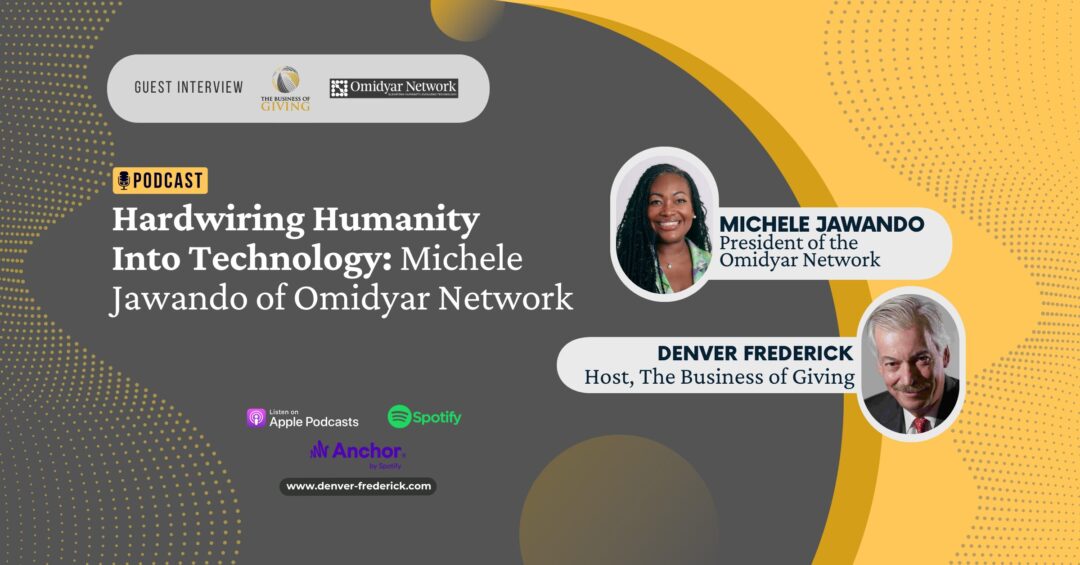
Welcome to The Business of Giving. I’m Denver Frederick, and today we’re joined by Michele Jawando, President of the Omidyar Network. Michele’s journey has taken her from Capitol Hill to Google to one of philanthropy’s most forward-looking technology ventures, giving her a rare perspective as both builder and translator — connecting policymakers, industry leaders, and civil society.
At a moment when AI is reshaping work, childhood, and connection itself, she’s leading an ambitious effort to “hardwire humanity into technology,” ensuring that dignity, fairness, and inclusion are embedded in our digital future. Her philosophy is clear:
“We believe technology, at its highest zenith, should really dignify labor, should dignify work, and should augment labor. It shouldn’t just be to replace workers.”
We’ll discuss AI companions and children, why 18-year-olds should help design the digital future, and how philanthropy can shift tech’s incentives toward human flourishing. It’s Michele Jawando on The Business of Giving.
Denver: Welcome to The Business of Giving, Michele.
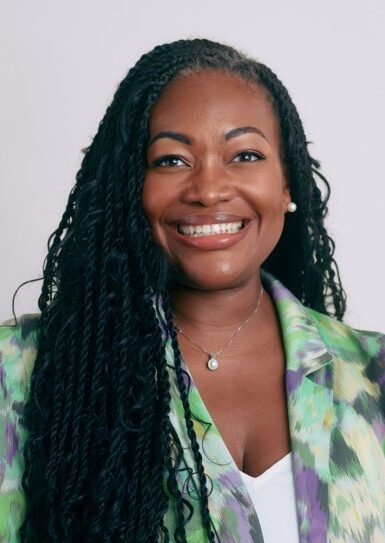
Michele Jawando, President of the Omidyar Network
Michele: Thanks so much, Denver. Great to be here today.
Denver: Your family has deep roots in the Civil Rights Movement. How did those early influences shape you as a leader and shape your vision for what technology can make possible?
Michele: I’m a third-generation attorney, and for me and my story and so much of who I am and the way that I approach problems and solutions, is really based on my family legacy and a few lessons that they’ve given me. We’re always focused on how you listen to the communities and people around you.
We’ve also thought about: What are the tools that you can use to have impact to make change? And for us, in our family, we use the law as one of those tools. And then finally, how do you ask… in every situation, you must ask the question: Who’s missing from this conversation? Who should be here in this coalition? How do you build if you’re missing voices that are needed to fix whatever the problem is?
And so I think those lessons have been reflective in the way that I approach every situation, from my time in the private sector, to my time on Capitol Hill, to my time in philanthropy. And I’m so grateful for all that my family’s really given me and how I’ve been shaped because of them.
“I think one of the things that is missing from most people’s imagination is the idea that you can be truly who you are, and that each of us have that individual value that they can bring to a problem, to a product, to product development, to a solution, to moving forward policy.”
Denver: Cool. In the world of tech, one of those voices that have been missing have been the voices of Black women. What has been the most difficult part about being one of the few Black women leading at the very highest levels of tech?
Michele: I think one of the things that is missing from most people’s imagination is the idea that you can be truly who you are, and that each of us have that individual value that they can bring to a problem, to a product, to product development, to a solution, to moving forward policy.
And so I believe that you have a really short time here on Earth, and you got to use everything that you’ve been given to really have and to make the change that you want. And so when you leave, you have to think about: What is the impact that I’m trying to leave? What are the changes that I’m trying to see in the world? And I think about that at a very deep and spiritual level.
And being a Black woman leader in spaces where that kind of assuredness doesn’t always show up, or that confidence that I have something to add to product development… I have something to add to a policy conversation… I have something to add to this legal brief. And there’s a perspective that I have here that will make our case stronger, that will make the product stronger, that will help sell something better and faster; seeing yourself as a part of a necessary ingredient, I think changes everything.
And I think it’s a real reflection today for us to say, technology is a reflection of who builds it, who designs it, who creates, who has those ideas. And we need to make sure that everyone is really reflected in that moment.
“And so I think at this moment when we think about technology, we at ON, we’re really focused on building a different kind of future. And in order to do that, we know that we’re going to have to do that together. And too often, we’re not just pushing for one specific regulation. We’re working to make sure that everyone’s perspective is represented.”
Denver: Absolutely. Michele, you crashed at legislation on Capitol Hill, then you moved on to Google. Now you’re in philanthropy. How has that unique path, that blend, changed how you see where real power to change tech actually rests?
Michele: So I think I see myself as a builder, right? I build both ideas, organizations, people, coalitions. I believe deeply in collaboration. And I think of myself also as a translator. I’ve spent time in industry, and I recognize the needs every quarter… what a company needs to do, and what duty they owe to their shareholders, and what responsibility they have to their consumers or their users.
I’ve seen up-close, I’ve worked with amazing leaders like Congressman Gregory Meeks and Senator Kirsten Gillibrand. I’ve worked across state and party lines with local elected officials. I’m married to a local elected official. And so I really see the need for policymakers to be at the forefront of some of these conversations.
But I finally, now here in philanthropy, really recognize that there’s the missing voice of civil society really seated at the table with these other really important voices. And so my work often is: How do you translate across those different spaces? How do you get people to recognize what are the needs and what are the push and pulls? Where can we shift market incentives? Where is advocacy needed to change a narrative or a conversation?
And so I think at this moment when we think about technology, we at ON, we’re really focused on building a different kind of future. And in order to do that, we know that we’re going to have to do that together. And too often, we’re not just pushing for one specific regulation. We’re working to make sure that everyone’s perspective is represented.
And we’ve seen technology when it develops, when it doesn’t have all of the necessary voices. We’ve seen some of the mistakes we’ve made around social media. Right now, we’re paying attention to how we’re developing AI companions, and particularly what that means for young people and families. And this time, I think we have an opportunity to do it right.
Denver: Yeah. Yeah. Well, you’re at a perch where you can really exert extraordinary leverage across all these different sectors.
Let’s take one of your experiences– Google. And over there, you oversaw investments, and elections, and cybersecurity, gender equity. What surprised you, Michele, most about what worked versus what didn’t work?
Michele: Well, what I see so often with so many of my friends, colleagues, and mentors in the private sector, so many people are really focused on a mission orientation of how you build either a product.
They really believe that, Hey, if I’m working at particularly a big tech organization, I can really move and make impact at scale. And the opportunity is: Let me take all of my knowledge, my engineering background, my understanding of marketing, my understanding of policy, and let me put that into action here.
And that’s a beautiful thing. I love mission orientation, and I think so many business leaders that do exceptionally well have that as a core. But what happens is there are other incentives that come into play, and we all know that often those incentives redirect that mission orientation to focus on something else.
And so you may only end up focusing on shareholder value instead of thinking about: Who are all of the stakeholders that need to be a part of this conversation? And so what I think philanthropy has the great opportunity to do is to really take a whole of society approach. We have the opportunity to say, Let’s look at the role that industry and private sector will play.
Let’s look at the role of governance and policy makers, and then let’s look at the role of civil society, and academics, and families, and children and legislators. And let’s put that all together and really see what we can do to make sure that humanity is well-represented in product development and policy and orientation.
And when you put all of those pieces together, you get a much better outcome than just having one sector or one voice determine the future and the shape that will affect all of us. And so that’s some of the things that I love about working at ON, about leading a brilliant team of leaders who are constantly thinking about: How do you shift technology in service of the public interest?
Denver: Well, let’s talk a little bit more about that. Pierre Omidyar founded this network believing technology could democratize opportunity. How has that original vision of his evolved, and how are you helping push it further?
Michele: Yeah. Well, it is an honor and privilege every day to take a leadership role as the president at ON. And the transition to philanthropy for me really felt like a natural evolution because it was a years-long focus on building, and I just wore a different builder hat in different spaces, whether it was in Capitol Hill or in technology. And it’s really about building organizations, ideas, and bridges across different perspectives, different needs, and different communities.
But one of the things that really drew me both into the legacy and mission of the Omidyars is the opportunity to use a really broad toolkit in order to build for humanity, and to change the culture, the governance, and the business of technology. I mean, we come from deep Silicon Valley roots.
We’ve been 20 years in EdTech and Fintech as an investor. We’ve spent years working with different leaders and influencers and thought leaders really shaping this conversation. And so about 18 months ago, we decided we’re going to take everything that we’ve learned over the last 20 years and really singularly focus on: How do we hardwire humanity into the future of what digital technology should be for us all?
And so it is this whole idea that I think Pierre and Pam launched many years ago, that all of us need to be at the table, that we need to think singularly in a mission of: What does pro-social good look like? And how and who are the partners that we need to work with to make it happen?
In fact, we call our grantees and our investees partners, because that’s how we actually think about it. We don’t think about it as this kind of dynamic that any one of us can do this work alone. We really have to work together to move it forward.
Denver: Yeah. Sometimes I think we talk too much about siloed organizations, but I think the bigger problem is most people have siloed minds.
Michele: Yes. That’s it. It doesn’t work anymore. It doesn’t work.
Denver: Absolutely. There’s no boundaries in your mind. It’s all together.
Michele: That’s right. That’s right. Or like a good mishy bowl of spaghetti. I mean, that’s how I think about a good gumbo if you’re in the south. If you’ve Italian roots, where like a wonderful bolognese. I mean, all coming together. We’re balancing venture with impact and advocacy and market incentives and social good, and really thinking about culture and narratives. And that’s really how you see the change that you want to see in the world.
Denver: You’re making me hungry, but…
Michele: I think food is a love language. That’s the other thing about me, Denver.
Denver: Well, let’s talk a little bit about what you just mentioned, hardwire humanity into technology. I love that thought. I love that phrase. What does that mean in practice, and what would technology really look like if we had succeeded doing it?
Michele: Yeah. So it’s such a great question. So when I step back, and we’ve spent a lot of time as an organization over the last 18 months as we’ve reset our strategy, really thinking about it. At the core, we think technology is a force for good. I am one of those people who is still wildly optimistic about this moment. And I think you have to be.
We’re at an amazing moment in history where so many pieces are coming together that we get to experience, that are this unique opportunity. But in order to see the kind of tech futures that we want, we have to be intentional about those choices. And so for us, hardwiring humanity has a lot to do with what gives people dignity, what makes people feel like they’re flourishing.
And then we work to tangibly build that technology and to support the systems that make those futures possible. So for example, one of our grantee partners was Ai-jen Poo of the National Domestic Workers Alliance. One of the things that they’re doing is they worked with technology companies with a large language model company.
They worked with some of their caregivers to develop an LLM that would help support caregivers in their work, that would do things like: How do I help move a client who weighs more than I, but I want to move them with dignity and with respect? Do you have recommendations to do that? And at the same time, it was improving their actual work because it also gave them an opportunity to say, Hey, I want to talk to my employer about asking for paid time off. How do I do that in a respectful way? And are there examples that you can give me?
These are practical tools that are improving the life for the workers, that are improving the quality of the jobs. And to me, that’s an example of how you hardwire humanity. You’re thinking about the people and the mission, and then you’re using both technology in service and changing the culture of how people experience that technology.
Denver: Wonderful example. You mentioned a moment ago, one of the things you love about OM is the toolkit, the flexibility, the adaptability, and that extends to the fact that you write both grants and investment checks…
Michele: That’s right.
Denver: … to nonprofit and to profit organization. When someone pitches you, how do you decide which checkbook to use?
Michele: Ooh. This is one of the fun parts of the job. So I think, Listen, building a digital future is going to take all of us. And I’ve mentioned it earlier, that right now we’re talking about in some cases $4 trillion companies. The markets are moving, listening to what that company does every single day.
And you’re also hearing really strong voices saying, Hey, listen, I want to have some agency over technology. I want to have the say over whether or not this AI chat bot can talk to my child for hours and hours at night. Like these are questions that are happening in real time, and there are coalitions and voices that are speaking up.
And then in real time, you’re seeing companies who are changing the face of the market. So we recognize that you need both market incentives to build responsible innovation, and you need advocacy, and you need the voices who can represent all of those pieces. So we really think about supporting this ecosystem is really about which toolkit that is necessary.
So we, for example, invested in Anthropic because it’s a leading generative AI company, but we also really see their commitment to transparency and building safely and accountability. That’s a market shift that they can use to say to other companies, Hey, listen how we’re building successfully, responsibly. And that starts a groundswell to change the incentives of how other people are building.
And then at the same time, we’re supporting advocacy organizations like the AI Collective Impact Coalition. There’s 61 investor signatories that are saying, Here is what you need to build ethical AI governance. And so both of those are important in the overall ecosystem, and our role is to think about: Which tool we should use to move the system forward?
Denver: I always equate it to a desk drawer and we don’t need nine staplers… You need a stapler. You need a scotch tape.
Michele: That’s right. That’s right. That’s right.
Denver: You know you need a pen, and we really want to have all those things because it’s a different tool for a different job, a different…
Michele: That’s right. That’s right.
“So like I tell people, technology has never existed in a vacuum. It has always reflected our values, our power structures, and our priorities. And the reality is we don’t always acknowledge it. So I’m a builder, but I’m also a truth teller. And one of the things that I recognize is every design decision that we make, every algorithm and governance model is shaped by human choices. And what we’re saying is: We need more humans shaping these choices, and those choices have real consequences and benefits for all of us.”
Denver: …mission. You have bet big on HBCUs, grassroots groups, leaders who don’t look like the typical tech founders. What’s actually working to get these voices real power and not just a seat at the table?
Michele: Yeah. So like I tell people, technology has never existed in a vacuum. It has always reflected our values, our power structures, and our priorities. And the reality is we don’t always acknowledge it. So I’m a builder, but I’m also a truth teller. And one of the things that I recognize is every design decision that we make, every algorithm and governance model is shaped by human choices.
And what we’re saying is: We need more humans shaping these choices, and those choices have real consequences and benefits for all of us. So for example, with some of the work that we’re doing with HBCUs, we’ve invested in Spelman College, which is an all-Black women’s independent college in Atlanta, and they are looking at the future of content innovation, design, computer science, quantum.
They’re one of the universities in the U.S. that has the largest groundswell of Black women who are leading in STEM fields, and they’re an underrepresented group who could help build and are right now building companies of the future. And for some reason, we think that innovation only exists on the coast or in a few different schools, and I reject that. I think that we’re going to have better products, more creative products if we think wild, if we think wider of who can help shape.
And so we believe that investing in different networks makes a difference. We’re investing in a group of young technologists with a cohort of other funder partners under the Responsible Youth Technology Fund because we think that people who came of age, digital natives who came of age before any of us, just recognizing that this is the digital life that I lead, they are going to approach technology differently.
And right now, they’re cut out of the conversation. There’re still 30 somethings who are making all of the tech choices. I’m like, I want to hear from the 18, the 19, the 20-year-olds who are moving culture every single day, and we haven’t empowered them to say what they want, their digital future. And they’ve had the longest digital footprint of any of us, and so let’s give them an opportunity to shape where our future should go.
That to me is how you bring in all voices. We’re going to change the market, we’re going to build more responsibly, and we’re also going to have some of the… what I like to say is that good gumbo, the sauce, the swag, the uniqueness of all of these communities. And that just means for a much more colorful and exciting world together.
Denver: That’s right. The best ideas in the room are not with you. It’s with them.
Michele: Yeah.
Denver: It’s with young people, and they’ve never had a chance to really voice it, and it will be eye-opening when they do. Most tech policy probably happens in Silicon Valley and in Washington, but you’re funding globally. How do you make sure communities in Kenya or Brazil are shaping their own digital future and not just receiving our solutions?
Michele: That’s right. Well, this is why we think that the best futures include everyone, and there isn’t going to be a one-size-fits-all solution for global engagement around technology. And so we’re working with our partners at the U.N. I’m so excited because in a few weeks, we’ll be back at UNGA, the UN General Assembly, working with the envoy on AI and digital futures to once again think about globally what our kind of governance and standards and guidelines… What does AI for good look like in Kenya is going to look very different than what’s happening in Norway. And both of those ecosystems deserve to thrive, and we need to make sure that we’re building culturally.
I have one of our partners that we work with, Rumman Chowdhury. She’s working on assurance technology. So basically, because every company now says that they’re an AI company…. So one of the things that she’s doing, and she’s developed a tool, she’s a longtime leading tech leader and is building a tool that will help companies and third parties really determine whether or not this tool does what it says it’s going to do.
And one of the things that she’s recognized in working with some of her partners in India… she’s in those large language models: When you put in cricket, what comes up? First is the sport. Over here in the U.S., when you put in cricket, some of the things that come up in your prompt engineering is the animal because there’s a different cultural context that is needed for both.
It’s just a great example of: This is a great big, wide world. Language has different connotations, and so many of the U.S. based models don’t necessarily pick up on that. And so we want to make sure that our data sets are representative, that there’s compute power that is widely distributed around the world, so we can come up with these really beautiful models that can do great things.
And that finally, they represent and speak and cater to the needs of each of our communities differently.
Denver: Yeah.
Michele: And we’ve decided to do that.
Denver: Yeah, she’s an interesting woman. She’s been on the program.
Michele: Oh, yeah.
Denver: Yeah, yeah. And I remember she was saying, I’m thinking back now, that AI is one of the few things we blame in terms of a technology, unlike other things. If I put down my toaster, my toast burns or something like that, I’m not blaming the toaster. You know what I mean?
Michele: Right. Right.
Denver: I’m not yelling at the toaster. If the car, I’m not yelling at the car.
Michele: Right.
Denver: When AI gives me an output, I’m yelling at AI.
Michele: Yeah.
Denver: Forgetting that it was humans who programmed that AI.
Michele: That’s right. That’s right.
Denver: But that’s what we do.
Michele: And humans who can fix it…
Denver: And who can fix it.
Michele: …and develop something better. And that’s why we speak so often about human agency because we often detach the technology from the choices that humans make as they’re building.
Denver: That’s right. Yeah.
Michele: And we’re like, they go together. And so let’s bring those worlds back together.
“This is something that’s top of mind and one of our singular priorities, one of our leading priorities at ON. We believe technology, at its highest zenith, should really dignify labor, should dignify work, and should augment labor. It shouldn’t just be to replace workers.”
Denver: Probably on the top of so many people’s agenda right now, Michele, is this: AI could eliminate millions of jobs, or it could create new opportunities. What’s the difference between those two futures, and how do we ensure we get the right one?
Michele: This is something that’s top of mind and one of our singular priorities, one of our leading priorities at ON. We believe technology, at its highest zenith, should really dignify labor, should dignify work, and should augment labor. It shouldn’t just be to replace workers.
And too often, executives are deploying AI tools thinking about efficiencies, without seeking input from their employees, who often can tell you where you can find those efficiencies and how something can work better. So that only deepens the distrust that we see in society, and it lowers overall effectiveness.
And when we see leaders who are working with their employees and not around them, that’s when we see some of the best benefits from new technology. And I’ll just give you a quick example, Governor Shapiro from Pennsylvania. He did an amazing pilot where he was working with OpenAI, SEIU, one of the foremost labor associations in the country, and state employees.
And he brought them together and said, Hey, we need to do better implementation on some state benefits. And what happened was a completely different experience. It was a positive experience for both the workers and the organizations. They reported average savings time of like 95 minutes per day working with OpenAI and IT support, and over 85% of the persons who participated in that pilot said they had either a somewhat positive or a very positive experience.
The difference? People came together. They said: Let me come in with this leading AI company and the workers and labor to respect the voices of workers, and we can come up with some great solutions. That’s what the future of work should look like. It shouldn’t be working around people, but working with.
Denver: Yeah. Yeah. And it’s transparency.
Michele: That’s right.
Denver: Because generally what happens, leadership does it behind closed doors.
Michele: That’s right.
Denver: And even if leadership isn’t doing anything bad behind closed doors, if you don’t know what it is, you’re going to fill that gap with really bad stories.
Michele: That’s right. And listen…
Denver: That’s what happens in a vacuum.
Michele: And listen, people are loath to adopt technologies that they don’t trust, okay? So you will see a lag in efficiency. You’re going to see a mistrust, a distrust in the system. So I say to avoid that. Bring people in from the beginning. And so often a lot of the work that we do at ON is to try to be a collaborator, to bring folks from industry, from technology, from workers, from creative industries, together to really figure out our way forward.
This is going to be one of the central questions, and when you ask most Americans, when you ask people around the world what’s their biggest fear around AI, it’s always this question around work and: Will work be available for me and my children in the years to come?
Denver: For sure. That is absolutely correct. ON recently endorsed 17 specific California AI bills. Tell us about this and what convinced you that these particular policies could actually change how AI gets built.
Michele: So I am so excited you’ve asked me this question because this is really the first time we’ve ever endorsed specifically, publicly endorsed state legislation.
We’re a California-based organization, philanthropic venture and what we really recognize is at this moment, if we’re saying that this is the most critical new technology, that this is a once-in-a-generation shift around technology, then we needed to use our individual, our own voice, and really say where we would love policymakers to really focus.
And so we endorsed these 17 bills, and if you’ve been following who ON is, we really focus on a few things: on accountability; on data privacy…. which we think is a sacrosanct human right… antitrust enforcement, and fair labor standards in the age of AI. And in so doing, what we’re really hoping is that we’re reinforcing actually not our voice, but the voice of our state-based peers and partner organizations who’ve really been pushing.
So we’ve seen great work on AI companions. Some of the bills have really focused on, again, fair labor standards and how do you open up this market. So one of the things that we did is we supported legislation that would create public options around AI, so academics and researchers in California can pull from data sets to build the kind of technologies we want.
In 2023, when you looked at where Y Combinator, which is one of the leading VC incubators in the Valley, 98% of the businesses, and this is from ’23, 98% of the businesses that were receiving VC capital, were all business enterprise. Less than 2% were focused on healthcare. Yet in our minds, we all say AI is going to help us cure cancer. It’s going to help us eliminate disease.
Well, right now, we don’t always see the money following that. So endorsing legislation that will say, California wants to be at the leading edge of having public data sets and opportunities for us to really dive into things like healthcare, this is a step forward. This is how you do it, where you put resources and capital behind it. So we were really proud to work with so many great state legislators in endorsing this legislation.
Denver: And I salute you for doing it. I mean, this is a first, I know. There’s a generation growing up with AI tutors and social media algorithms and deep fakes. Michele, what keeps you up at night about the work we’re creating for them?
Michele: Yeah, my husband and I are proud parents of four. Shout out to all of the parents sending kids back to school, for first day of school. So many parents are just trying to get their kids out the door, get them fed, and get them off to school.
And they are trying to do that in a world where technology encompasses almost every aspect of their children’s life. It’s not just for gaming, it’s for social interaction. It’s at school, when they’re on EdTech. They are around technology more than we can ever imagine. And so parents are like: I don’t even know how I begin to engage in this conversation.
And so one of the things that we’ve been doing is we work with partners like Common Sense Media and others to try to demystify and to think about places of early intervention, and steps, and how you can be a partner with your child. And also, once again, we’re the voices and the leadership of parents and children and teens saying: This is the type of technology we want.
So we supported one of our partners– HumanConnections.AI. We’re partnering with industry, so folks like Google Jigsaw and DeepMind, as well as academics, really looking at the multi-sector hub for coordinating case making on evidence-based technology, on AI companions and kids. We want to figure this out together, and we want to make sure it’s done right.
We are going to be laser-focused and we have been on AI companions and their relationship. We don’t want to see the same things that happened with social media. And so we’ve been working with partners on this legislation and really examining the second and third-order effects. What does it mean for our relationship, Denver, if as a young person, the only way I can come up online is really working with an inanimate chatbot that can reflect back to me, but I don’t really understand myself and my own identity?
What does that mean for social identity and connection and human connection? And so we’re working with some of the greatest thought leadership on this issue to make sure that the things that make us human– our relationship, the connections that we have– those are the things that we still prize and honor, and we create space for.
And we develop technology to support that in a healthy way, versus an extractive way. And so we’re excited to kind of really dig in. Those are the things that as a parent, as someone who believes deeply in the promise of technology, I think about quite often, and we’re really committed at ON to work on that.
Denver: Well, thank goodness you are because that is going to be an issue beyond belief, and it already is. Let me close with this, Michele, and sort of go back to earlier in the interview about wanting to leave a place in a better state than when you first found it. What’s the one thing you most want to achieve through your work at ON?
Michele: So I grew up a huge Star Trek, Star Wars kid, right?
Denver: Really?
Michele: Like so many of us. And one of the things, and I’m the next generation, I know everybody has their favorites… I’m Captain Picard all the way. And one of the reasons I loved watching that show in growing up is there was this idea that I was using technology not in service of just the technology itself that would help them get to far off galaxies, but it was always in service of helping that civilization, that world deal with a great disaster or plague or crash.
And it was this beautiful, diverse conglomeration of alien species and humanoid species all working together. I love that world. I believe that that world can be possible, and I want to develop new narratives that aren’t just based on fear, that aren’t just about making money for shareholders, but it’s really about building a type of future where everyone can thrive.
That is the thing that I want more than anything else. And I believe at ON, we’re working towards that every day. And I actually believe it can be possible, but we got to work towards the future that we want and the technology that we want, and we’re proud to do it at ON.
Denver: Where can people follow ON’s work and see these investments in action and the impact that you’re having.
Michele: Well, you can come check us out on our website, omidyar.com. You can follow us on LinkedIn. We have a very active LinkedIn page. You can find us on most social media channels, and we often put forward like the places where we’re going to be.
So we’ll be out and around UNGA. We’ll be participating in the WIRED Conference. You can always find us during SXSW. So we like to be out and about, and we share where we’re going to be because we really think that the only way you do this is together. That’s one of our favorite words at ON, together.
Denver: You are an organization on the move. Michele, this has been incredible. Thank you for your time and your work. It was really a pleasure to have you on the program.
Michele: Thanks so much, Denver. Appreciate all you do.
To celebrate my 50th year in the nonprofit sector, I’ve put together a gift for you — a practical, field-tested guide to building world-class nonprofit workplace cultures. It’s called Cultivating Nonprofit Excellence, and it’s based on insights from nearly 1,000 interviews and 150 focus groups with nonprofit leaders around the globe. It’s completely free and instantly downloadable at blanchedalmond-mosquito-418475.hostingersite.com