
What happens when you inherit billions to give away, but the weight of that responsibility threatens to define you more than your own dreams? And how do you honor a grandfather who was simultaneously the “father of fracking” and one of America’s most passionate environmentalists?
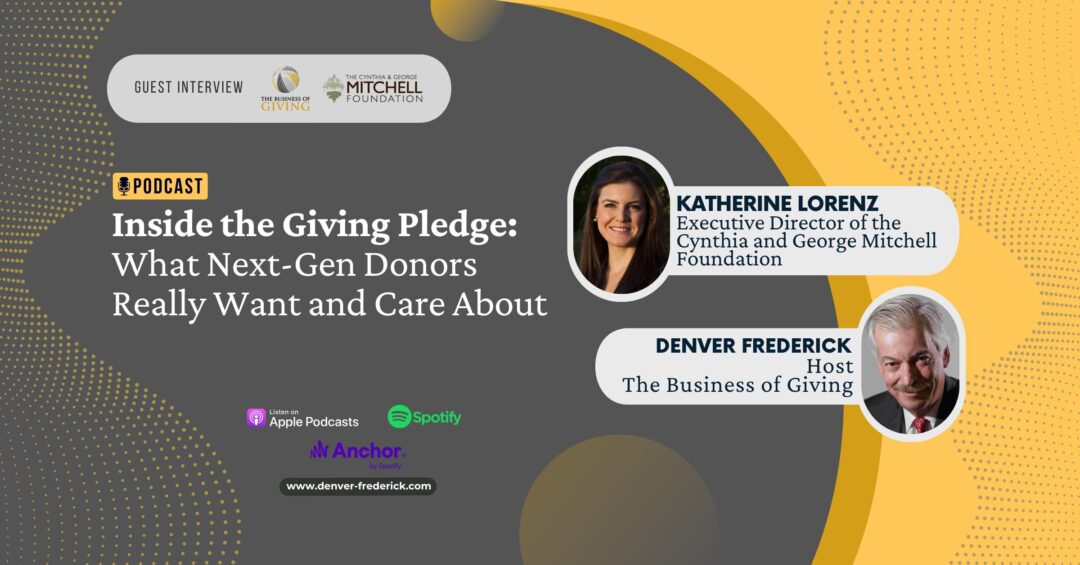
Welcome to The Business of Giving. I’m your host, Denver Frederick. Today we examine next-generation philanthropy with Katherine Lorenz, Executive Director of the Cynthia and George Mitchell Foundation and co-founder of the Giving Pledge Next Gen initiative.
Katherine’s family preserved decades of intimate conversations with her grandparents—a treasure trove of philanthropic wisdom. But her path wasn’t predetermined. Working with indigenous farming communities in the mountains of Oaxaca, she experienced a revelation that would reshape everything:
“And I began to realize that no matter how much we were doing, the changing climate was having such an impact on their livelihoods that there was only so much you could do if you didn’t get at the root cause of what was really causing the difficulties in them having livelihood and steady food sources. And it was that moment when I realized: I love this work with farmers in Mexico, but I think climate change and energy in particular, in the role of that, is where I can have a bigger impact.”
This is a conversation about wrestling with paradox, building authentic peer networks, and discovering that sometimes the most powerful philanthropy comes from embracing life’s contradictions.
Denver: Welcome to The Business of Giving, Katherine.
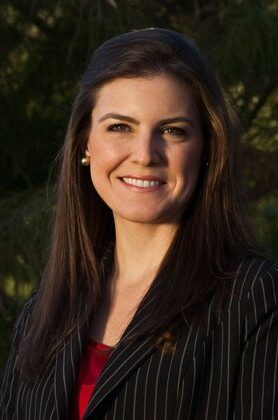
Katherine Lorenz, Executive Director of the Cynthia and George Mitchell Foundation
Katherine: Thank you for having me. I’m thrilled to be here.
Denver: You’ve spoken about decades of recorded conversations with your grandparents. What’s one piece of their advice, maybe something that was never written down in the foundation documents, but it anchors you during high stakes decisions?
Katherine: Yeah, we are incredibly lucky to have many years of conversations with my grandparents, notably starting in 1993 actually, where they’re specifically speaking about our family foundation and what they wanted for it, and then ongoing through my grandfather’s death in 2013. So, quite a long time, many different conversations.
I’d say a few things really come to mind in terms of how those have been important. First of all, it’s amazing to see the threads of dialogue that continued the same over those decades. Some were kind of fleeting– a specific interest at a specific point in time for some reason, versus those topics that stayed very front and center for years and years.
And so that has been one thing that we’ve looked at a lot– in terms of understanding those topics that stayed very front and center over decades, we feel are the most important to carry on as part of their legacy.
And I’d say the second part of it is not so much specific organizations or even issue areas or topics, but values…how they talked about their values, what sort of things they valued, what sort of things they wanted and didn’t want, but in much broader areas than just a specific organization or specific need at that point in time, but kind of bigger values around why they were creating the foundation, what they wanted for it, how they wanted our family to work with it and such.
Denver: Yeah. Yeah. So you were good at extracting what was timeless in those conversations and what was ephemeral.
Katherine: Yes. It wasn’t just me. I mean, it’s because these spanned decades, there were aunts and uncles, and then I had the privilege of doing it toward the end. But yes, it was really wonderful to see all of these things, and in particular the values and the trust they put in future generations.
I think many families or many founders feel very specific, give very specific mandates about what they want. And ours were kind of broader mandates embedded, with values embedded and led by values.
But there was a lot of talk of: we can’t know what your generations will be facing. We can’t know what the issues your generations will need to address, and therefore we leave a lot to you all to figure out.
Denver: What a healthy perspective that is!
Katherine: Very lucky.
“So for us, when I talk about the threads of conversation of the things that stayed front and center over decades, it was sustainability. I mean, every time you saw him, he would say, ‘If you can’t make the world work with 4 billion people, how are you going to make it work with 10 billion people? And what are you going to do about it?’…So that deep, real dedication to sustainability and the environment was there forever.”
Denver: Yeah. Yeah. Well, your grandfather, George Mitchell, he was both the father of fracking, but he was also a passionate environmentalist. How has grappling with this duality informed your own leadership?
Katherine: Yeah. I mean, it feels like a paradox to people who didn’t know him. It was in no way a paradox for those of us who knew him and lived and worked with him. He was a passionate environmentalist from the late ’60s. In 1968, he heard a talk by Buckminster Fuller that utterly changed his world and worldview, and went on to do things like found a sustainable city called The Woodlands in the early ’70s.
He was investing in, philanthropically and otherwise, sustainable issues, how to get CEOs involved in sustainability all throughout the ’70s and ’80s. And then he’s best known as, quote-unquote, “the father of fracking.” That didn’t happen until way later, decades later.
So for us, when I talk about the threads of conversation of the things that stayed front and center over decades, it was sustainability. I mean, every time you saw him, he would say, “If you can’t make the world work with 4 billion people, how are you going to make it work with 10 billion people? And what are you going to do about it?”
That was what he said every time I saw him… I think every time in my whole life. And we joked he should get it tattooed on his forehead so he didn’t have to keep saying it to us. So that deep, real dedication to sustainability and the environment was there forever.
And then, I would say the one other piece that feels like a paradox, but really wasn’t for his time and generation was around the role of oil and gas and the environment. The talk about climate change and the negative impacts came later in his career, but he was really shaped by the need for energy independence and energy security for the country.
And so, I think, that was much more of a driver than anything else, and his energy exploration and his world. So, I don’t see those two as a paradox. And then, I think as the reality of the role of oil and gas in the environmental and climate fight came more front and center, he was very dedicated to trying to figure it out and to move toward cleaner fuels, from oil to gas, and kind of bridge to what was next.
And he was the one who mandated the foundation really work on this energy transition issue. So, I think you can look at almost any issue and realize there’s some sort of paradox there… that if you dig deep enough, it seems, how can you make money on the one hand and want to deal with social justice issues on the other hand or whatever the topic is.
I think you can see some sort of paradox there, but I think what’s more important from a leadership perspective, back to your question, is: How do you do the best with what you’re given? So we really know his values around the importance of sustainability, and we work toward those. Where the money came from, or what he grappled with and what we grapple with, it’s kind of unrelated to then: How do you just do the best in making the world as sustainable as possible?
Denver: Yeah. Interesting perspective. And another thing I’ll say about leadership that you just mentioned, great leaders repeat things over and over and over again. And they really did…
Katherine: Well, then he was a good leader.
Denver: And he was a good leader, even without the tattoo. And sometimes when I speak to leaders, they say they’re sick and tired of hearing it. And I said, They’re not sick and tired of hearing it, you’re sick and tired of saying it.
Katherine: Yeah.
“And I began to realize that no matter how much we were doing, the changing climate was having such an impact on their livelihoods that there was only so much you could do if you didn’t get at the root cause of what was really causing the difficulties in them having livelihood and steady food sources. And it was that moment when I realized: I love this work with farmers in Mexico, but I think climate change and energy in particular, in the role of that, is where I can have a bigger impact.”
Denver: But you didn’t have any idea how quickly it leaves their mind unless you repeat, repeat, repeat. And your grandfather knew that lesson particularly well, and maybe I’m sure there were times too well.
Well, from co-founding that public health nonprofit at Oaxaca to taking the helm of Mitchell, you’ve really had a remarkable journey, Katherine. Was there a moment that crystallized your readiness, not just to inherit, but to truly steward your grandparents’ legacy and purpose?
Katherine: I don’t know that there was a moment. I had a really interesting experience where I was working with rural indigenous farming communities in Oaxaca. And I began to realize that no matter how much we were doing, the changing climate was having such an impact on their livelihoods that there was only so much you could do if you didn’t get at the root cause of what was really causing the difficulties in them having livelihood and steady food sources.
And it was that moment when I realized: I love this work with farmers in Mexico, but I think climate change and energy in particular, in the role of that, is where I can have a bigger impact. And I have this unique opportunity with my family who is working both in sustainability and in energy to kind of work in that area to… always at the back of my mind with kind of many, many of the beneficiaries of that work… include people like the farmers I worked with in Mexico.
So that Aha moment was huge for me, and it came right at a time when I was also able to be more integrated into our family foundation, which was focusing on this work. So I think that for me was my Aha moment. I then continued on to work at an organization called The Philanthropy Workshop, working with other donors to learn how to be strategic in their impact.
And that I think gave me some of the strategy and impact perspective of: How would you set up a foundation and do philanthropy to have an impact on an issue you care about? So the kind of climate thing with the farmers made me want to move on from Mexico, and then once I was working with donors, it became clear that leading our family foundation could be a place where I could then implement all of those lessons learned and how you actually make impact in philanthropy.
And then the real moment came… and that my aunt who was running it was ready to step aside and give way to the next generation. And I guess I was the one who was kind of most…
Denver: You’re there.
Katherine: …prepared, and there, and available to do it at the moment.
Denver: That’s great. The only one, too… I love it. You’re also a vocal champion of productive failure. Talk a little bit about that and maybe give an example when you have had a failure, but learned great lessons from it that reshaped the way you approach things.
Katherine: I mean, I just think change doesn’t happen when it’s easy and going great. You keep doing the same things when it’s working, and it’s only in those moments when it doesn’t work that you take a step back to reflect on why. And it’s not that you should always be changing, but you only evolve and grow with some sort of change.
And I think that only happens in the face of, not necessarily failure, although obviously failure would do it, but some sort of challenge or something that doesn’t work, or something you think is going to go great, and it blows up in your face. And it makes you take a step back and think like, Well, what could I have done differently? Or what will I do differently next time?
I don’t tend to look backward and ruminate on what didn’t happen, but I do often try to think about how would that be different next time.
Denver: Yeah. Yeah. Well, no learning’s ever going to take place unless you take that moment to reflect. If you just keep on plowing ahead, you’ll probably keep on making the same mistakes. So those reflective moments are great.
Let’s turn our attention to your role as shaping the next generation of philanthropic leaders through the Giving Pledge Next Gen initiative. And for those who may not be familiar with it, Katherine, tell us what it is and how it came about.
Katherine: Sure. So I’m sure many have heard of the Giving Pledge. It was started by Bill and Melinda Gates and Warren Buffet, encouraging their peers of significant wealth to give the majority of their wealth away, either during their life or upon their passing. My grandfather was in the first round of pledgers in 2010.
Denver: Yep.
Katherine: And so it was a small group at that point and just kind of a newly established entity. And so at that time, I was running the foundation, or soon thereafter, I came in to run the foundation, but only he was able to participate in the support and work that the Giving Pledge was giving to those donors.
But he was 92, 93, so he was not traveling, he wasn’t going. And it was very clear that our generation was going to be the next, the leaders, and to actually give away this bequest that he’d made, that both my grandparents had made. And so a colleague and I– who was in a similar position running a foundation, approached the Giving Pledge team and essentially said, We know you’re supporting the pledgers, but what about people like us?
We are the children and the grandchildren of pledgers, and we, in many cases, are the ones who will be actually doing the philanthropy. Is there a space for us to participate in some of the training and the resources that you have? And the Gates Foundation, to their credit, said, “That’s a great idea, but we need leadership from within. So if there is interest, we will absolutely support you all to do this.”
And so I spent about a year trying to find other next gen participants– children and grandchildren of pledgers– to see if there was interest. And of course, there was a huge amount of interest because I think people were either already leading the philanthropy, knew they were going to have a place leading the philanthropy, or just kind of curious how to navigate these huge bequests that were being made in their families.
And I think all of us, who are in this position to help carry out this philanthropy, understand the gravity of it, understand the impact, the reason our parents and grandparents have made this pledge and want to do right by them, but don’t necessarily always have the tools or resources.
And so this group, over the years, has grown significantly and is very focused on helping everyone in that position to have those tools and resources to make that philanthropy have the most impact possible.
Denver: Well, that was a brilliant idea you had. And as always is the case, when you have that brilliant idea, you get to run it. You know what I mean? It’s like…
Katherine: Well, thank you. I think it was also a bit self-interested. I was in that role and really, we had benefited from the peers I did know, and knew that if there were more peers in my position, that it would be helpful for me and helpful for them. So, yeah, it’s been a really wonderful group, and I think primarily helping us do and carry out the legacy of our parents and grandparents in a way that we want to do, but don’t necessarily always have the tools to do.
Denver: Yeah. Talk a little bit about that. And how do these next gen members carry out the legacy of their parents or their grandparents, their family’s vision, but at the same time carve out their own philanthropic identity?
Katherine: Well, that is the question they got. Many next gen philanthropy leaders have that question. It is always an interesting role to have your full-time work, be carrying out somebody else’s philanthropic dream, and especially when you may or may not necessarily need to work, you may or may not necessarily need to even have a job.
And you have so many opportunities, you really could go chase your own dreams, and instead you’re in a role where you’re helping carry out essentially somebody else’s dreams. And so everyone who’s in that role I think has figured out a different way to navigate it. For me personally, I am incredibly honored to have the responsibility of carrying out my grandparents’ legacy, and I do the absolute best I can.
And I find great joy in working with other people like me to find that similar place where it feels good to be doing this, and you can also find your own mark, whatever that is. So, for some people, I’d say it’s creating a program area and an issue they really care about that might not be the full focus of the foundation, but they get at least to have some outlet like that.
For me, I’m a bit of a governance dork, and I love kind of organizational management and stuff, and so I am able to sit on boards of organizations I care about and think about that role. So I might not be in the day to day of running organizations that are doing work I really care about, but I’m able to be at that level, having those conversations, and kind of doing things that bring me joy and purpose that are both related to the foundation, but a little bit my own.
And I think everyone… I don’t want to say everyone struggles with it, but it is very common to kind of have this interesting position of really wanting to do it and to do it well, but then wanting to also be known for you, not just be known for being someone else’s child or grandchild. I think that’s what ends up happening a lot, is you end up being sought out or known for being somebody’s relative rather than being you.
And so how you figure out: who am I in this, and what do I care about, and how do I bring that to my day-to-day work and purpose and meaning, is a journey I think everyone, as a next gen philanthropist, Giving Pledge or otherwise, grapples with and hopefully finds.
Denver: Yeah. Yeah. Well, I can imagine. I mean, it’s either, Are you interested in me, or you’re interested in that I’m a next gen philanthropist? is always the age-old question that people are…
Katherine: That’s exactly like: Are you seeing my eyes or are you seeing dollar signs in my eyes?
Denver: That’s a better way to put it, I guess.
So let me ask you this. What’s the single biggest challenge or tension facing next gen donors today that you think older generations, hey, like me, often misunderstand or maybe just completely overlook?
Katherine: Well, I think there are big topic areas, obviously things like climate change and things. I think like democracy, and I think there are big challenges that many next gen donors feel a huge pull toward, that maybe their predecessors don’t feel quite as moved by. I think a big difference in how different generations think about impact is often one of the tension points in families.
So, I can say in my family, for example, and I think this is quite common in very much older generations… thinking of big institutions as where change happens and where social impact is made. So big universities, endowing universities, big research institutions, kind of the big churches, synagogues, places that are well-known institutions that can handle big gifts and big endowments, and that will kind of trickle down.
And I’d say younger generations, in my experience, are a bit more interested in people and movements and community building, and getting down to: Who’s actually impacted by this problem? And how do we have their voice in the room? And how do we know that this is what’s going to help change their reality?
And so I sometimes feel that it’s not so much the issue area that’s the difference, it’s the tactics. So we might both agree that environment is the big thing, but someone in my grandfather’s generation might want to endow a big institution to have an environmental program, and my cousins and I might be more interested in kind of helping environmental movements of communities of color.
And those are the same issue, but the tactics are quite different. So I think that’s where a lot of the difference is, is not so much the big issues, but the tactics and how you think change is made.
Denver: Yeah. I would say just looking at my generation, we built these organizations, so therefore we care about the organization. And I speak to my daughter, and she has no use for the organization. She cares about the cause. And she wants to solve the problem, and she doesn’t care how the problem is solved; where we say, Well, it’s the institutions that solve them. And…
Katherine: That’s right.
Denver: …we break right there, but we get over it really well.
Katherine: Yeah. Yeah, exactly. And I think it can actually be great dialogue because I actually think you need both.
Denver: You do.
Katherine: But that I think is where some of the tension comes down. I see less family, not in our family specifically, but in ours and others, less conflict about the issues. Do we care about water? Do we care about land conservation? But more about like: If we care about water, how do we invest in water to have the most impact? That’s where I think that the conflict ends up happening in many families, is the: How do we do this?
Denver: Let’s talk a little bit about the initiative in this sense. Beyond networking events, what mechanisms does next gen offer to share lessons, and how do you assure they drive real change? What kind of training or insights do you provide the folks in your cohort?
Katherine: Yeah. So, I mean, I don’t want to get too detailed and specific about how this group operates, but I will just say that the Giving Pledge and the Gates Foundation are an incredible resource. I mean, they’ve done so much philanthropy, the Gates Foundation specifically. And then of course, the network of donors within the Giving Pledge is incredibly valuable, the knowledge of each of those donors, and especially some of the ones who’ve been around longer and the foundations that are more established.
So there’s a lot of peer-to-peer experiences at every level, whether it’s peer-to-peer foundations and talking about strategies and their specific issue areas, and: How do you make an impact in education? Or, how do you make an impact in racial justice? Or, how do you make an impact in democracy? There are those sorts of learning sessions, and then there are also kind of more peer cohorts. How are you a CEO of one of these organizations, and what are lessons learned?
I mean, what’s so amazing about the Giving Pledge is so many foundations and philanthropists are very new to this. And so now that it’s been around 15 years, there are more that are much more established and can really share like: This is what our first 15 or 20 years was like, and this is what we’ve learned.
And so a lot of that peer sharing at the donor level, at the staff level, formal and informal resources from written resources and research papers, to consultants who can help you implement, to all those sorts of things, I think there’s a lot available to wherever you are in your journey and what you need.
And I can just say from the next gen perspective, the peer-to-peer learning I think is what people find most valuable, the peer-to-peer, formal and informal. And sometimes it’s the formal presentations followed by an informal break afterward where you connect over coffee over what was just said on the panel. And I think anyone can relate to that.
Those are, I think, the most important– the combination of learning with a group of peers, and then having some time to debrief with peers and say, How does that relate to me? And how have you done it in your family? That’s where I think people find the most value.
Denver: Yeah, I work with a number of nonprofit organizations, and one of the things I do with them is peer-to-peer coaching. And it’s amazing, the feedback we get from that. And I guess I read recently that 80% of learning on the job is done from your peers because you can just really have honest conversations, share experiences– much more candid than with your boss– and people just love it.
Katherine: That doesn’t surprise me at all and certainly, that’s my experience both in… we’re talking about the next gen of the Giving Pledge, but I’ve seen that in other donor networks. I’ve seen it when I was running a nonprofit. It’s just you can read all the literature, but sometimes it really speaks to you… sometimes it doesn’t feel quite right.
But there’s something about the combination of the expert advice or literature, whatever it is, in combination with: Well, how does this really work?
Denver: Yeah. What happened…
Katherine: How have you really done it at your…
Denver: …at your department when you tried it? You know what I mean?
Katherine: Exactly. And what actually happened when you tried it there? And so that combination I think is what is most valuable in any learning network.
Denver: From participatory grant making to complex impact investing, are there any new philanthropic models that particularly excite you?
Katherine: One thing that I find interesting is many people moving toward investing in the people and where the change is happening. I’m seeing this a lot in people who are worried about our democracy and how do you really empower people to make change in their communities.
And thinking back to the conversation about institutions versus people, that continuing to find leaders and fund them rather than fund organizations, find communities that are somehow making a change and help other communities do that. So I don’t think it’s particularly new, but I think we are in an era where that can be… I’m seeing that as a really interesting tactic for a lot of the work that’s going on– helping people advocate for themselves.
Denver: Yeah.
Katherine: Giving them the tools and resources to advocate for themselves rather than assuming that someone’s going to come in and put some help on top of them, helping, actually working to more bottom up. And there was a huge push obviously after the murder of George Floyd, and a lot of the conversations around DEI that obviously there’s been a backlash against that.
But I think that fundamental question that was being asked which is: Who’s making decisions? Who’s sitting in the boardroom making decisions about beneficiaries? And are the beneficiaries having a voice in that? I think that fundamental shift in mentality is staying for the most part and is a really critical and important piece.
Denver: I think you’re absolutely right ,and it’s always been there, I guess, to a certain degree, but it’s really accelerating. And an interesting guest I had on just a couple days ago was Emma Bloomberg…
Katherine: Well, yes, she’s amazing.
Denver: …and Michael Bloomberg. She’s great, but I mean, what she’s trying to do is give those local community-based organizations all the modern tools they need to really operate at a high scale. And I think that’s where so much of the change that’s going to happen is going to come from right there.
Katherine: Absolutely. Absolutely.
Denver: Yeah. Chuck Feeney has famously committed, Giving While Living, I think it was $8 billion, if I remember. How are you seeing the next gen cohort grapple with this idea, giving that money away, making it work, having an impact now, versus the traditional model of the permanent endowment?
Katherine: Oh, I think it’s a huge shift. Huge shift to giving while living or just giving it all away fast. I’d say to the extent people aren’t doing this, it’s probably more about the donors or still not quite being comfortable with it, or older generations being in charge.
But I think the younger generations are absolutely moving toward: Give it away faster, and now. And so I think we’ll continue to see the uptick of spend-down foundations or really trying to get the money out the door sooner.
“I mean, I think to lose trust, especially next gen, I think the questions we’re talking about that often we grapple with is, ‘Are you seeing me, or are you seeing somebody else’s money when you look at me? And what is it that you actually want from me? What are you trying to get out of me?’ Because that’s so often the scenario.”
Denver: The next gen cohorts, they work with a significant ecosystem– advisors, and philanthropic folks, experts. In your experience, what’s the quickest way for a wealth advisor to lose trust of a next gen donor? And on the other hand, what’s the fastest way for them to gain trust?
Katherine: Good question. I mean, I think to lose trust, especially next gen, I think the questions we’re talking about that often we grapple with is, “Are you seeing me, or are you seeing somebody else’s money when you look at me? And what is it that you actually want from me? What are you trying to get out of me?” Because that’s so often the scenario.
And so I think if there’s any sense that someone’s going to take advantage of them or, Hey, I have this great charity I’m on the board of. You should give to this. Like…
Denver: Yeah, yeah, yeah.
Katherine: …anything like that that feels self-interested, or that it’s not about the next gen donor’s journey, but rather kind of getting money out of them, that will be the first thing in my mind to really help break the trust.
And I think on the flip side, to gain trust, having a real and genuine relationship that’s really about them, not their family, it’s about their needs and their values and their desires, and what it is they want to do with their lives. And if they don’t know, helping them figure that out before you start writing big checks or before you start kind of pushing them in a direction.
I’ve said before, but I think connecting them to other peers who may be a few years ahead of them on this journey, where I think advisors are very hesitant to introduce their clients to other people, but when they can, especially to peers who can share: When I was in your shoes, I did A, B, C, and D, and here I am now. That is a really helpful piece of the journey.
And I think if an advisor can help create those safe, trusted conversations, then the advisor ends up being part of that safe, trusted network.
Denver: Yeah. Yeah. It’s movement generosity, as opposed to just sort of husbanding it and trying to say: They’re mine! Really just be generous and let them explore. And it’s going to come back to the advisor many times over because it’s that kind of attitude that people embrace.
Katherine: Exactly. I think there are many… someone once said, if you have a toothache and you go to the mechanic and say, “I have a toothache,” they’ll say, Go to the dentist. And if your car’s broken, now you go to the dentist, they say, Go to the mechanic. But if you say to either your dentist or the mechanic, “I have all this money, I need to give it away,” they’ll both give you all sorts of advice as if they know exactly where to give it.
And that has stuck in my head in that it is…
Denver: It’s great.
Katherine: …to really know how to do philanthropy well and have impact, there is some knowledge that really good advisors have, but there are many advisors who don’t have it yet, or unwilling to say they don’t, or they think they do, and so they give bad advice, or they’re unhelpful.
And so I think that’s a piece of it, too. An advisor should stick to what they know.
Denver: Yep.
Katherine: And if they don’t know it, it’s okay, and send them to someone who does know. If you are a wealth advisor on how to make money, it is unlikely you’re also the best philanthropic advisor, like it is highly unlikely you are both of those, and that’s okay. But enable the expert in whatever that person needs to come in and help them in that area.
Denver: Yeah, a little dose of humility would go a long way.
Katherine: Especially when it comes to the nonprofit sector. There’s just this assumption that, Oh, that’s easy. Oh, I can help. I know how to do that. Anyone could do that. And anyone who’s actually worked in the nonprofit sector knows it’s not true. I think that’s actually one of the things I admire a lot about Bill Gates, is quitting his day job at Microsoft and saying, I’m committed full-time to philanthropy.
And this is hard. It needs someone like me to be totally dedicated to understanding philanthropy, and even still, it’s hard to do well. There are so few people at his level, at that level of success, who will say that. I don’t know whether they think it or not, but they certainly won’t say it, and they won’t lead by example.
And I’ve been such an admirer of his for recognizing this is hard.
Denver: Yep.
Katherine: And just because I built this company doesn’t mean I know how to do this. I need to get over here and learn about it. And he has, and he now is very, very well versed in it. And it wasn’t just by making money, he suddenly was all-knowing in philanthropy as well.
Denver: I had a similar experience with Michael J. Fox. I helped him launch his Parkinson’s Foundation.
Katherine: Oh!
Denver: And I have never seen anyone so determined, Katherine, to know everything about Parkinson’s than him. He was going to know as much, if not more than the doctors, and he just did not want to be one of those celebrity talking heads.
He really wanted to understand the issue, and I think that has really spoken well for itself in the way that foundation has been able to thrive.
Katherine: I love that. And it’s true. I mean, people know that about him. People know he’s serious, and it’s really helpful. I mean, we need more people like him who will step into that leadership role.
Denver: Yeah. He is one of these guys who wouldn’t read the executive summary of the science. Give me the whole thing.
Katherine: Right, exactly.
“…I think that actually one of the things I learned then too is: If you don’t tell your story, someone else will tell it for you. And so there’s a lot of power in being able to tell your own story rather than read in the press what someone who didn’t know your story thinks your story is.”
Denver: He’s going to get in there, and it does make a difference.
I’m guessing, Katherine, that your recognition has grown since you’ve been named, and I congratulate you, to the TIME 100 for Philanthropy. It certainly probably amplifies one’s voice. How do you strategically decide when to leverage that public platform, versus preserving the discretion that family foundations often value?
Katherine: Well, thank you. Yes, I was honored and humbled to be part of that list. For sure it was a nice surprise and honor. I learned through the philanthropy workshop one of the most impactful sessions I had. Really helped me focus on the power of your voice and how to use that effectively.
And the philanthropy workshop was at the time a training course and how to have impact in your giving, and thinking about the different tools and how to have strategy and how to choose organizations and due diligence and all that.
But one of the ones that impacted me the most was about communications and recognizing that the power you have in where and when you say something can be, as if not more powerful than the money you put behind it. And they go hand in hand. If you just put money somewhere, sometimes it’s not as powerful as if you have put the money and the voice there, or try and get on a platform and talk about it.
And so for me, it is just one of the tools in the toolkit I’ve always thought about since those days at the philanthropy workshop almost 20 years ago of: How do I look at all the tools I have to make the impacts that I’m here to make on this Earth? And so that is everything from: Who do I know? Who are my connections? Who can I connect to make some action happen? Or, where can I voice something that’s important to me?
So it is just, to me, one of the tools in the toolkit. I understand why families who have been in the press or in the limelight would shy away from it. But I think that actually one of the things I learned then too is: If you don’t tell your story, someone else will tell it for you. And so there’s a lot of power in being able to tell your own story rather than read in the press what someone who didn’t know your story thinks your story is.
And so from the personal perspective, I think having that desire to, if my story’s going to be told, I want to be the one to tell it. If my family’s story’s going to be told, I want to make sure it’s one of us telling it. And if we can use that at the same time to further the impact we’re trying to have, then we will definitely do that.
Denver: Absolutely, shape your own story. And as you said, money can only be a small part of your wealth if you use those other tools in the toolbox.
And finally, a young Katherine sketching clouds, they sparked family philanthropy talks. If you could whisper to that girl now, what would surprise her most about where those conversations led?
Katherine: My second-grade teacher said: if you were a cloud, draw a picture of yourself and what would you be doing? And I drew a picture of clouds raining on the crops in Ethiopia and I said that I would be… I’m going to cry… be raining on crops for the children who were starving in Ethiopia. Clearly, I was really impacted by that at that age. Those kids were my same age, and there was a lot of conversation about that in our family.
And so I think on the one hand, I’m not surprised that I would end up in a career focused on trying to support families who have less, or trying to help farmers as I was doing in Mexico. I don’t know that I would’ve said anything too different except for to, like, keep following your passion and your dream.
Denver: Yeah. You knew it then, just like Steph Curry knew at the same age, he knew he wanted to be a basketball star. You knew your calling when you were seven.
Well, Katherine, you have been incredibly generous with your time and insights, sharing stories and perspectives that most people just never get to hear. And I want to thank you so much for being here today. It was a real delight to have you on the program.
Katherine: Thank you. It was my pleasure. Thanks for taking the time and for highlighting these really important issues in the world. So thank you.
Denver: Thank you.
To celebrate my 50th year in the nonprofit sector, I’ve put together a gift for you — a practical, field-tested guide to building world-class nonprofit workplace cultures. It’s called Cultivating Nonprofit Excellence, and it’s based on insights from nearly 1,000 interviews and 150 focus groups with nonprofit leaders around the globe. It’s completely free and instantly downloadable at blanchedalmond-mosquito-418475.hostingersite.com