
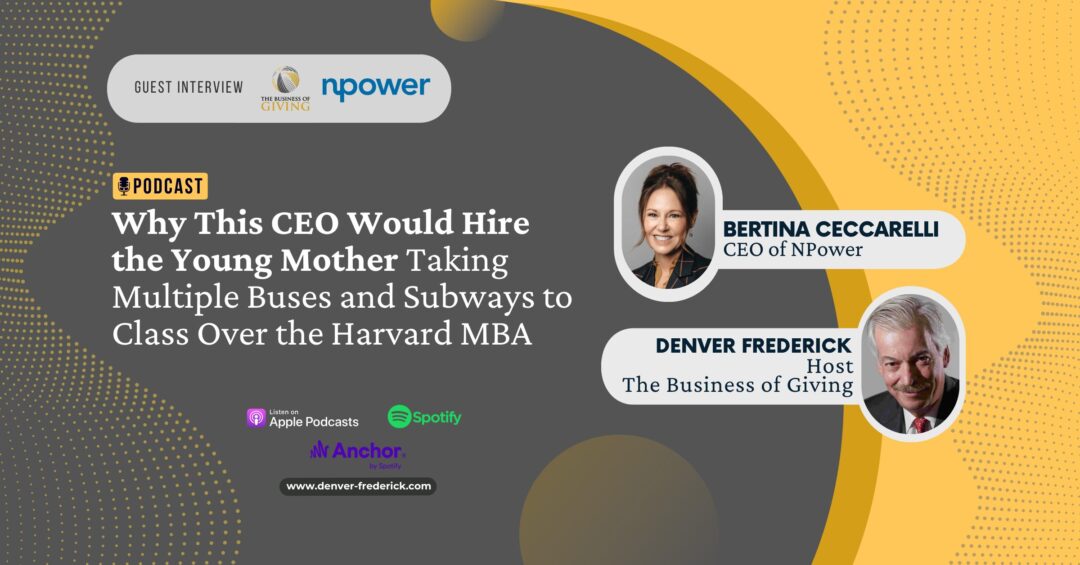
Denver: Welcome to The Business of Giving, Bertina.
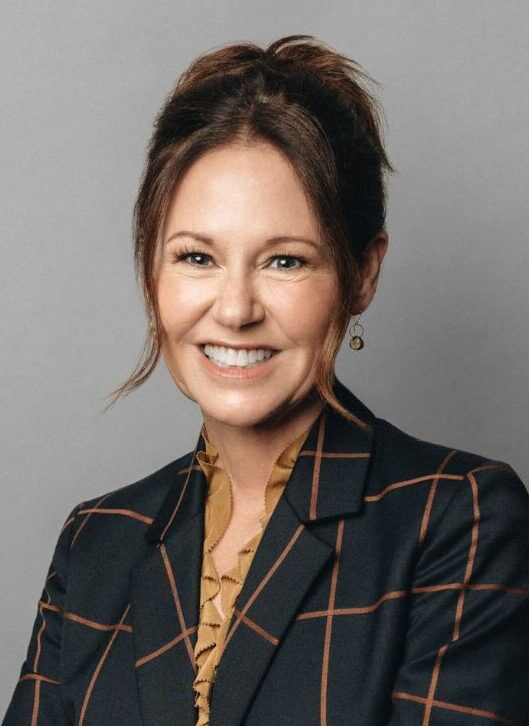
Bertina Ceccarelli, CEO of NPower
Bertina: Thank you so much, Denver. I’m thrilled to be here today.
“I would say the mission of NPower is really to advance economic mobility and for individuals, largely in low-income communities for whom college may not necessarily be their first pathway, or for veterans who are struggling to find a foothold for a career in the civilian economy. And we do that economic advancement work by helping people get into great career growth jobs in the tech sector.”
Denver: How would you capture NPower’s mission for someone completely new to it, and what makes it distinct from other organizations driving tech access?
Bertina: Yeah, that’s a great question, Denver. Thank you for that. I would say the mission of NPower is really to advance economic mobility and for individuals, largely in low-income communities for whom college may not necessarily be their first pathway, or for veterans who are struggling to find a foothold for a career in the civilian economy. And we do that economic advancement work by helping people get into great career growth jobs in the tech sector.
And one of the things that I think really differentiates NPower is the holistic approach that we take, is really getting to know our students very deeply and very personally, and helping to connect them to the resources necessary so that they can be successful in the program and then later on in their careers.
Denver: Yeah. So you know how they live their lives, and it’s just not taking this course and going to work. There’s a lot of other things around it and you really address those, which is great. How has the mission evolved under your leadership, Bertina?
Bertina: Well, listen, I think a couple of things. It’s interesting, NPower was formed 25 years ago, and the original mission of NPower as it was launched was really to connect successful technology professionals to volunteer opportunities with nonprofits, to help those nonprofits with their technology concerns; that might be building a website, or running cables, or connecting peripherals.
And one of my predecessors had the really bright idea: What if we had some young people in the Bronx shadow these volunteers as they’re doing that work for a nonprofit to inspire their interest and maybe a tech career? So out of that was born the workforce development component of NPower.
So for many years, NPower did both things. We were a volunteer connector, and we were a workforce advancement provider. So by the time I arrived in 2016, looking at the mission, looking at the way technology advanced, I realized, Hey, there’s a lot of great organizations in the nonprofit sector doing great work with volunteer connections.
That’s probably not going to be the area where we shine, but we are getting phenomenal results around placement and completion rates and certification rates around workforce development. So let us focus 100% of our time on that. So that’s really where our mission became fully aligned with the North Star of economic mobility for the populations we serve, while at the same time though maintaining that DNA of volunteer connections and relationships.
So you’ll find one of the things very present in anything that we do in any of the markets where we serve, a strong volunteer component, whether that is employer partners who come into the classroom to give a guest lecture on professional development or a technical subject, or whether that’s senior level volunteers serving on regional advisory boards, or certainly our national board. But we’re very devoted to tapping all that goodness and that desire for tech professionals to give back.
Denver: Yeah, that’s just wonderful. Sometimes people get so focused, they leave something so valuable like that and they jettison it, and you did not do that. Listeners probably want to get a picture of the full scale of what you do… how many students, what the placement rate is, the retention rate, states in which you operate. Give us a little idea of the breadth of NPower.
Bertina: Yeah. Well, thank you. Well, we are headquartered where I am sitting right now, in Brooklyn, New York. But we serve communities all across America. We serve today close to 3,000 individuals. And again, those are young adults, primarily 18 to 26, again, many of whom are underemployed, unemployed, without a college degree.
And the other population we serve, and this represents about 30% of our population base, are what we call military-connected individuals. That would be veterans as well as their spouses, and active-duty personnel who we largely serve through a Department of Defense program called SkillBridge, where we can train individuals within six months of their separation date from the service so that we can really pipeline them into great civilian careers, particularly in cybersecurity.
But the states where we operate, and particularly the regions within those states, in addition to New York, include Newark, New Jersey, and parts of southern New Jersey, Baltimore. In Texas, we’ve got a thriving program in Houston, San Antonio, Dallas, and Fort Worth. In California, we’re in Los Angeles, the Bay Area, and my hometown of Sacramento. We’re in St. Louis, Missouri and Kansas City. We’re in Detroit, and we’re in Dayton, Ohio.
And I think that sort of a footprint, with a strong presence in Texas, on the coast, and in key cities in the Midwest, really gives us a perspective on some of the commonalities of the challenges individuals are facing anywhere in the U.S., but also gives us a really good view on some of the regional differences that we also have to understand.
Denver: Give me one of those regional differences.
Bertina: Yeah. Listen, I would say as we look at our program in Baltimore, it’s interesting… we probably see more similarities between Baltimore and Detroit than we might between Baltimore and New York City. And we see some severe challenges, for example, in the transportation infrastructure. And our students might get all of the credentials and be ready to work, but find barriers around how to travel to their workplace.
And so we recognize that the work that we do doesn’t exist in isolation, that we’ve got to work with local civic leaders on how we can address that problem successfully. And so, I think where we see commonalities and differences also connects to the K-12 educational system that might serve any one of those communities where there are gaps and deficiencies, and where NPower can play a role in helping to elevate those skills so that young people in particular are prepared to excel in an ever-demanding workplace.
Denver: Yeah. So interesting. Bertina, NPower’s programs, let’s say Tech Fundamentals or Cybersecurity, those are meeting market needs, but market needs are changing so fast, I just read, and I can’t keep up with market needs.
How do you stay ahead of the curve, and also how do you train people to be adaptable for something specific they may have been trained for, but have to have the mindset that something else might be coming along to replace it?
Bertina: Oh my goodness. I look at that, Denver, as the very heart of what we do and what we have to do, is to teach people how to learn. And one of our mantras, and we say this every day in class: You have to always be learning. And that is a mantra that we share with our students, and we give them tools on how to do that, and a way and a discipline of how to do that. But it’s also something that internally has become a big part of our culture.
So if I maybe start there for a moment. We’ve stood up the National Instructors Institute, run by our chief innovation officer. So just by having that title and really focusing on the issue of innovation has really, I think, motivated and encouraged us that at every step of our curriculum development process, we are engaging our corporate partners, we’re engaging our alumni.
We have real-time information feeding into us to tell us: Here’s how we need to shift our curriculum every six months. Here are some of the new curricula pathways we’ve got to launch. Here’s a way that we’ve got to be more flexible, so that we can have electives that can be developed on a quicker timeframe.
So our cycle times are getting faster and faster. And it means that culturally, we’ve got to have the systems in place, not only to develop and respond to that, but also to be able to measure and understand: How effective are those? How can we always be learning and always do better?
Same idea with our students, and it’s one of the reasons I’m very proud that we don’t just send our students on their way once they complete the program with a certification, or even get a job. It’s really maintaining the connectivity with our alumni to offer continued development and upskilling.
So somebody graduating from our program… by the way at no cost to students, can always come back to upskill and fill in gaps in their learning and understanding and add to the stack of their certifications.
Denver: That is fabulous. I always say that this is the fastest that things have ever been, and it will never be this slow again.
Bertina: I would agree with you… I would agree with you.
Denver: We talked a little bit about what you do beyond the training, and the fact that you really deal with each student or participant as an individual. You offer mentorship and other things. What are the biggest non-technical barriers your students face?
Bertina: Yeah, I would say it’s a combination of things that touch many groups we serve, but are also deeply personal. And some of those barriers are often grounded in baseline poverty.
And so what that means is somebody may be worried about paying rent. It may be that they are even living in a shelter. We find, and I think this is common to so many young people regardless of economic status, that mental health supports are critical, and food security, childcare, transportation.
And I think for me, what I have come to learn as a CEO in this spot is that even as you look at those barriers, what inspires me and astounds me that so many of our students have learned to navigate, who rise above it, and because of their own resilience are able to say, Hey, here’s a program that’s going to help me overcome this.
And when I look at, for example, a young mother who is taking a bus to the subway to get to her part-time job, manage her childcare demands, and then come to one of our programs in the evening, and do it all over the next day, combined with maybe the care for her parents or other obligations, the fact that an individual who can juggle so much complexity in her life… Oh my goodness! Once that individual now also has all of these technical skills, who would not want to hire that kind of a problem solver?
Denver: Right.
Bertina: Somebody who in real time understands how to get stuff done and how to manage, and manage a program, manage a project, manage time. I think it’s those qualities that we see in abundance in the individuals we serve, that our employer partners tell us make them outstanding leaders, outstanding employees, and oh, by the way, have a much higher retention rate than many of the students that they might hire directly out of college.
Denver: When I was working in an organization, when I interview people, I always ask that do-it-yourself question in terms of not waiting for people, but things that you just had to do yourself. And that skillset that you just identified is so important because one of the greatest complaints you get, and you know all this better than I from employers, is that people are waiting to be told what to do.
And employers don’t want that. They can’t scale fast enough if they have to tell everybody what to do. They need people like you just described, who see what needs to be done and do it.
Bertina: Yes. Yes. And sometimes it’s out of necessity, and sometimes it is just out of pure hustle.
Denver: Yeah. Yeah.
Bertina: And a recognition of what’s got to be done to make the rent.
Denver: That’s right. You talked about your employer partners, Citi, Microsoft, …you got some big ones, and they help amplify your impact. Tell us a little bit about those partnerships and maybe share a partnership that went beyond funding to a whole different level.
Bertina: Yeah. Listen, there are so many examples. It’s one of the things… I want to go back to something I said earlier around how I think one of the things we do really well in our connection to students is build relationships. Those relationships have to be grounded in trust, and I would say that that is an ethos that we carry forward to all of our funding partners, and especially what we call our 360 corporate partners where the funding matters.
It is important. It’s the fuel that keeps the operations working. But those partners who then we cultivate that 360 relationship with, who provide volunteer talent, who employ our students, who serve as mentors, and who help really give us guidance on some of the local nuances of markets that we happen to have a mutual presence in, those are the kind of partnerships where you now suddenly have not just one or two or three leaders you’re working with, but you might have a hundred.
And that’s where the magic is. And so, I’d certainly look at organizations like Accenture, who kind of check all of those boxes in the things that we do together collaboratively that help their business and certainly help our program and the students we serve, but at the same time are benefiting from really terrific pro bono research and projects that help keep us on the cutting edge of technology and program delivery.
Citibank, Bank of America, our work with Truist who really helped to advance our efforts in Raleigh, is another good example.
“So one of the pillars that we talk a lot about here at NPower is a seamless transition. How do we avoid the disconnectivity that some people in America face because of transition? If we can streamline somebody immediately into a great job, we save a whole lot of headache, and we get them faster to that route for economic mobility. Same thing with students coming out of high school without a post-secondary plan… Let us identify those pathways fast.”
Denver: Yeah. Yeah. You mentioned earlier in the conversation, Bertina, how you work with veterans and military spouses. What unique challenges do they face in transitioning to tech careers? And how do you try to tailor your programs if you need to, to turn these into opportunities for them?
Bertina: Yeah. Well, let’s just focus for a moment on our program that is under the aegis of the SkillBridge program with the Department of Defense. And we take all individuals who are cleared by their commanding officer for the SkillBridge program, but just as it happens to turn out, many of the individuals we serve through that program just happened to be those who chose to enlist.
And so in many respects, the profile of that individual is not too unlike many of the young adults who are 25, 26 in our program, who, because of their military service just have some astounding qualities, situational awareness, quick thinking, deep problem solving. But their role in the military may not necessarily translate very clearly to that civilian job.
We had one student in our program who loaded bombs onto a ship and outstanding logistics experience, most certainly, and all these other leadership qualities because of his service. He came to our program because he recognized, Look, I want a certification. I want to get some hard skills and work with an organization that can connect me to a job.
So, what we find is that many of our students in that program… but that’s 10 weeks, it’s full-time, it’s fully focused on cybersecurity…. land outstanding positions with defense contractors, and many times making three to four times their salaries in the military. And when you think about the alternative, research has shown that those who enlist in the military often have about a year of unemployment, where they’re trying to figure out what’s that next thing.
And that next thing may be a minimum wage job as a security guard. That’s exactly the outcome that we are trying to avoid. So one of the pillars that we talk a lot about here at NPower is a seamless transition. How do we avoid the disconnectivity that some people in America face because of transition? If we can streamline somebody immediately into a great job, we save a whole lot of headache, and we get them faster to that route for economic mobility.
Same thing with students coming out of high school without a post-secondary plan… Let us identify those pathways fast.
Denver: Yeah. I know we both worked with the United Way, me a longer time, a lot longer time before you did, but I do remember that one of their focus areas, at least a number of years ago, was transitions in terms of moving from one… like high school to college, or college, or after the military. And it’s never gotten enough attention because those transitions are so important and can make or break.
And when it doesn’t go well, sitting around ain’t the thing to do, that nothing good is going to be coming from sitting around.
Bertina: And sometimes the key to successful transitions is that social network.
Denver: Yeah.
Bertina: And what we find, because we have a cohort-based model, that SkillBridge student isn’t doing self-study by him or herself in a room, it is together with a group of people who they can identify with, they can respect, they can learn from. And same with our Tech Fundamentals programs or our Cloud Computing programs. We’ve had students who have met and married in our program.
Denver: Wow.
Bertina: We’ve had students who have graduated and gotten great jobs, and then in turn hire some of their classmates from the cohort that they had two years ago. And so it’s really lovely to see these…
Denver: Yeah, it really is.
Bertina: …relationships begin to blossom.
Denver: Yeah. Yeah. And I think when you’re in one of those transitions and are having a difficult time, and you’re around other people who are having the same difficult time, you don’t feel like you’re alone.
Bertina: That’s right. That’s right.
Denver: Because at times, you feel like you’re the only one, and everybody else has been able to figure it out, but me. And that community can really help that so much.
You have said, Bertina, “No margin, no mission.” So let’s talk a little bit about your business model and how you balance philanthropy and government grants and fee-based services to drive NPower’s growth, and stay true to your values at the same time.
Bertina: Well, listen, I have to give credit to the one and only, Patti Calabrese, who was the chief financial officer at another organization I worked with, the Wildlife Conservation Society, who said that, “No margin, no mission.” And it has stuck with me all this time…
And I think, Look, first and foremost, we are a hundred percent focused on the outcomes we need to generate on behalf of the young adults and military-connected individuals we serve. And if everything flows from that, you can be laser-focused on what’s necessary to achieve that objective.
And for us, it’s close reviews of our budget, and it’s a really close review of how we track and measure our outcomes. And I know, Denver, on many other podcasts, you’ve talked about ROI; you’ve talked about that need for donors to feel like they are making an investment. This is not necessarily just a charitable contribution, and we take that very seriously.
And one of the things I’m really proud of is, and it was very, very hard, as I know you well know, that we entered into a randomized control trial with the lab for economic mobility at Notre Dame, at the Wilson Sheehan Center for Economic Opportunities.
And what was so stunning is over that period of time in two of our markets, New York and Dallas, galvanizing our own staff to appreciate the challenges, but also the benefits and opportunities of an RCT. And I think it’s one of the hardest things as an organization that we’ve ever had to do.
But now that we’re getting some early results, and we are seeing already a $12,000 salary gain for those who have been in the treatment group, receiving NPower services versus the control, recognizing that that far outpaces even the one-year cost of our program, just gives us great confidence that what we are doing is working. And so when I lean on that kind of an outcome, that is in part our margin, right?
Denver: Yeah.
Bertina: Our margin is not necessarily just the financial resources that we bring into the organization, but it’s the delta that we are creating in people’s lives.
Denver: Yeah. And I wouldn’t say this for NPower because I don’t know it well enough, but I often see staff members who get a bit cynical over time. And they tend to see the hole in the donut and not the donut itself. And there’s always thinking about what’s missing and what we’re not doing, especially when they’ve been around five, six, seven years. They’re past the new, and they’re not on the senior team.
And I’ve seen RCTs and other ROIs say, Wow, maybe I should look at all we’re accomplishing and not focus so much on what we’re not doing.
Bertina: Yeah. Although, listen, Denver, what I would say to that is that’s healthy. You always want those people in the organization who are pushing and saying, What are we missing? What could we do better? What could we do differently? But that’s got to be balanced with every now and then taking stock and saying, Look, these are the things that are working really well. These are the assets. Let us make sure that we’re building on that and leaning into those assets.
Denver: Let me share a story that was told to me by Gail McGovern, who was the CEO just recently of the American Red Cross, and she worked for the telephone company previously. And she has a story where maybe it’s apocryphal, or not, from the telephone company, but these two guys are out there and they’re laying the poles, the telephone poles.
And they’re in the middle of Kansas, and they’re just looking down the long highway. And one guy looks at the other guy and says, “Oh my God, we’re never going to finish this. Look at all we have to do.” And his colleague taps him on the shoulder and says, “Look behind you!” And he looks and sees all the poles that they’ve put up.
And she says, “It’s always great as a leader sometimes to tap somebody on the shoulder and say, ‘We have a lot of stuff in front of us, but look what we have done!’” Because it really does give you the sustenance to keep on laying those poles and going. And sometimes, we look at what’s not being done, and not enough that we’ve come a long, long way. And that’s really wonderful.
Bertina: Aah, good words to remember for all of us.
Denver: You have an active board, which has helped drive NPower’s success, and you’ve turned that board into a dynamic force, advocates for fundraising and strategy. Just beyond oversight, what’s the secret?
Bertina: I think the secret is no secret. It’s the success of our mission. And listen, one of the things that I am just kind of personally touched by and inspired every day in working with this board, I will tell you… we have some individuals on our board who have experiences not that unlike our students.
We have leaders who are managing multi-billion-dollar global budgets, divisions with thousands of people who don’t have a college degree. Individuals who themselves came from some pretty hardscrabble backgrounds and have just, through their own savviness and grit and resilience and intelligence, risen to the top of their profession.
And it’s when you’ve got people like that who are a part of your board, who understand and appreciate the challenges that our students confront, but also importantly, to go back to your analogy, what is before them and the opportunity that they can seize, that is pure inspiration.
And to have some of those board members talk to our students at a graduation, or to come address them during one of our classes, I think that is part of the fuel that helps to just make this board run, and what really helps with that level of engagement. Because you know what? For all of them, it’s real. It’s: I care about this, and I want to help this organization get better, and I will do what’s needed to make that happen.
Denver: Beautiful. You have emphasized an AI-resilient workforce. I won’t even pose a question after that. Tell me, what is AI going to be doing to everything? And particularly, how do you prepare your students to be adaptive, and what’s NPower doing to just be prepared for that day… which changes every single day?
Bertina: Yeah. Well, listen, I would say that that day has come, and that day has gonna come over and over and over.
Denver: Over again. Groundhog Day.
Bertina: Exactly. And so I think resilience is the name of the game. And there’s a couple of different ways that we’re thinking and doing about AI, and the first is just as we think about our internal operation, there’s things that we can do. Leveraging AI to be more effective. And a few examples that I’ll just share with you briefly is: it’s been a real boon on how we match students to jobs. There are AI tools that we’ve leveraged.
AdeptID is one of those tools that really help us refine the resume of the student to speak the language of some of the filtering systems, but more importantly, also looking at the actual skills required by certain jobs, and being able to advance candidates who have those skills and just present it a different way to the hiring partners that we work with. And we’ve already seen gains in our student placement success rates with that technology.
The other thing that we’re seeing is there’s ways we can prepare students for interviews that don’t necessarily take the sort of human capital. We could deploy that human capital in other very high value ways, but we’re using an AI technology called Huru that allows students to practice many, many times, however many times they want in an environment that replicates a one-on-one interview that goes beyond the bot. Oftentimes that’s going to be the first step, but they’ll eventually get to a live interview.
It really helps to support their preparation for technical interviews, but it’s a tool that also will look at eye contact, facial expressions, filler words that really make great observations and recommendations for improving the delivery. What I like about this tool is because it’s the privacy of you and your AI agent, that you could take some risks.
Denver: Yeah.
Bertina: And you can overcome what so many of us, not just our students, but I think that this is a common condition, a certain kind of imposter syndrome that if I get skilled enough and I’m comfortable enough, I don’t have to worry about that. I can leave that behind.
So, there’s many different applications internally that help us programmatically, help us with operational efficiencies. But the second thing with AI is just what we teach, and making sure that every single curricular track that we have incorporates not just AI literacy, but an AI understanding and a preparedness around: What kind of AI tools are you going to be using in your job? Let us get you skilled on that today.
And what we find is that so many of the young people coming through our program are the ones who are teaching some of their older colleagues once they do get at… name your Fortune 500 company.
Denver: Yeah, yeah, yeah. Oh, that’s great. Bertina, since 2016, you have scaled NPower from $6 million to $35 million. You’ve doubled the reach, maybe more than doubled your reach. In a nutshell, what is your leadership philosophy?
Bertina: It starts with culture. I think oftentimes when we discuss scale, we think about the size of the organization, the budget, the numbers served, but I think too often we overlook what’s needed to scale culture. Because I think that there are some qualities that a smaller organization exhibits that get lost when you bring in four times more staff members and you go to five times as many places around the country.
And if you can codify: what is it that is important to culture? Accountability, respect, innovation, curiosity. And you can look for those qualities in the new people who you hire and how they are onboarded, in what the management structure looks like, in what you reward, and when you make hard choices for people to leave the organization.
So cascading this and finding great leaders and great staff members who are culture carriers is, I think, the fundamental most important thing if an organization is going to successfully scale.
“…I think it’s also recognizing that, look, as the CEO, you’re not going to be the only one who communicates. And so really ensuring that you’ve got great leaders up and down the organization who are accessible and they are informed, and they are passing along key pieces of information that staff need to do their job… but equally important that they are listening carefully to the ideas that staff have– that make us better”
Denver: I would agree. And I also think about scaling culture. So much of it is communications, and I read someplace that you have to change the way you communicate every time you 3x your employees.
So you can communicate with three people… Eh, we all just get together and have coffee, but you have to change it at nine, you have to change it at 27, and you have to change it at 81 because if that communication modality doesn’t change dramatically, people will be left out, and that’s not good for a culture.
Bertina: Yeah, no, that’s absolutely right, and I think it’s also recognizing that, look, as the CEO, you’re not going to be the only one who communicates.
Denver: Yeah. Right.
Bertina: And so really ensuring that you’ve got great leaders up and down the organization who are accessible, and they are informed, and they are passing along key pieces of information that staff need to do their job… but equally important that they are listening carefully to the ideas that staff have– that make us better.
Denver: Sure. You mentioned risk a moment ago, with students in AI, and taking a risk. I’m going to ask you about risk. Was there a decision, Bertina, or an initiative that you led at NPower that felt really risky at the time, but turned out to be transformative?
Bertina: I would say, I’m going to use an example of a pilot that we went out on a limb to try over, now about 18 months ago. And one of the things that we’ve been very, very proud of is our Tech Fundamentals program, which is a high touch, pretty intensive program where we really surround our students with a myriad of supports. And we’ve got relationship managers, social support managers, instructors, career developers. And it’s important, and it works.
But what we’ve recognized is that one size doesn’t fit all. Even within Tech Fundamentals, we were noticing that there were some individuals who might not need that intensive support and who might have the wherewithal and the ability to take some of the modules and fly and go much faster, and earn those certifications at a higher level even.
And so we piloted something that we call Network Systems Administration. And what we teach is less important than how we teach it because it is one of our first, what we call hybrid asynchronous programs. And it’s a lighter touch model. And it was scary because I think that we have all so carefully crafted and built this organization around that Tech Fundamentals model.
And it’s been astounding what we have seen in the results of what we call net essay, where in a pilot program where 80% of the program is self-study, 20% is led by an instructor… so there’s still a community and a cohort-based approach. But even in the pilot, we had close to a 70% retention rate, and we’ve had students who have gotten jobs two weeks before the program even ended, at about three times the placement rate after four weeks that we have in our traditional program.
And so we’re beginning to see these really strong outcomes, and it is now defining some of how we will scale to other parts of the country. And so this combination, that high intensity Tech Fundamentals model is core to what we do, but we can now differentiate our services and match them to the needs of students, as opposed to saying everybody needs to go through and power the very same way.
Denver: Yeah. Yeah. Well, a lot of organizations don’t want to bite the hand that feeds them, and this has always worked, and we should stick with their knitting. Kodak with film, but you went digital, and it turned out. Maybe it’s going to accelerate just not that, but everything across the organization.
Finally, Bertina, if we’re having this conversation five years from now, what would have to be true for you to feel that NPower had made the impact you’re striving for?
Bertina: I think I would start by saying that we have maintained the quality of our service and our outcomes, that while we might innovate in many different directions around that core idea, that we have held true to ensuring that 80% of our students within six months are getting a great job. That we are holding true to 85% certification rates and retention rates. And that we continue to serve the populations who need us the most.
Those are just some core philosophies that underpin everything that we do. So that would be the number one piece, but I would also say if I look five years from now, we’re taking this notion that we can meet students where they are differently and expand upon that. So while today, that might be the Network Systems Administration, tomorrow that could look like healthcare; it could look like tracks that help us streamline people into great jobs at data centers, and then help elevate their careers once those jobs are done.
It’s looking at new industry sectors that today we’re not necessarily in and building an infrastructure around that– board members from those industries, funders from those industries. So what I love about the world of training for tech professionals, it is constantly evolving, and our success will depend on how well we evolve with it.
Denver: A very exciting vision. For listeners inspired to learn more about NPower or financially support this work, tell us about your website and the kind of information they’ll find on it.
Bertina: You can find us at npower.org, and I would personally be happy to speak to any of your listeners about what we do, and I can guarantee you that they will not get a bot.
Denver: You are anything but a bot. I want to thank you so much for being here today, Bertina. It was such a great pleasure to have you on the program.
Bertina: Likewise, Denver. I really appreciate the opportunity. Have a great rest of your day.
To celebrate my 50th year in the nonprofit sector, I’ve put together a gift for you — a practical, field-tested guide to building world-class nonprofit workplace cultures. It’s called Cultivating Nonprofit Excellence, and it’s based on insights from nearly 1,000 interviews and 150 focus groups with nonprofit leaders around the globe. It’s completely free and instantly downloadable at blanchedalmond-mosquito-418475.hostingersite.com