
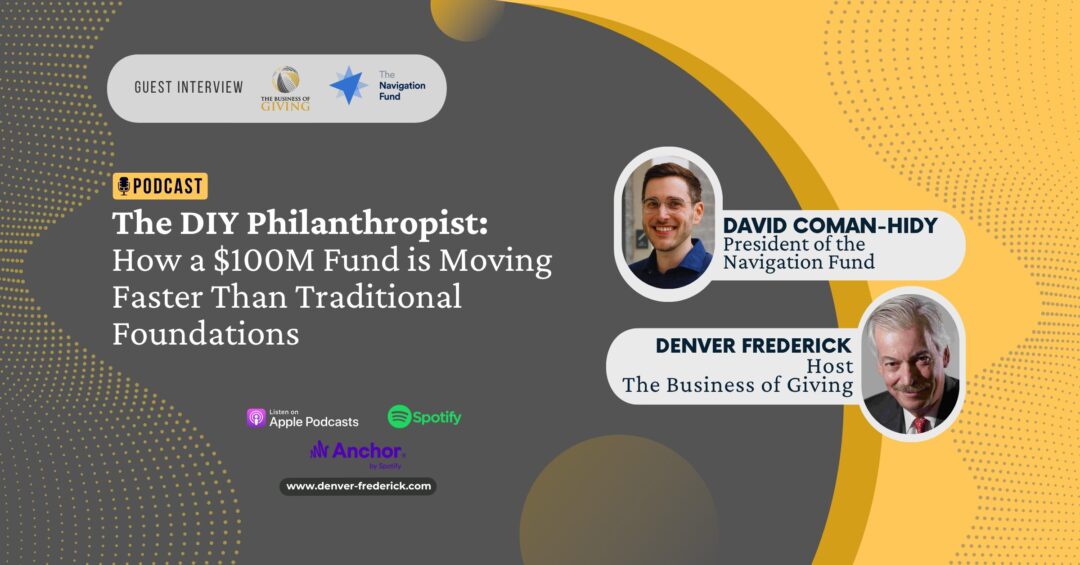
Welcome to The Business of Giving. I’m your host, Denver Frederick.
Today we’re joined by David Coman-Hidy, who leads The Navigation Fund, a $100 million philanthropic organization tackling some of the world’s most pressing challenges. From his punk rock roots to running a major foundation, David brings a unique do-it-yourself mentality to philanthropy that’s shaking up how we think about creating change.
“Well, our mission is pretty simple. We’re here to work on some of the world’s most pressing problems. And we do that by offering grants to high-impact organizations that we feel like are advancing pretty bold solutions for these urgent problems.”
David will share how The Navigation Fund is moving faster than traditional foundations, why they’re funding everything from AI consciousness research to youth justice reform, and what the future of philanthropy might look like when the next generation takes the reins. Let’s get started.
Denver: Welcome to The Business of Giving, Dave.

David Coman-Hidy, President of the Navigation Fund
David: Thanks so much for having me, Denver.
“Well, our mission is pretty simple. We’re here to work on some of the world’s most pressing problems. And we do that by offering grants to high-impact organizations that we feel are advancing pretty bold solutions for these urgent problems.”
Denver: For someone who’s never heard of The Navigation Fund, how would you describe its mission and what sets it apart from other philanthropic organizations?
David: Hmm, interesting question. Well, our mission is pretty simple. We’re here to work on some of the world’s most pressing problems. And we do that by offering grants to high-impact organizations that we feel are advancing pretty bold solutions for these urgent problems.
Denver: You went from playing in punk bands to running this hundred-million-dollar philanthropic fund. How did that do-it-yourself, challenge-the-system mentality shape your approach to trying to change the world?
David: Yeah. Well, sadly, I was never in much of a punk band. I just played a little bit with my friends when I was a kid, but I was very much in the punk community growing up, and that’s really what got me into activism as a teenager. I think any kind of alternative subculture with this really do-it-yourself ethos has a lot to offer both philanthropists and social entrepreneurs, or people working in the nonprofit space, or whatever you want to call it.
I think that the most important thing that I feel like I’ve carried on is that do-it-yourself ethos where in the punk community, especially early days, ideas like: You don’t know how to play an instrument, you don’t know how to put on a concert, you don’t know how to organize a protest, you just figure it out. There’s like a zine or a website that’ll tell you how to do it. You can ask people. You can just try and experiment.
And I think this attitude is incredibly useful for advocacy. And I think it’s something that should be embraced by more philanthropists… more openness to risks, more just imagining like: Oh, what if we just tried it? What if we just tried to do something ourselves?
I think the other thing is like, yeah, the one thing that, especially early punk music, is really communicated, coming from kind of like Thatcher-Reagan era was, the idea of like there’s the consensus that everything’s pretty good right now. And the punk community was saying, or the punk musicians were saying: In fact, that’s not the case, and there’s a lot of people who’ve been left behind… or there’s a lot of suffering in the world.
And I think that taking that kind of critical lens, regardless of where you land on those specific political questions of the 1980s, I think is really important. And that’s where you end up working on causes like criminal justice reform or farm animal welfare and so on, where you’re kind of looking after those who’ve been left behind or have fallen through the cracks.
Denver: Push the envelope. Never be complacent. Always more to do. And that mindset just keeps you moving forward.
Well, talking about animal advocacy, your work there, like leading cage-free campaigns. I mean, that was a masterclass in systemic change. Dave, how are you applying those lessons to The Navigation Fund’s other cause areas?
David: Yeah, so my background is in working in pharma advocacy for, I don’t know, about 12 or 13 years, and I’d say it’s a few. So one thing that I’m definitely bringing with me is that I ran an organization called The Humane League for about a decade. And by the time I left, we were in a number of countries, maybe $20 million budget, a little over a hundred employees.
So I think having that experience of having run a nonprofit organization has been really useful in grant making, both in sympathizing and understanding the challenges that charities go through and that advocates go through, and also just being able to assess things like campaign strategy, strategic plans overall, assessing executive directors and leaders. So that’s been incredibly useful.
In terms of specific lessons from something like the cage-free campaign, I think it really depends on the cause area. In some, it’s more applicable than others. So, I have no expertise in reforming the criminal legal system, but you can imagine some parallels, right? Like groups that work on ballot initiatives or corporate campaigns against companies that are benefiting from the private prison industry, and so forth.
So, that has been somewhat useful in helping contextualize these areas that are relatively new to me. I think overall, it’s just given me a really healthy understanding of how difficult creating social change is and the kind of ecology of different sorts of organizations and methods that you need, that there’s no single silver bullet that could win something like a cage-free campaign.
That it’s built on the foundation of this movement ecology of: You’ve got the groups that are recruiting students and training them to become advocates. You’ve got groups that are quite friendly with industry and working as advisors and consultants to them. You’ve got the aggressive campaigning groups. You’ve got the policy organizations. You’ve got people writing books and putting out podcasts and so on and so forth.
So, I think that that’s really the… a lot of humility, I suppose, is what it’s taught me, is like that there isn’t… anyone who claims to have the single answer of what to do… I just have a lot of skepticism towards them.
Denver: Yeah, yeah. When people tell me they have a single answer to something, I head for the hills because it’s just not the case.
You have some empathy for nonprofit organizations having run one, but you just don’t write checks. You’re building infrastructure like Voltage Park and running operations. Tell us a little bit about this hybrid model, funding model, and why both roles instead of just sticking to traditional philanthropy.
David: Yeah, so we have… a lot of our endowment is in a company called Voltage Park that is a cluster of GPUs that are rented out for things like artificial intelligence. And the idea is to have a long-term investment there that’s going to generate funds for our grant making.
And we also do a number of more operational things within the grant making and nonprofit side as well. So for example, we do a lot of funding of meetings and conferences. We have on contract folks who provide support on things like fundraising or communications that we essentially loan out to our grantees.
All of our program officers are practitioners from their fields, who are pretty well- connected with the organizations. So we try to provide as much support outside of just grants that we can.
Denver: You’ve also highlighted the fact that lack of talent is a key constraint in social impact work. What strategies is The Navigation Fund using to address this bottleneck and build a pipeline of changemakers?
David: Yeah. So, again, I’ll speak a little bit from my experience in the animal world. It’s a real struggle. I think you’ve got a number of ongoing challenges, both in recruitment of talent and retention across various sectors.
I think it’s really important to invest in these long-term programs. So like one of the animal groups we invest in is called New Roots Institute, and they work with students to launch campaigns, become stronger advocates, get tied into like an alumni network and connected with mentors where they’re developing into people hopefully helping lead the movement in a decade or two. But you also have the challenge, so we have to invest in those for the long term.
But you also are trying to get kind of mid or late career people who can bring a lot of skills, and in a lot of these nonprofit sectors, especially really small and underfunded ones like farm animal welfare, working on the criminal legal system and so forth, even in some parts of the climate sector, they are just missing a lot of executive experience or more specific skill sets– things like strategic communications, even stuff like web development and, a lot of professional skills and people with a lot of professional experience.
It’s not so hard to find excited young people without much experience. It’s a lot harder to find folks bringing decades of work from the private sector or from larger NGOs. And what you often see is that the transition for those folks can be quite challenging if they’re going from a really professional work environment and experience to work at a small NGO with a bunch of activists.
So we’re trying to find ways to help those folks transition effectively. We support a group called, Animal Advocacy Careers. That’s one of the issues they work on. They provide a class that trains people in: Here’s what the movement looks like; here are the various sectors; here are ways you can use their skills. I’m very encouraging of those folks to look into things like high-level volunteering, such as board positions, as a way to kind of get their feet wet in the nonprofit sector and learn a little bit about the space and where they might be able to fit in.
We’re also really interested in retention. So one really exciting thing that our climate program officer led a few months ago was a set of transition grants for people whose work was being cut from the federal government. We had about a little over a hundred applicants, and we selected nine of those where we’re able to help people kind of transition to their next role, or even just capture the information that they were leaving with to make sure that that could be made public and made useful instead of just lost.
So to me, those kinds of projects are also incredibly important in retaining that skill.
Denver: Cool. Yeah. I guess the other thing you could do is just tell them to adopt that punk rock, do-it-yourself mentality and get started.
David: That’s right. Exactly.
Denver: So, let’s talk about your five cause areas. And you’ve already made the point that each is led by a former practitioner or expert in those areas. Let’s start with AI safety, which is a crowded field, from technical alignment to governments. What specific challenges are you funding to ensure that AI doesn’t go off the rails?
David: Yeah, so our program is actually narrowed quite a bit, so we’re working on something that’s a little bit more on the philosophical and experimental side in this topic of understanding consciousness and potential digital sentience.
So this is kind of the intersection of computer science and neuroscience and philosophy. So one example of a group we fund is called Eleos AI Research, and they work with Frontier Labs. They’re run by a philosopher named Rob Long, who’s published with a lot of leading philosophers on things like consciousness.
And they actually run audits and experiments on these frontier labs and also try to come up with the various theories of consciousness and how they might apply to these large language models or other potential future AI systems. One of the ways that folks worry about AI going wrong is generating an AI that has experiences and that can have a negative experience.
And having these kinds of cutting-edge philosophers and folks, taking a real look and trying their best to assess this question, even if we think it’s a relatively small chance it might happen, seems like an important and incredibly underfunded safeguard in the system.
Denver: Yeah. Well, my guest on Monday is going to be philosopher Peter Singer.
David: Oh, wow. Amazing.
“I think some of the specific kinds of things we’re really excited about are areas like youth justice, which is already a very underfunded space, especially in the last few years. But that specific niche in particular is just crucially underfunded. So this is trying to help young people who are caught up in the system, helping them get out of the system or avoid getting caught into it at all.”
Denver: Yeah, he’s been on the show before. So, you’ve just given me a question. I thank you very much for that.
Transforming justice, the criminal legal system. That’s a bold goal. What specific interventions are you funding, and how do you measure their impact?
David: Yeah, that’s a great question. I mean, there’s so much work to be done. That’s one thing that I have learned a lot over the last two years at The Navigation Fund working with Erin Keith, our program officer in that space. And she’s got, I don’t know, it’s well over 60 grantees at this point, and she started with a relatively broad portfolio introducing us to the space.
I think some of the specific kinds of things we’re really excited about are areas like youth justice, which is already a very underfunded space, especially in the last few years. But that specific niche in particular is just crucially underfunded. So this is trying to help young people who are caught up in the system, helping them get out of the system or avoid getting caught into it at all.
We’ve worked with regranters and a few individual groups in this space, and it’s something we’re excited about exploring more. We’ve also looked at some really cool, kind of innovative tech solutions to some of the issues here… so I really like this group called Scrutinize, that we funded. Their mission is to make state courts more accountable and transparent to the people.
These are like very opaque places for the most part, but they just use AI and data analysis to take all of this really complex data that exists out there in the world and compile it in ways where voters and citizens can check out the actual records and comments of these various judges. Like that to me is just a really interesting and exciting use of AI towards this problem.
And we’re also funding more traditional things like organizing and advocacy and so on. And you asked about: How do we measure our impact? In a few different ways. For each of the grants that we make at the organization across our programs, we have the goals of the grant. So we’re kind of measuring it against itself. Like here’s what we expect to happen.
Our program officers actually register predictions of how likely various outcomes are to happen, so we understand the level of risk and reflect on how accurately we’re predicting against those. This is actually something our friends at Open Philanthropy taught us about that they do with their grants.
But then we also hold that against the broader strategy itself and what are the overall longer-term goals that we’re trying to reach. And those are actually published on our website for the criminal justice program. So folks can check that out themselves at navigation.org, if they’re curious.
We’ve also got the full strategy and goals for most of the programs up at this point. I believe we still have to post our climate one, though.
Denver: Yeah, but by and large, not opaque at all. Just the opposite.
David: Yeah. Yeah, yeah, yeah.
Denver: Your third cause area is climate philanthropy, and in that, you emphasize global equity. What’s a specific climate project, Dave, or grant that shows how you’re doing things differently?
David: Hmm. Yeah, that’s a good question. I think we are especially focused on mitigating some of the near-term harms of climate change that are already happening. So this is a range of things from groups like, say, like Spark Climate Solutions. They’re working on early-stage orgs, doing things like agricultural nitrogen management, warming-induced emissions, methane removal. They also do lots of field building and that kind of thing. We’ve also looked at climate intervention stuff like enhanced rock weathering and this kind of stuff.
I think when you’re talking about the near-term harms of climate, a lot of the people who are going to be suffering the most from changes are in parts of the world where they may not have as much of a voice in discussing what the solutions and interventions are going to look like. So we think it’s really important to partner with organizers and folks in the climate space who are making sure that they are working with and with the support of those communities to talk about what kind of interventions and solutions we want to work on.
Denver: Good. Yeah. And they’ve had very little to do with how this all came to be, but they unfortunately are the ones who are at the front lines of what’s happening.
David: Yeah.
Denver: The next area, fourth would be funding changes to how research is done and shared. I really love this one. Give us a specific open science project you’re supporting that’s, let’s say, shaking things up.
David: Sure. Yeah. So one thing I’ll just preview, we’ve just closed an RFP on AI in open science and how AI tools can be used to reform things like scientific publication and sharing of data.
So I think we’re going to have some really cutting-edge stuff to announce in the coming months. One of our grants from last year was really cool. It’s a group called DataCite. They’re a nonprofit that helps researchers track their work online through these stable, permanent identifiers.
So that makes it possible, even if original websites or databases change, to track data and share, which is just incredibly important for open science. So we’re helping fund them to build these really easy-to-use tools that allow people to improve and update their records, to make the research really accessible and interconnected.
Some of it is quite technical, grants like this, this tool building, but it’s about creating an alternative to traditional, slower systems that are incredibly satisfying and easy to use, and just make information really accessible for other scientists or journalists or researchers or whatever it is.
Denver: Yeah. That is so key. And the last area is animal welfare. We talked a little bit about that with cage-free. What’s a bold animal welfare project you’re funding now to push that needle a little bit further?
David: Yeah. I mean, man, there’s so, so many to choose from. See, it’s a topic close to my heart, of course. I mentioned New Roots Institute who are working with young people. I think that’s incredibly important.
I’m really excited about the work of a group called the Albert Schweitzer Foundation. I’m sure Peter Singer, who you’re talking to soon…
Denver: Yeah, yeah.
David: …will know all about them. They’re in Germany, and they’re just an incredibly impactful group that’s been doing amazing work for a long time. And I think Germany, to me, is a place that is setting, kind of planting a flag out in the future of what might be achievable for other countries as their animal movements think about what’s next.
And they’ve really made a lot of progress when it comes to both improving the welfare of animals on farms, so getting animals out of cages and getting them better treatment and conditions, as well as working with retailers and companies to reduce the amount of meat being sold or used… or like increase, I should say, increasing the number of alternatives within supermarkets.
And I think there’s just like it’s a mix of having an incredible group there with a great leader, Mahi, and a great team, as well as a kind of culture in society that’s increasingly worried about climate and the treatment of animals. So, that’s one that’s really on the frontier that I’m super excited about.
Denver: Very good. That’s quite an eclectic and impressive portfolio. Congratulations.
Dave, you pride yourself on moving faster than traditional foundations. This is a big question I think that plagues the nonprofit sector, and that is: What is the secret to moving fast?
David: Yeah. It’s an interesting challenge. And listen, like I’m in my second year… I just hit two years. So, yeah, I speak with humility here because I know there’s a lot of really experienced philanthropists out there. I think though, a few things I’ve noticed in my first two years that have been helpful for us.
One is about this mindset that we talked about at the beginning is coming from being a practitioner of activism, where I think if the folks who are closest to making the grants have that mindset and aren’t just thinking of themselves as philanthropists, but thinking of themselves like as advocates or activists among the people in their field, I think it increases the kind of sense of urgency and this bias towards action that we want to be instilling in our team, and trying to avoid bureaucracy where we can.
And part of how we have institutionalized that is to let our programs be thesis-driven or strategy-driven, where the program officer is writing up: “Here is what I want to do. The board is approving that.” And then they’re able to act with a lot of speed and leeway to make those grants pretty quickly without a lot of process that slows things down, because it’s already… it is within the strategy.
So, there’s some oversight to make sure things fit in with the strategy.
Denver: Sure, sure.
David: We update the strategy each year and so on. The board members have a good sense of what’s happening on a quarterly basis, but I just think we have an unusually high level of trust because we spend a lot of time on alignment at the beginning.
Denver: Yeah. And you empower the team; you don’t micromanage, and you get things done. Yeah.
David: I hope so.
Denver: Well, you know, this is a thing that just I don’t even know what to say because so many nonprofits I work with are just so slow-moving, and they just can’t make a decision, and it’s costing them. And I don’t know whether it’s a lack of urgency in some cases, but it does seem to be an epidemic in the nonprofit sector.
David: Yeah. Yeah. I’ll add, I think I… so I used to be on the fundraising side, right? That’s most of my career, and I’ve developed a lot of sympathy for the philanthropists on the other side, I think things that I used to find frustrating.
It is very different being in the position of dealing with the complexities that funders face and trying to land on risk tolerance when you feel this big burden of duty to distribute the funds well, both for the people who are donating to you and because you care about the cause where you just have so much less insight.
If you’re just talking to fundraising staff and executive directors, you have so much less insight than if you’re working in the field and talking to people. So I don’t want to come across as too overconfident…but because I do think it is challenging, but that’s why it’s important to constantly remind ourselves to not let that slow you down.
Denver: Yeah. I think it was Warren Buffet who said it was a lot easier making money than giving it away. It was right before he gave it all to Gates I think at one time.
David: Yeah. Yeah. He found a hack.
“…there’s some answer in each of our cause areas of the kinds of levels of things we can hope for. I think for me, I will be really happy if we have been successful in catalyzing and funding bold organizations that are pushing the envelope, maybe things that are otherwise really neglected or are too risky for more traditional philanthropy to go after… and having a track record of seeing those groups grow, seeing the victories that come from them.”
Denver: Because it really is if you don’t want to make a mistake. So Dave, looking to 2030, what do you hope The Navigation Fund will be known for in terms of impact and in terms of influence?
David: Yeah, that is a good prompt. I think that, for me, yeah, I could… there’s some answer in each of our cause areas of the kinds of levels of things we can hope for. I think for me, I will be really happy if we have been successful in catalyzing and funding bold organizations that are pushing the envelope, maybe things that are otherwise really neglected or are too risky for more traditional philanthropy to go after… and having a track record of seeing those groups grow, seeing the victories that come from them.
And in terms of influence, any inspiration that those things can be to others and acting in that way would be very gratifying. And I think in particular, this model of really empowering practitioners from the field is something that I’m excited to see play out in the coming years, in the transparent strategy-driven approach.
So by 2030, it’s like if we’ve been able to execute on those things in a successful way, I’m going to be really, really proud of that.
Denver: Let me ask you a follow up on that. I don’t mean to put you on the spot, but is there a future cause area you suspect philanthropists aren’t yet thinking about?
David: Hmm, interesting question. I mean, I think that there’s a number of highly neglected cause areas, so some of these climate items I mentioned. I think when you think about the scale of the problem and the solutions that are needed, the amount of funding is just incredibly small.
So I think there’s certainly areas within the big categories. Obviously, I can put in my plug for farm animals. It has about $300 million in funding around the entire world for all the organizations each year.
Denver: Wow.
David: I mean, it’s just incredibly tiny. It punches way above its weight. But that is an area where I think it’s just a great moral tragedy of our time that I think future generations will come to recognize. So that’s one that I expect to grow a lot in popularity.
And then I also think it’s an open question how AI is going to impact our economy. And it could be the case that there are pretty dramatic changes in unemployment, education, healthcare, and I wouldn’t attempt to predict what those would look like. But my guess is that for a transitional period, the philanthropy sector is probably going to need to move quickly to address the disruptions that come to society before governments in the private sector catch up.
Denver: Well, let me close with a question that’s another prediction, which you probably are going to dread, but I’m going to go ahead 25 years to 2050. What assumptions about doing good which we hold today will seem outdated, even maybe quaint by then?
David: Oh, fascinating. Hmm. So when I think about 25 years from now, and doing good, and philanthropy, and the changes that are coming, right now we’re at the start of the largest wealth transfer in history, and a lot of what we think of as traditional, old money, and philanthropy… their kids are going to be inheriting money soon– younger, younger adults.
And we’re seeing a huge explosion of wealth in the tech sector and AI, so lots of people in their 20s and early 30s who are going to become fantastically wealthy in the coming years. So I suspect there will be a large number of cultural changes, especially to philanthropy that will come during that period.
I think just to name one that we’re already seeing as more tech money has entered philanthropy is that you have folks who are coming from a background where they’re pitching to VCs; they’re living in the Bay Area. And those folks tend to be much more open to risk. They are very entrepreneurial. They’re looking at things in a very different way than like a mega foundation in New York, let’s say, and they’re staffing up in a totally different way.
And I have to imagine that the next generation is also going to have a different approach to what we’ve seen at some of the larger institutional philanthropies. It’s really hard for me to predict what that will look like, but I do think that we will see people being probably more risk-taking, probably a little bit more hands-on… probably less mega institutions, and more family offices.
And probably, people who are going to be giving based on causes that they felt really connected to as young people who are inheriting a lot of wealth early on, rather than just giving to their university or something like this. So I predict some of those kinds of changes are coming.
Denver: That’s a great insight because those guys or gals, they ain’t afraid of failure because they know if they invest in 10 things and only one hits, it can change the world. And that’s not the traditional thinking that we have currently.
David: Yes. Yeah, that’s right. I mean, how often have I heard in these last two years of philanthropy: No regrets giving. That’s a lot of what is said when you’re getting someone in. That is not the approach that the VCs take. If you’re not regretting, you’re not trying hard enough, right?
Denver: That’s exactly right. That’s great. Dave, for listeners inspired to learn more about The Navigation Fund, tell us about your website and the kind of information they can find there.
David: Sure. Yeah. So our website is navigation.org. So check it out. You can read a little bit more about our cause area strategies and meet our program officers. If you’re a group working in one of those fields who’s interested, you can use one of our Introduce Yourself forms on each of those pages for the cause areas, so you can get your work in front of our program officers.
Yeah. And we expect to be launching newsletters later this year, hopefully, in some of our cause areas, so keep your eyes peeled for that.
Denver: I will subscribe. Great. I want to thank you so much for being here today, Dave. It was a real, real pleasure to have you on the show.
David: Thanks so much, Denver.
To celebrate my 50th year in the nonprofit sector, I’ve put together a gift for you — a practical, field-tested guide to building world-class nonprofit workplace cultures. It’s called Cultivating Nonprofit Excellence, and it’s based on insights from nearly 1,000 interviews and 150 focus groups with nonprofit leaders around the globe. It’s completely free and instantly downloadable at blanchedalmond-mosquito-418475.hostingersite.com