
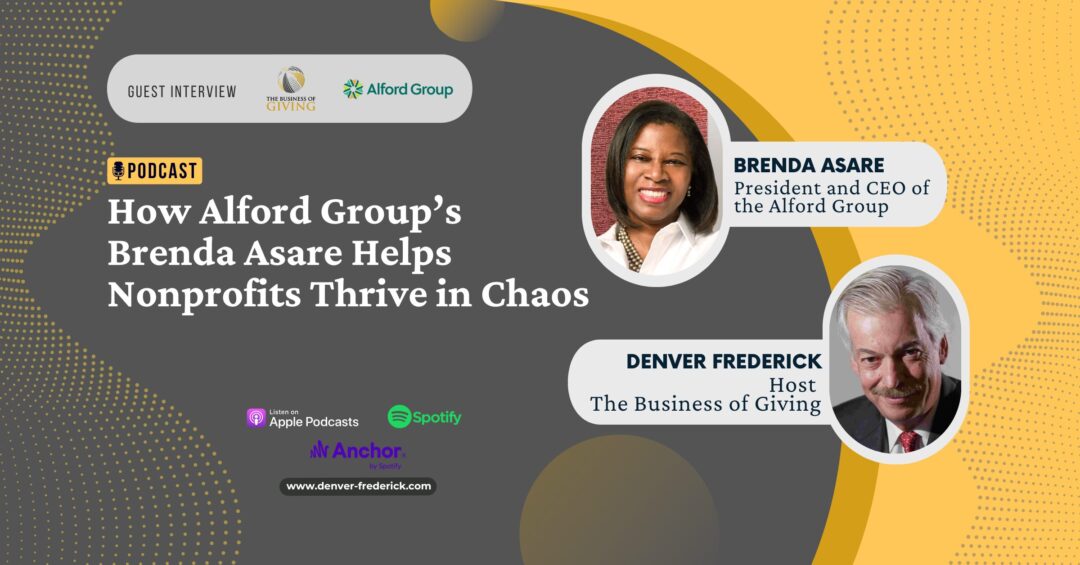
Welcome to The Business of Giving. I’m your host, Denver Frederick.
Today we’re joined by Brenda Asare, chair of the Giving Institute and president and CEO of the Alford Group, a 45 year consultancy that’s powered billions in nonprofit impact. With decades of experience, including leading major disaster fundraising efforts, she’s tackling today’s wild nonprofit landscape. We’ll dive into the sector’s strains, donor shifts, and how resilience is rising to meet the moment.
Denver: Welcome to the business of giving, Brenda.
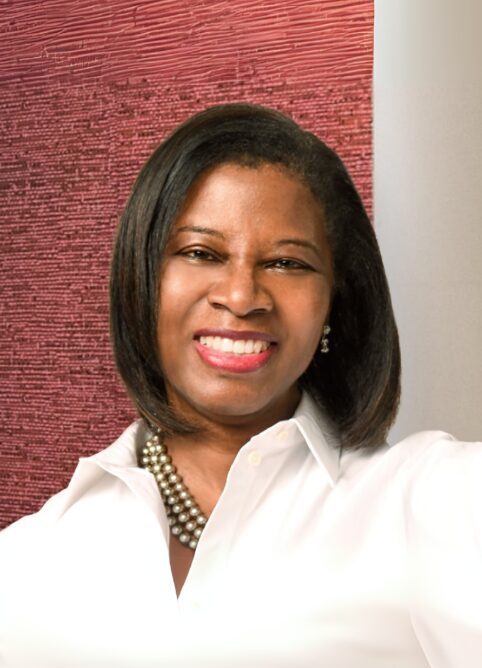
Brenda Asare, Chair of the Giving Institute and president and CEO of the Alford Group
Brenda: Thank you so much, Denver. I am so looking forward to our conversation this afternoon.
Denver: Likewise. Let me start with this, you’ve been around for a while. You have great perspectives on things, but I don’t even know if you’ve ever run into times like the ones we’re in at this moment. But looking at that, with that historical perspective and taking a sense– from the clients you’re talking to, what you’ve observed, what you’ve read– how would you describe this moment in time for the nonprofit sector?
Brenda: That’s such a great question, Denver, to launch this conversation. In this moment, the nonprofit sector is really under immense strain due to a combination of political and economic pressures. We’re seeing where executive orders are causing disruptive policy changes. Inflation is increasing operational costs, and the threat of recession is looming, creating a ton of funding uncertainty.
Certainly all of this has been compounded by the executive orders, which has added complexity to service delivery and funding. Denver, I think back to other times in our history where the sector has had to really pivot and innovate. I think about in the context of the 2008, 2009 recession.
Now, this was primarily a financial crisis impacting endowments and corporate giving, but we found that individual giving was still relatively resilient. There was a lot of focus on financial stability. And during that point in time, we were doing things like working with organizations to look at mergers. How can they work together in a collaborative fashion to expand their services?
The other innovation that came out of the 2008, 2009 crisis was what we call back-office cooperative. So this was an opportunity for nonprofits to share operational costs. We didn’t have to have 12 organizations ordering paper 12 different times. Can we order enough and take advantage of the savings that would be realized as a collective or a cooperative?
So now we go to the pandemic. Now this was certainly much more of a health and social crisis, causing a surge in demand for basic needs and a rapid response and shift to using digital platforms. We weren’t allowed to be together for meetings. Donor visits were taking place over Zoom and other technological platforms. So we really understood how to pivot in that way of using technology as a way to continue to build connection. We saw an increased reliance on these digital tools.
Now here in this current environment, we really are seeing this as a blend of economic uncertainty and political shifts. The executive orders are creating a lot of angst. What we’re seeing, Denver, those are organizations who are directly funded through federal dollars; they are the ones who are really on the ropes right now.
I read a report where over a hundred thousand nonprofits received direct funding from federal grants and allocations to the tune of $3.3 billion. There’s no way for states and private philanthropy to completely fill that gap if all of those dollars were to go away. Now we know that a percentage of those dollars will probably be impacted.
So now what that means to the larger nonprofit sector is intense competition for private philanthropy. So again, more organizations in the marketplace trying to win over the mind share and wallet and purse shares of individual donors, going to corporations, approaching foundations to ask for gifts that they may not have asked for before.
But the good news is, I always love talking about the good news. We’re seeing things happening, Denver. For example, the MacArthur Foundation, which is located here in Chicago, their CEO just recently announced a new initiative called Set it at Six, where they have made a minimum of a two-year commitment to use 6% of their earnings and more to support and sustain nonprofit organizations.
And they are encouraging their colleagues in the foundation world, as well as individuals who have donor-advised funds, to also increase their giving to at least 6% or more over the next two years or more. So we’re seeing this rise to the challenge, which I love seeing this kind of resilience.
And we saw the same thing happen too during COVID where the pie didn’t shrink, the pie grew, where donors leaned into supporting organizations to make sure that they were strong and resilient for the future.
Denver: Let me ask you about your assessment of what’s going on with some of these larger philanthropies like MacArthur, which has been a champion, and I would add Robert Wood Johnson to that list and a number others.
Brenda: Yes.
“I do feel what we’re going to see from donors is what I’m going to call values-driven philanthropy. That they’re going to lean into their values relative to equity and accessibility. Being inclusive in terms of helping all people build back better and live sustainable futures. So I think values-driven philanthropy is going to be a hallmark of this time.”
Denver: There are a few that you can be exceedingly proud of– who’ve stepped up to the occasion, and there’s also been a lot who’ve been very, very quiet. What would be your assessment as to how donors and foundations are stepping up to this moment as it relates to funding, as it relates to DEI?
Brenda: Yeah. You know, I feel they’re all trying to figure it out right now. I’m on a board of a small foundation, and our board met a couple weeks ago to talk about how we could put together a pool of funds to help our grantees who may be impacted by the federal cuts. And so we did approve at that time some additional dollars, some emergency funding dollars.
I think that individual donors are still waiting to see exactly where the impact is going to be the heaviest. I predict, just based on data, that where we’re going to see the heaviest impact is going to be in health and human services. When we look at the $303 billion that the government currently funds through federal funding, over 50% of those organizations are health and human services organizations.
So I think donors are waiting to see the severity of it… or any of it be restored. Just recently, we know that employees were released; many were called back. That’s another ripple effect because, again, we talked about the competition for donor heart and wallet share. We have to think about unemployment.
What’s going to happen now if we have 50% of our government staff cut? They’re going to be in the larger marketplace. And now we have unemployment rates probably at unknown levels or more than we’ve had in the past number of years. So I think donors are really trying to figure out where they can play a role.
I do feel, however, and I’m excited about this because I shared with you, I always look for the good news. I do feel what we’re going to see from donors is what I’m going to call values-driven philanthropy. That they’re going to lean into their values relative to equity and accessibility. Being inclusive in terms of helping all people build back better and live sustainable futures. So I think values-driven philanthropy is going to be a hallmark of this time.
I also see where donors are willing to support nonprofits to build coalitions. So again, let’s have collective voices around advocacy. And for many in the nonprofit sector, this will be something new. And that’s a new muscle that they will be learning to use is: How do we lift our voices collectively as advocates for change and be able to go to their state capital, go to DC to, again, bring their collective voices to the table, not only to the table, but also to their representatives?
Denver: Yeah. Yeah. Well, I think first of all, you make a very fair point about donors trying to figure it out, because I have to remember that this has been about two months. And it feels like two years, no, it feels like 22 years, and it really is early, but what are you doing?
Well, you bring up a very interesting thing about values, and particularly as it relates to DEI. And how are you seeing your clients handling that? Because many of them are trying to maintain those values, but they’re also trying to maybe alter their language a little bit, so they’re not in the crosshairs of having their federal funding cut off.
I even had an organization I was working with who lost a corporate gift because they were too explicit about their DEI values on their website, and they didn’t want to get into trouble. How do you advise people in terms of maintaining those values, but doing so, I guess, carefully? Or you don’t advise that?
Brenda: Well, we are seeing clients reviewing their websites and the language that they’re using and massaging the language. And I would just say this, regardless of the language on the website, what matters is what happens on the inside…
Denver: Yeah.
Brenda: …the action and the intentionality. If you need the language on your website to behave in a way that is equitable and fair and inclusive, then you have to question, is that really a value?
So I think what more and more what we’re seeing now, and I’ve even heard corporate leaders say the same, is their commitment to creating a place for all is still in place. Yes, they may shift their language, but they’re not shifting their actions.
Denver: Yeah. That’s…
Brenda: And I think that’s the piece that we need to take a look at. What are they still committed to as relates to the intentionality of their actions?
Denver: You brought up a great point before with this cut in federal funding, this hyper competitive environment that we’ve always been in to a certain degree in the philanthropic sector, but it’s on steroids right now.
I mean, people are really going after many of the same donors for gifts. Is there any advice or guidance you are giving folks/organizations in terms of what they need to do to be successful in that arena?
Brenda: Well, certainly if you weren’t diversified before January 20th,
It doesn’t happen overnight, Denver. You’ve been a long-time, successful development professional leading billion-dollar projects, so you know this all takes time.
And so it’s all about the relationships that you will need to continue to build. This is the time to lean into your existing donors, be in close communications with them relative to what is going on, help educate them about the impact.
Certainly one of the things that we all have heard about are those organizations who are directly funded through federal dollars. We’ve not heard as much about those who are indirectly, and what’s going to be the impact to those organizations.
I think about when I hear the government say, Well, it’s going to go to the state to make those decisions. Well, will the dollars also flow from the federal government dollar to the state level? Because otherwise, that’s an empty bottle, so to speak– to say now it’s a state responsibility if they don’t have the resources to support services and programs that the federal government had supported in the past.
Denver: Yeah. Well, I have a guess…
Brenda: So these dollars also need to flow down.
“The Giving Institute serves as a vital resource for consultants and organizations dedicated to advancing generosity. It was established in 1955. Our mission is to empower our members to drive impactful philanthropic strategies, ultimately strengthening the ability of nonprofits to fulfill their critical mission.”
Denver: Yeah. I have a guess, in terms of what’s going to happen as far as that’s concerned.
You wear two impressive hats. You’re the President and CEO of the Alford Group, and you’re also the chair of The Giving Institute. Now I know we have a lot of listeners here who are probably not as familiar with The Giving Institute as they will be in about two minutes. Tell us a little bit about it, what it does, and how it’s thinking about this current environment.
Brenda: The Giving Institute serves as a vital resource for consultants and organizations dedicated to advancing generosity. It was established in 1955. Our mission is to empower our members to drive impactful philanthropic strategies, ultimately strengthening the ability of nonprofits to fulfill their critical mission.
We’re deeply committed to upholding the highest ethical standards in fundraising and philanthropic consulting. We equip our members with cutting-edge research, best practices, and innovative tools to enhance their consulting expertise and business expertise.
We foster a vibrant community where we learn together. Three times a year, we come together. We have 72 members as a part of The Giving Institute. We learn and we grow together, and we learn those best practices that we take back to our respective businesses and consulting firms, and ultimately to the larger sector.
The Giving Institute is the parent organization of the Giving USA Foundation. We are the stewards of the Giving USA Annual Report on Philanthropy. This is the longest running in standing report on philanthropy in this country. We provide invaluable data and insights into giving trends. And this annual report enables our members in the broader sector to make informed decisions.
One of the focuses of the organization over the past couple of years has been on creating greater generosity, so expanding the pool of opportunity, expanding the definition of philanthropy to be much more inclusive of more than just the dollars. But also how do we measure time? How do we measure talent, ties, volunteerism, community impact?
So The Giving Institute really is the organization in this country that is holding up our ethical practices, looking at: How do we advance philanthropy on all levels? How do we use data to inform our work?
Right now we know, you know, in 2023, because our report is always a year look-back because the report is done based on tax records from the previous year. So the most recent report is for the giving year of 2023. In 2023, over $570 billion was given by Americans to charities in this country.
So we know that’s a very generous number, over $500 billion. We want to see that that number continues to increase because one of the things and one of the reasons that we focus on generosity is when we look at disposable income, somewhere between 1.8% and 2.4% of disposable income goes to charitable giving. And right now it’s at 1.8% of disposable income.
And so if we can continue to have incremental increases, imagine what it will mean to helping more people thrive, more communities be more resilient, and increase the quality of life for all people. Not just a certain segment, but all people being able to have greater possibilities.
Denver: Brenda, is there a strategy to try to get more people to give? Now I remember because I’ve been doing this for a while; in 2000, about two out of three households gave. And now it’s less than one in two. So those numbers have been helped obviously by mega donors. I don’t know how you guys are thinking about: What do we need to do to try to increase that?
I love this concept of broadening the definition, but I just was wondering what your thinking was on all that.
Brenda: It’s interesting as we look at giving in America, and you’re so right in terms of what we are seeing relative to giving. And in 2021, The Giving Institute established the Generosity Commission, a blue ribbon panel of social sector leaders, and they were charged to better understand this drop in the number of households participating in giving and volunteerism.
So basically what we saw is a phenomenon that we call “dollars up, donors down.” So it speaks to what you just touched on in terms of the increased number of high-net-worth individuals, but where we were and what we are seeing is the impact of everyday donors not being at the table the way we would like for them to be.
So some data points– The share of US households reporting donating to nonprofits fell from 65% in 2008 to 53% in 2016. And then in 2018, it dropped below 50% to 49.6% of households participating in philanthropy.
Now we know that there are a number of reasons that the Generosity Commission was able to discern through their work. Number one, the economy played a role. We also saw the erosion of broad-based participation. So we’re going to say that this really was a shrinkage in the base of everyday traditional donors, the rise of informal giving.
So during that whole period of time, we saw crowdfunding, mutual aid, direct individual support still reflecting a desire for more immediate and tangible impact. But it was bypassing the more traditional ways of giving because remember, the Giving USA annual report measures tax records, right? That’s the more formal structures that we have in place.
So I have a hypothesis that maybe the drop isn’t as drastic as we think, that maybe people are giving in other ways through these other vehicles. That one of the recommendations from the Generosity Report was to look at the different vehicles through which individuals are participating and being generous– that we’re not yet capturing or we don’t have the vehicles in place yet to capture.
So I’m still very hopeful because we continue to see the impact of these informal ways of people to give and support each other still being activated. Last year over the past five years, we’ve seen an explosion of giving circles. Again, these are individuals coming together and deciding on their own the organizations that they want to support.
So we’re seeing a lot more of that kind of independent, informal giving that we’re just understanding: How do we best track… what are the systems that we need to put in place to track generosity? So again, Denver, it goes back to expanding the definition of generosity… Who do we see as being generous?
So there’s an opportunity for young people. That was one of the recommendations from our everyday donor report that was released by the Generosity Commission last year in September. That we need to engage young people more because they want to be actively involved in giving and being generous in the way that is most comfortable and relevant to them.
So it may not apply to the baby boomers, the more traditional, but again, making space for different ways for individuals to be generous.
Denver: Yeah. Yeah. And I think you’re so right about that, particularly as it relates to young people. They like to do things on a communal basis. They do not like to do it individually.
I always thought, Brenda, and one of the reasons text giving never took off because you go to your phone, you put in a code, you give 20 bucks or something like that and you get it back, and that’s it. And you don’t share it with anybody. You know what I mean?
You don’t have other people you’re cheering along– other people you don’t know. But this notion of doing things communally is really a generational shift. And I think giving circles are really the embodiment of it.
Another way to maybe increase it is something that you guys have been championing as well, and that’s the Charitable Act, correct?
Brenda: That’s exactly right. I indicated from our report. The report, in case your listeners want to download it, is called Everyday Actions, Extraordinary Potential: The Power of Giving and Volunteering.
There were nine recommendations rendered from this report in terms of: how do we increase generosity in this country, and one of the recommendations from the report revolves around our tax laws and specifically the Universal Charitable Act.
So this act is a bipartisan act, which… we’re really proud that across the aisle, there’s unification and agreement that this is a good thing.
Denver: Wow.
Brenda: And I know…
Denver: That’s almost unheard of.
Brenda: Yeah. I mean, really, the Universal Charitable Act was introduced by Senators James Lankford of Oklahoma and Chris Coons of Delaware. And this bill aims to revolutionize charitable giving in the United States by making charitable deductions more accessible and equitable.
It would open the door for more people to give. And we’ve already seen some evidence that having this kind of act of proof would increase generosity because we saw it during COVID.
Denver: Yeah.
Brenda: So in 2020 and 2021, during the pandemic, there was a temporary universal deduction authorized by Congress and is estimated that in 2021, that deduction generated $30 billion in additional donations from 90 million taxpayers. So again, it worked.
Denver: Yeah.
Brenda: People wanted to support. And again, remember those were, I think, what, $300 deductions that non-itemizers could take in order to help other people.
So definitely we’ve seen that by having that kind of act in place and approved, that it will create greater generosity to help more organizations, particularly some of the smaller organizations who tend to have the greatest impact from federal funding, as well as they may not be as well-known as some of our larger organizations with mega donors and larger donors.
Denver: Yeah. But they’re doing…
Brenda: So a way to democratize philanthropy.
“Alford Group, we’re a 45-year-old consultancy and really built on a premise of partnering with our clients to help them make transformational change in the communities that they work within. Our focus really has been on our unwavering commitment of our values being rooted in equity. We’re not just providing services; we’re building strong relationships. We’re trusted partners.”
Denver: Absolutely. And they’re doing incredible work at the community level. They really know it, and they really have an impact.
Brenda, tell listeners about the Alford Group. What do you guys do? Who are your clients? What are your services?
Brenda: Alford Group, we’re a 45-year-old consultancy and really built on a premise of partnering with our clients to help them make transformational change in the communities that they work within.
Our focus really has been on our unwavering commitment of our values being rooted in equity. We’re not just providing services; we’re building strong relationships. We’re trusted partners. We meet our clients where they are. We pivot with them when they need to pivot. We’re those advisors sometimes having to say, Hey, have we thought about this?
And oftentimes, we’re raising their sites on the opportunities. So our consultancy, we partner with our clients across the country, everything from board development, capital campaigns, development assessments, strategic planning, interim staffing. We provide a whole suite of services to organizations of all sizes across the country to help them accelerate their impact.
So we make their mission more possible, and I take great pride in the work that we’ve been doing over the past 45 years to help over 3,000 nonprofit organizations realize and exceed their potential.
Denver: Accelerating impact, that is your mantra.
Finally, Brenda, as chair of The Giving Institute, you’ve had a front row seat, you really have, to philanthropy’s pivot points. What’s your boldest dream redefining the sector over the next decade– resilience, inclusion, whatever, and how do we make it happen together?
Brenda: That’s a big question in terms of my dream for the sector and I’m so privileged to serve as chair of The Giving Institute. It’s a two-year opportunity to be a catalyst for change, to continue to lead an organization, making great impact in our sector.
My dream for the nonprofit sector in the next decade isn’t just about incremental improvements. It’s a radical reimagining of its role as a catalyst for societal transformation. I dream of a sector that transcends traditional models and ignites a revolution of impact, where nonprofits become architects of systemic change.
Data is being used to inform the work and how do we work smarter. In the old days, we always used to say fundraising is a combination of art and science. We’re seeing both of those come together I think in this moment when we look at the art of engaging with donors, and at the same time the science and the AI tools that we have available to us.
Another dream, and what we’re working toward as a part of The Giving Institute, is philanthropy is democratized and decentralized, so there is opportunity for breaking down the barriers to giving and empowering everyday citizens to become active philanthropists, embracing decentralized fundraising models, leveraging blockchain and crowdfunding to everyone. So it shouldn’t just be held at a high level of income that you were able to take advantage of some of these vehicles.
I just feel that our sector is on the brink of innovation of really taking the lead relative to ethical AI and taking a charge on their social justice. You know, there’s a gap. We oftentimes think about: what is the role of government and philanthropy, and how much should government shape philanthropy.
And I just think as everyday citizens and the work that we do through Alford Group and The Giving Institute, there’s so much potential and empowerment that we have to really create meaningful change in the world.
Government does have a role, as we all know. I feel that more and more when we look at fundraising as a private/public partnership, because there’s work that the government can do, and there’s work that private philanthropy can also leverage and unlock. And I feel we are better together when we’re able to bring those two together.
Denver: It’s an exciting space to be in right now, and those are certainly inspiring aspirations. If I just picked up one that really caught my ear was ethical AI because I always feel sometimes the nonprofit sector follows the private sector. And I think ethical AI is a place where we can really take the lead and show the private sector: This is the way it’s done and this is the way it really needs to be done.
Brenda, tell listeners about the Alford Group website and the kind of information they can expect to find there.
Brenda: You can go to alford.com, and you’re going to be able to download a host of tools, board governance tools. Right now, one of the tools that we are really accelerating and asking our clients in the sector to pay attention to is scenario planning. We all need to be doing that for our own personal lives, much less our businesses.
So we’re really partnering with our clients to look at what are scenarios A, B, and C in this moment of uncertainty. And how to be planful about your future in a way where eyes wide open to the potential, as well as the headwinds. And how are we going to deal with the headwinds in a way that still enables nonprofits who advance their missions in winning ways and in ways that will still be meaningful to the communities and individuals that they serve?
So you’re going to find blogs, you’re going to have webinars, you’re going to have tools to help you build stronger, more resilient nonprofits and fundraising activities.
“But we do want to make sure that our nonprofit community mobilizes itself to have direct contact with their elected officials and educating and informing their networks, and being engaged in informed conversations. This is truly one of the gifts that I feel that this moment is bringing, is for us to have this shared, unified, collective vision of change and how we can do that together through advocacy.”
Denver: I think it was Eisenhower who said that scenario planning, those plans really weren’t worth that much, but the act of planning and doing them was invaluable.
Brenda: That’s exactly right. And I do want to encourage.. you asked about the Universal Charitable Act. I want to make sure that when I talked about building advocacy, it’s really important that during this time that our nonprofit sector feel empowered to have their voices be heard and for them to create the coalitions, and for them to reach out to their representatives and let them know how they’re being impacted, the importance of the work that they’re doing, why this act should be supported and passed.
Right now, we know it is on hold because of the budget, so things are being sorted out in terms of having a budget, hopefully by midnight tonight. But we do want to make sure that our nonprofit community mobilizes itself to have direct contact with their elected officials and educating and informing their networks, and being engaged in informed conversations.
This is truly one of the gifts that I feel that this moment is bringing, is for us to have this shared, unified, collective vision of change and how we can do that together through advocacy.
Denver: I couldn’t agree more. The sector has been on its heels for a couple months, but I see everybody beginning to get up on their toes again, and it’s going to be great. So thanks so much, Brenda, for being here today. It was a wonderful joy to have you on the show.
Brenda: Thank you so much, Denver. I look forward to the next time that we’re together.
Denver: Likewise.
To celebrate my 50th year in the nonprofit sector, I’ve put together a gift for you — a practical, field-tested guide to building world-class nonprofit workplace cultures. It’s called Cultivating Nonprofit Excellence, and it’s based on insights from nearly 1,000 interviews and 150 focus groups with nonprofit leaders around the globe. It’s completely free and instantly downloadable at blanchedalmond-mosquito-418475.hostingersite.com