
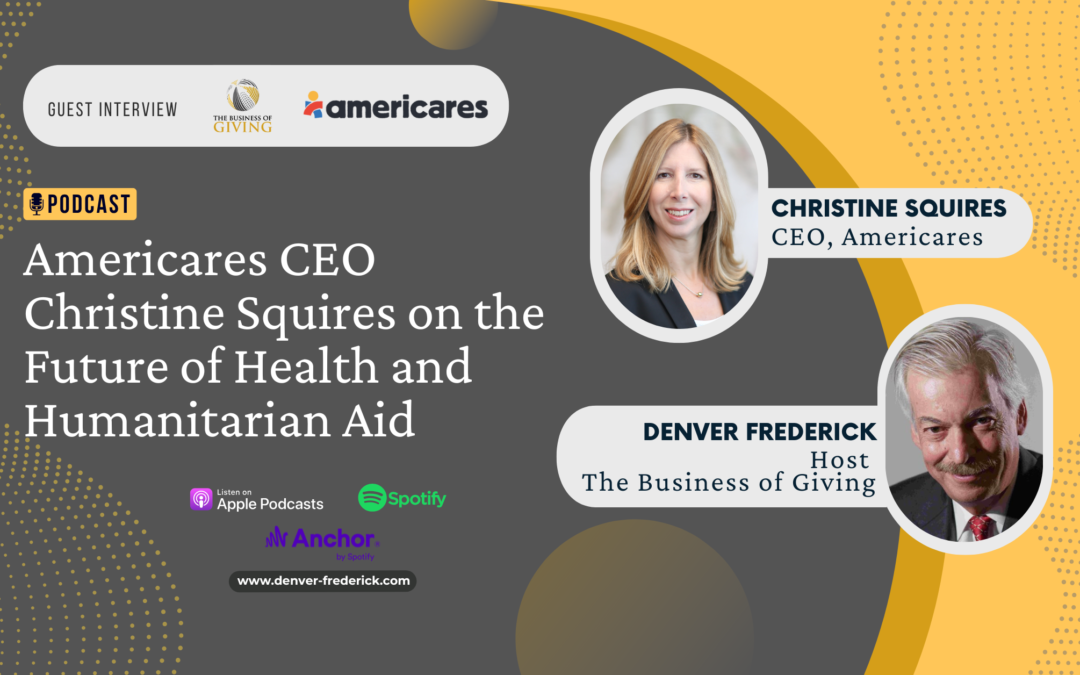
Denver: Christine Squires, welcome to The Business of Giving.
Christine: Well, thank you so much for having me.
Denver: Tell us about Americares’ mission and the unique role it plays in global health and disaster relief.
Christine: Absolutely. Well, Americares, we are a global health organization. We just celebrated 45 years, and our mission is to help people and communities around the world access health in times of disaster every day. And that includes here in the US as well. We do that in a few areas.
One is ensuring access to quality medicines and medical supplies, emergency programming, and supporting and providing health services, and that is whether we provide them ourselves or support local health communities and health centers.
And we believe health is essential; it’s a human right. And also with good health, there’s opportunity, so people have the opportunity to work, go to school and build stronger communities.
Denver: You know, you have a significant global presence. I think you’re in some 85 countries. Why don’t you highlight a couple recent initiatives that have really had great impact on the communities that you serve?
Christine: Absolutely. There’s so many. I think I’d have to start with the pandemic. So, Americares immediately responded to the pandemic. And that affected everyone around the world. While that has been challenging and has undone some of the health gains we’ve made, the impact we’ve had is not only by providing support, you know, the masks, gowns and medications.But where we really helped to move the needle is in mental health support.
That started as a program with Americares in emergency response and recovery. And we all know what we saw during the pandemic as frontline health workers were having so many burdens on them.
So, we were able to, with funding, expand our work and really support frontline health workers all over the world. And mental health is really now a core program of Americares that cuts across all of our programming. And we could talk about that for a very long time, but I’ll just say we can come back to that.
More recent initiatives in terms of emergencies are work in Ukraine where Americares was; we’ve been working in that region with partners for over 30 years, immediately responding and providing essential medicines, medical supplies, also mental health support, and we’re still there providing that support.
And I’d say most recently I came back from North Carolina and Tennessee just a couple weeks ago. I was a month in after Hurricane Helene and really proud of the progress we’re making, again, supporting local health centers in a time where they’re in shock.
Health centers, who are serving communities in need, need to get back up on their feet; we’ve helped them do that, and also providing that mental health support for clinic frontline health workers.
Denver: You know, when I turn on the news, it just seems to me that Americares could be everywhere with all the disasters that we’re encountering. They just seem to be endless. They’re not letting up. Is there a system that you look at to determine where you’re going to go and maybe where you can’t go right away?
Christine: Absolutely. We’ve started as an emergency response organization, so we’ve honed that system very well. There are several factors we consider. One is we always work through partners. So, you mentioned we reach 85 countries. We are not ourselves in 85 countries where our model is working through partners, health center partners.
So, one consideration is: we always ask our partners, “What do you need?” If it’s a natural disaster, we know there’s something coming. So, do we have a partner in the area? Most important is “Can we add value? Is there something uniquely valuable Americares can add, or not?”
Because if not, then if someone else has something that we don’t that they could add, we rely on that. And the third area we always have to consider is also funding. That’s a reality of the business that we’re in.
So, do we have the resources, and can we raise the resources to make an impact? So, we do respond on average to 35 emergencies every year. And then a lot of those responses are providing those medicines and medical supplies. But we also, again, only do so where we know we can make an impact. And we know we have partners we can lean on.
Denver: That makes a lot of sense. Let’s go back to North Carolina for a minute and just the broader issue of climate change. They used to be, I guess, relatively rare occurrences 20 years ago.
But now, I’m just keeping track of the top story of the national news, and about 30% to 40% of the time, by my unscientific account, it starts with a climate disaster someplace. How have you adapted the work that you do and the emergency relief that you provide with all these constant, climate disasters?
Christine: Absolutely. Yes. It’s interesting. There are no more pockets of climate disasters anywhere. And, you know, just by evidence, but North Carolina, when I was talking to people there, they couldn’t believe that this happened to them.
So, something that we’ve done, and we started this initiative four years ago, and it’s actually the first of its kind is we have a project, it’s building resilience for health clinics in the face of climate disasters. And we’re partnering with Harvard C-CHANGE.
And the initiative started as in pockets in the US… we’re expanding it, but it’s preparing clinics and health workers and communities for wildfires, hurricanes, floods, and extreme heat. So, that is a shift that has to happen because unfortunately, we know these climate disasters are happening. They’re happening more frequently.
There are no boundaries anymore. And clinics, who are serving communities that lack access to quality care and need to reach their communities, need to understand how to be ready, how to have a plan, how to reach communities in the face of these disasters.
So, that project, again, started four years ago. Now, we’re expanding it globally. We’re adapting it… we’re starting in the Philippines, and we want to take that further. So, that’s how we’re adapting, and it’s part of being prepared and ready.
Denver: You know, one of the things you do so exceptionally well is distribute affordable medicine. And I see often, too, people are suffering. They just can’t get the medicine they need, particularly in remote areas. How do you go about that? What’s your model to make sure that people who need that medicine get it?
Christine: Absolutely. That is a core program of Americares– access to medicines, and we’re calling it “medicine security” because there are two billion people in this world who lack consistent access to the medicines that they need.
So, how we go about that is we have a reach, as you talked about, 85 countries, and we have partners with pharmaceutical companies who donate medicines to Americares. We have a partner network of 4,000 health center partners, 1,000 here in the US, and we have long established partnerships, understanding what their needs are.
A lot of the needs are for basic medications, and we make that match and provide those medicines and medical supplies. It’s such an impact because we’re talking about free clinics or health centers who have very, very, very small budgets.
And so, they have to make a decision, “Am I going to hire a nurse practitioner, or am I going to spend the money on filling up our shelves with basic medicines and supplies?” So, we can help in that way by providing free medicines and medical supplies. It really helps strengthen the health center and the whole system.
Denver: One thing that I didn’t realize until I started to prepare for this interview is that you do have free clinics here in the US, particularly for uninsured Americans. Why don’t you talk a little bit about those, and particularly the free clinic network you have in your home state of Connecticut?
Christine: Absolutely, yes. Well, first our start. So, we do support across the US a thousand free clinics, and we do that with primarily providing medicines and medical supplies. We have our global distribution center here in Stamford, Connecticut.
And we have an online ordering system, not to dare say, but almost like the Amazon of this for our free clinics, who really can go in and they can order what they need, and we provide that to them. We have four clinics here in Connecticut. Our first one was started 30 years ago in Norwalk.
And those also provide services, free services for uninsured people who are working hard and really need that quality healthcare. We’re actually celebrating our 30th anniversary tomorrow night.
And those clinics, we have provided services over the years to about 30,000 patients and over 160 million value of service. We also work with our local hospitals to do referrals so we can provide their quality care.
Denver: You know, you mentioned you do very few things, if any, without a partner, and collaboration is a core competency and key to everything you do. What is the key? What is the secret to a good collaboration, a good partnership?
Christine: A great question. It’s building that relationship. It’s listening. That is a core value here at Americares, as you know, we ask and we listen. We ask our partners what we need. We listen and we develop those solutions together, and also ensuring you have local partners.
So, our partnerships are with local health centers on the ground or where we work. We have our local teams because they best understand the issues they’re facing and we can collaborate together. So, trust goes a long way.
And then, again, those partnerships are really meaningful when there’s an emergency that happens. And we know, and the partners know that they can count on us to address their needs and help them through it.
“…we do have country offices, established country offices in several countries throughout the world. And we believe that, again, building trust in the community is essential. So, all of our teams are local and investing in local leadership.”
Denver: How do you invest in local leaders within the communities you serve?
Christine: Yeah. Well, in addition to partners, so Americares, we do have country offices, established country offices in several countries throughout the world. And we believe that, again, building trust in the community is essential. So, all of our teams are local and investing in local leadership.
We are an organization. We have a local global operating model. So, again, work locally, so understand those local needs and solutions, and then engage as a global community where our leaders can support each other and share ideas and best practices.
Denver: With all the work you do, and this is the question I guess every nonprofit struggles with, is: How do you measure impact? How can you tell you’re really making a difference? What do you look at? What are some of the metrics? What are some of the success stories?
Christine: Sure. A lot of success stories. Last year, we reached over 8 million people alone with medicines.
Denver: Wow.
Christine: We delivered over 32 million prescriptions. We responded to 40 emergencies in 28 countries. So, you know, we do have those quantitative numbers. And also, how we measure impact, whether it’s through our own clinics or clinics we support is those health outcomes.
So, really what’s important is seeing patients progress, whether it’s health, education, and tracking the outcomes ensures that they’re getting healthy and staying healthy. So, that is how we measure our impact and success.
Denver: What are some of the innovations going on in humanitarian aid, and how are you leveraging technology along with that?
Christine: Sure. I mean, there’s a lot of innovations going on. One, we touched on, but I think is innovative although it’s not the technology piece, although there is a component of that, but that is the climate resilience and preparedness.
And, again, the world has evolved, and it’s no longer emergency response. It’s preparing for recovering and responding, you know, long-term to emergencies. So, building that climate resilience toolkit… it’s the first of its kind, it’s on our website. It’s been downloaded 20,000 times. There is a hunger, there is a need for it.
And that is an innovative approach that started… we talked about partnerships, at our first partner summit put together in 2019, where we didn’t yet have a relationship with Harvard Chan C-CHANGE, and they were a guest speaker. And together, understanding the issues around health and climate, we developed that together.
And, again, that innovation is now expanding to different countries around the world. So, it’s that innovative approach, and that came from listening to our clinic partners and understanding their challenges and their needs.
Denver: Yeah. I hope more people embrace that because we are not a world that prepares for disasters. We tend to respond to them. And no matter what happens, we continue to follow that, but it costs so much money too, aside from the loss of life and the destruction. I mean the trillions that run up when you’re not prepared for these disasters from climate is just remarkable.
Christine: It is remarkable. And there are statistics within the range of every dollar that you spend on preparedness, you save $7 to $10 on the backend. So, there’s a financial argument to be made while supporting preparedness, which is not as newsy, but at the same time, it is critically important.
Denver: You have a lot of fundraiser in your DNA, I know. So, let’s talk a little bit about that, and I know how essential donors are to your work. What are some of the more effective ways you have found to connect with your supporters and to sustain their involvement?
Christine: Absolutely, yes. A lot of fundraising in my DNA. A couple things, where we have the opportunity, we really like to take donors to see our work firsthand. And, one of the things we do at Americares is we have our annual Airlift Benefit. And so, that’s our gala where we come together and celebrate and learn about the work and the impact.
But also from that event, we take some of our supporters on a, well now, it’s a 48-hour, but 24 to 48-hour mission to understand the work that we’re doing in different countries around the world. I’ve received feedback from our supporters that once they’ve been on Airlift Benefit, that is really life changing for them, and that engagement really sticks with Americares.
In fact, many members of our board have started off on joining us on Airlift Benefit. Couple of other hands-on things that we do is because we have our distribution center here in Stamford, Connecticut— one of the most requested items in an emergency situation are hygiene kits or first aid kits.
So, we invite volunteers to come here together to roll up their sleeves and actually put those kits together and stock them on our shelves. In fact, we had one event just about 10 days before Hurricane Helene hit, and we were able to send those hygiene kits over. But you can’t take everybody with you physically.
Denver: Yeah.
Christine: So, the other thing that we want to make sure we do, whether we’re writing to a donor, is ensure that our supporters or potential supporters understand their impact, and that’s through sharing a story of somebody that their support has helped. I’m also talking about our efficiency.
I mean, supporters really want to understand that their money is going to an organization that is being efficient and efficiently using it. So, we want to share that we have impact. We are a four-star Charity Navigator organization, and 98% of what they give is for programmatic support.
Denver: Pretty remarkable. You get a little bit of boost from your 45th anniversary this year.
Christine: We did. Yes, we did. We had a couple of celebrations, both internally, and then here we had a celebration at our office in Connecticut, and we had some of our local senators, and we had proclamations of supporting that event. So, we did have a boost for that.
Denver: Great. Christine, how would you describe your leadership style and what have you found to be most helpful in really navigating just this constantly changing humanitarian sector?
Christine: Great question. A couple things. One is something you may not know that my first day as CEO was March 13, 2020.
Denver: I did see that.
Christine: So, that was the day that many of us shut down with the pandemic. I was with the organization beforehand, luckily, and that really shaped my leadership style because we had to adapt really quickly, and I’ve been told that I do remain calm in the face of crisis. And so, that was something that did serve me well.
And also really, from an internal perspective, we respond to a lot of emergencies, and I would describe this as an organization who was basically living in the middle of the hurricane while responding to it.
So, it was really ensuring that staff understood that I know that they were in crisis, the world was in crisis, but bringing us together to know that through all the world, that we didn’t know what was going to happen the next day, we actually were making an impact during this pandemic by providing that needed medicines, medical supplies, and mental health support. So, the adaptability, flexibility and staying calm.
And the other thing I would say is listening, and we talked about that before, but I really, really do try to listen to our partners, the patients we work with, and our teams, because I just feel not enough people listen these days. And, if you’re keen on listening, you’re really going to learn a lot.
And that’s really going to shape how you make decisions and also be inclusive in your decision-making. So, you’re bringing everybody along, and everyone really feels and sees themself in your mission, and that’s critically important.
Denver: Is there anything that you do to let the people who are talking know that you are really listening?
Christine: That’s a great question. One is, if you’re on Zoom, I will make sure I nod my head and look at you, because with this new world, we’re multi-tasking. So, if you hear clacking around and, you know, people will say you’re multi-tasking. And also, I’ll chime in and ask questions and say, “Oh wait, tell me more about that.” So, want to ensure that people do know I’m listening.
Denver: Yeah, I love “tell me more” because I’ve always found Zoom to be great for talking and not great for listening. And a lot of the meetings that I go to or observe, people just can’t wait to get on to speak their piece, but once they’ve spoken their piece, they’re off, you know what I mean, to a bunch of different things.
And the other thing I’ve noticed with Zoom, too, it’s great for vertical communication, like the marketing department or the finance department, not so good with horizontal communication between departments. And I know that’s something that every organization needs to work on.
Christine: Absolutely, I agree. In-person is much easier in that we really work too hard, you know, as a leadership team; we also have agreements with each other, throughout the organization.
One of those is being present in conversation, and if there’s something going on in your world or life that you need to say, “Hey, I’ve got something on my mind. So, if I seem a little distracted, that’s why.” You can get that out in the beginning and understand that.
“I will say that the silver lining of the pandemic is that for our global organization, it did actually bring us closer together.”
Denver: What do you do to try to shape and influence the workplace culture? I mean, you got a couple things going on. You got hundreds of employees and, I don’t know, eight countries around the world and are operating in, you know, 77 more, through your partners.
How do you both, I guess, keep the central culture together and respect the individual differences from where people are? I mean, a leader can really shape and influence that. What do you do?
Christine: Sure. Well, what I do, one, is actually as an organization, just recently we’ve gone through a whole process of revising our values. And so, I shared one of them as this, you know, asking, listening. Partnership is another value– that we’re better together. Partnership is at our core, and we’ve got six of them.
And, I say that because the values and how we work together…but also, they’re all based on our mission… really helped to shape the culture. The process we went through was by engaging all of our global employees and asking them, “What do you feel the values are at Americares? What’s important to you?” And we’ve done a lot of work to celebrate those values.
We use them every time we have our town hall or all-hands meeting every other week, which is a global meeting. So, let’s make it part of that, whether we’re reporting out on some of the impactful work we’re doing, or we want to share a compliment to another colleague who’s been sharing those values.
But we also do have a lot of process in place because we have organizations that are local country offices. So, I do travel and make sure that I get to see and spend time with the teams and understand how they’re doing, and I can really understand the work and the needs and build those relationships.
But not everyone can all travel together. So, we also have a lot of global connection opportunities. We have a fabulous people and talent team that make that happen. So, we’ve done virtual tours with country offices. We actually have meditation sessions together.
Today, here at our office in Stamford, we’re having a potluck, an early celebration of Thanksgiving. So, just a lot of different ways. And we have our annual celebration in two different time zones every January to celebrate the accomplishments of the last year. So, there’s a lot of things in place we do.
I will say that the silver lining of the pandemic is that for our global organization, it did actually bring us closer together. One of the things that I came on as CEO as well where, you know, our headquarters are in Stamford, Connecticut, I very much wanted us to be more of what we are– a global organization.
And rather than having a meeting in Stamford and everyone else is on Zoom or this and that, having everybody on an even playing field has really helped us build and strengthen relationships from a global perspective.
“…we cannot do it alone. It’s going to take all of us together, not only Americares and our organizations, but it takes a global community of partners… and that is health center partners; that’s other NGOs.”
Denver: Yeah, I think one of the things that Zoom did really well is they made all these rectangles the exact same size. No hierarchy whatsoever. Finally, Christine, what’s your long-term vision for Americares, and how do you see the organization evolving to continue to serve vulnerable communities across the globe?
Christine: Yeah. Great question. And we’ve evolved so much over the last 45 years, and I always come back to our belief that, again, we believe in a world with pathway and health and opportunity for all, and our focus is on people and communities who lack that access that they deserve.
And so, that focus, over time, is something that we continue to evolve. And the other thing is we cannot do it alone. It’s going to take all of us together, not only Americares and our organizations, but it takes a global community of partners… and that is health center partners; that’s other NGOs.
And that partnership piece is really how we’re going to continue to evolve. We want to deepen and sustain our impact. And, again, that does take all of us, and the ultimate goal is that communities and health centers can stand on their own.
A dream is that our services aren’t needed anymore. And so, if that were the case, that would be success. And so, that’s leaning into those partnerships and building that global community who all share that same vision.
Denver: Wouldn’t it be great to be obsolete?
Christine: It would be. It would be for sure.
Denver: For listeners who want to learn more or support this work, where can they find you online, Christine, and what can visitors expect on your website?
Christine: Right, yes. They can go to americares.org and they can expect a lot of information. You’ll see about what our latest work is happening, whether it’s emergencies. You can learn about our health and climate work, our mental health work.
And if you’re interested, you could also go and download that climate toolkit I’ve been talking about for wildfires and hurricanes and flooding and extreme heat. So, americas.org, it’s very easy to navigate and to find what you’re looking for.
Denver: Yeah. It’s a good website. 20,000 downloaded. Will make it 20,001. I want to thank you, Christine.
Christine: And you can also donate on the website.
Denver: You can also donate.
Christine: It’d be a miss if I didn’t say that.
Denver: Oh, that’s right. As an old fundraiser, I mean, you’ll be hearing about that.
Christine: Exactly.
Denver: I want to thank you for joining us today, Christine. It was a real pleasure to have you on the program.
Christine: Thank you, Denver.
Denver Frederick, Host of The Business of Giving serves as a Trusted Advisor and Executive Coach to Nonprofit Leaders. His Book, The Business of Giving: New Best Practices for Nonprofit and Philanthropic Leaders in an Uncertain World, is available now on Amazon and Barnes & Noble.