

I’m Denver Frederick, the host of The Business of Giving. My guest today is Michael Dowling, CEO of Northwell Health, New York’s largest healthcare provider.
Under his leadership, Northwell has grown from a single hospital into an integrated system, offering everything from ambulatory care to end-of-life services. Dowling is a visionary, redefining healthcare by addressing issues like gun violence and mental health, which he views as integral to public health. As he says:
“I believe that CEOs have a responsibility to take on those social issues, especially in healthcare, that have a direct impact on health. And when you look around, there’s a lot of things. Everything has a direct impact on health. So we just can’t be talking about medical care delivery only. We’ve got to get involved in influencing societal issues that have a negative impact. Gun violence is one of those.”
With this approach, Dowling places Northwell at the forefront of both healthcare innovation and social responsibility. Now, let’s dive into an inspiring conversation about his bold vision for healthcare leadership and the community-centered initiatives driving change at Northwell Health.
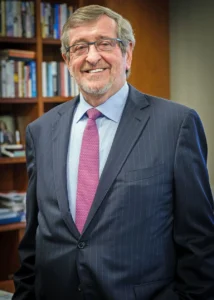
Michael Dowling, CEO of Northwell Health
Denver: Michael Dowling, welcome to The Business of Giving.
Michael: Well, thank you so much. I’m delighted to be with you. I thank you for the invitation, and looking forward to the discussion.
Denver: Likewise. Well, for those who may not be familiar, could you share a little bit about the history and evolution of Northwell Health and what makes it a standout leader in the healthcare industry today?
Michael: Well, the history goes back to the early ’90s, and it was all begun by North Shore University Hospital, which is a large hospital here in Long Island. It is much bigger today than it was way back, and I came to North Shore as a Chief Operating Officer in the early ’90s.
And North Shore had this idea that we should try to create a health system. Now, there were no health systems in New York back then. And there was really none in the northeast United States, even though they were pretty popular on the West Coast with Kaiser Permanente, people like Intermountain in Utah.
But it was not. What was around here were all individual hospitals, all separate from one another. So North Shore decided it would make a good idea if the hospitals came together and figured out that if they worked together, could they do better than if they stayed separate. And we were the leader on this.
And so we started to work to connect with hospitals in the early ’90s, and it started slowly with one hospital, and then that was the first merger… was at a small community hospital called Glen Cove. And then that expanded. Within a couple of years, we added about nine hospitals that were willing to work with us and come under the ownership of what was known back then as the North Shore Health System.
And then in 1996, ’97, we did a big, big merger with Long Island Jewish. And that was very, very important. It was a big deal. Nobody thought it would ever happen. And actually, we were taken to court by the United States Justice Department to try to prevent the merger, but we won in court. And that merger occurred at the end of 1997, and we changed our name to North Shore Long Island Jewish Health System; then we continued to expand. And then we became Northwell Health about 16 years ago. We just changed the name.
Now, what makes us different? We are the largest, number one. We’re the biggest private employer. We have all aspects of medical care delivery. We have everything from birth to end of life. We are the most comprehensive organization in the region. We are very integrated. It is not just a collection of individual entities. We all work together.
And what’s important, which a lot of people don’t fully appreciate, is they were not all about hospitals. Most health systems and most people’s view of health systems is that it is about hospitals only. Yet, only 47% of our total business is hospital business. We have 900 outpatient ambulatory locations. And we have post-acute, which means we’ve got home care, nursing home care, end of life care, et cetera. So we have everything.
So one of the things that is distinctive about us is that we can take care of patients irrespective of the circumstances that they’re in– all medical care delivery–but also we can do it ambulatory… primary care, ambulatory care, hospital care, end of life care. We can do the whole thing.
And we have a very, very positive culture. I think we are recognized for a place that works as a team, very collaborative, very entrepreneurial. We like to do new things all the time. We see status quo as the biggest competitor. We like to shake things up. We like to be different. We are not risk averse and on and on, et cetera. So it’s an exciting place to work.
We have a lot of great people here and 90,000 employees at the moment, and we continue to grow and expand.
“I believe that CEOs have a responsibility to take on those social issues, especially in healthcare that have a direct impact on health. And when you look around, there’s a lot of things. Everything has a direct impact on health. So we just can’t be talking about medical care delivery only. We’ve got to get involved in influencing societal issues that have a negative impact. Gun violence is one of those.”
Denver: That is a fabulous background. I thank you for that.
Well, you are the leader in several healthcare initiatives with a major focus on treating gun violence as a public health crisis. You’ve advocated for reducing gun violence without infringing on gun ownership rights. How do you see, Michael, the healthcare industry’s role in promoting safety while respecting those rights?
Michael: Well, let me give it a little bit of context. I am a big believer that if you are a CEO of any large organization… and I know there’s some controversy around this.
Denver: Oh yeah.
Michael: But I believe I’m right. I believe that CEOs have a responsibility to take on those social issues, especially in healthcare, that have a direct impact on health. And when you look around, there’s a lot of things. Everything has a direct impact on health. So we just can’t be talking about medical care delivery only. We’ve got to get involved in influencing societal issues that have a negative impact. Gun violence is one of those. Guns are the leading cause of death for kids in the United States. That is a statistic that should horrify everybody.
Denver: Absolutely.
Michael: It’s a statistic that the United States should be ashamed of. We are unique in that statistic. I mean, cancer is the third leading cause of death for kids, but guns are number one. So if guns are number one, then to me, it is definitively a public health issue.
We’ve got to do something about it because when you’re in our space, you see the families coming to us distraught over the circumstance. We see the mental health effects of it. We see the physical health effects of it.
And so I decided about six years ago to go public and make a case that every healthcare leader should be tackling gun violence as a public health issue. That this is directly in our lane and we should be dealing with it. And you focus on the public health side of it.
If you tackle the Second Amendment, you don’t get as much traction. But if I talk about safety and prevention, and making sure that kids are safe, and making sure that if people own guns, that there is a responsibility for them to lock up the guns in a safe place… or you don’t have a situation like we’ve had a number of times recently, where kids get a gun in a home that is loaded. They take the gun, they go to the school, they shoot somebody.
We actually talk to all patients that come to us about their relationship with guns and with gun violence. And if there are guns in the home, we actually give all of these patients locks so that they can go home and lock up the guns or have their parents lock up the guns, obviously.
So, you have to stay away from the Second Amendment.
Denver: Yeah.
Michael: And we’ve been very, very successful. I now have a national organization of all CEOs in healthcare working on this. And when I started, I couldn’t get anybody to be focused on it, but now I’m getting everybody wanting to get focused on it, which is a good thing.
Denver: It’s a fantastic thing, yeah, I think, the National Healthcare CEO Council for Gun Violence Prevention. Did you get a lot of pushback when you first started, Michael, when you went forward with this?… Whether even internally or externally because it’s a bold move you did six years ago, for sure.
Michael: Well, if you’re a CEO and you’re afraid to take bold moves, you shouldn’t be a CEO.
Denver: There you go. I like it.
Michael: These are not jobs for people that want to stay in their offices and be quiet and not be distraught. We have a responsibility and an obligation overall. So when I started, oh yeah, I got a lot of pushback. Not internally.
Denver: Okay.
Michael: I mean, my staff were very, very, very supportive and continue to be so. In fact, it gives them this sense of mission that we are involved in something that is bigger than themselves.
Denver: Got it.
Michael: But when I called around to get other CEOs to get involved with me, initially I couldn’t get anybody. And I know most of the CEOs around the country, so I made a lot of calls, and obviously there are other organizations working on this in other spaces other than in healthcare, but gradually people are going to get interested. For example, the CEO of Intermountain Health in Utah got very involved with me, and now Utah is a red state.
Denver: Right.
Michael: I mean, every household in Utah has a gun. Yet Robert Allen, who is the CEO of Intermountain, another large, large health system, had become very active and has told me that he has become quite popular when he takes on this issue of gun violence prevention and safety, even in a red state.
And we hold every year a gun violence forum in New York, where we’d invite people from all over the country here. And last year, we had a mayor of a city in Texas come and speak about the importance of focusing on safety and prevention. So there is a major widespread support now for this issue.
And in February next year, we are holding a major forum here in New York City on gun violence, and we’re going to be launching with the Ad Council a major national campaign on behalf of all of these CEOs on the responsibility of us to deal with prevention and safety.
We have our own division inside our organization working on this. And to me, it’s a societal issue that we have to deal with. It’s something that we have to, over time, have a statistic where guns are not the leading cause of death for kids. And that’s a statistic that we hope to be able to talk about at some point in the future.
But it’s a long journey. It’s not a quick fix. You don’t do it quickly. You stay the course. You focus on people’s values and responsibilities and sense of decency, and what it means to be American, and promoting the concept of safety. So a lot of support, more so now than I can ever imagine.
And the White House has been very helpful here, the Biden White House. They have a task force inside the White House now working on this. And of course that can possibly change given what happens with the presidential election.
But even if it changes, if the White House leadership changes, which I hope it doesn’t, but if it does, we will continue to focus on this issue. It’s beyond politics. This is not politics. This is public health.
Denver: Yep. Yep. Well, it’s amazing what happens when you frame the issue right and you’re persistent. You really get those kind of results. Influencing public policy, I would imagine, is a priority of yours. Michael, what legislative changes do you believe are most critical?
Michael: On the gun violence issue?
Denver: Yep. On the gun violence issue, right.
Michael: Oh, I think that, for example, I don’t see at all why in the heck that there should be any ability for people other than military people to get assault weapons.
I think there should be universal background checks. For most things, you have to get approval. If you have a swimming pool, you’ve got to get approval and licenses, et cetera.
Denver: Yeah.
Michael: In many places, if you want a dog, you’ve got to get a license. The fact that you can, in many places, just walk in and get a gun… and anybody can do it without having to go through a screening process; universal screening, is important.
So, on the legislative side, I’ve kind of stayed away up to this point with the CEO Council because I wanted to get everybody involved on the prevention and safety concept, and then agreeing over time, hopefully, to look at some legislative issues that we should be focusing on. And there are other people doing this.
For example, last week I had a lunch with Gabby Giffords, who is obviously very, very active, and we work very closely with her on this and her organization. And I work with a lot of the legislators as well. So there’s some basic things that we need to be making sure that legislatively, that a person who should not have a gun, shouldn’t have a gun.
Denver: I know how technologically savvy Northwell is. Are you leveraging that, AI and other innovative approaches, to enhance these prevention strategies?
Michael: Well, we use AI on almost everything now. I mean, AI is not new as you know. Across our healthcare system, we use AI in the early diagnosis of many diseases. We use AI in analyzing all of the data sets that we’ve got, et cetera.
And so almost in everything that we deal with, artificial intelligence is kind of part of what we do. Now there are dangers to artificial intelligence that we’ve got to be careful with, but it’s a new technology that is going to be used on almost everything.
With regard to the work of the CEO Council, we’ve not been talking an awful lot about AI in that context. But what we do locally in analyzing data about gun deaths and gun injuries, et cetera, oh sure, artificial intelligence is important.
“Integrating mental health into the overall healthcare system and make it seamless is obviously a major goal of ours because what we’ve done policy-wise for years is… we have isolated and separated mental health from physical health. If you come into a hospital for anything else, you’re treated in the generic hospital. But if you have a mental health problem, obviously we tend to isolate you and put you in a separate mental health facility. That has to change.”
Denver: Northwell’s impact extends well beyond just preventing gun violence. And let’s talk about a couple things.
Mental health is a growing concern, not that it’s completely unrelated to gun violence. How is Northwell integrating mental health services into its overall care model to ensure comprehensive patient support?
Michael: Well, we are the second largest provider of mental health in New York State. We have a big mental health provider. It’s a huge issue. I just want to reference a couple of things, then get to your question directly.
One of the areas that we have to be very concerned about, which I don’t think people pay much attention to it at the moment, is the mental health effects of social media. We are seeing a dramatic increase in anxiety, depression, and suicide among the young.
Denver: Yeah.
Michael: It is phenomenal, and it has been escalating at an enormous pace since 2012. So I think, all of the tech companies, all of the social media entities, they all have a responsibility here over time to limit what the negative effects are.
Integrating mental health into the overall healthcare system and make it seamless is obviously a major goal of ours because what we’ve done policy-wise for years is… we have isolated and separated mental health from physical health. We have mental health hospitals, and now we have separate entities. If you come into a hospital for anything else, you’re treated in the generic hospital. But if you have a mental health problem, obviously we tend to isolate you and put you in a separate mental health facility. That has to change.
Denver: Yeah.
Michael: So what we are doing is integrating mental health services in all of our physician practices. We are now trying to raise money to build a pediatric and adolescent mental health program, a new pavilion, and build a new building, but make it part of our children’s hospital.
So when you come into a children’s hospital, irrespective of what’s wrong with you, be it mental health or not, you are taken care of inside the one hospital. We don’t… because when we isolate mental health, we stigmatize it.
Denver: Right.
Michael: And that problem is getting better, but we still got an awful lot of work to do. The problem with mental health overall is the funding. Most of the funding for mental health is government funding, and the government does not pay you enough to meet the cost of delivering the service.
So every time you expand mental health services, you lose money. Like I lose a lot of money on my mental health programs.
Denver: Yeah.
Michael: But despite that, we’re going to continue to expand them, grow them because they’re needed in the community. We are going to do everything we possibly can to do more of it, even though we lose more money every time we do so.
Denver: Yeah. Yeah. Well, I can see integration is a theme of yours. You started off with that in terms of your internal culture and how all these just came together, and now you’re trying to do it with your patient care and bringing them together in a seamless way, as opposed to separate entities.
Michael: Yeah. And patients especially, we have a major, growing elderly population as you know the statistics. But as people get older, especially as they get older, people just don’t suffer from one thing. They suffer from multiple things: cardiac, cancer, mental health, respiratory problems, orthopedic problems, et cetera. So the only way that you can deal with the holistic nature of a person’s illness, which is multifaceted, is to deal with it in an integrated, interdisciplinary way.
We can’t be isolating the patient into little silos and deal with cancer separate from everything else. That was a traditional way things were done. That’s not going to be the way it has to be done in the future. But it requires a complete rethinking about how we educate people, how we train people, and how we practice. It’s a long journey, but I’m glad to say that there’s a lot of progress being made, and people are looking at everything like this a little bit differently.
So, we should be very, very thankful, and I will make this comment that sometimes, United States healthcare system gets criticized and there are lots of things that are wrong with it. There are a lot more things right with it than that are wrong. And I’m very familiar with other countries and what happens overseas, and I can tell you, I am much happier being in the United States because of the quality of the healthcare here as compared with any place else.
“…I look at patients as customers of our service. We are in the customer service business, and we’ve got to take care of the totality of the customer’s needs, as well as the patient’s and the customer’s family’s needs. So we deal with the family members as well, not just only with the patient alone.”
Denver: Yeah. And it is so inspiring to hear that healthcare and what you’re trying to do is actually address the way people actually live their lives because they are all integrated… and to do one thing at a time, that’s not the way we live, you know?
Michael: Yeah. We don’t live that way, and I look at patients as customers of our service. We are in the customer service business, and we’ve got to take care of the totality of the customer’s needs, as well as the patient’s and the customer’s family’s needs. So we deal with the family members as well, not just only with the patient alone.
And when a person goes home living with a family, one of the big issues we have to deal with is: how do we train family members and educate them about how to deal with the family member that is sick and going home after maybe being in the hospital and how to deal with the issues.
And I was dealing with a family yesterday on this where a patient is going home, and we’re spending an awful lot of time now with the family at home to get them much more attuned to how to deal with the results of the illness that this person has. And this person’s illness doesn’t go away. It’s a permanent thing. So you’ve got to be educating the caregivers, which in many cases are the family members.
Denver: That’s exactly right.
Michael: So it’s a holistic view of the world. It’s not an isolated view. Just like health is not only about the provision of medical care, health is everything. Having a job improves health. Getting a good education improves health. And that’s why we are involved in all aspects like this.
Denver: Yeah, I was talking to somebody, the CEO of Noora Health, the other day, and they’ve done exactly what you talked about in India and Bangladesh, and that is the greatest underutilized resource is the family member, who cares more and is going to spend more time… It can have more impact.
And often what they do is they get handed a brochure in about three point font when they leave, but if you train them, it can have just miraculous impact.
Michael: Yeah. And we don’t do this as well as we should. I mean, probably there are tens and tens of millions of family caregivers who are left with the responsibility of taking care of a sick family member without much knowledge, without much understanding.
And the more we can make them part of the treatment team for that patient, when that patient is home, the better we’ll all be. But it requires a reorientation, and I’m glad to say that it’s happening, even though we have a long, long journey ahead of us.
Denver: Michael, let’s turn our attention to Northwell’s Feinstein Institutes for Medical Research. Can you share some of the recent breakthroughs that have the potential to really impact patient care?
Michael: Well, Feinstein is very world famous. And the person who runs it, a guy named Dr. Kevin Tracey, is a renowned, internationally known scientist.
And one of the things that I’d like to mention is a new field of medicine that has emanated from the research that Kevin Tracey has been doing for the last 20 years, where he’s been focusing on the vagus nerve. And I’m not a clinician, so I’m not a clinical person, but I have enough genetic understanding of this that I’ll try to explain it.
But he’s researched using the vagus nerve, which sends electrical signals to the body and can modify the immune system. So you can turn it on or off. You can turn it on, turn it off. So he’s come up with a device that you implant in the vagus nerve and then to be able to modify the electrical signals that go into various parts of the body.
And he has used it in clinical trials, which have proven quite successful. I’ll give you an example of a girl whom I know quite well now, was confined to a wheelchair. If she got out of the wheelchair, she had to have a cane. She suffered from major rheumatoid arthritis. Young girl in her late twenties.
She participated in a clinical trial… put in the device. And by the way, she was on about 30 medications. None of them really worked. She now has no…all rheumatoid arthritis has gone, disappeared. She’s walking around like you or I, and even better than I. And she gave up the cane. She works full time. She takes no medication. And she is completely healthy.
And this technology can apply to many, many, many diseases. You’re going to hear an awful lot more about this, and so will the world over the next couple of years, because the FDA is about to come over and report on the clinical trials being done which show the efficacy of this. It’s extraordinary.
A part of this, another thing that has occurred at Feinstein recently, which is the first time in the world where we’ve had a patient that was paralyzed from the neck down after jumping into a swimming pool, 42-year-old individual, where our researchers under Kevin’s direction found a part of the brain, connected it to this person’s arms with a connector wire. That patient now can move his arms. That patient now can pick up and drink.
Denver: Wow.
Michael: That patient now, when you touch the person’s hand, they have a sense of feel. Now, this is a person a year ago could not move anything. This opens up the possibility that people who are totally paralyzed can eventually move again. This is also some of the research coming out of Feinstein.
But the Bioelectronic Medicine one, I think, is the one that will be more renowned work for being so new and innovative. And for people who want to learn more about this that might be watching and might be wondering about this, I would google Kevin Tracey.
And he actually was on the cover of Time Magazine. I’ve known… was it the New York Times magazine? I think he was on the cover of recently, but if I want to google it, I can study this. There’s lots of information available, but it’s pretty earth shattering, but it’s all coming out of the Feinstein Institute, which is a part of Northwell.
Denver: Fantastic. Yeah, really extraordinary stuff, and let’s hope that the media can turn off their negative spigot for a while and give this the kind of attention that it deserves. Because I think that would really lift the morale of the country.
Michael: Oh, absolutely.
Denver: We don’t hear enough of these stories. We just hear bad news, bad news, bad news.
Michael: Yeah. We have so much bad news. We need more positivity. We need more optimism these days than…
Denver: I can’t agree more. And that’s not a puppy dog story, too. These are systemic type changes. This isn’t a lemonade stand. This is…
Michael: No, these are the discoveries that are coming out of all the research facilities all over the world right now. It’s absolutely unbelievable. I mean, yesterday, the governor of the state of New York was down here and announced the opening of the building of a massive cell and gene therapy research facility on our grounds here, which is one of the largest investments by a state any place around the country in the area of cell and gene therapy.
And this has unbelievable possibilities in cancer and lots of other diseases over time. So there’s an amazing amount of good news going on.
Denver: Yeah. Yeah.
Michael: And I see it every day. When you think of all of the patients who come into all of the hospitals every day, very worried and concerned in the morning, worried about what’s wrong with them. They’re all suffering from something. But remember, most of them go home at night better off than when they came in.
The media will pick up on the one story that fails, but they forget about the million stories that win.
Denver: Yep.
Michael: I mean, I’m an optimist. I believe we’ve got to continue to give oxygen to hope and positivity. And so the amount of great stuff that we see, being in the business like we are each and every day, is absolutely amazing. And the progress that we’ve seen over the last 50 years is extraordinary.
Denver: Yeah, it really is. And I think people’s anxiety levels would go down. Their trust levels would rise if they heard more of these stories. But when all you get is somebody being pushed on the subway night after night after night, no wonder people feel the way they do.
Michael: Well, but people like you who do shows like this and who talk to people who give positive messages, I mean, that’s all part of the process of changing the narrative about what it is. The narrative right now, if you listen to a lot of our politics, you’d look to think the United States by some of our politics, that the United States is a terrible place. It’s dying, it’s killing; immigrants are going to kill everything.
I’m an immigrant. Everybody’s an immigrant. I mean, it is doing a disservice to what this country is all about and a disservice to civilization in general. And I think people who advocate like this should be pretty much ashamed of themselves.
“…leadership to me is about influence. It’s about having a positive influence. Leadership is about relationships. It’s about building trust. It’s about reaching out. It’s about inspiration. It’s about making sure you don’t believe that it’s all just about you. That is what you can do to inspire others. That’s what leadership is about.”
Denver: Michael, could you share your leadership philosophy and how your experiences, whether it’s addressing gun violence or navigating that COVID-19 pandemic, have influenced it?
Michael: Well, leadership to me is about influence. It’s about having a positive influence. Leadership is about relationships. It’s about building trust. It’s about reaching out. It’s about inspiration. It’s about making sure you don’t believe that it’s all just about you. That is what you can do to inspire others. That’s what leadership is about.
It’s about keeping your feet on the ground and not thinking that you’re so goddamn important, which some CEOs sometimes think:it’s all just about me. And unfortunately, I know a lot of people who don’t believe that. Leadership is about looking forward, kind of looking over the horizon, seeing what’s possible, and then getting people to want to go there.
Denver: Right.
Michael: It’s not about forcing people to go there or requiring them to go there, or mandating them to go. True leadership is getting them to want to go there because of what you have indicated they should believe in. And I know trust is a big part of it. I mean, we’ve talked about this a lot here, that progress moves at the speed of trust.
Denver: Yeah.
Michael: And I spend an awful lot of time with employees. I meet every new employee that is hired at Northwell, and we hire 250 people a week.
Denver: My goodness.
Michael: So I meet with all new employees, come to a central orientation every Monday. And I spend the first two and a half hours with them every single Monday.
Denver: That’s great.
Michael: And I’ve been doing it every Monday for 22 years because you’ve got to connect with the people at the bottom of the organization, in the middle of the organization, and not just only focus on the top. I spend a lot of time… I walk the floors, I take frontline employees out to dinner monthly.
In any organization, the key people in your organization are your first line supervisors, your middle managers. Organizations evolve around middle management. And the work of organizations is done by the people at the bottom. So you got to be at the bottom and relate to the people whose influence down the organization is very, very, very, very important.
And so those of us who get jobs like this have to feel unbelievably fortunate. We’re very, very privileged. It is not a job that we have; it’s an obligation and responsibility. And we have the ability to change the direction of the way people think about things in a positive way…
Denver: Yeah. Yeah.
Michael: …and be upbeat.
Denver: I love the way you meet with those new employees. I don’t think employees will ever be more susceptible to being shaped about an organization. They’re anxious, they’re all ears. And when you get them right at the outset, you can have a profound influence.
I want to dig a little bit deeper on this, if I could. Ninety thousand employees, I’ve known this for years, that Northwell has an incredible workplace culture. Tell us a little bit about it and what makes it so distinctive? I mean, it’s legendary.
Michael: Don’t hire jackasses.
Denver: That’s a good…
Michael: Hire good people. Relate to people the way they’ll need to be related to. Have certain values that you tolerate, and have a very solid understanding of what’s not going to be tolerated.
We are a team here. We work together. I don’t tolerate people who try to deep-six their partner who’s part of their team.
Denver: Yeah.
Michael: I have on occasion at orientation when I meet with new employees, when you’ll find somebody behaving in the room that is not indicative of what we should be doing and not consistent with our culture… I have actually asked people to leave at orientation.
You pick your people carefully. You pick people that have a positive attitude, that want to do the right things, that are smart, but who believe in doing what’s good, who believe in each other, and who believe in the possibilities that we all have to make a positive difference.
You surround yourself with people like that in your place. You put people in the various locations, and you communicate, communicate, communicate all the time. We do town hall meetings. I’ve done 50 town hall meetings since February of this year.
Denver: My goodness.
Michael: And you’re out in the field, and you connect and you deal with people decently. It’s respect. It’s integrity. Have a high sense of and understanding the importance of being respectful of other people.
It’s enhancing diversity. Making sure that we take advantage of the innate talents of everybody, irrespective of who they are, wherever they came from, and getting people to understand other cultures. I send an email out to all of our employees on every ethnic and religious holiday, explaining to everybody if there is an Indian holiday or a Jewish holiday or an Irish holiday.
I send out automatically, and they go out almost every week that communication to all employees explaining the holiday, explaining the history of it and what it means. Many people will be hearing about another ethnic group or holiday, but don’t know anything about the meaning of it.
Denver: Yeah.
Michael: It should explain the meaning of it so that they understand it. So it’s creating that family feel that we are very, very focused on here. And we are not tolerant with people who deviate from it.
Denver: Yeah. Yeah. Somebody said to me once, and I think you’ve just captured it even better, is that a culture is the worst behavior that leadership allows. And you really said that particularly well.
Michael: Yeah.
Denver: Finally, Michael, as you look ahead, what are Northwell Health’s priorities for the next few years? And how do you envision the role of the organization in shaping the future of healthcare?
Michael: Oh, I think, and the last part of it, I think big systems like Northwell are the key to the improvement of healthcare long term. I think our fundamental responsibility is to do it differently, and we’ve been doing that here. We have a very unique medical school where the curriculum is completely different than almost every other medical school.
And we now have a top-rated medical school, but we changed the way we did it. The same with nursing school. The same with the fact that we are mostly an ambulatory care system, not just only hospitals. And so I think we have a fundamental responsibility to shape, improve access, impact on government policy to the extent that we possibly can, make sure everybody has access to good care, but also make sure that we go upstream.
And this is a major fundamental part of what we do all of the time. Healthcare is a lot more than just the provision of medical care. It is everything, and we should be much more involved in the wellness and prevention issues… as the gun violence fits into this, by the way.
Denver: Yep, absolutely.
Michael: We are very good at taking care of you when you get sick. What we got to do… have to be very, very good at getting you to adopt those behaviors and change those societal issues that cause the illness in the first place. And that’s a major focus of ours. We are going to continue to grow and expand.
And quite frankly, when I’m asked this question by employees, I say on everything that we do, no matter how good we think it is, it can always get better, that there is nothing as good as you want it to be. And you should never believe your own press releases.
The worst thing in the world to do is to feel overconfident because then you get complacent and lazy and you fall backwards. That you’ve got to keep your leg on the accelerator. Be comfortable a little bit with discomfort. Be comfortable with stress up to a point, of course. And be somebody that challenges the status quo all the time.
And so I think big organizations like Northwell are going to be the key to continue to enhance care delivery, enhance education, and enhance research because it’s all intertwined. They’re all interconnected. There’s none of them are separate from the others.
And so I believe that the future is very bright, given the developments that are occurring research-wise and the new discoveries, that we will be able to solve things in the future or deal with things in the future that today we can’t even imagine.
Denver: As you said earlier, the status quo is your biggest competitor.
For those wanting to learn more about Northwell Health, maybe your gun violence program, maybe more about Kevin Tracey… tell us about your website and what visitors will find on it.
Michael: Well, they can go on our website and get information on us, but I would say that no matter how good the website is, it will not provide you with a completed, holistic, substantive view of everything that we do. So if anybody out there is interested in any part of what we do, if they’re interested in research, then contact us, and we will obviously connect you with the people that can provide a lot more information… and similarly with education or anything else.
So we’re very transparent. We love to share. We love to learn from others and share because we all learn from each other all the time. It’s not a one-way street at all. So go on the website, but more importantly, if there is something you’re really specifically involved in, then just call us.
Denver: Go on the website, but don’t stop there. I want to thank you, Michael, for being here today. It was such a pleasure to have you on the show and for such an inspiring conversation. I really enjoyed it.
Michael: Well, thank you. What’s the alternative? I mean, nobody wants to follow a pessimist, right? Everybody wants to follow an optimist, so be optimistic. That’s how you inspire others to do more than they think they can do.
Denver: Great final word. Thanks, Michael.
Michael: Thank you so much. Bye-bye.
Denver Frederick, Host of The Business of Giving serves as a Trusted Advisor and Executive Coach to Nonprofit Leaders. His Book, The Business of Giving: New Best Practices for Nonprofit and Philanthropic Leaders in an Uncertain World, is available now on Amazon and Barnes & Noble.