
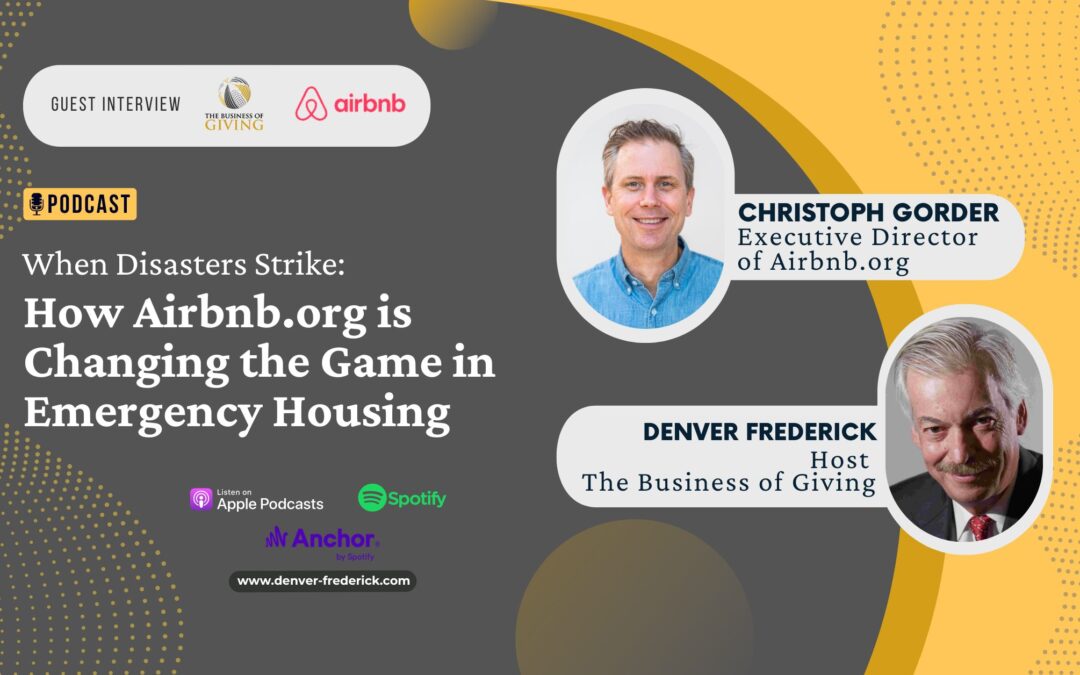
The following is a conversation between Christoph Gorder, Executive Director of Airbnb.org, and Denver Frederick, the Host of The Business of Giving.
Denver: Christoph Gorder is the executive director of Airbnb.org. Launched in 2020, the organization builds on the spirit of hospitality initiated by Airbnb hosts. They have provided free emergency stays to over 220,000 people, displaced by crises, including natural disasters and humanitarian emergencies. Christoph brings decades of experience from his tenure at charity: water and AmeriCares, where he led significant global humanitarian initiatives.
Welcome to The Business of Giving, Christoph.

Christoph Gorder, Executive Director of Airbnb.org
Christoph: It’s great to be here, Denver. Thanks for having me.
Denver: Why don’t we start by you telling us the origins of Airbnb.org, what inspired its creation, and how does it fit into the broader Airbnb ecosystem?
Christoph: Great. Well, it has an interesting origin story, and the idea goes actually pretty far back to 2012 when Hurricane Sandy struck New York City. And if you remember, thousands of people were displaced out in the Rockaways. Hundreds and hundreds of houses were destroyed. And one of the Airbnb hosts, a woman named Shell who was in Brooklyn, reached out to Airbnb and said, I want to open up my home for free and help house survivors. How do I do that?
And so the Airbnb engineers went to work and built some tools really quickly for hosts to be able to do that. And very quickly, we had about a thousand hosts sign up to help their neighbors. And this sparked sort of an idea that lived on for about 10 years as an initiative within Airbnb.
And by the time we got to about 2020… so about, almost four years ago, we realized that this was really an idea that had a much bigger potential. And so Airbnb decided at that time to really formalize it and create Airbnb.org to help empower hosts around the world– there’s 5 million hosts around the world, there’s 9 million properties– with the idea that this really unique network can come into play in times of crisis, and neighbors can step up and help neighbors, and we can be the trusted platform for people to be able to do that.
So, that’s really our goal. And the idea goes back to really a host, part of the Airbnb community, asking for this.
Denver: Back to Shell. I love founding stories and not even knowing that much about your organization, when you hear the founding story of an organization, you know so much about the organization just from that story because it just seems to permeate and continue on for years and years and years.
Christoph: Yeah, it’s a powerful story, and the generosity of hosts is very powerful. I mean, we’ve seen it around the world so far. You mentioned in your lead-up that we’ve been able to house almost a quarter million people around the world. But I think that the other interesting factor around that is: 134 countries where hosts have opened up their homes.
And so you start to think about being able to expand this in a world where there’s so much need and so much increasing need. We’re really excited about what the future can hold.
“…we definitely find that the hosts step up in times of need and really are the backbone of this. Our job is really to empower them and to be able to capture that generous spirit in times of need.”
Denver: Yeah. Really cool. Well, dig into that a little bit, Christoph. I mean, how do you engage and empower these hosts to open up their homes to those in need? And how long do people generally stay when they go to one of these homes?
Christoph: Well, the hosts are a very broad and diverse community. Like I said, there’s 5 million of them around the world, so they come in sort of all shapes and sizes. We engage them through the normal email channels, through our social. And then when a disaster happens, we’re reaching out to hosts in that particular area.
So, for example, today we’re reaching out to hosts in New Mexico where there’s been some terrible wildfires around Ruidoso and telling them about the Airbnb.org platform. We’ve already liaised with the government, emergency management officials in New Mexico and putting this all together to house some of the most vulnerable people.
And so, we definitely find that the hosts step up in times of need and really are the backbone of this. Our job is really to empower them and to be able to capture that generous spirit in times of need.
Denver: So .org has been at this for four years, but as you said before, you’ve really been at this for about 12 years. How has the organization’s approach evolved? And what lessons have been most valuable in improving your crisis response capabilities?
Christoph: I think we’ve gone through a number of different phases, and I think we’ve had a couple really massive, massive events. And the biggest one was the Ukraine crisis where we were able to house over 130,000 people fleeing Ukraine. So when Russia invaded Ukraine in early 2022, millions of people fled the country to get to safety with their families and showed up with no plan.
And so we worked with local social service agencies and NGOs, meeting people at the train station and getting them into a safe place where they would stay for about a month, which would give them a place to just settle in, figure out their plan, work with all of the nonprofits there that were there to help them, get working papers, figure out where they were going to go next, and come up with their plan.
And so out of a time of immense trauma for these people, this is a moment, a respite, a moment of safety where they can take a breath and really think clearly about where they’re going to go next.
So generally, our stays are between three and four weeks.
Denver: Okay.
Christoph: So it’s not very short term, but it’s also not a long-term solution for everybody.
Denver: When I think about your culture, you must be an adaptable culture. I mean, it’s not one of those things where you set out a plan and a mission. It’s sort of like you just have to respond, like the…
Christoph: You don’t know. I mean, that’s the emergency response. That’s the emergency response culture, is you have to be adaptable and meet people where they are. I think that married with the tech culture… Airbnb has been such a dynamic, adaptable, fast-growing… as a big organization, still has the startup-like ethos going.
And so I think the matching of these two, which is like: “There isn’t a challenge that’s too big for us” is what we’re trying to bring to bear here and ultimately bring new resources into the game, right? That we’re trying to tap into new sources of temporary housing that weren’t available yesterday.
And our ability to be able to engage, get hosts, and get them to open up their homes is something that didn’t exist and wouldn’t exist if we weren’t doing it. So that part’s really exciting.
Denver: Yeah. Yeah. It was funny. It reminded me, I was speaking to somebody at Patagonia recently, and he was talking about challenges, and he said, “No challenge is too big for us” as well. But he says, what happens is after you meet one of those challenges, you get organizational confidence, and you’re ready for the next challenge, which is bigger.
And I’ve never really heard anybody talk about organizational confidence in quite the same way that can result from having met these challenges.
Christoph: Yeah. I mean, I can tell you that the challenge that we’re facing is so complex, right? You think about housing people, getting people into the right houses on the other side of the world. We were working in Brazil a few weeks ago. We were working in Chile and Japan just in the last couple months.
So you think about the logistics, the cultural aspects, the complications, the trauma that people are going through, the sensitivity that you need to adapt to, the government rules and regulations which are different. It’s enormously complex.
And coming in, I came in from a background that wasn’t in housing, so I’m learning a lot. And I will tell you that if Airbnb.org had not been able to demonstrate that they could house 130,000 Ukrainian refugees, I don’t think I could sit here and tell you with confidence that we could do it. But they showed that it could be done, and so now we’ve got our high watermark, and our job is to figure out how to replicate that again and again.
So it’s incredible what you can do when you put your mind to it. And when there are, honestly, people’s lives and wellbeing in the balance, people really step up.
Denver: What are some of the unintended consequences you run into when you take big, big challenges like this on?
Christoph: I mean, I think two things. One is if you stop and look at the enormity of the challenges that any nonprofit out there is tackling, you can kind of get depressed and pack up your bags and go home.
I mean, I spent a lot of time working in clean water. There’s almost a billion people around the world who don’t have access to clean water. One small organization… what could you possibly do, right? You just move the needle. It’s a drop in the ocean, not to use a bad pun.
But I think when you say, no, we can make a difference. We can make a difference, we can start a movement, we can catalyze things. And I think that’s where the vision happens. That’s something that we can learn a lot in the nonprofit from the tech sector, I think, which is when you talk to tech entrepreneurs, they don’t feel limitations–We will build the world’s biggest platform to do X, Y, or Z.
And I think that level of ambition and disdain for limitations is really inspiring and has created some massive, massive companies. So I think that part has something that we can take in the nonprofit sector and just set our sights higher.
Denver: Yeah. Yeah. Well, I can detect a difference among nonprofit organizations. Those who are tech-centered, the morale in those places is completely different because they wake up in the morning thinking they can solve a problem. And you run into bricks-and-mortar organizations that are still a bit behind, you know: “Well, we’re making a little bit of a difference,” but you don’t have that same zest or that same energy. And you see it within the sector itself.
Christoph: Yeah. On a personal level, I spent the last 10 years working in an organization called charity: water, where we were a nonprofit that was very techy.
Denver: Oh yeah.
Christoph: And now, I’ve kind of flipped the script and come over here where it’s very much a tech culture which is nonprofit-y. And so it’s really interesting to kind of flip that script and see it from the other side. But there’s a lot of similarity there.
“So I think we want to use our resources to the maximum impact. And the most strategic resources we have are for emergency housing, to get people out of congregate shelters or out of tents, get them into a stable place where they can be stabilized, and then let’s give them a little bit of runway to be able to come up with a long-term plan.”
Denver: You talked about Ukraine before and Brazil before, and NGOs before, tell us a little bit about the partnerships that you have with those sectors, not to mention other corporations.
Christoph: So Airbnb.org accomplishes its mission by working through and with other organizations, and those are generally nonprofit organizations in the front lines, working with survivors of whatever crisis that we’re trying to address. So, refugees from the Ukraine or survivors of the wildfires in New Mexico, for example.
So there are social services agencies out there who are helping them out and identifying the most vulnerable population. And so we’re working with them to facilitate access to Airbnbs, and they identify the beneficiaries, the people who are going to become our guests.
Denver: Got you.
Christoph: And so we rely on their expertise, their local expertise, their technical expertise helping these folks. But they’re also generally providing a whole bunch of other services with it, right? So housing is just one piece of the puzzle, and that way our housing is really leveraged. So you have, you know, you think about that story of the Ukrainian family getting off the train in Poland. Like, what are we going to do?
There’s somebody who’s helping them think about what they’re going to do. They’re helping them with medical issues. They’re helping them get working papers. They’re helping them get their kids into school. They’re helping them with their refugee status, whatever it is.
So by partnering with these organizations… we partner now with over a hundred organizations around the world. And that’s the way you find the most vulnerable cases. So for example, in Brazil last month, there were these terrible floods– 600,000 people were displaced. We are a small organization. We can help a small number of people.
And so we worked with a local cancer hospital and helped to house families with kids going through chemotherapy who’d lost their homes. So these kids were like mid-therapy, right? They were going through their chemotherapy, and they couldn’t complete their treatment if they didn’t have a stable place to live, because their houses were underwater.
And so by us coming in and giving them a stable place, they’re able to continue their treatment and literally save their lives. So by working with hospitals and nonprofits, you find these cases where it is really, really a game changer.
Denver: Yeah. You said before that you’re a nonprofit expert. You know how to run organizations; you know how to get things done, but you’re not a housing expert. And now that you’ve spent this amount of time around housing, I’m just wondering if your attitude about it or your perspectives about housing, as we look at the larger crisis in this country and around the world, has changed anything as a result of being in this chair.
Christoph: Well, I think in my case, personally, I’ve always been a generalist. So I spent 10 years in clean water, and I was not a hydrogeologist or a water expert. And I spent 15 years working in the medical sector in emergency response, working with hospitals and doctors, and you would not want me to be your doctor.
But what I developed in terms of skills was really listening to all of these different pieces of the puzzle and getting them together and forming a strategy and coalescing a strategy and an operational plan that actually helps us scale.
And so, if you acknowledge your own ignorance and you’re humble about it, and you go into it thinking like: How am I going to… my job is to make this doctor successful. My job is to make this hydrogeologist successful. My job is to make hosts successful and nonprofits successful to be able to house people. How do we do that?
90% of the problem solving is not necessarily going to be on the technical side. I will say housing is extremely complicated, and what we see is we really bump up against the limitations of short-term housing when you run into the long-term housing needs. So you think about, here in the United States, long-term housing needs are just huge. Everybody feels it.
And this isn’t uncommon. I mean, I think, again, having worked in the front lines of the humanitarian sector for the last 25 years, you’re always running up against your limitations. You could always do more. There are systematic problems that you want to solve, and you can’t necessarily solve them today.
So I think we want to use our resources to the maximum impact. And the most strategic resources we have are for emergency housing, to get people out of like congregate shelters or out of tents, get them into a stable place where they can be stabilized, and then let’s give them a little bit of runway to be able to come up with a long-term plan.
Denver: You know your niche, you do it well, and you’re part of the continuum, and that’s the focus that you really need to have.
Christoph: You’ll drive yourself crazy if you don’t really stick to the plan. When you think about emergency responders, you think about like your local EMS team or your local firemen… like they are very clear about what they can do, and they’re going to be really, really good at it, right?
So the EMS’ job is to get you to the emergency room. The emergency room’s job is to get you stabilized and get you into the next phase of treatment. And so I think when you think about that, like emergencies are… crises and disasters are just so overwhelming to the system that I think you need to be really clear. Otherwise, you can be operationally scattered, but also just emotionally, you know, it can be very, very difficult.
Denver: Yeah. Yeah. And you’ve got a great design here. You tap into the voluntary sector, and exponentially you increase the impact by getting more and more people involved. You talked about resources. How is Airbnb.org funded?
Christoph: So the hosts will offer their place for a discount or for free. But not all hosts can offer their place for a discount and for free, so there has to be some amount that’s paid. So we then, as a nonprofit organization, we fundraise for the rest of that. Airbnb is generous, but there are also thousands of hosts around the world who give up a portion of their proceeds to be able to fund stays with other hosts.
So you imagine, if you are an Airbnb host, you might not be in a position to give somebody a free stay for three weeks, but you might be willing to give up sort of a night’s worth of revenue, which then we can cobble together with 21 other hosts doing that, and then pay for somebody to stay in a listing that’s going to be the right listing for them in the right place, in the right time.
And so building this movement among hosts has been very successful so far. And we hope to expand that. We saw definitely in the Ukraine crisis and when there are big crises, we see just outside donors coming in and donating and funding a stay, because I think there’s two things that are really special about this.
First of all, a hundred percent of the public’s donations goes directly to pay for a stay because Airbnb as a company waives all their fees, and then they cover all of the operating support. So the staff costs, the platform costs, like the travel, like all that is covered by Airbnb…
Denver: Sounds like charity: water in a lot of ways. Very familiar.
Christoph: And then a hundred percent goes through. So that’s really powerful, and it’s something easy to understand, right? Like when you donate, it’s really transparent and it’s like I can understand exactly what my money is doing. It’s not going into a big pot that’s going to go into a lot of overhead, or it gets lost someplace.
Denver: World Refugee Day… that was recent, and you made an announcement as I think you’re going to be expanding housing opportunities for refugees and asylum seekers. Speak a little bit about what you’re up to.
Christoph: So World Refugee Day was just recently, and on June 20th, and it’s just an important day for us to stop and think about the people who were forcibly displaced around the world. There’s over a hundred million people who are forcibly displaced around the world for generally conflict or insecurity.
And increasingly, people start talking about climate refugees because the climate in some places is just becoming unsustainable for people to continue their lives there. And the plight of the refugee is really, really, really tough. You imagine losing everything, moving to a place where you don’t speak the language… you don’t understand what’s going on.
And so raising a little bit of awareness is kind of the objective of World Refugee Day. Our mission is really to help people in crisis and we do that in natural disasters… obviously hurricanes and wildfires and earthquakes. But people in refugee situations are also in terrible crisis, and we look to help them, too.
So, for example, I was in Guatemala two weeks ago, visiting some local partners there, and there’s this massive crisis with migrants just moving north. And I had the opportunity to spend a little bit of time with a Venezuelan woman. She’s a single mom who’d been on the road for three months with her three kids.
Denver: Wow.
Christoph: A 16-year-old, a 10-year-old, and probably a 5-year-old daughter. Three months, they had fled Venezuela. A third of the Venezuelans have left the country because it’s so bad there. You can imagine how bad it would have to be for this woman to take her children and put them in this situation and hike across Panama… and the terrible things that they’ve gone through.
And when they showed up in Guatemala City, they were in really, really bad shape. And from a health point of view, the kids were really sick. They’d been outside living in a park for three weeks, and our local partner picked them up and got them in an Airbnb so they could get some medical care, get stabilized. And I spent some time with them in that house, and it was the first time they had felt safe in three months.
And regardless of where you are on some of the difficult political issues that surround this, at a humanitarian level, these are our brothers and sisters. And if we can do something to help them, I think we have the moral responsibility to do that. So if we can help, we’ll try our best.
Denver: Yeah, yeah. No, that’s quite a story. I worked at Ellis Island, the Statue of Liberty & Ellis Island, and there is something about people like that Venezuelan woman, her three kids. They’re a special breed, you know?
Christoph: They’re special…
Denver: Just the way the Ellis Island people, the courage that they have for a better life and a better life for their kids. It’s almost like it’s a filter. These are the people that really are going to make a difference in the world, not the ones necessarily who stay. They just are something different. And I guess you saw that pretty much when you were looking at the four of them.
Christoph: I mean, a hundred percent. And like what these people… she was a professional person in Venezuela. She had a career. Like she’s actually not looking for a handout.
Denver: No.
Christoph: She just wants to be safe and raise her kids and have them be educated. Like she’s looking for the basics.
So what’s interesting is, you think about the history of Ellis Island, and some of my ancestors came after the first World War from Norway, where like the economy was just terrible. There were no jobs. And they came here, and three generations later, like we’re totally assimilated in the country. And it’s just, it’s an amazing story, and many of us share it in a certain way. It’s just, yeah.
Denver: And the common thread is courage. They have the courage to move.
Christoph: It really is. It really is. I mean, you see this resilience in times of crises, people are really their best self. And whether it’s with refugees or you certainly see it in natural disasters where people just do amazing things for their neighbors. They’re amazingly generous.
And I think that’s the human sentiment that we’re really tapping into with the hosts and with .org, is that we know… I mean, if I could show you a map of the hosts that offered their homes up for free after the Ukraine crisis, it lit up the entire globe because we put out, you know, they heard that we were helping people.
I mean, we had hosts in Argentina, in Indonesia, in Africa, who said like, so of those 5 million hosts, like there’s a large number in there that are ready to do extraordinary things for people and help them through a very difficult time.
Denver: Well, that’s cool. I mean, anytime you get cynical, all you got to do is take a look at that map and say, Hey, you know what? There’s a…
Christoph: Yeah. Yeah. I mean, I think the world is a complicated place. It’s easy to get discouraged, and I think, you know what, because problems do continue to come, right? But when you see the inspiring generosity of people, that gives me energy. I’m like, okay, well, what can I do to help you be successful today? And I think that’s really the driving story here, is: How do we enable people to be generous and host people?
And the thing, you probably stayed in Airbnbs, too. You come up against hosts who are really extraordinary, right? Like…
Denver: Oh yeah.
Christoph: I mean, who go the extra mile and leave a bottle of wine there for you as a guest. And so what we see when they’re .org guest is that they’re driving them to the train station or they’re driving them to their medical treatment. It’s so much more than four walls and a roof.
Denver: Yeah. I’ve had some great hosts. I haven’t had the bottle of wine one though yet. So…
Christoph: You can go to France or Spain.
Denver: Looking at that, is there a story of a host that you have found particularly moving or impactful?
Christoph: So I’ve traveled a lot in the last six months, meeting with hosts around the world and guests. So I’ve been to France and the UK and Germany, Mexico, Guatemala, and I’ve met a lot of hosts. I mean, they’re really extraordinary. I would say one of them that stands out is coincidentally a family member.
So, my wife’s cousin reached out to me when I joined Airbnb.org and she said, “Oh, I hosted a family.” I didn’t even know this. And so she and her husband were living in LA, and they had a little sort of mother-in-law’s apartment, and this was during the Afghan crisis. They’d seen something about Airbnb.org. They’re not Airbnb hosts. They had just seen the call for places to stay.
And so they signed up for Airbnb.org. So you can do that. Like you don’t have to be hosting people commercially; you can just say like if there’s a humanitarian need, I’ll help out. And so she was one of those. And so they got a call from our local partner that said, Hey, we have a young family that needs a place to stay tomorrow. Can you take them?
So overnight, the next day this family showed up. So a young couple with a 3-year-old. They show up in a taxi with like literally plastic bags. And the mom is nine months pregnant. And they’ve been bouncing around. They’d evacuated out of Kabul…and those terrible scenes that you saw on the news of the evacuation. They’d spent two or three months, like bouncing around military camps in the Middle East, just completely unmoored, right?
Denver: Yeah.
Christoph: And so they arrived there, and the next week, the lady had her baby, and they ended up spending four months there. The host did a GoFundMe to pay for a year’s worth of rent, found them an apartment, got them English classes, and they’re still like friends and close to the family as this young family is developing and building their new life here in the United States.
And so that mobilization of the whole community was really… like that’s how this can work.
“And the first people to help are always neighbors. And then it’s the first responders, and then it’s the government agencies and whatever. But like the first people to help are the neighbors who are right there.”
Denver: Yeah. Yeah. And I kind of wish we were hearing more stories like that instead of the diet of news that we get fed. Because I think a lot of the anxiety and angst that we have is because we don’t hear stories like that as much as we should. We hear people being pushed on the subway or whatever it may be, just one after another, after another.
Christoph: Yeah, there’s a famous quote by Mr. Rogers who was talking to kids about when something bad happens. I can’t remember when… it was like maybe when 9/11 happened or something like that. And so he is talking to the kids and he said, “When something bad happens, look for the helpers.”
Denver: Yeah.
Christoph: Because there’s always somebody there. And the first people to help are always neighbors.
Denver: Mm-Hmm. Yeah.
Christoph: And then it’s the first responders, and then it’s the government agencies and whatever. But like the first people to help are the neighbors who are right there. Like they’re going to be the Airbnb hosts who are in Ruidoso in New Mexico. They’re the Airbnb hosts in Poland. And they can move so much faster and help so much more than any of us can in those first critical days.
“So I think we’re going to try to build the tools and get the word out as much as we can. Those are the two key activities. But if we can become the go-to in an emergency where people think, ‘Yes, I need temporary housing; Airbnb.org can help me,’ that would be my idea of success.”
Denver: Absolutely. Finally, Christoph, you have a full plate, but if you had a moment to take a look at where you want to take Airbnb.org over the course of the next five years, in light of the global displacement and the housing insecurity that just seems to be mushrooming, what are your thoughts in terms of where you’d like to take this organization?
Christoph: I would love to see Airbnb.org become the go-to platform for temporary emergency housing, and really leverage and harness the power of the Airbnb community of 5 million hosts and a hundred million guests… or people who use it in their leisure travel… to be able to harness that community, which has been really a values-driven community around belonging and welcoming and hosting.
That has produced all of these amazing experiences for those of us who’ve traveled with our families on vacation. And to be able to use that and harness that power for humanitarian purposes would be amazing.
So I think we’re going to try to build the tools and get the word out as much as we can. Those are the two key activities. But if we can become the go-to in an emergency where people think, “Yes, I need temporary housing; Airbnb.org can help me,” that would be my idea of success.
Denver: That would be fantastic. But you’re starting off with a great asset with the people that you got. I mean, it is…
Christoph: It’s amazing. The opportunity is incredible.
Denver: That’s your asset, you know? Yeah.
Christoph: And the potential is there, which is why I’m so excited about it. And the support from the company and the leaders has been just extraordinary. There’s 6,000 employees at Airbnb as a company, and all of them are just like, “Just let me know how I can help.” And so that’s an extraordinary asset.
Denver: Well, you got a great job. For listeners who would like to learn more about Airbnb.org, maybe become a host or learn more about the organization, tell us about your website and the kind of information people are going to find on it.
Christoph: Great. So you can jump over to airbnb.org and learn a little bit about our work. If you want to sign up as an Airbnb.org host, either because you’re an existing Airbnb host or you would just like to make your home available if there’s a crisis in your area, we encourage you to do that.
And of course, you can donate to us. We’re a fully set-up charity, and so it’s a charitable donation, and 100% of your donation will be used directly for funding stays for people in need, people in crisis around the world. So, it’s a great proposition that will go directly to help people out there. So check it out: airbnb.org.
Denver: Very cool. Well, thanks so much for being here today, Christoph. It was a real delight to have you on the program.
Christoph: My pleasure. Thanks for having us today, Denver.
Denver Frederick, Host of The Business of Giving serves as a Trusted Advisor and Executive Coach to Nonprofit Leaders. His Book, The Business of Giving: New Best Practices for Nonprofit and Philanthropic Leaders in an Uncertain World, is available now on Amazon and Barnes & Noble.