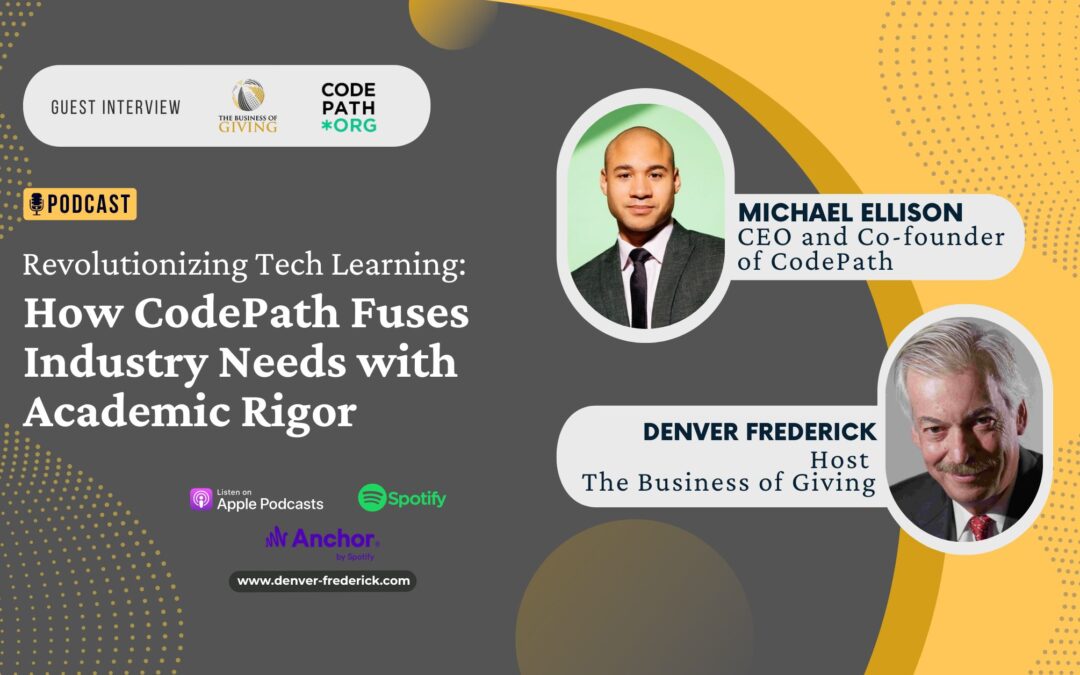
The following is a conversation between Michael Ellison, CEO and Co-founder of CodePath, and Denver Frederick, the Host of The Business of Giving.
Denver: Michael Ellison is the CEO and Co-founder of CodePath, a nonprofit reprogramming higher education to create a diverse generation of engineers, CTOs, and founders. CodePath offers industry-vetted courses and career support for Black, Latino and Latina, indigenous and low-income students, empowering them in tech careers.
With over 26,000 students and alumni from 600 colleges now working at 2,000 companies, they are reshaping the tech workforce and the industries of the future.
CodePath has been recognized by Fast Company Magazine as one of the world’s most innovative companies of 2024.
Welcome to the Business of Giving, Michael.

Michael Ellison, CEO and Co-founder of CodePath
Michael: Thanks for having me.
“All of that has fueled this appreciation for how important being prepared with the skills of the future, having the most powerful tools at your disposal can completely change your entire trajectory in reality”
Denver: What inspired you to start CodePath, and what were some of the initial challenges you faced in establishing this organization?
Michael: Well, I’ve always been incredibly passionate about changing the world. I started my first nonprofit when I was 19 years old. That nonprofit was high impact, but low scale, made lots of mistakes, learned a lot of different lessons, and one of the things that it really fueled in me was an obsession for: How do you go from high impact, low scale to high impact and high scale?
At the time, we saw a lot of tech companies scaling— Facebook and small teams, big impact, and it convinced me that I wanted to get into coding and importantly work with the most talented software engineers I could find to figure out what I didn’t know that they did know. That in turn led to founding multiple tech companies, still trying to be mission-driven, focused on education.
And then, had an opportunity to become one of the earlier Black founders in this accelerator in Silicon Valley called Y Combinator back in 2011; that ed tech pivoted to enterprise analytics and was acquired a number of years ago for over $3 billion.
So, I was incredibly lucky and perhaps even more so based on my background, where my father was incarcerated when I was five years old, between the ages of five to 12, in and out of homelessness, so not likely for someone from a background like mine to get into tech, start tech companies or have a major exit.
All of that has fueled this appreciation for how important being prepared with the skills of the future, having the most powerful tools at your disposal can completely change your entire trajectory in reality… and all because I thought, “Well, coding might be something interesting to take a look at and maybe engineers might be good to work with.”
So, that led to, 10 years ago, me and my co-founders… they both come from low-income backgrounds, accomplished serial tech entrepreneurs… we got together and we wanted to create the best technical education in the world, but have it focused on people from similar backgrounds as what we came from.
When you look at a lot of the high-scale ed techs out there, Courseras or Udemys or whatever, then it’s easiest to monetize those individuals who are going to pay the most and are the most prepared. We really want to focus on equity and focus on low-income Black, Latinx, indigenous young people because they ended up being the ones who were least likely to have those pathways to leadership.
So, that was the initial inspiration, and I’ll just share one important piece of it, which is we had three principles that were imperatives for us as we started the organization.
Number one, we wanted to keep our promises. This means that although we want to get to very high scale, we want to leverage our tech backgrounds. Scale is never more important than quality.
Denver: Yep.
Michael: And so we need to keep our promises to our students, number one.
Number two, we want to make sure that the programs would be pathways to excellence. There’s a lot of organizations that optimize for what’s the shortest path in order for you to get any job or any tech job, a 30-day training, a couple months training.
We thought it was extremely important that keeping our promises meant you are going to make it to technical leadership, become a CTO, be able to found a company, have as many options as possible.
And number three, it was important that as our programs would scale, we would drive systems change across college education. We want to change what default looked like for the majority of people pursuing technical education.
Denver: Yeah, well, those are wonderful principles. You really set this up absolutely beautifully.
You know, I know how challenging it is, particularly in the funding arena to look for that kind of quality because people are always looking for numbers, and they want to know how many people you’ve been able to help. And obviously, you had to stick to those principles to be able to say, “It’s going to take us a little bit longer, but these are really going to stick in terms of what’s going to be for somebody’s career and ultimately systems change.”
How are you able to do that? Because a lot of entrepreneurs aren’t able to do that.
Michael: You have to be very comfortable with going against the grain. Whatever leading experts, whatever’s the popular opinion, we were the opposite in so many ways.
Denver: Yeah.
Michael: I mentioned a lot of tech companies start at scale, and although we knew we wanted to get to scale, we started with one of my co-founders– 15 students in a classroom– and we tried to understand what were the mechanics of effective education and then map the different workflows, processes, what we were doing, not doing, lots of testing, and then we built technology around that in order to make one educator able to be initially way more productive… and then eventually for us to think and try to solve a problem of: How could we make every classroom exceptional regardless of who was in that classroom?
Denver: Yeah.
Michael: So, there is a principle, a product development process where we thought high quality, low scale, test experiment, learn, understand the mechanics of effective education, and then incrementally scale based on understanding those mechanics, leveraging technology.
I’ll say that there was another very important piece that we did. This breaks my heart. A lot of innovators, especially when they’re mission-driven, are stuck at the very beginning because they can’t find the right funding. They find a little bit, but maybe it’s not flexible enough, so they can’t learn, they can’t experiment. Then they ran out of funding really quickly because they couldn’t hit the numbers and the metrics.
We had as our first seed funders, we had a collection of serial entrepreneurs as my first board members in Silicon Valley– Adam Pisoni, CTO, and one of the co-founders of Yammer, he was my very first investor and he was our first board member– he helped quite a bit. And then we were also seed funded by Facebook’s engineering team, where they had a hypothesis that we could scale really quickly, and we would change the schools that they would hire out of.
Most major technology companies, they have a stack rank list, 20 to 50 schools, and you are invisible if you don’t come from those schools.
Denver: Got you.
Michael: So, we were to convince them that flexible capital at the beginning gave us a lot of room to be able to experiment and learn and then build trust with funders that required much more evidence than what we currently could offer.
“And that aha moment that we saw at Stanford shocked us because if you have some of the most expensive procedure schools in the world where there’s these huge gaps between theory and then actually what is expected in the industry, what about all the rest of schools, all the rest of the populations?”
Denver: Yeah. I love what you say about learning because so often, people are driven to scale so quickly, and when you scale quickly, your learning stops on a dime, and all you’re doing is running stuff and that’s not what you want… so if you want to get big, you really have to start small, and that is a wonderful discipline which to have.
Well, let’s talk a little bit about the challenges here that CodePath is trying to address.
There are some gaps and barriers in traditional computer science education, and what you’re looking to do is help underrepresented students successfully break into the tech industry and fill those gaps in between their education that they’ve received and what those tech companies are going to want in an employee. Tell us what those gaps and barriers are.
Michael: So, let’s even zoom out even more because every single CS program in the country, it’s not filling the right gaps that’s expected by industry. So, a part of our early aha moment when we were running CodePath, so a little bit of tangent, I’ll get back to it, but before we became a nonprofit, we were running enterprise training for Facebook and Airbnb and Netflix and other tech companies; we were training senior engineers and leveling up their teams. And when we were doing that, all these Stanford kids would keep trying to get into our courses, and we’d be like, “Stanford, you’re like the best school of the best schools in the world, especially if you’re interested in technology; why are you applying to our courses?”
And be like, “No, no, no. But they’re not practical, they’re theory, they’re not focused on what’s happening in the industry. The technologies of the frameworks are constantly changing, and yeah, we have great professors, we understand the fundamentals. We don’t understand exactly how you do things in industry, how you work in large code bases with other engineers. What are those tools? What are those techniques? What does excellence mean?”
And that aha moment that we saw at Stanford shocked us because if you have some of the most expensive procedure schools in the world where there’s these huge gaps between theory and then actually what is expected in the industry, what about all the rest of schools, all the rest of the populations?
And so, you know, the number one initially was just bridge that gap between theory and actual practice. And that gap is expanding across schools right now as AI is completely transforming what entry-level software engineering looks like and what the skills needed and are required are.
So. That was number one, and there’s additional major gaps that we’ve evolved to address. Technical interviewing is a distinct, different skill than even understanding the knowledge around theory, sales fundamentals, being a straight A student, even different than the practical software development.
It’s like, if you’re expected to take the SAT after you graduate high school, and no high school has an SAT prep program. It’s kind of like that.
Denver: Yeah. Got it.
Michael: Or maybe there’s like a few, like maybe Stanford, they have a class that says passing the Google interview, but the majority of high schools don’t have that.
So, we identify that as one of the highest leverage, most effective things that we could do: you can now pass the technical interview.
There’s additional gaps as well that we solve and we address. One of the additional ones– CS fundamentals are important, passing the technical interview, just like passing SAT is important. And then what about if you have the skills, but you are invisible because the ranking of your school is too low?
So, this is where we have from Day Zero built partnerships with companies where we actually run their internship programs. There’s a fantastic program we run with Salesforce, where you can take CodePath courses, and you can skip the entire interview process.
Denver: Wow.
Michael: Skills-based hiring is really valuable because it completely democratizes the opportunities that are out there.
Denver: Yeah.
Michael: And we’re not yet high scale there, but we built our courses to do predictive matching with companies, passing technical interviews and on-the-job performance that has allowed us to, with data and outcomes, prove to companies that they should be hiring out of schools that they normally don’t hire out of.
So, I mentioned some of the gaps. That’s not holistic, but those are some of, if you were to stack rank, those are a few of the most important that you need to address.
Denver: Is there a mindset gap that you need to address as well, in addition to the skills and tools?
Michael: Completely, completely. So, but this also goes back to that second key principle of why we were founded.
Why did we pick not just Java or different types of web development technologies, or why did we focus on the most competitive technical roles? That’s because the software engineering mindset is someone who at the highest level, they are an excellent problem solver. They are expected to be an excellent life-long learner. They have to learn at the pace of technological change, and they have to keep ahead of that. They’re great systems thinkers. They’re great architects. They look at in a high-pressure situation where you have very limited time– where do I find an answer? How do I understand what I should listen to or not listen to?
So, there’s so much that you get with great software engineers that you would want across a whole variety of different professions and options, and we think of the most important element of our programs is actually the mindset beyond: I can code in iOS, or I can code, or I understand different approaches in cybersecurity.
So, really, the mindset is the key, and for the future, increasingly more important, more important than it’s ever been I think, the mindset piece.
Denver: Yeah. I’m trying to change my mindset; what’s going on, you know what I mean? You just have to stay ahead of the curve as best as you possibly can.
Let’s talk a little bit about your students. You have such an impressive record. You have 26,000 students, 600 colleges, you’re working at 2,000 companies, I should say, some of the most prestigious companies in the world.
Tell us a little bit about that process, how your training model works, and how you’re able to mentor and do the career placement and all those things that bring that to life.
Michael: First, I’ll take another step back and: How does CodePath work? CodePath, we have a software platform that controls the student experience. It’s a learning management system, but it’s hyper-opinionated on every classroom and what happens.
So, across a hundred-plus schools we have some deep partnerships, and we have some that are lighter touch, lighter touch 600, deep partnerships 100-plus… those deep partnerships CodePath is training the professor or providing the curriculum.
When the courses are operating, you have two to four hours a week where the professor is leading what looks more like a lab session.
Denver: Okay.
Michael: And then you think of a flipped classroom where they’re logging to CodePath to have 10 to 15 hours a week of lots of different dimensions of personalized support.
So, our master curriculum, if we’re teaching iOS cybersecurity, Android, whatever else, it’s the same across every school.
If we update one classroom, we update all the classrooms, or we can update classrooms based on population segments or school types, or whatever we’ve learned in the past. So, I frame it in this way because one of the biggest challenges that we see in education is the lack of personalization.
Denver: Yeah.
Michael: The lack of the right intervention at the right time for what that student truly needs: mindset, getting over hurdle, the right feedback loops at the right time and ideally, you can intervene before the student even knows that you should intervene.
So, when it looks like, you know: What is the playbook across different students? I say, “Well, talk about segments, talk about subsegments.” Every CodePath class, there’s assessments, and we’ll route you down one or multiple different levels of rigor and personalized support depending upon how you place.
We’ve realized that we can’t just look at a school ranking to know that this is the right course for a student. So, we have a personalized adaptive learning experience at scale that tries to optimize for highest leverage next intervention to get you that technical internship and then to get you the job, if that makes sense.
I’ll pause there, if there’s additional questions.
Denver: No, no, no. It makes sense. I just had Sal Khan on recently in terms of what he does with young people in terms of, you know, it’s all AI-driven in many ways, but it’s knowing exactly where that student is, the challenges that they have, and then just really addressing that student with those challenges as opposed to the 35 people sitting in a class… and really only five of them have it in that spot. So, I would imagine this rapid advancement of AI technologies has really been instrumental in your ability to do that. Would that be right?
Michael: Yes. But I have like a love-hate relationship when talking about AI in a sense.
Denver: Okay. What do you want to start with? The love or the hate?
Michael: No, no. I mean, it’s incredibly powerful, but from a product innovation and a philosophy on how you are developing the products, I see too many AI startups, especially in education, trying to start at scale as opposed to starting with Baldi and understanding those mechanics of effective education, effective feedback loops, impacting the learner psychology, and then making sure that when they’re thinking about AI, they’re not thinking of a magic-anything tutor.
Think of those specific stack rank biggest pain points or the most important leverage opportunities for each learner.
So, if someone says, “Hey, this is for everyone, this is a career coach, that’s for everyone.” I’m like, ” Okay, well, let me tell you about one specific student type that is struggling versus these other student types that are not, and let’s make sure that if we stack rank what they need the most, then we’re able to get there.” So, I think of that process as how important that is.
For CodePath, we ended up building an AI router. So, we have, our students will communicate with our multiple tiers of student leadership in our own staff via Slack chat and via our learning management system; there’s different ways that they can chat and request help, lots of feedback loops, lots of different ways that they can get help and be supported.
And then we’ve integrated AI as this invisible layer where they don’t know necessarily if they’re talking to say the human or talking to the AI, but they’re used to just chatting with their TA or with a group of different TAs.
That allows us to then bucket what their challenge is, and then in some cases, we can automatically solve it with the AI. In other cases, it routes to a human expert. This is how you incrementally are able to maintain high quality and drive significant cost savings, is by not having one huge AI use case that’s overly scope, but identifying specifically areas that are high leverage and that you know you can solve is very high fidelity. So, it’s like an army of different types of AI bot use cases, much of that invisible to the end user, and for us, it’s driving, we think,… in the next five years, we’re going to decrease our cost per student by about 80%.
Denver: Wow.
Michael: AI being a big driver there. And, this year, we’re on track to decrease our marginal cost per student by over 70%.
So, leveraging AI, it’s got a lot of boring, like operational backend, like: How do you better optimize your army of mentors, career coaches, student leaders? But there’s lots of low-hanging fruit that doesn’t sound as cool as I’ve imagined AI tutor that can do anything you want, but it’s very effective if you have the control and consistency across classrooms.
Denver: Yeah, and that all comes, it seems, from that long-term vision that you started with. It just wasn’t running to that first spot, but it was an idea in terms of where this is all going to go, and when you can really stick to that long-term vision, that’s when you really see the benefits and the dividends coming to bear.
You have so many partnerships and collaborations. Tell us a little bit about them, how you enter into them, how you go about them, how you create mutual benefit for those who are involved.
Michael: Yeah, there’s a lot of different great partnerships and let me share some examples.
I’ve loved and CodePath has loved to partner with philanthropists, who care a lot about improving how funders are making their investing decisions, and we’ve had a number of great partners, from Blue Meridian Partners to Comcast to Knight Foundation, and we’ve seen that with the right types of funding partners– and one example is: Comcast is an early funder introducing us to Knight Foundation.
Knight Foundation got curious about our potential impact in South Florida, funded a pilot in South Florida, helped with introductions, led to CodePath having our first ever place-based focus, and with partnering with local government, and partnering with school leadership to drive a deeper level of change inside of schools from one or two courses to 3, 4, 5, 6 plus courses, larger percentage of the entire student body.
That in turn led to the County of Miami directly funding CodePath. Successful pilots from Knight ended up having Knight expand to also more cities, in Charlotte, for example. And then now, we have collaborations and support from Knight Foundation and a collection of funders where it’s looking at influencing state policy and state university system.
So, what’s so fascinating and exciting for me is the interplay across government, philanthropic, and of course, there’s many nonprofits that we love collaborating with and have collaborated with for years. Recent collaborations with rewriting the code, management and research for tomorrow.
We don’t see ourselves as it needing to be competitive as much as it’s a big problem to solve and we need to be as collaborative as possible, but I think, funders can play a huge role, not just from the dollars that they give, but their influence across other funders, as well as, we think it’s incredibly important that our evidence building leads to other nonprofits doing things more effectively.
Denver: Yeah, yeah. That’s such a smart route to go. You know, I think there’s a lot of organizations that need money and they pump out the proposals. And the more they get out there, the more they have in the pipeline, more that will come back. But the ones that really make the difference are the ones like you who’ve been able to create that virtuous circle, and that is exactly what it is. You get two or three of those key players, and then they introduce you to some other key players, and things begin to happen, and the leverage you get from that and the time you save and the frustration, it’s like night and day.
You got a pretty big alumni network. Tell us about them.
Michael: Well, you know, around 26,000-plus alumni.
Denver: Wow.
Michael: And if you stack rank where those alumni work in the companies of highest concentration as software engineers, number one is Amazon. Number two is Microsoft. Number three is Google.
Denver: Yep.
Michael: Why is that important? Well, because the quality of the job helps to connect to what’s the first-year salary. So, we average $92,000 first-year salaries, so I’m very proud of that.
And I’d say even more proud that if you disaggregate our alumni base based on race, gender, geography, ranking of schools that they’re going to, and various other measures of disadvantage, we have consistently high job outcomes and high salaries.
So, our mission is Black, Latinx, indigenous low-income students as our target population that we’re serving, but it’s very important for us to center on equity because we also care very much about how are we fundamentally changing the education system. So I’m very much proud of that.
A little bit more about alumni, our mission is reprogramming higher education to create the most diverse generation of software engineers, CTOs, and founders. So, we have partnerships with accelerators like Y Combinator, venture capital firms like Andreessen Horowitz or Base10, where I think that’s a testament to moving the needle for your students where they’re getting, or you are a pathway to influence and empower and leadership, and so, there’s potentially other areas that we are having a massive impact as well from an alumni standpoint.
Denver: Yeah, you do a great job of measuring the impact and the metrics.
What about the industry itself? Have you looked in terms of the impact you’ve had with the increasing diversity in the tech industry?
Michael: We’re working towards this, but I don’t have a top-of-mind measure of holistically, across all companies, what is our footprint with diversity change?
I would say, I think we’re very proud when we are able to work with employers and get to a certain level of size of their early talent funnel in a way that’s not constrained by a CSR initiative.
So, one challenge a lot of nonprofits face in our space is that they are inside of a diversity, equity, inclusion budget. They are a part of corporate social responsibility, almost like a risk mitigation, like we got to do something and here’s a budget.
Denver: Yeah, sure.
Michael: Unfortunately, that could mean that depending on who the partner is, you end up having a cap, like there’s a ceiling to the number of people that you could place. A lot of apprenticeship programs end up being a lot smaller than you might think.
Denver: Yeah.
Michael: One or two, or maybe there’s less than 10, And a lot of companies that they are hiring thousands of people every year.
And so, I’d say another measure that has been important, valuable to us, is being seen more as a business imperative and adding long-term strategic value that the company is connecting to their stock price. So, the conversations we’re having are with chief people officers or with CTOs and it’s not necessarily with a team that doesn’t have as much influence, you know, fortunately, unfortunately.
Denver: Yeah, you have so many balls in the air. Are you also looking at policy advocacy and systemic change in any kind of, you know, intentional way? I’m sure you are, but I’d just be curious as to how you’re thinking about that.
Michael: We are. We’re slowly working with a couple of funding partners to build internal capacity around that.
We actually received a grant from Knight Foundation, which is kind of the precursor to influencing policy, which is our own capacity building and a good friend of mine, Gerald Chertavian, who is a former CEO of Year Up.
Denver: He’s been on the show a couple times.
Michael: Yeah, yeah, yeah.
Denver: Great guy.
Michael: Yeah. I’ve chatted with him a bit about government, and we do receive some federal- and city-level government funding. But, he mentioned that you really need to be fully invested and go all-in with that, you can’t go halfway, it would be disastrous.
And so, we’re trying to be very intentional with working with existing foundations that have a bit more expertise than we do. Blue Meridian, NEW PROFIT end up coming to mind as some of those… Knight Foundation as well. It is on our radar.
We really love the leverage of having presidents and provosts of the largest state schools and community colleges in the country as your advocates.
Denver: Yeah.
Michael: So, I would say, we’re very intentional with: How do we make sure that we have built trust and formed relationships with people that then unlock more trust and more relationships? And policy and government is on the roadmap, but it is soon and not yet now.
“You need an army of the right types of supporters and expertise, people to point out blind spots, and also for people to lift you up and really break down the barriers that you can’t break down yourself.”
Denver: I got you. You’re assembling the pieces as we go along.
Michael, what advice would you give to aspiring social entrepreneurs and changemakers who want to create a positive impact in the tech education space.
Michael: So, I think that, for aspiring social entrepreneurs, there’s two things I’d highlight. One is the importance of getting your own conviction, not based on what you’re reading or researching, but rather based on what is your lived experience and the experiments that you’re doing.
With this number one piece, I’ll give you an example, that first nonprofit I founded when I was 19. Within two years, I was speaking at Harvard Business School and I’m like 20, 21 years old, where I’m on panels with experts, and I don’t consider myself an expert. I have professors asking if they can work for me, and it completely changed how I thought of expertise or insights or, you know, at the very beginning I was like, “Ah, I don’t know if I even know enough to solve this problem.” And then I was like, “Wait a minute. Because of my lived experience and my passion, I am actually adding to the conversation with all these different experts that are very well known.”
So, I think that’s number one is: believe in yourself, and the conviction, but getting out of a classroom and just rolling up your sleeves and really understanding what’s going on from a first principle standpoint.
Number two is there’s nothing more important than the champion network that you build.
Denver: Yeah.
Michael: You have your board, but you also have your circle of different individuals. You need an army of the right types of supporters and expertise, people to point out blind spots, and also for people to lift you up and really break down the barriers that you can’t break down yourself.
So, I think those two are where I would focus.
Denver: Yeah, no, that’s great advice. I sometimes think too, that, you know, you have all these experts at Harvard and you’re 20 years old and you’re up there, and what do you have to add? And much of what you know from lived experience is really pretty obvious to you. But then when you say it out loud, it wasn’t obvious to them, you know? And therefore, it allows them to make other connections.
And that’s one of the things I’ve learned about innovation is that when I say things and I say, “Well, everybody knows this.” I’m wrong, and it can make all the difference in the world.
Michael: Yeah.
Denver: Finally, Michael, what’s your long-term vision for CodePath, and how do you see the organization evolving over the next five or 10 years?
Michael: So, I’ll start with five years and then I’ll go further out. So, in the next five years, we just completed a strategic plan. Pretty ambitious. We are projecting to scale 14x with only increasing our budget by 2x.
So, 14x increase in students served, maintaining quality of job outcomes, and only a 2x from an increase in budget standpoint.
Denver: I like those metrics.
Michael: Yeah. And that would get us to roughly around 20% of the nation’s computing students. And, that would allow us the level of scale to potentially diversify the nation’s most competitive entry-level software engineers.
And then if we are at that level scale, then within the next 10, 15 years afterwards, we’ve been able to diversify the industry, but in a way that is also centering on low-income and equity, economic mobility.
That level of scale, it will be meaningful to multiple cities. Thinking about income inequality, thinking about social mobility.
What is that also impactful for? Well, software engineering and AI are accelerating as necessities across a variety of different disciplines where they weren’t put, as in deeper use.
So, I have really fascinating conversations with cancer researchers, Alzheimer’s researchers, with space exploration companies. There’s a lot of these different sectors; look at government, look at nonprofit, look at a lot of areas where even just improved software and workflows could be game-changing.
And then, AI is even more game-changing, but you need someone to build the plumbing, to have the data infrastructure. You need data scientists, you need software engineers. You need someone that creates the applications that then interface with humans and people and understands the problems to solve.
So, that acceleration is here today, and CodePath focusing on computer science, software engineering, means that I believe we have the potential to accelerate US innovation, to be a core lever behind that.
And accelerating US innovation within a 20- to, say, 30-year time period, I would like the economic footprint that we have on low-income communities to be in the trillions.
Denver: Yeah, yeah, no, I can see it. You know, you look at all these exponential improvements have been made in each one of these technologies, and now for the first time, we’re getting a convergence of all of them coming together that just takes it and blows it out of the water.
And I could see 20% in terms of being able to reach that in five years; that does sound like a tipping point to me because I’ve always found that when you hit that 20%, 25%, everything changes, you know, all at once. Hard to get there, but once you’re there, things begin to really accelerate that much faster.
Michael, for listeners who would like to learn more about CodePath or support this really incredible work, tell us about your website and the kind of information they’re going to find on it.
Michael: Yeah, well, the website is www.codepath.org.
And, you know, we love to be really transparent about how we do things and what our approach is. You’ll find a lot of resources for students, especially that are meant to be personalized; how can they find their path, financials to annual reports, to just a lot of information we publish regularly, you’ll find it there.
And you’ll also find some really interesting developer-facing resources. We didn’t get into this, but we linked to these open source textbooks, if you will.
For every technology, we actually open source an entire living textbook around these different technologies, which are some of the most popular developed resources on the internet. So, find a lot of different things.
And then, as far as if anybody was interested in connecting with me, then I’d recommend probably connecting with my assistant. I’m pretty open about different connections and outreach, so [email protected]. For people interested in collaborations, connections, whether it’s higher ed systems change, whether it’s influencing the way that philanthropists are thinking about our space, Juliette, [email protected].
Denver: Glad you spelled it.
Michael: Yeah.
Denver: Well, I want to thank you so much for being here today, Michael, it was a real pleasure to have you on the program.
Michael: It was my pleasure. Thank you for the opportunity.
Denver Frederick, Host of The Business of Giving serves as a Trusted Advisor and Executive Coach to Nonprofit Leaders. His Book, The Business of Giving: New Best Practices for Nonprofit and Philanthropic Leaders in an Uncertain World, is available now on Amazon and Barnes & Noble.