
I read four nonprofit annual reports last week. Two donor appeal letters. A CEO transition announcement. A foundation’s strategic framework.
I could not tell you which organization wrote which document.
Not because they were bad. Because they were indistinguishable. Polished, frictionless, carefully emptied of anything that might make a reader uncomfortable, surprised, or moved.
Competence is rising across the sector. Believability is not.
And artificial intelligence is about to industrialize that gap.
Every layer of AI-assisted drafting removes a little more friction. Every round of committee review softens another edge. Every legal concern neutralizes another sentence. The language gets safer, flatter, and more forgettable with each pass.
The result is communication that signals empathy without containing any. That references values without revealing conviction. That sounds like an organization without sounding like a human being actually works there.
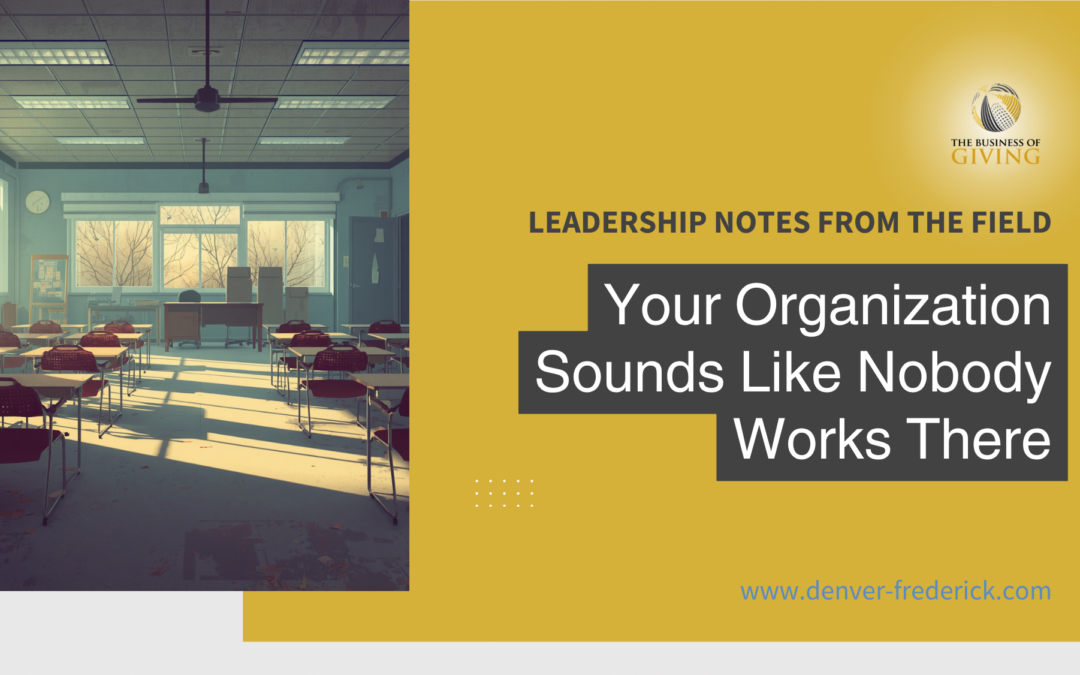
The voice no longer sounds inhabited.
This is not primarily a technology problem. It is a trust problem.
Trust has never been built on perfection. It has been built on signs of life. People trust leaders who sound like they have wrestled with something. People trust communication that contains texture, tension, specificity, and the unmistakable evidence that a real person with real convictions wrote it.
But most institutions have been sanding down every edge long before AI showed up. AI did not create that instinct. It just gave it a faster machine.
Here is the part that should concern every mission-driven leader. The organizations that sound the most optimized may become the least trusted. Because the more communication sounds consensus-managed and emotionally standardized, the harder it becomes for anyone to tell the difference between genuine conviction and manufactured competence.
The real risk of this era is not that machines will replace people. It is that organizations will quietly lose their tolerance for the very qualities that make people want to follow them.
Moral friction. Emotional specificity. The willingness to say something that has not been approved by everyone in the room.
The organizations that stand out over the next decade will not be the ones that use AI least.
They will be the ones disciplined enough to protect authentic voice while everyone else drifts toward institutional sameness.
People do not give, follow, volunteer, or believe because communication sounds perfect.
They do it because something in it feels unmistakably alive.
Pull up the last donor letter or public statement your organization sent. Read it out loud.
Does it sound like a specific human being with a specific point of view wrote it? Or does it sound like it could have come from any organization in your space?
If you cannot hear a living voice in your own communications, neither can your donors.