
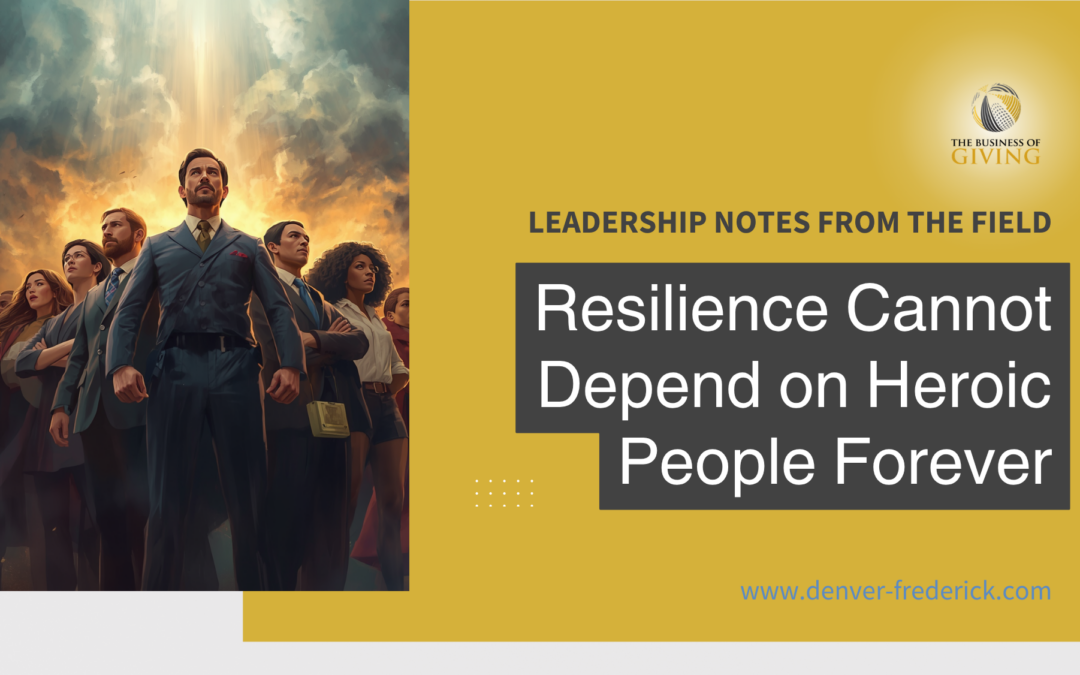
Every struggling institution has a hero. The program director who never stops working. The development officer answering emails at midnight. The nurse who stays calm through impossible shifts. The executive who absorbs everyone else’s anxiety while privately running on fumes.
These people are often celebrated. And they should be. For years, they are the reason the mission survives.
But eventually, every leadership team must confront an uncomfortable possibility. What if the organization’s resilience is actually masking structural fragility?
When extraordinary people continually compensate for broken systems, leaders mistake endurance for health. The organization appears functional. Services continue. Fundraising targets are somehow met. But beneath the surface, the institution is balancing on the emotional labor of a shrinking number of exhausted people.
That is not resilience. That is dependency disguised as resilience.
The nonprofit sector is uniquely vulnerable to this because mission-driven people routinely tolerate conditions that would be unacceptable elsewhere. They stay because they care.
They absorb because the work matters. They sacrifice because the need is urgent. And over time, organizations begin unconsciously building operating models around that sacrifice.
Leadership sees commitment. Boards see perseverance. Donors see impact. But internally, the institution is quietly converting human devotion into operational fuel.
Then the signs appear. Emotional numbness replaces empathy. Talented people leave quietly. Small problems trigger disproportionate stress. Innovation disappears because everyone is surviving. Reactivity replaces strategy. Exhaustion becomes the culture.
Human sacrifice is not a long-term growth strategy. And burnout is not evidence of commitment alone. Often it is evidence that the institution has confused urgency with design.
Real resilience is not emotional toughness endlessly stretched. It is building systems where responsibility is distributed, recovery is possible, workloads are sustainable, and excellence does not require self-destruction. Organizations that rely on heroics are simply borrowing strength from people faster than people can replenish it.
Who on your team is currently holding something together through sheer will that should be held together by a system? Name the person and the thing. That is where this conversation stops being abstract.