
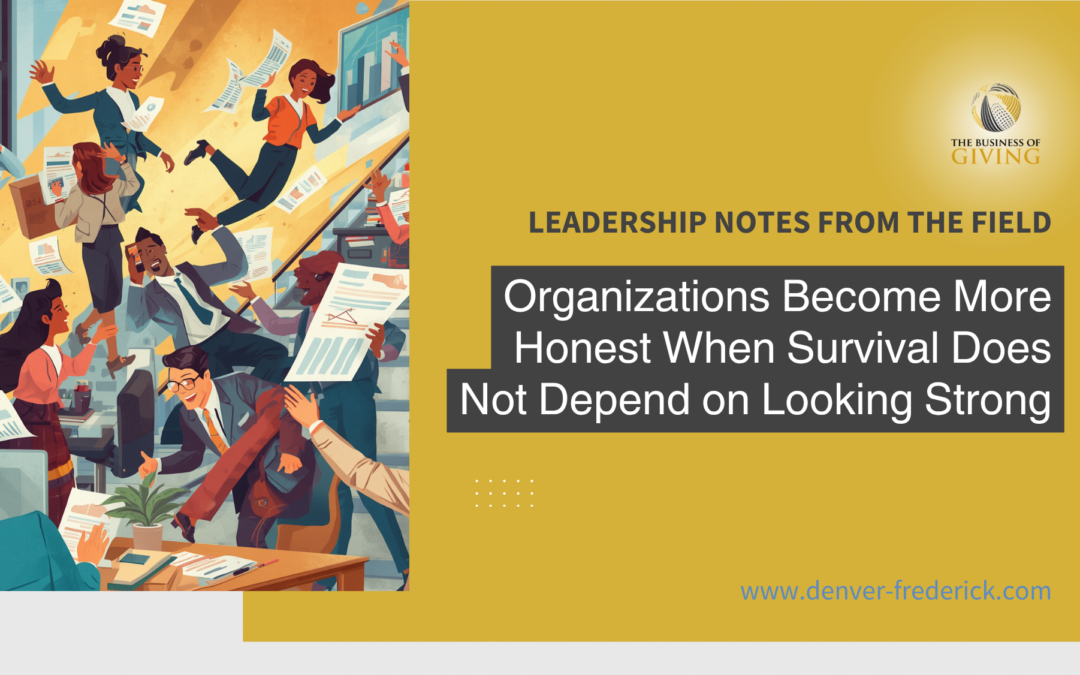
A nonprofit CEO recently told me something I have been thinking about ever since. She said the hardest part of her job is not the work itself. It is performing stability while privately managing crisis.
That sentence captures something the entire sector struggles with but rarely says out loud.
The system quietly rewards confidence far more than vulnerability. So institutions learn to perform stability. They sound optimistic during uncertainty. They project momentum during exhaustion. They present growth during fragility. Boards expect reassurance. Funders expect progress. Public narratives reward success stories.
And gradually, organizations begin managing perception as carefully as they manage mission.
A nonprofit may desperately need operational support but request program funding instead because infrastructure feels less inspiring. A leadership team may avoid discussing burnout because exhaustion sounds like weakness. An organization may overpromise outcomes because nuance feels risky in a competitive funding environment.
Eventually, institutions become trapped inside versions of themselves they no longer fully recognize.
The strongest funder-grantee relationships are rarely built on flawless reporting or carefully polished narratives. They are built on enough trust that organizations can say: “This is harder than we expected.” Or “This approach is not working.” Or “We need capacity before expansion.”
Those conversations are extraordinarily important. And extraordinarily rare. Because too many institutions fear that honesty will be interpreted as incompetence rather than maturity.
That creates a cycle. Organizations perform strength. Funders fund the performance.
Pressure intensifies. Reality gets harder to discuss. Meanwhile, everyone quietly wonders why the sector feels so exhausted.
Institutions become healthier when survival no longer depends on pretending to be healthier than they are.
What is one truth about your organization’s current reality that you have been afraid to share with your board or your funders? Not because it would destroy the relationship, but because you have not been sure the relationship could hold it. That is probably the conversation that needs to happen next.