
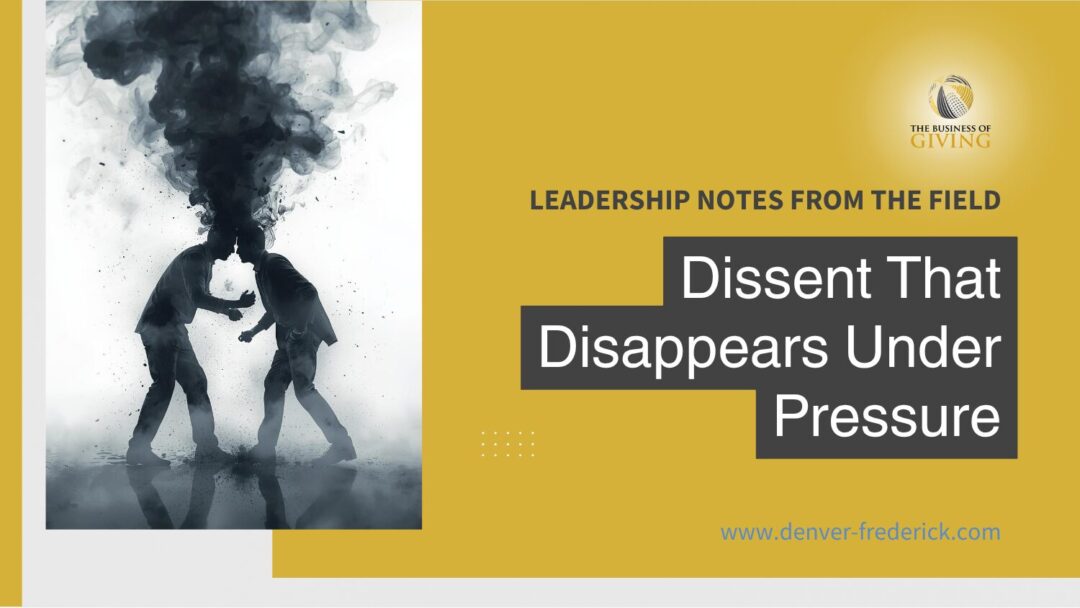
A dissenting voice is only valuable if it survives pressure.
Many organizations like the appearance of honesty. They like the symbolic dissenter. The one person who asks the hard question. The one moment in the meeting that allows everyone to believe the culture is open and healthy.
But that is not the real test.
The real test comes a few minutes later, when the room tightens, when the leader gets impatient, when the person raising the concern realizes there may be a cost to continuing.
That is when you find out whether the dissent was real or decorative.
I have seen this in nonprofit boards, executive teams, and donor strategy conversations.
Someone says the thing that most needs to be said. The room pauses. And then the pressure begins. A glance. A shift in tone. A subtle signal that this truth has now become inconvenient.
And just like that, the truth gets softened. Or shortened. Or withdrawn altogether.
Then the room learns the wrong lesson.
It learns that honesty is welcome, but only within limits.
It learns that courage is admired, but only until it starts affecting the outcome.
It learns that disagreement is permitted mostly as theater.
That is how self-censorship spreads. Quietly. Professionally. Often in organizations that still describe themselves as candid and values-driven.
Strong cultures do more than permit dissent. They protect it. They understand that one of the most valuable people in any room is the person willing to risk comfort for clarity. Because once people stop telling the truth, alignment becomes performance. And missiondriven organizations cannot afford that kind of blindness for long.
When was the last time you watched real dissent get punished, even quietly, in a room that
prided itself on candor?