
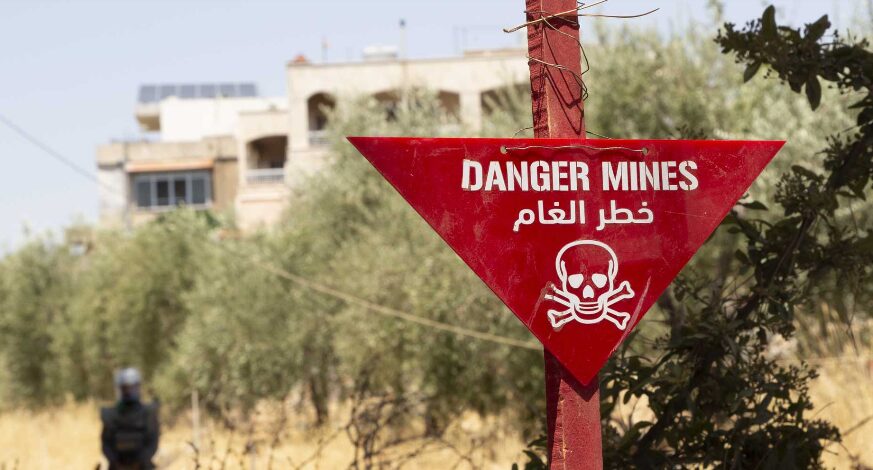
Picture this: An exhausted mother drives two hours to work after spending the night comforting her children through drone strikes overhead. At her job, she kneels in a field, methodically probing the earth inch by inch for explosives that could vaporize her in an instant. Then she drives two hours home to do it all over again.
This isn’t a nightmare scenario. It’s Tuesday for thousands of employees at the Mines Advisory Group.
For CEO Darren Cormack, that image crystallizes everything wrong with how most leaders think about workplace wellbeing. While corporate executives obsess over ping-pong tables and meditation apps, Cormack wrestles with a more fundamental question: How do you build an organizational culture when your employees’ commute is the safest part of their day?
The answer, it turns out, requires throwing out every traditional leadership playbook and confronting an uncomfortable truth. In crisis zones, management by empathy isn’t a nice-tohave. It’s the difference between life and death.
The Mathematics of Mortality
The numbers tell a brutal story. Every year, roughly 6,000 people are killed or maimed by landmines. Four out of five are civilians just trying to live their lives: tending goats, walking to school, farming ancestral land. Nearly half are children drawn by curiosity to objects that glitter in the dirt.
“Children are curious,” explains Cormack, recent recipient of the 2025 Hilton Humanitarian Prize. “I’m a father of three. I worry about them playing in the street outside our house. I don’t have to worry about them getting blown up because they’re wondering what’s over the neighbor’s fence.”
That casualness captures the chasm between Cormack’s world and the one his 5,500 employees navigate daily. The phrase “I don’t have to worry about them getting blown up” reveals everything. MAG operates where conflicts have ended but their ghosts remain buried, waiting. Founded after witnessing the devastating landmine crisis in 1980s Afghanistan, the organization now works across territories so dangerous that traditional humanitarian metrics barely apply.
There are two ways to clear a landmine, Cormack notes. An organization like MAG removes it, or somebody steps on it. His job is winning that race.
The Radical Act of Presence
Here’s where Cormack’s approach gets interesting and breaks every rule in the corporate playbook. Most organizations confronting the story of that exhausted mother would focus on protocols and safety procedures. Cormack focuses on the human being holding the metal detector.
“I was talking with a mother who was one of our demining team leaders,” he recalls. “She was commuting two hours, having been kept awake with her children because she was concerned for their safety. There were drones flying overhead at night. They were up scared. Then she was driving two hours, demining, and driving back.”
This insight revolutionizes how MAG approaches everything from shift scheduling to mental health support. The organization invests heavily in wellbeing schemes because they understand something most leaders miss: exhaustion kills as surely as explosives do. A deminer who cuts corners because they’re sleep-deprived doesn’t just risk their own life. They endanger everyone around them and leave behind land that communities trust is safe but isn’t.
“So much of good management of minefields is that engagement, that listening with staff, that empathy, that sense of understanding of where somebody’s coming from,” Cormack explains. The management philosophy sounds simple until you consider the context. How do you have meaningful one-on-ones when air raid sirens interrupt your Zoom calls? How do you assess team morale when “bad day at the office” could mean literal explosions?
The answer lies in what Cormack calls “authentic leadership,” though he’d probably wince at the corporate speak. He leads by admitting he hasn’t got it all figured out either. He publicly declares that his three children come first, MAG second. He confesses that sometimes he comes to work to relax from the chaos of parenting.
“My biggest challenge,” he admits, “is trying to get people not to work long hours rather than encouraging them to work harder.”
In an industry notorious for burnout disguised as dedication, this stance borders on heretical. But Cormack understands that by modeling sustainable boundaries, he gives his globally dispersed teams permission to be human. When your CEO admits he needs breaks too, it creates space for honest conversations about stress, capacity, and limits. These are conversations that could save lives.
Innovation Born from Necessity
The technical work of mine clearance still requires what it has always required: human beings lying prone, working inch by inch, meter by meter, to make land safe. Most deminers are employed from the communities they’re protecting. This model honors local knowledge while providing economic opportunity in devastated areas.
But modern warfare has evolved beyond neat battlefield lines. Today’s conflicts leave behind three-dimensional nightmares: urban sprawl where bombs pancake through collapsing buildings, twisted rebar that makes every sweep of a metal detector a false alarm, children’s playgrounds turned into death traps.
MAG has adapted by becoming part detective agency, part tech startup, part community theater troupe. They deploy drones to scout booby-trapped buildings in Syria before sending in teams. They stage puppet shows for Vietnamese children. They develop game shows that teach teenagers to recognize unexploded ordnance while having fun.
“We’ve had to find ways to adapt our messaging to relate to our audience,” Cormack explains. “It’s about civilian protection and finding content that’s engaging for the way people learn.”
The underlying philosophy is brilliant in its simplicity: meet people where they are, not where you think they should be. It’s the same principle that guides Cormack’s leadership. Whether he’s engaging a team leader in Ukraine or a curious child in Southeast Asia, the approach remains consistent. Listen first. Understand context. Adapt accordingly.
The drone technology represents more than just operational efficiency. In a sector historically dependent on government funding and limited by bureaucratic constraints, innovation creates breathing room. It allows MAG to define problem areas faster, to release land that was suspected of contamination but proves safe, to protect staff from the most dangerous survey work.
“If you can harness technology to help you discount areas that are currently suspected as being hazardous, but probably aren’t, enormous gains can be made,” Cormack notes. It’s the kind of practical thinking that defines his leadership. Not innovation for its own sake, but innovation in service of the mission: finding landmines before children do.
When Hope Has Coordinates
Here’s what makes landmine clearance uniquely compelling in the humanitarian sector: the results are measurably, undeniably real. Food security studies in Lebanon show that cleared farmland produces three to four times higher yields. Not because the soil improved, but because farmers finally feel safe enough to hire help and experiment with new crops. Fear had been the invisible contaminate, as limiting as any buried explosive.
Yet the transformation that matters most can’t be captured on any spreadsheet.
Cormack was in an Iraqi valley for a land handover ceremony when an elderly man approached him, tears streaming, pressing prayer beads into his hands. “I have lost a brother, a nephew, and a son out herding goats in this valley,” the man said. “I can now die in peace knowing that my future generations are safe.”
Decades after the conflict ended, the deadly legacy had continued ripping the community apart. Until it didn’t. Until a team of deminers (themselves from communities affected by conflict) worked meter by meter to restore what should never have been taken away: the fundamental right to walk your own land without fear.
That’s the metric that drives everything. Not just land cleared or devices destroyed, but communities returned to themselves.
The Unspoken Challenge of Leadership
As Cormack and I talk, a pattern emerges that he doesn’t explicitly name but that defines his entire approach. He’s leading an organization where the conventional tools of leadership exist but feel almost absurdly inadequate given the stakes. Performance reviews, incentive structures, career ladders: all present, all insufficient.
How do you motivate someone who’s already choosing to kneel in a minefield? How do you retain talent when your competitors offer climate-controlled offices and stock options? How do you maintain standards when your team is working under air raid sirens?
The answer, Cormack demonstrates, lies in culture. Specifically, a culture built on recognition of shared humanity rather than hierarchy. He talks about wanting to create mechanisms where good ideas can surface from anyone, anywhere in the organization. He describes his focus on building an inclusive culture as a “superpower” for MAG.
“Culture shows up every day,” he says simply. “You have good days when things happen and you have bad days when things happen, but culture is the one constant.”
It’s a deceptively simple observation that reveals sophisticated thinking. In organizations operating across multiple conflict zones, time zones, and cultural contexts, shared values become the connective tissue holding everything together. Culture becomes strategy. Culture becomes safety protocol. Culture becomes the reason someone chooses to show up tomorrow.
The advocacy work MAG does flows from this same cultural foundation. Pushing back against countries considering withdrawal from the Anti-Personnel Mine Ban Treaty, representing civilian perspectives in policy discussions: this work matters as much as the clearance operations. As a co-founder of the international campaign to ban landmines and
co-laureate of the 1997 Nobel Peace Prize for that effort, MAG doesn’t just clear mines. It works to ensure fewer get planted in the first place.
“International law was not written for the easy times,” Cormack notes. “It was written for the dark times, and I think we’re in one of those right now.”
The question hanging in the air: How do you maintain hope when the problem keeps multiplying?
Racing Against Reality
As conflicts multiply globally and traditional funding sources strain under competing priorities, MAG’s recognition through the 2025 Hilton Humanitarian Prize offers both validation and opportunity. The award provides breathing room. It creates space to think strategically rather than just reactively, to innovate not just operationally but structurally.
“We’re in a race to find a landmine before a child does,” Cormack reflects, “and this money will help us run that race faster.”
But he’s also thinking about how to run it smarter. The humanitarian sector’s traditional government funding model faces unprecedented pressure as foreign policy priorities shift and conflicts multiply. Cormack sees potential in innovative finance mechanisms, in engaging private philanthropy, in leveraging the concrete, quantifiable nature of mine clearance to attract new forms of investment.
“One of the really interesting things about clearing landmines, it’s a tangible expression,” he explains. “You can take it to an investor and say, ‘We can clear this amount of land,’ and show the return on investment for our work.”
There’s pragmatism in this approach, but also something deeper. Cormack is wrestling with how to sustain an organization doing essential work in an increasingly unstable world. The question isn’t just operational. It’s philosophical. How do you build something durable when everything around you is designed to destroy?
The answer, perhaps, lies in that image of the exhausted mother driving home after a day in the minefields. She comes back tomorrow. And the day after that. Not because it’s easy or because the compensation is exceptional or because there’s a clear career path. She comes back because the work matters. Because her children need a future where valleys are safe for herding goats. Because someone has to win the race.
Cormack’s job is ensuring she has what she needs to keep running. Not just equipment and training, but recognition, rest, and the knowledge that her organization sees her as a human being, not just a deminer. That when she’s kept awake by drones overhead and arrives exhausted, someone notices. Someone cares. Someone adjusts.
It’s leadership stripped down to its essence: creating conditions where people can do impossible things sustainably. One cleared square meter at a time.
Want to hear this conversation in full? Listen to my complete interview with Darren Cormack on The Business of Giving podcast, or read the full transcript at The Invisible Race: Clearing Death Before Innocence Finds It.